Introduction
TL;DR Every business wants to jump on the AI bandwagon right now. ChatGPT solves everything, right? Just plug in an API and watch the magic happen. Marketing teams promise AI will revolutionize operations overnight. The reality looks dramatically different from the pitch.
Off-the-shelf AI solutions work beautifully for generic problems. Customer service chatbots handle basic inquiries. Email categorization systems route messages correctly. Sentiment analysis tools gauge social media reactions. These one-size-fits-all solutions deliver value quickly. Companies deploy them within days and see immediate results.
Complex business workflows tell a different story entirely. Your pharmaceutical company needs AI to analyze proprietary drug trial data. Your manufacturing plant requires predictive maintenance for custom machinery. Your legal firm processes documents with specialized terminology and unique workflows. Generic AI solutions crumble under these specific demands.
Understanding when off-the-shelf AI suffices versus when custom development becomes necessary saves millions. The wrong choice wastes time, money, and organizational trust. This guide explains why pre-built solutions fail for complex scenarios. You’ll learn the exact criteria for choosing between ready-made and custom AI. Real examples show both successful implementations and expensive failures.
Table of Contents
The Promise and Reality of Off-the-Shelf AI Solutions
Technology vendors market AI products as universal problem solvers. Salespeople promise seamless integration and instant ROI. The demos look impressive during presentations. Everything works perfectly in controlled environments. Your specific use case seems simple enough to fit the template.
Pre-packaged AI products democratized access to machine learning. Small businesses can now afford capabilities previously limited to tech giants. The barrier to entry dropped from millions to thousands of dollars. Companies without data science teams can deploy AI features. This accessibility drives the explosion in AI adoption.
What Off-the-Shelf AI Actually Means
Off-the-shelf AI refers to pre-trained models available for general use. Vendors train these systems on massive generic datasets. OpenAI’s GPT models learned from internet-scale text. Computer vision APIs trained on millions of labeled images. These models understand common patterns and general knowledge. They perform well on mainstream tasks without customization.
The business model relies on broad applicability. Vendors amortize training costs across thousands of customers. Each customer pays a fraction of development expenses. This economics only works if the solution serves many clients. Customization destroys the unit economics. Vendors resist modification requests that don’t benefit all users.
API-first deployment defines most off-the-shelf AI products. You send data to vendor servers through standardized interfaces. The black-box model processes your input and returns results. You control nothing about the internal workings. The model architecture, training data, and decision logic remain hidden. This opacity creates both convenience and limitations.
Common Use Cases Where Pre-Built Solutions Excel
Content generation for marketing materials works excellently with off-the-shelf AI. Generic writing models understand standard business language. Blog posts, product descriptions, and social media content generate quickly. The output quality matches or exceeds average human writers. Companies save significant time on routine content creation.
Basic customer support automation succeeds with ready-made chatbots. Common questions follow predictable patterns across industries. How do I reset my password? What are your business hours? Where is my order? Pre-trained models handle these inquiries without custom training. Response accuracy reaches 80-90% for straightforward queries.
Image recognition for standard object detection deploys easily. Pre-trained models identify common objects, faces, and scenes. Security cameras detect people and vehicles. Photo management software tags images automatically. These applications use categories the training data already covers. No specialized training becomes necessary.
The Hidden Limitations Nobody Talks About
Off-the-shelf AI performs poorly on domain-specific terminology. Medical diagnosis systems trained on general health data miss rare conditions. Legal document analysis fails with jurisdiction-specific language. Financial models don’t understand your proprietary trading indicators. The gap between general knowledge and specialized expertise is enormous.
Data privacy concerns plague cloud-based AI services. Your sensitive data travels to vendor servers for processing. Healthcare records, financial information, and trade secrets leave your control. Compliance teams rightfully question this data exposure. HIPAA, GDPR, and industry regulations might prohibit certain uses. The convenience creates serious legal risks.
Integration challenges emerge when connecting to legacy systems. Your 20-year-old ERP doesn’t have modern API capabilities. The off-the-shelf AI expects clean, standardized data formats. Your data lives in proprietary databases with custom schemas. Bridging this gap requires significant engineering work. The “simple” integration becomes a multi-month project.
Why Complex Workflows Break Off-the-Shelf AI
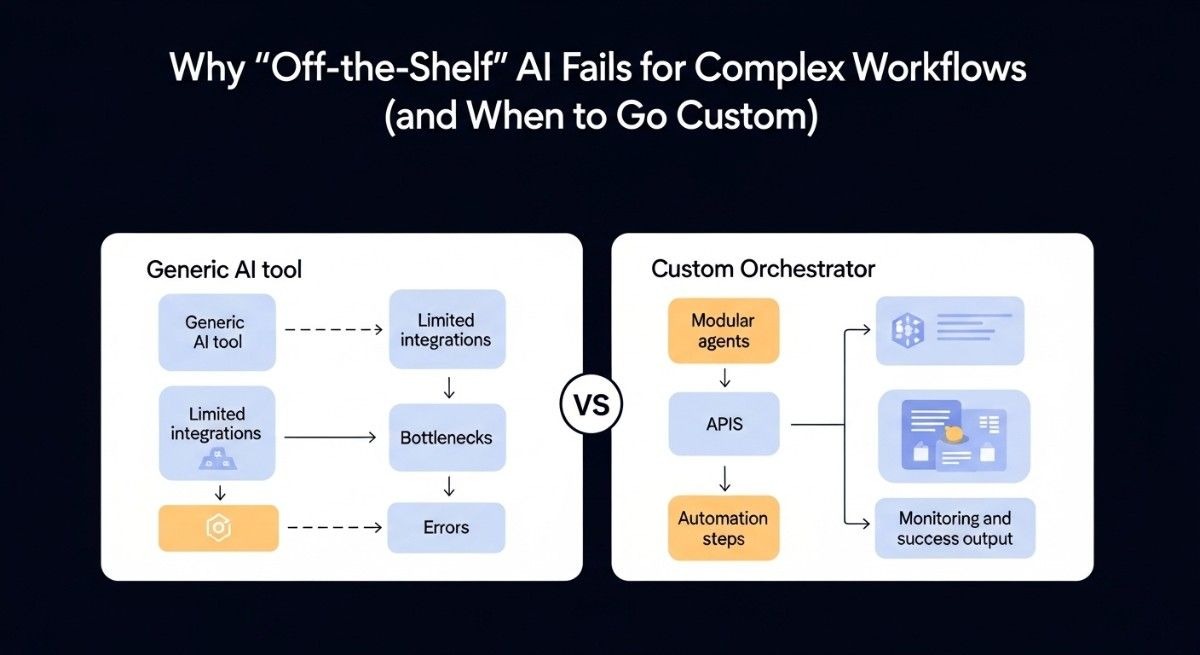
Sophisticated business processes have too many moving parts for generic solutions. Your workflow evolved over decades to handle specific scenarios. Edge cases and exceptions dominate the decision logic. Generic AI models can’t replicate years of institutional knowledge. They fail when confronted with real-world complexity.
The 80/20 rule destroys off-the-shelf AI effectiveness in complex domains. Pre-built solutions handle the common 80% of cases adequately. The remaining 20% of edge cases break everything. Your business judges AI by the failures, not the successes. One mishandled VIP customer complaint outweighs 100 routine interactions handled perfectly.
Industry-Specific Knowledge Requirements
Healthcare workflows demand understanding of medical terminology, treatment protocols, and regulatory requirements. Off-the-shelf AI doesn’t know your hospital’s specific formulary. It can’t navigate your insurance approval processes. Clinical decision support requires integration with proprietary electronic health records. Generic models lack the depth for safe medical applications.
Manufacturing operations need AI that understands your specific equipment and processes. Your injection molding machines have unique failure signatures. Your quality control processes follow proprietary specifications. Predictive maintenance models must learn from your historical maintenance records. Off-the-shelf AI trained on generic manufacturing data misses these nuances.
Legal practices operate with jurisdiction-specific laws and precedents. Contract analysis requires understanding your standard clause libraries. Due diligence processes follow firm-specific methodologies. E-discovery workflows integrate with specialized legal tech platforms. Generic document AI misses the legal context that determines outcomes.
Multi-Step Decision Processes
Loan approval workflows involve sequential decisions with complex interdependencies. Credit scoring happens first, followed by collateral valuation. Income verification cross-references multiple data sources. Exception handling triggers human review at various stages. Off-the-shelf AI can’t orchestrate these interconnected steps. Each decision point requires specific business rules and data access.
Supply chain optimization demands coordination across procurement, inventory, and logistics. Lead times vary by supplier and season. Storage capacity constraints affect order quantities. Transportation costs change based on route and timing. Generic optimization models can’t encode your specific constraints. The complexity requires custom algorithms tuned to your operation.
Clinical trial patient matching involves dozens of inclusion and exclusion criteria. Medical history must align with protocol requirements. Geographic proximity to trial sites matters. Genetic markers determine eligibility for certain studies. Off-the-shelf AI lacks the depth to evaluate all these factors simultaneously. The workflow requires custom logic that understands medical research protocols.
Data Format and Integration Challenges
Your proprietary data formats don’t match what off-the-shelf AI expects. Customer records span multiple disconnected systems. Product information lives in legacy databases with custom schemas. Transaction data includes non-standard fields specific to your industry. Converting everything to generic formats loses critical context. The data transformation becomes more complex than the AI implementation.
Real-time integration requirements strain off-the-shelf AI capabilities. Your manufacturing floor needs predictions within milliseconds. Customer service representatives need responses during live calls. Trading systems require decisions in microseconds. Cloud-based AI APIs introduce latency that breaks these workflows. The round-trip time to vendor servers is simply too long.
Batch processing limitations restrict when off-the-shelf AI can run. Your insurance claims must process overnight before business opens. Month-end financial close requires AI results by 6 AM. Vendor APIs have rate limits that throttle batch operations. Processing 100,000 records might take days instead of hours. These timing constraints make pre-built solutions infeasible.
Compliance and Regulatory Constraints
Financial services regulations require explainable AI decisions. You must document why a loan was denied or approved. Off-the-shelf AI models operate as black boxes. The vendor can’t explain individual predictions. Regulators reject “the AI said so” as justification. Your compliance team demands transparency that pre-built solutions can’t provide.
Healthcare privacy laws restrict where patient data can be processed. HIPAA requires business associate agreements with specific terms. Many AI vendors won’t sign these agreements. Sending protected health information to their APIs violates regulations. The legal exposure makes off-the-shelf AI unusable for clinical applications.
Government contracts often mandate on-premise deployment. Cloud-based AI services don’t meet security requirements. Defense contractors can’t send classified information to external APIs. Financial institutions face similar restrictions on sensitive data. The deployment model itself becomes a deal-breaker for regulated industries.
Signs You Need Custom AI Development
Recognizing when to abandon off-the-shelf AI saves significant resources. Certain indicators clearly point toward custom development. Ignoring these signals leads to failed projects and wasted investments.
Your Domain Experts Can’t Explain Their Decisions
Subject matter experts say “I just know” when asked how they make decisions. Years of experience created intuition they can’t articulate. Off-the-shelf AI won’t replicate this tacit knowledge. Custom AI development includes extensive knowledge elicitation processes. The model learns patterns experts recognize subconsciously.
Decision rules contain dozens of exceptions and special cases. “Usually we do X, except when Y, unless Z happened last month.” Generic AI struggles with this complexity. Custom models encode these nuanced rules explicitly. The development process forces documentation of institutional knowledge. This knowledge capture alone justifies custom development for some organizations.
Data Is Your Competitive Advantage
Your company collected unique datasets over decades. Customer behavior patterns specific to your market exist nowhere else. Proprietary sensor data from custom equipment is irreplaceable. This data represents enormous strategic value. Off-the-shelf AI trained on generic data can’t exploit your advantage. Custom models trained on your data create sustainable differentiation.
Competitors can access the same off-the-shelf AI tools you use. Everyone deploys the same chatbots and recommendation engines. The playing field stays level when everyone uses identical capabilities. Custom AI trained on your unique data creates separation. Competitors can’t replicate what they don’t have access to.
Integration Complexity Exceeds AI Complexity
Your systems landscape includes 15 different applications that must exchange data. Legacy mainframes store critical information in COBOL databases. Modern microservices handle customer interactions. Excel spreadsheets somehow remain mission-critical. Connecting off-the-shelf AI to this environment requires more work than building custom AI. The integration becomes the project bottleneck.
Real-time bidirectional data flow between systems is essential. The AI must query multiple systems before making decisions. Results must update downstream applications immediately. This orchestration exceeds off-the-shelf AI capabilities. Custom development builds integration directly into the AI system. The holistic approach handles complexity better than trying to force-fit generic tools.
ROI Calculations Favor Custom Development
Your workflow processes millions of transactions annually. Improving accuracy by 1% saves millions of dollars. Off-the-shelf AI plateaus at 85% accuracy for your use case. Custom AI trained on your specific data reaches 95% accuracy. The 10-point improvement justifies custom development costs. The business case is overwhelming when dealing with high-value, high-volume processes.
Licensing costs for off-the-shelf AI scale with usage. Processing 100 million API calls monthly costs six figures. Custom AI deployed on your infrastructure has fixed costs. After the initial development investment, marginal costs approach zero. The economics flip in favor of custom solutions at sufficient scale.
Security and Privacy Are Non-Negotiable
Your data cannot leave your infrastructure under any circumstances. National security, trade secrets, or competitive intelligence prohibit external processing. Off-the-shelf AI hosted by vendors is simply not an option. Custom AI deployed on-premise or in your private cloud meets security requirements. The deployment model drives the build-versus-buy decision.
Fine-grained access control determines who sees what data. Different user roles need different AI capabilities. Patient information, financial details, and personal data have distinct restrictions. Off-the-shelf AI offers coarse access controls at best. Custom development builds role-based security into the AI architecture. Compliance becomes manageable with purpose-built access control.
The Custom AI Development Process
Building custom AI requires systematic approaches and realistic expectations. Understanding the process helps organizations make informed decisions. These steps apply across industries and use cases.
Requirements Gathering and Problem Definition
Start by documenting exactly what you need AI to accomplish. Generic goals like “improve efficiency” doom projects to failure. Specific objectives like “reduce claim processing time from 48 hours to 6 hours” create clarity. Measurable success criteria enable project evaluation. Vague requirements lead to scope creep and disappointment.
Identify all stakeholders who will interact with the AI system. Customer service representatives use it differently than supervisors. IT operations teams have distinct requirements from business users. Each stakeholder group brings unique constraints and needs. Comprehensive requirements gathering prevents surprises during deployment.
Understand current process workflows in excruciating detail. Shadow employees performing the tasks AI will augment. Document decision points, data sources, and exception handling. This process archeology reveals complexity that isn’t obvious. You can’t automate what you don’t understand. The discovery phase often uncovers process improvements independent of AI.
Data Collection and Preparation
Inventory existing data sources relevant to your AI objectives. Customer transaction histories, sensor readings, document repositories, and communication logs all contain signal. Assess data quality, completeness, and accessibility. Missing data, formatting inconsistencies, and access restrictions become project risks. Address data quality issues before AI development begins.
Label sufficient training examples to teach the AI system. Image classification needs thousands of labeled examples per category. Natural language processing requires annotated text showing correct interpretations. This labeling represents significant effort and expense. Plan for months of data preparation in complex domains. Underestimating this phase kills many custom AI projects.
Establish data pipelines that continuously update the AI system. Models degrade over time as patterns change. Fresh data maintains accuracy through concept drift. Automated pipelines extract, transform, and load data regularly. Building these pipelines during initial development prevents technical debt. Data infrastructure matters as much as the AI algorithms.
Model Architecture Selection
Choose AI architectures appropriate for your problem type. Computer vision tasks require convolutional neural networks. Sequential data like time series needs recurrent or transformer architectures. Document classification works well with BERT-based models. Architecture selection dramatically affects performance and development time. Domain expertise guides these technical decisions.
Evaluate tradeoffs between model complexity and interpretability. Simple decision trees explain their reasoning clearly. Deep neural networks achieve higher accuracy but obscure decision logic. Regulated industries often require interpretable models. The business context determines acceptable complexity levels. Make this decision consciously rather than defaulting to the fanciest algorithms.
Plan for model versioning and experimentation tracking. You’ll train dozens of model variants during development. Systematic tracking prevents losing promising approaches. Version control for models parallels software development practices. Infrastructure for experiment management pays dividends throughout the project. Tools like MLflow or Weights & Biases standardize this process.
Training, Testing, and Validation
Split data into training, validation, and test sets properly. The model never sees test data until final evaluation. This separation prevents overfitting to training examples. Use cross-validation for robust performance estimates. Statistical rigor at this stage ensures reliable accuracy claims. Cutting corners here produces overly optimistic metrics.
Monitor training progress to detect problems early. Loss curves should decrease steadily during training. Divergence indicates learning rate or architecture issues. Validation accuracy plateauing suggests you’ve maximized performance. These signals guide when to stop training or try different approaches. Experienced ML engineers read these patterns fluently.
Evaluate performance on realistic examples representing production conditions. Test data should mirror the actual distribution the model will encounter. Include edge cases and difficult examples deliberately. The model must handle adversarial inputs and unusual scenarios. Comprehensive testing reveals weaknesses before deployment. Fix critical issues during development rather than in production.
Deployment and Integration
Build APIs that expose AI functionality to consuming applications. RESTful interfaces work for request-response patterns. Streaming APIs handle real-time predictions. Batch processing endpoints support large-scale offline scoring. The API design affects how easily applications integrate with the AI. Plan interfaces carefully with consuming teams.
Implement monitoring and observability from day one. Track prediction latency, accuracy, and error rates continuously. Alert on anomalies that indicate model degradation. Log inputs and outputs for debugging and retraining. Production AI requires DevOps discipline. Monitoring prevents silent failures that damage business outcomes.
Create fallback mechanisms for when AI predictions fail. Human review queues catch low-confidence predictions. Rule-based systems provide backup logic during outages. Graceful degradation maintains business continuity. AI should enhance processes, not create single points of failure. Resilience engineering applies to AI systems like any critical infrastructure.
Cost-Benefit Analysis: Custom vs. Off-the-Shelf
Making the build-versus-buy decision requires honest financial analysis. Custom AI development involves significant upfront investment. Off-the-shelf AI has lower initial costs but ongoing expenses. The right choice depends on your specific circumstances.
Upfront Development Costs
Custom AI projects typically cost $100,000 to $500,000 for moderate complexity. Simple applications might cost $50,000. Enterprise-scale systems can exceed $1 million. The range reflects differences in scope, data availability, and technical difficulty. Get detailed quotes from multiple development partners. Beware of estimates that seem too good to be true.
Internal costs add to vendor expenses significantly. Your team’s time for requirements, data preparation, and testing has real cost. Subject matter experts might spend 20% of their time for 6 months. Project management and coordination require dedicated resources. Calculate fully-loaded costs including all internal labor. Hidden internal costs often equal external vendor fees.
Ongoing Operational Expenses
Off-the-shelf AI charges based on usage volume. API calls, processing time, or storage determine monthly bills. Costs scale linearly with business growth. A small pilot might cost $500 monthly. Production usage can reach $50,000 or more. Review vendor pricing tiers carefully. Understand how costs change as usage increases.
Custom AI has mostly fixed operational costs after deployment. Infrastructure hosting charges depend on compute requirements. Model retraining happens quarterly or monthly. Maintenance and monitoring require some ongoing effort. Total cost of ownership becomes predictable. Budget accuracy improves compared to variable usage-based pricing.
Break-Even Analysis
Calculate the payback period for custom AI development. Divide upfront costs by monthly savings from improved efficiency. A $300,000 project saving $30,000 monthly breaks even in 10 months. Compare this to the lifetime cost of off-the-shelf AI alternatives. Include the value of competitive advantages from custom AI. The analysis often favors custom development for strategic applications.
Consider time value of money in your calculations. Custom AI takes 6-12 months to develop and deploy. Off-the-shelf AI delivers value within weeks. The faster time-to-value has monetary worth. Discount future benefits appropriately when comparing options. Sometimes the quick win justifies lower long-term ROI.
Risk-Adjusted Returns
Custom AI development carries execution risk. Projects can fail or deliver less than promised. Budget for contingencies and potential overruns. Risk management includes proof-of-concept phases and staged funding. Off-the-shelf AI eliminates technical risk but introduces vendor risk. Vendors can change pricing, features, or discontinue products. Diversification across multiple vendors reduces concentration risk.
Strategic value often outweighs pure financial returns. Custom AI creates defensible competitive advantages. Patents and trade secrets protect your innovation. Market position improvements have long-term value. Quantify these strategic benefits when possible. The full business case extends beyond direct cost savings.
Real-World Examples of Custom AI Success
Concrete examples illustrate when custom development makes sense. These stories show the decision process and outcomes. Learn from organizations that chose custom over off-the-shelf AI.
Manufacturing Predictive Maintenance
A automotive parts manufacturer needed to predict equipment failures. Off-the-shelf AI couldn’t handle their specialized machinery. The equipment included custom modifications and sensors not found in generic training data. Downtime cost $50,000 per hour in lost production. Accurate predictions were critical to profitability.
The company invested $400,000 in custom AI development. Data scientists collected three years of sensor readings and maintenance records. The model learned failure signatures specific to their equipment. Prediction accuracy reached 92% compared to 65% from generic solutions. The system paid for itself in 8 months through reduced downtime.
Healthcare Clinical Decision Support
A hospital network wanted AI to identify patients at risk for sepsis. Off-the-shelf AI didn’t integrate with their specific EHR system. The model needed to understand their clinical workflows and alerting protocols. False alarms would overwhelm already-busy nurses. Missed detections could result in patient deaths.
Custom development cost $600,000 and took 14 months. Clinicians labeled thousands of patient records for model training. The AI integrated directly with their Epic EHR system. Alert fatigue decreased while early sepsis detection improved. The system saved an estimated 50 lives in the first year. ROI calculations included both cost savings and lives saved.
Financial Fraud Detection
A payment processor needed real-time fraud detection for unique transaction patterns. Off-the-shelf AI flagged too many legitimate transactions as suspicious. Their customer base included high-risk merchant categories that generic models misunderstood. False positives cost merchant relationships. Missed fraud cost direct financial losses.
The custom AI project cost $800,000 over 18 months. The model trained on their specific transaction history and fraud patterns. Integration with their transaction processing system happened at the database level. Fraud detection accuracy improved from 78% to 94%. False positive rates dropped by 60%. The system saved millions annually in prevented fraud and reduced customer friction.
When Off-the-Shelf AI Is the Right Choice
Custom development isn’t always necessary or wise. Many scenarios favor using off-the-shelf AI products. Recognizing these situations saves money and time. Start simple before investing in custom solutions.
Proof of Concept Projects
Initial AI experiments should use off-the-shelf AI tools when possible. Test whether AI can add value before committing to custom development. Quick pilots validate assumptions and business cases. You learn what works without major investment. Success justifies further investment in custom solutions.
Non-Core Business Functions
Generic business processes don’t need custom AI. Employee expense report processing works fine with off-the-shelf AI. Meeting transcription doesn’t require custom models. IT helpdesk automation uses standard chatbots effectively. Save custom development for competitive differentiators. Commodity functions deserve commodity solutions.
Limited Budget and Timeline
Startups and small businesses often lack resources for custom AI. Off-the-shelf AI provides capabilities otherwise unaffordable. The 80% solution delivered quickly beats the perfect solution that never ships. Pragmatism trumps perfectionism for resource-constrained teams. Start with off-the-shelf AI and graduate to custom as you grow.
Rapidly Changing Requirements
Uncertain business requirements make custom AI risky. You might invest heavily in the wrong solution. Off-the-shelf AI offers flexibility to pivot quickly. Switch vendors or approaches without sunk costs. Experimentation phase favors flexible, low-commitment solutions. Lock in custom development only after requirements stabilize.
Read More:-Transforming Healthcare with HIPAA-Compliant AI Automation
Conclusion
Off-the-shelf AI solutions democratized access to machine learning capabilities. Small teams can now deploy AI features that required massive resources five years ago. Generic problems like content generation, image classification, and basic chatbots work excellently with pre-built solutions. These tools deliver quick wins and immediate value.
Complex workflows expose the limitations of off-the-shelf AI dramatically. Domain-specific knowledge requirements exceed generic training data. Integration with legacy systems becomes the bottleneck. Data privacy and compliance concerns restrict cloud-based APIs. Multi-step decision processes require orchestration that generic tools can’t provide. The 80% solution fails when the remaining 20% determines business outcomes.
Custom AI development makes sense when data represents competitive advantage. Your unique datasets create differentiation that competitors cannot replicate. Off-the-shelf AI levels the playing field by giving everyone identical capabilities. Custom models trained on proprietary data create sustainable advantages. The investment protects and amplifies your data advantage.
Scale economics favor custom AI at sufficient volume. Usage-based pricing for off-the-shelf AI becomes expensive at enterprise scale. Custom solutions have higher upfront costs but fixed ongoing expenses. The break-even point often arrives within 12-18 months. Strategic applications processing millions of transactions justify custom development investment.
Security and compliance requirements force custom solutions in regulated industries. Healthcare, finance, and defense cannot send sensitive data to external APIs. On-premise deployment requires custom AI infrastructure. Fine-grained access controls demand purpose-built security architectures. Regulated organizations have no choice but custom development for many applications.
The decision framework combines technical and business considerations. Evaluate problem complexity against off-the-shelf AI capabilities honestly. Calculate total cost of ownership for both options. Assess execution risks and strategic value. Consider time-to-value and organizational readiness. The analysis reveals the right path for your situation.
Start with off-the-shelf AI for proof of concept and learning. Validate that AI can solve your problem before committing major resources. Graduate to custom development once business case and requirements solidify. This staged approach manages risk while building organizational capabilities. You avoid both premature optimization and perpetual experimentation.
Many organizations successfully combine both approaches. Off-the-shelf AI handles commodity functions. Custom AI powers strategic differentiators. The hybrid strategy balances cost and capability. Core competitive processes get custom development. Support functions use pre-built solutions. This pragmatism maximizes ROI across your AI portfolio.
The future includes more sophisticated off-the-shelf AI products. Vendors will offer greater customization through fine-tuning and configuration. The line between off-the-shelf AI and custom solutions will blur. Foundation models with domain-specific training data will bridge the gap. The economics will continue evolving rapidly.
Make informed decisions based on your specific situation. Cookie-cutter advice fails in this domain. Your industry, scale, data, and competitive position determine the right choice. Invest in understanding the tradeoffs deeply. The stakes are high as AI becomes central to business operations. Choose wisely between off-the-shelf AI and custom development to maximize competitive advantage.