Introduction
TL;DR Single AI agents struggle with complex real-world problems. Monolithic systems hit capability ceilings quickly. Performance plateaus despite throwing more compute power. Your ambitious projects need different approaches.
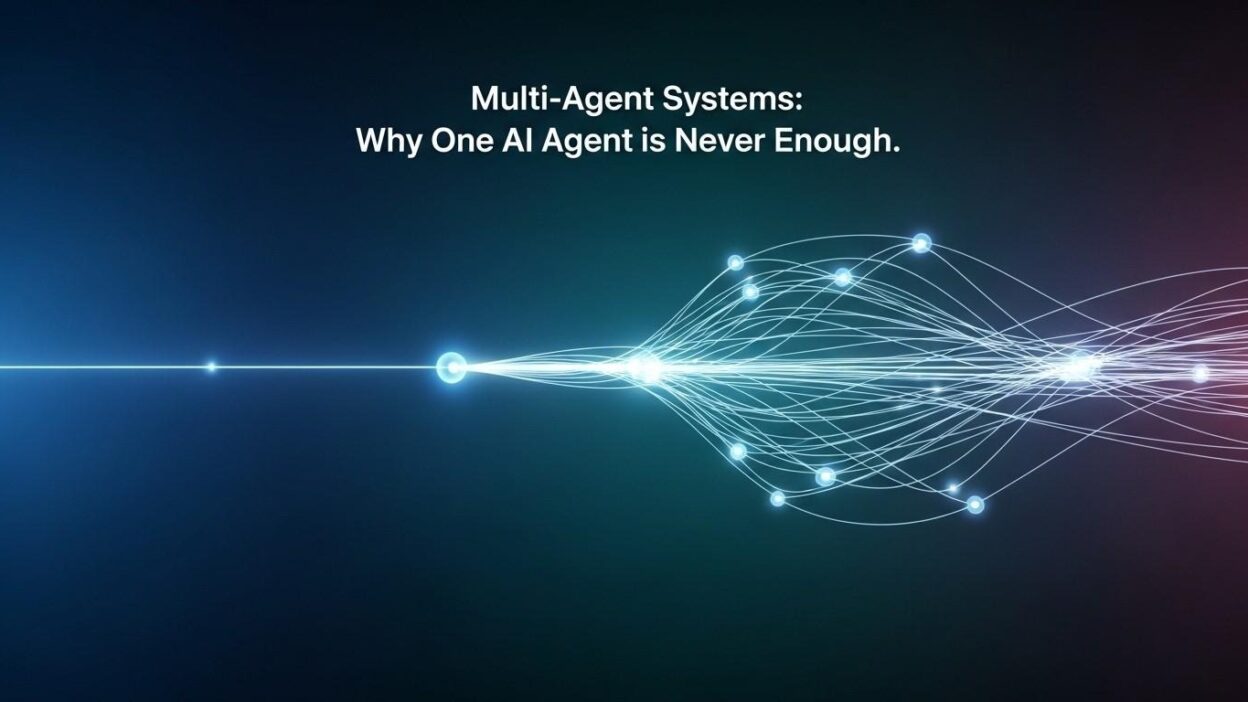
Multi-Agent Systems distribute intelligence across specialized components. Each agent masters specific domains independently. Collaboration emerges through structured communication. Collective capability exceeds individual limitations dramatically. Your applications achieve what seemed impossible before.
The shift mirrors human organizational evolution. No individual possesses all necessary expertise. Teams outperform solo contributors consistently. Specialization drives efficiency across industries. AI architecture follows identical principles naturally.
Understanding why single agents fail reveals design imperatives. Complexity overwhelms unified models inevitably. Context windows impose hard limits. Reasoning depth hits computational boundaries. Multi-Agent Systems solve these constraints elegantly.
Table of Contents
The Fundamental Limits of Single Agents
Language models contain finite knowledge ultimately. Training data coverage has gaps. Specialized domains lack sufficient examples. Proprietary information never appears in training. Your unique business context stays invisible.
Context windows restrict information processing. Current models handle 128K tokens maximum. Complex projects exceed these limits easily. Relevant details get truncated away. Critical information disappears from consideration.
Reasoning chains hit depth limitations. Multi-step logic requires sustained attention. Error accumulation increases with steps. Complex proofs exceed practical boundaries. Single agents stumble on intricate problems.
Computational costs scale poorly with complexity. Larger contexts consume exponentially more resources. Processing time increases quadratically. Your bills explode for challenging tasks. Economic feasibility becomes questionable.
Brittleness appears under edge cases. Unusual inputs confuse unified models. Recovery mechanisms stay limited. Graceful degradation proves difficult. Multi-Agent Systems handle failures more robustly.
How Multi-Agent Systems Actually Work
Agent specialization drives the architecture fundamentally. Each agent focuses narrowly. Deep expertise develops in specific areas. Interfaces remain clean and simple. Your system becomes modular naturally.
Communication protocols enable coordination. Message passing shares information. Standardized formats ensure interoperability. Asynchronous exchanges prevent blocking. Agents collaborate without tight coupling.
Task decomposition happens systematically. Complex problems split into subtasks. Appropriate agents handle each piece. Results aggregate into solutions. Multi-Agent Systems orchestrate workflows intelligently.
Hierarchical structures organize agents effectively. Manager agents delegate to specialists. Supervisors monitor progress continuously. Escalation handles exceptional cases. Your architecture scales elegantly.
Feedback loops improve performance over time. Agents learn from interactions. Successful patterns get reinforced. Failures trigger adjustments. Collective intelligence grows through experience.
The Specialization Advantage
Domain expertise concentrates within agents. Medical agents understand healthcare deeply. Legal agents know regulatory frameworks. Financial agents grasp market dynamics. Specialization beats generalization consistently.
Training becomes focused and efficient. Smaller datasets suffice for narrow domains. Fine-tuning costs decrease substantially. Updates target specific agents only. Your maintenance burden stays manageable.
Performance improves through specialization. Accuracy increases for specific tasks. Response quality exceeds generalist approaches. Users notice better results immediately. Multi-Agent Systems deliver superior outcomes.
Resource allocation optimizes automatically. Expensive models handle complex reasoning. Cheap models execute routine tasks. Cost-effectiveness improves dramatically. Your budget stretches further.
Knowledge depth increases within domains. Subtle nuances get captured. Industry jargon gets understood. Context-specific patterns emerge. Expertise becomes genuinely useful.
Scalability Through Distribution
Horizontal scaling becomes straightforward. Add more agent instances easily. Load balances across agents naturally. Throughput increases linearly. Your system handles growth smoothly.
Geographic distribution reduces latency. Agents deploy near users. Response times decrease globally. Network costs drop substantially. Multi-Agent Systems serve worldwide efficiently.
Fault tolerance improves through redundancy. Multiple agents provide backup. Failures affect limited scope. Recovery happens automatically. Your uptime increases measurably.
Independent scaling targets bottlenecks. Critical agents get more resources. Underutilized agents scale down. Resource efficiency maximizes. Operational costs optimize naturally.
Parallel processing accelerates completion. Multiple agents work simultaneously. Dependencies determine sequencing. Critical paths get prioritized. Your results arrive faster.
Real-World Application Patterns
Customer service benefits enormously. Routing agents direct inquiries. Knowledge agents retrieve information. Response agents generate answers. Escalation agents handle exceptions. Multi-Agent Systems deliver superior support.
Software development accelerates dramatically. Planning agents design architectures. Coding agents implement features. Testing agents verify functionality. Debugging agents fix issues. Your development velocity multiplies.
Research applications discover insights faster. Search agents gather information. Analysis agents process data. Synthesis agents generate conclusions. Validation agents verify findings. Knowledge creation accelerates substantially.
Financial operations improve accuracy. Data agents collect market information. Analysis agents identify patterns. Trading agents execute strategies. Risk agents monitor exposure. Your returns improve while risks decrease.
Healthcare diagnostics become more reliable. Symptom agents gather patient information. Analysis agents consider possibilities. Specialist agents provide expertise. Coordination agents synthesize recommendations. Multi-Agent Systems save lives literally.
Communication and Coordination Mechanisms
Message queues enable asynchronous communication. Agents publish events. Subscribers receive relevant messages. Decoupling prevents bottlenecks. Your system stays responsive.
Shared memory provides common context. Databases store intermediate results. Agents read and write data. Consistency mechanisms prevent conflicts. State management becomes reliable.
Event-driven architectures trigger reactions. State changes emit events. Agents respond appropriately. Workflows progress naturally. Multi-Agent Systems coordinate elegantly.
Direct agent communication enables collaboration. APIs facilitate interaction. Request-response patterns work well. Streaming supports real-time exchanges. Flexibility accommodates requirements.
Orchestration layers manage workflows. Supervisors coordinate activities. Schedules determine sequencing. Conditions control flow. Your processes execute reliably.
Error Handling and Resilience
Failure isolation contains problems. Agent crashes affect limited scope. Other agents continue functioning. Recovery happens independently. Multi-Agent Systems stay robust.
Retry mechanisms handle transient issues. Failed operations attempt again. Exponential backoff prevents overload. Success rates improve automatically. Your reliability increases substantially.
Fallback strategies maintain service. Primary agents try first. Backup agents take over. Degraded modes preserve functionality. User experience stays acceptable.
Circuit breakers prevent cascades. Repeated failures trigger protection. Traffic redirects around problems. Recovery happens gradually. System stability improves.
Monitoring detects issues early. Health checks verify agent status. Metrics track performance continuously. Alerts notify operators promptly. Multi-Agent Systems stay observable.
Design Patterns and Best Practices
Single responsibility principle guides design. Each agent does one thing well. Interfaces stay simple. Dependencies minimize naturally. Your architecture becomes maintainable.
Loose coupling enables independence. Agents evolve separately. Changes affect limited scope. Testing happens in isolation. Development velocity increases.
High cohesion improves understanding. Related functionality groups together. Agent purposes stay clear. Code organization makes sense. Multi-Agent Systems remain comprehensible.
Contract-first design ensures compatibility. Interfaces define before implementation. Agreements prevent misunderstandings. Integration works smoothly. Your system stays coherent.
Version management prevents breakage. Backward compatibility maintains. Deprecation happens gradually. Migration paths exist. Evolution proceeds safely.
Security Considerations
Authentication verifies agent identity. Credentials prove legitimacy. Unauthorized access gets blocked. Trust establishes systematically. Your system stays protected.
Authorization controls capabilities. Permissions limit actions. Role-based access works well. Principle of least privilege applies. Security posture strengthens.
Encryption protects sensitive data. Communication channels secure. Stored information encrypts. Keys manage carefully. Multi-Agent Systems preserve confidentiality.
Input validation prevents attacks. Malicious data gets rejected. Sanitization removes threats. Injection attacks fail. Your agents stay safe.
Audit logging tracks activities. Actions get recorded. Investigations become possible. Compliance requirements meet. Accountability ensures naturally.
Performance Optimization Strategies
Caching reduces redundant work. Expensive operations cache results. Lookups become instantaneous. Hit rates optimize over time. Your response times decrease.
Batching improves efficiency. Similar operations group together. Overhead amortizes across requests. Throughput increases substantially. Multi-Agent Systems process more.
Asynchronous processing prevents blocking. Long operations run background. Immediate responses acknowledge receipt. Completion notifications arrive later. User experience improves.
Resource pooling shares infrastructure. Agents reuse connections. Startup costs amortize. Utilization increases efficiently. Your costs decrease.
Load balancing distributes work. Traffic spreads across agents. Hotspots get avoided. Capacity utilizes fully. Performance stays consistent.
Testing Multi-Agent Systems
Unit testing verifies agent behavior. Individual components test thoroughly. Mocking simulates dependencies. Isolation enables focus. Your confidence grows.
Integration testing validates coordination. Agent interactions test carefully. Communication protocols verify. End-to-end flows validate. Multi-Agent Systems work together.
Contract testing ensures compatibility. Interface agreements verify. Breaking changes detect early. Integration confidence increases. Your system stays stable.
Chaos engineering reveals weaknesses. Failures inject deliberately. Recovery mechanisms validate. Resilience improves through testing. Production readiness increases.
Performance testing benchmarks capabilities. Load scenarios simulate reality. Bottlenecks identify clearly. Capacity planning informs. Your system meets requirements.
Monitoring and Observability
Distributed tracing tracks requests. Flows visualize across agents. Bottlenecks identify quickly. Performance optimizes effectively. Multi-Agent Systems stay transparent.
Metrics collection quantifies behavior. Latencies measure continuously. Error rates track carefully. Resource usage monitors. Your understanding deepens.
Logging captures detailed information. Events record systematically. Debugging becomes easier. Troubleshooting accelerates substantially. Problem resolution improves.
Dashboards visualize status. Real-time updates show. Trends appear clearly. Anomalies stand out. Operations teams stay informed.
Alerting notifies appropriately. Thresholds trigger warnings. Escalations happen automatically. Response times decrease. Multi-Agent Systems stay healthy.
Cost Management
Right-sizing optimizes spending. Agent resources match needs. Over-provisioning decreases. Waste eliminates systematically. Your budget utilizes efficiently.
Spot instances reduce costs. Interruptible workloads save money. Fault tolerance enables usage. Discounts reach 90 percent. Economic efficiency improves.
Auto-scaling adapts to demand. Resources increase under load. Scale down during quiet periods. Costs track usage closely. Multi-Agent Systems optimize automatically.
Model selection balances capability and cost. Expensive models handle complexity. Cheap models execute routine tasks. Strategic allocation saves money. Your ROI improves.
Usage monitoring prevents overruns. Spending tracks continuously. Budgets enforce automatically. Alerts prevent surprises. Financial control strengthens.
Future Directions and Innovations
Self-organization capabilities emerge. Agents configure automatically. Optimal structures discover themselves. Manual design decreases. Multi-Agent Systems become autonomous.
Learning from interaction accelerates. Agents improve through collaboration. Successful patterns propagate. Collective intelligence increases. Your system gets smarter.
Emergent behavior surprises designers. Unexpected capabilities appear. Novel solutions emerge. Innovation happens organically. Creativity multiplies exponentially.
Standardization efforts progress. Common protocols develop. Interoperability improves industry-wide. Agent marketplaces emerge. Ecosystem maturity increases.
Regulation considerations arise. Safety requirements appear. Governance frameworks develop. Compliance becomes necessary. Multi-Agent Systems adapt responsibly.
Implementation Roadmap
Proof of concept validates approach. Small-scale testing happens. Feasibility demonstrates clearly. Stakeholder buy-in increases. Your journey begins.
Pilot projects build confidence. Limited scope reduces risk. Learning happens through doing. Success stories emerge. Momentum builds naturally.
Incremental rollout manages change. Gradual adoption prevents disruption. Lessons apply to expansion. Scale increases systematically. Multi-Agent Systems grow sustainably.
Team training develops capability. Knowledge transfers effectively. Skills build progressively. Competence increases organizationally. Your capacity expands.
Continuous improvement refines systems. Feedback informs evolution. Optimization never stops. Excellence pursues relentlessly. Competitive advantage grows.
Common Pitfalls to Avoid
Over-engineering wastes resources. Complexity adds without value. Simple solutions work better often. Pragmatism beats perfection. Your time invests wisely.
Under-communication causes failures. Agents need coordination. Protocols must define clearly. Integration requires planning. Multi-Agent Systems demand orchestration.
Ignoring latency creates problems. Network delays accumulate. Response times suffer. User experience degrades. Performance requires attention.
Neglecting security invites breaches. Vulnerabilities compound across agents. Attack surfaces expand. Protection needs design. Your system stays secure.
Skipping testing courts disaster. Integration issues surface late. Production failures occur. Reputation suffers damage. Quality requires investment.
Frequently Asked Questions
How many agents should a Multi-Agent System contain?
Agent count depends on problem complexity entirely. Simple applications need 3-5 agents typically. Complex systems deploy dozens or hundreds. Each distinct responsibility suggests separate agents. Over-specialization creates coordination overhead. Under-specialization limits benefits. Start small and grow organically. Your specific requirements determine optimal count. Testing reveals right balance empirically.
Do Multi-Agent Systems cost more than single agents?
Initial costs may increase slightly. Development complexity requires more effort. Infrastructure runs multiple components. Long-term economics favor multi-agent approaches. Specialized agents optimize resource usage. Scaling costs less through distribution. Maintenance becomes easier through modularity. Total cost of ownership decreases. Your investment pays off substantially.
Can I convert existing single-agent applications easily?
Migration requires thoughtful planning always. Identify natural separation boundaries. Extract cohesive functionality into agents. Define communication protocols carefully. Implement incrementally to reduce risk. Testing validates each migration step. Complete rewrites rarely make sense. Multi-Agent Systems evolve from monoliths gradually. Your transition happens systematically.
What happens when agents disagree?
Conflict resolution mechanisms handle disagreements. Voting systems aggregate opinions. Confidence scores weigh contributions. Hierarchical structures provide authority. Escalation routes to human judgment. Design determines resolution strategy. Clear protocols prevent deadlock. Your system stays decisive.
How do I debug problems in Multi-Agent Systems?
Distributed tracing reveals request flows. Logging captures detailed events. Correlation IDs connect related activities. Visualization tools map interactions. Replay capabilities recreate scenarios. Testing isolates problematic agents. Observability becomes essential. Multi-Agent Systems demand comprehensive monitoring. Your debugging improves through tooling.
Are Multi-Agent Systems suitable for small projects?
Small projects benefit from simplicity usually. Monolithic agents work fine initially. Complexity justifies distribution eventually. Growth triggers architectural evolution. Start simple and refactor later. Over-engineering wastes time. Right-sizing matches current needs. Your architecture scales when necessary.
What skills do developers need for Multi-Agent Systems?
Distributed systems knowledge helps substantially. Message passing patterns matter. Asynchronous programming skills apply. API design experience proves valuable. Testing strategies need understanding. Monitoring tools require familiarity. Learning curves exist but manageable. Multi-Agent Systems build on existing knowledge. Your team adapts through practice.
How long does implementation take typically?
Timeline varies by project scope. Proof of concepts complete within weeks. Pilot projects span several months. Production deployments take longer. Team experience affects speed significantly. Framework selection influences duration. Complexity determines effort required. Your specific context determines timeline. Planning improves estimation accuracy.
Read More:-The Death of the Junior Developer? How AI is Redefining Entry-Level Roles
Conclusion

Multi-Agent Systems represent the future of AI applications. Single agents simply cannot handle modern complexity. Specialization drives superior performance consistently. Distribution enables unprecedented scale. Your ambitious projects need this architecture.
The benefits appear across every dimension. Capability increases through focused expertise. Reliability improves via redundancy. Scalability becomes straightforward. Cost efficiency optimizes naturally. Quality exceeds monolithic approaches.
Implementation requires thoughtful planning. Architecture design determines success. Communication protocols need careful definition. Security considerations demand attention. Testing validates everything thoroughly.
Specialization mirrors human organizations. Teams outperform individuals consistently. Collaboration multiplies capabilities. Diversity strengthens problem-solving. Multi-Agent Systems apply these principles.
The technology matures rapidly currently. Frameworks simplify development substantially. Best practices emerge from experience. Tools improve continuously. Adoption barriers decrease steadily.
Real-world applications demonstrate value. Customer service improves measurably. Software development accelerates dramatically. Research discovers insights faster. Healthcare saves lives. Financial returns increase.
Error handling ensures robustness. Failures isolate effectively. Recovery happens automatically. Graceful degradation maintains service. Multi-Agent Systems stay reliable.
Performance optimization maximizes efficiency. Caching eliminates redundancy. Batching improves throughput. Asynchronous processing prevents blocking. Resources utilize optimally.
Cost management controls spending. Right-sizing eliminates waste. Auto-scaling adapts to demand. Model selection balances budget. ROI justifies investment clearly.
Monitoring maintains system health. Observability reveals behavior. Metrics quantify performance. Alerts enable rapid response. Operations teams stay informed.
Security protects valuable assets. Authentication verifies identity. Authorization controls access. Encryption preserves confidentiality. Multi-Agent Systems stay protected.
Testing builds confidence systematically. Unit tests verify components. Integration tests validate coordination. Performance tests benchmark capabilities. Production readiness ensures.
Future innovations promise more. Self-organization will emerge. Learning will accelerate. Emergent behaviors will surprise. Capabilities will expand continuously.
Your competitive advantage depends on adoption. Early movers gain substantial benefits. Learning curves favor pioneers. Market position strengthens through innovation. Multi-Agent Systems provide differentiation.
Implementation starts with small steps. Proof of concepts validate approaches. Pilot projects build confidence. Incremental rollout manages risk. Success compounds over time.
Teams need training and support. Knowledge transfers systematically. Skills develop progressively. Competence grows organizationally. Your capability expands substantially.
Common pitfalls await the unprepared. Over-engineering wastes resources. Under-communication causes failures. Security neglect invites breaches. Awareness prevents mistakes.
The paradigm shift feels profound. Monolithic thinking becomes obsolete. Distributed intelligence dominates. Specialization drives excellence. Multi-Agent Systems define the future.
Begin your journey today. Study frameworks and patterns. Experiment with small projects. Learn through hands-on experience. Your transformation starts now.
Remember that complexity requires distribution. Single agents hit limits quickly. Multiple specialized agents collaborate effectively. Orchestration enables coordination. Collective intelligence exceeds individual capability.
Your applications deserve better architecture. Modern problems demand modern solutions. Multi-Agent Systems provide answers. Success awaits implementation. The future belongs to distributed intelligence.