Introduction
TL;DR Artificial intelligence evolved rapidly over the past few years. Single AI models accomplish remarkable tasks independently. ChatGPT writes content. DALL-E creates images. Specialized algorithms optimize logistics. Each operates in isolation handling specific functions.
A revolutionary shift changes how businesses deploy AI technology. Multiple AI agents now work together within coordinated systems. One agent plans while another executes. A supervisor agent monitors worker agents continuously. This orchestration creates capabilities far beyond individual AI systems.
Multi-agent AI systems for business automation represent the next frontier in enterprise technology. Companies deploy teams of specialized AI agents instead of single monolithic models. Each agent masters particular tasks. Coordination layers ensure agents collaborate effectively. This architecture mirrors how human organizations distribute work.
The results transform business operations fundamentally. Complex projects that required human oversight now run autonomously. Decision-making improves through diverse AI perspectives. Error rates plummet when specialized agents handle appropriate tasks. Scalability becomes effortless as new agents join existing teams. Organizations implementing these systems gain substantial competitive advantages.
Table of Contents
Understanding Multi-Agent AI Architecture
Traditional AI systems operate as standalone entities handling requests individually. You ask a question and receive an answer. You submit data and get predictions. The AI processes inputs using trained models. Outputs emerge after internal computations. This single-agent approach works well for isolated tasks.
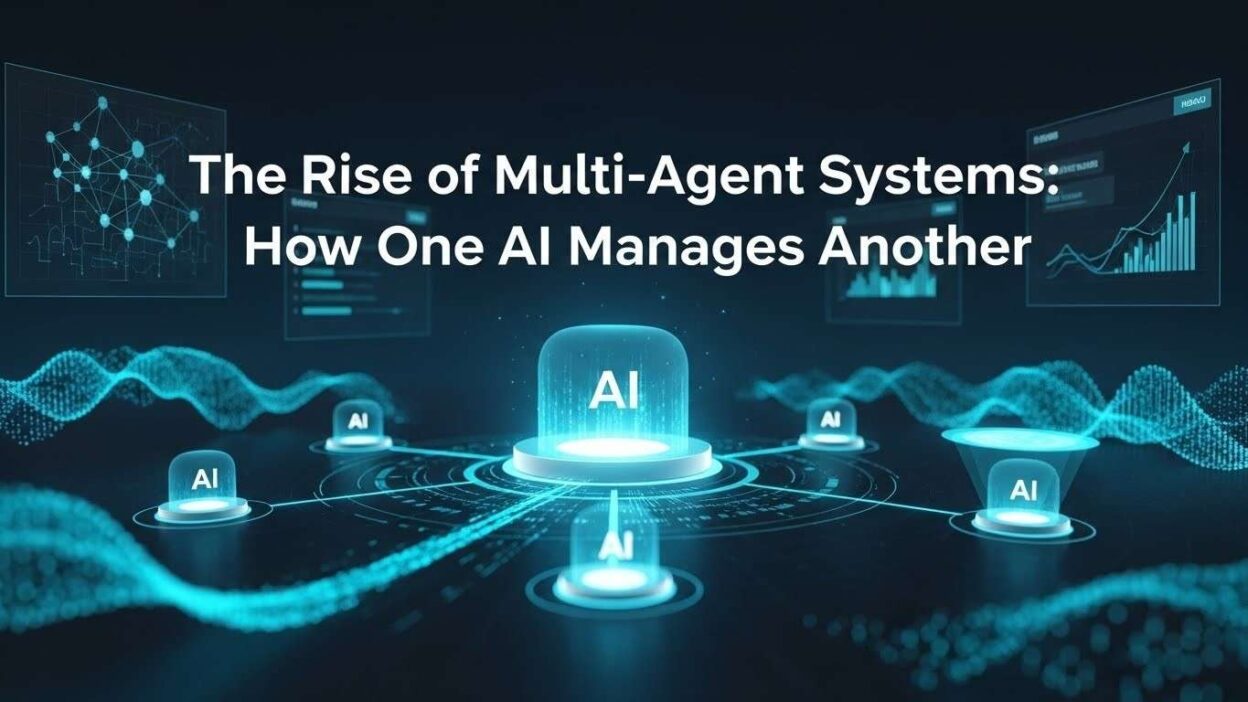
Multi-agent systems introduce hierarchy and collaboration between multiple AI entities. Orchestrator agents receive complex requests from users. These coordinators break down problems into smaller components. Worker agents receive specific subtasks matching their specializations. Each worker completes assigned tasks independently. The orchestrator synthesizes results into coherent outputs.
Communication protocols enable agents to share information and coordinate actions. Agents pass messages containing task specifications and results. Standardized formats ensure mutual understanding across diverse agent types. Query mechanisms let agents request information from peers. Notification systems alert agents about status changes. These communication channels create functional AI teams.
Specialization allows each agent to master narrow domains deeply. One agent excels at data analysis and pattern recognition. Another specializes in natural language processing. A third handles numerical optimization. Code generation belongs to a dedicated programming agent. This division of labor increases overall system capability.
Multi-agent AI systems for business automation leverage emergent intelligence from agent interactions. Individual agents possess limited capabilities within their domains. Collaboration produces solutions no single agent could achieve. The whole exceeds the sum of its parts. This synergy creates breakthrough performance levels.
The Supervisor-Worker Relationship
Supervisor agents manage teams of specialized worker agents. These coordinators understand overall objectives and constraints. They decompose complex goals into achievable subtasks. Assignment decisions consider each worker agent’s strengths. Supervisors track progress across all active tasks.
Worker agents focus exclusively on their assigned specializations. They receive clear instructions from supervisor agents. Execution happens without requiring broader context. Results return to supervisors upon task completion. This focused approach maximizes individual agent efficiency.
Dynamic task allocation adapts to changing conditions and priorities. Supervisors reassign work when agents become available. Priority shifts propagate through the system immediately. Bottlenecks trigger additional resource allocation. The system self-balances automatically without human intervention.
Quality control mechanisms ensure output meets standards. Supervisors validate worker agent results before proceeding. Inconsistencies trigger re-execution or alternative approaches. Multiple agents verify critical outputs independently. This redundancy catches errors that single agents might miss.
Escalation protocols handle situations beyond agent capabilities. Supervisors recognize when problems exceed available resources. They request human intervention for edge cases. Learning systems capture these situations for future improvement. The boundary between autonomous and assisted operation adapts continuously.
Specialized Agent Types and Their Roles
Planning agents decompose complex objectives into executable sequences. They analyze goals and identify required steps. Dependencies between tasks become explicit. Resource requirements get estimated upfront. Alternative approaches receive evaluation and ranking. These planners create roadmaps that other agents follow.
Research agents gather information from diverse sources. They query databases and APIs systematically. Web searches retrieve relevant external data. Document analysis extracts key facts. Synthesizing information from multiple sources produces comprehensive understanding. These researchers provide knowledge foundations for decision-making.
Analysis agents process data to identify patterns and insights. Statistical methods reveal correlations and trends. Machine learning models generate predictions. Anomaly detection flags unusual patterns. Visualization agents transform findings into understandable formats. These analytical capabilities inform strategic decisions.
Execution agents perform concrete actions within business systems. They update databases with processed information. API calls trigger operations in external platforms. File generation creates documents and reports. Communication agents send emails and notifications. These workers implement decisions autonomously.
Multi-agent AI systems for business automation combine these specialized types effectively. Research agents gather facts. Planning agents design approaches. Analysis agents evaluate options. Execution agents implement chosen strategies. Supervisor agents orchestrate this entire symphony. The coordination creates powerful automated workflows.
How Agents Communicate and Coordinate
Message passing forms the foundation of agent communication. Agents send structured messages to specific recipients. JSON formats carry task specifications and data. Unique identifiers track conversations across multiple exchanges. Asynchronous processing allows agents to work independently. This architecture scales efficiently as agent teams grow.
Shared memory spaces enable information exchange across agent groups. Common databases store facts and state information. All agents access centralized knowledge repositories. Updates propagate immediately to interested parties. This shared context reduces redundant information gathering. Coordination becomes implicit through shared understanding.
Event systems broadcast notifications about state changes. Task completion events alert dependent agents. Error conditions trigger exception handling workflows. Priority escalations notify supervisory agents immediately. Interested agents subscribe to relevant event streams. This pub-sub model decouples agents while maintaining coordination.
Negotiation protocols resolve conflicts between competing objectives. Agents propose approaches and trade-offs explicitly. Voting mechanisms aggregate preferences across agent teams. Optimization algorithms find solutions satisfying multiple constraints. These negotiations produce better decisions than individual agents make.
Feedback loops enable continuous improvement across agent teams. Performance metrics track individual agent effectiveness. Successful strategies get reinforced through positive feedback. Failures trigger analysis and adaptation. The system learns optimal collaboration patterns over time. Multi-agent AI systems for business automation become smarter through experience.
Real-World Business Applications
Customer service operations benefit enormously from multi-agent architectures. A routing agent classifies incoming inquiries by topic. Knowledge agents retrieve relevant information from documentation. Response agents craft appropriate replies. Sentiment analysis agents evaluate customer satisfaction. Escalation agents identify situations requiring human attention. These teams handle routine inquiries autonomously while routing complex cases appropriately.
Financial analysis leverages multiple specialized analytical agents. Data collection agents gather market information continuously. Statistical agents identify trends and correlations. Risk assessment agents evaluate potential exposures. Portfolio optimization agents recommend allocation strategies. Reporting agents generate executive summaries. Investment firms using these systems make faster, more informed decisions.
Supply chain optimization coordinates numerous interdependent decisions. Demand forecasting agents predict future requirements. Inventory agents optimize stock levels across locations. Routing agents plan efficient delivery schedules. Supplier agents evaluate vendor performance and pricing. Exception handling agents respond to disruptions. These coordinated systems reduce costs while improving service levels.
Content creation workflows orchestrate multiple creative agents. Research agents gather source material and facts. Outline agents structure content logically. Writing agents generate prose matching brand guidelines. Editing agents refine drafts for clarity and accuracy. SEO agents optimize for search visibility. Publishing agents schedule and distribute finished content.
Software development teams augment with AI agent collaborators. Requirements agents clarify specifications through user interaction. Architecture agents design system components. Coding agents implement features in appropriate languages. Testing agents verify functionality and find bugs. Documentation agents maintain up-to-date technical guides. Development velocity increases dramatically with these augmentations.
The Technology Stack Behind Multi-Agent Systems
Large language models provide the intelligence foundation for modern agents. GPT-4, Claude, and similar models understand natural language. They reason about complex problems and generate coherent responses. Each agent leverages these models within specialized contexts. Fine-tuning adapts models to specific agent roles. These powerful models enable sophisticated agent behaviors.
Orchestration frameworks coordinate agent interactions and workflows. LangChain and similar tools provide agent coordination primitives. They handle message routing and state management. Error recovery and retry logic come built-in. Integration libraries connect to business systems. These frameworks accelerate multi-agent AI systems for business automation development.
Vector databases enable semantic search and knowledge retrieval. Agents store information as high-dimensional embeddings. Similarity searches find relevant facts instantly. Context-aware retrieval surfaces appropriate knowledge for tasks. These databases give agents long-term memory capabilities. Knowledge accumulates and remains accessible over time.
API management layers connect agents to external services. Authentication handles credentials securely. Rate limiting prevents resource exhaustion. Circuit breakers protect against cascading failures. Monitoring tracks API usage and performance. These management layers ensure reliable integration.
Monitoring and observability tools provide visibility into agent operations. Logging captures detailed execution traces. Metrics track performance and resource utilization. Alerting notifies teams about problems. Debugging tools help diagnose unexpected behaviors. These capabilities make complex multi-agent systems manageable.
Advantages Over Single-Agent Approaches
Specialization enables deeper expertise in narrow domains. Single agents balance breadth against depth. Multi-agent systems assign experts to appropriate tasks. This focused mastery produces superior results. Quality improves across all dimensions simultaneously.
Parallel processing accelerates complex workflows dramatically. Independent agents work simultaneously on different subtasks. Total completion time equals the longest individual task. Single agents process sequentially instead. Multi-agent architectures achieve order-of-magnitude speedups.
Fault tolerance improves through redundancy and graceful degradation. Failed agents don’t crash entire systems. Supervisors route work around unavailable agents. Alternative approaches activate automatically. Systems continue operating despite component failures. Reliability exceeds monolithic alternatives significantly.
Scalability becomes straightforward by adding specialized agents. New capabilities require deploying additional agent types. Capacity increases by running more agent instances. Horizontal scaling works naturally with agent architectures. Single agents hit fundamental performance limits eventually. Multi-agent AI systems for business automation scale indefinitely.
Maintainability improves through modular agent design. Updates affect specific agents without system-wide changes. Testing focuses on individual agent behaviors. Debugging isolates problems to particular agents. This modularity reduces complexity management burden substantially.
Challenges and Limitations
Coordination overhead increases with agent team size. More agents mean more communication messages. Supervisors manage more complex state tracking. Latency accumulates across multiple agent interactions. These coordination costs eventually limit practical team sizes. Careful architecture design mitigates but cannot eliminate overhead.
Debugging multi-agent systems proves more difficult than single agents. Behaviors emerge from agent interactions rather than individual logic. Reproducing specific execution paths becomes challenging. Distributed state complicates understanding system status. Sophisticated observability tools become essential requirements.
Cost considerations affect deployment decisions significantly. Each agent potentially queries expensive AI models. Message passing generates additional API calls. Storage requirements increase with agent communication logs. These costs scale with system complexity. Economic optimization requires careful agent design.
Consistency maintenance challenges distributed agent teams. Different agents may hold conflicting information. Race conditions emerge without proper synchronization. Transaction boundaries span multiple agents. Ensuring system-wide consistency demands sophisticated coordination. These problems resemble distributed systems challenges generally.
Security implications multiply with agent proliferation. Each agent represents potential attack surfaces. Compromised agents threaten entire systems. Authorization management grows complex. Auditing agent actions requires comprehensive logging. Multi-agent AI systems for business automation need robust security architectures.
Designing Effective Multi-Agent Workflows
Task decomposition strategies determine system effectiveness. Break problems into truly independent subtasks. Minimize dependencies between agent responsibilities. Create clear interfaces between agent roles. This separation enables parallel execution and simple coordination.
Agent specialization decisions balance generalization and expertise. Overly specialized agents proliferate unnecessarily. Too general agents sacrifice performance. Find the right granularity for your domain. Consider how often specific capabilities get used. Design agent boundaries around natural problem structure.
Communication pattern optimization reduces unnecessary overhead. Batch related messages together when possible. Use shared memory for frequently accessed information. Implement caching to avoid redundant queries. Stream results instead of waiting for complete outputs. These optimizations dramatically improve performance.
Error handling strategies ensure robust operation. Define fallback behaviors for common failures. Implement exponential backoff for transient errors. Establish clear escalation paths to human operators. Log sufficient context for post-mortem analysis. Graceful degradation maintains partial functionality during problems.
Testing approaches verify agent interactions function correctly. Unit tests validate individual agent behaviors. Integration tests check communication between agents. End-to-end tests verify complete workflow execution. Chaos testing introduces random failures. Comprehensive testing catches problems before production.
Building Your First Multi-Agent System
Start simple with two-agent supervisor-worker architecture. The supervisor receives requests and delegates work. The worker executes tasks and returns results. This basic pattern establishes core concepts. Complexity adds after mastering fundamentals.
Select appropriate tools matching your technical capabilities. Cloud-hosted AI APIs simplify initial development. LangChain provides excellent getting-started documentation. Python offers rich ecosystem support. These choices lower barriers to experimentation.
Define clear agent responsibilities with minimal overlap. Write explicit specifications for each agent role. Document expected inputs and outputs. Establish communication protocols upfront. This clarity prevents confusion during development.
Implement comprehensive logging from day one. Track every agent interaction and decision. Log timing information for performance analysis. Capture errors with full context. These logs prove invaluable during debugging. Multi-agent AI systems for business automation require excellent observability.
Iterate based on real-world testing and feedback. Start with narrow use cases before expanding. Monitor performance metrics continuously. Gather user feedback about system behaviors. Refine agent designs based on actual usage patterns. Gradual evolution produces robust systems.
Advanced Multi-Agent Patterns
Hierarchical agent structures create scalable organization. Top-level supervisors manage mid-level coordinators. Coordinators oversee teams of specialized workers. This hierarchy mirrors corporate organizational charts. Communication flows through management layers. The pattern scales to large agent populations.
Auction-based task allocation optimizes resource utilization. Agents bid for tasks based on capability and availability. Supervisors award tasks to optimal bidders. This market mechanism balances workload automatically. Resources flow to highest-value activities.
Agent specialization through fine-tuning improves performance. Train agents on domain-specific datasets. Optimize prompts for particular agent roles. Build specialized tool integrations for each agent type. This customization creates expert-level capabilities.
Feedback and learning systems enable continuous improvement. Capture successful interaction patterns. Identify common failure modes. Adjust agent behaviors based on outcomes. The system becomes smarter over time. Performance improves without manual intervention.
Human-in-the-loop integration maintains control and oversight. Agents request approval for significant decisions. Humans review outputs before final implementation. Exception cases route to human experts. This collaboration combines AI speed with human judgment. Multi-agent AI systems for business automation augment rather than replace people.
Security and Governance Considerations
Access control limits agent capabilities appropriately. Each agent receives minimum necessary permissions. Role-based access restricts sensitive operations. API keys and credentials stay isolated. This principle of least privilege contains damage from compromised agents.
Audit trails track all agent actions comprehensively. Log who initiated each workflow. Record every decision and action taken. Maintain immutable audit logs. Enable reconstruction of complete execution history. Regulatory compliance demands this transparency.
Input validation prevents injection and manipulation attacks. Sanitize all data entering agent systems. Validate against expected formats and ranges. Reject suspicious or malformed inputs. This defensive programming protects against attacks.
Output monitoring catches problematic agent behaviors. Check responses for policy violations. Filter harmful or inappropriate content. Verify outputs match expected patterns. Alert humans about anomalous results. This safety layer prevents automated mistakes.
Rate limiting protects against resource exhaustion. Limit requests per agent and per user. Implement exponential backoff for repeated failures. Monitor usage patterns for abuse. These controls prevent denial-of-service conditions. Multi-agent AI systems for business automation need robust safeguards.
Measuring Multi-Agent System Performance
Task completion rates indicate overall system effectiveness. Track percentage of requests successfully handled. Measure how often human intervention becomes necessary. Monitor automation coverage across different request types. These metrics show system capability breadth.
Latency measurements reveal performance characteristics. Record time from request to completion. Break down delays by agent and operation. Identify bottlenecks in workflow execution. Optimize slow components for better throughput.
Accuracy metrics validate output quality. Compare agent results against ground truth. Calculate precision and recall for classification tasks. Measure error rates across different scenarios. Track quality improvements over time.
Cost tracking enables economic optimization. Monitor API calls and token usage per workflow. Calculate total cost per completed request. Identify expensive operations for optimization. Balance performance against financial constraints.
User satisfaction scores reflect real-world value. Survey users about system usefulness. Track task completion success from user perspective. Monitor support ticket volumes. Happy users indicate successful automation. Multi-agent AI systems for business automation must deliver business value.
Future Directions and Emerging Trends
Self-organizing agent teams adapt without explicit programming. Agents discover optimal collaboration patterns autonomously. Role specialization emerges from experience. Communication protocols evolve based on effectiveness. This emergent organization handles novel situations.
Emotional intelligence capabilities humanize agent interactions. Agents detect user frustration and adapt responses. They recognize appropriate communication tones. Empathy improves customer experience. These soft skills complement analytical capabilities.
Cross-organizational agent collaboration extends beyond single companies. Supply chain agents coordinate across partner organizations. Industry consortiums share specialized agents. Standards enable interoperability between agent platforms. This cooperation creates ecosystem-level intelligence.
Quantum computing integration may accelerate certain agent tasks. Optimization problems solve exponentially faster. Pattern recognition achieves higher accuracy. These advances multiply multi-agent system capabilities. The convergence creates unprecedented possibilities.
Biological inspiration drives architecture innovations. Ant colony optimization algorithms coordinate agent swarms. Neural network structures organize agent hierarchies. Evolutionary algorithms optimize agent designs. Nature provides proven templates for complex coordination.
Getting Started with Multi-Agent Implementation
Assess your business processes for automation opportunities. Identify repetitive tasks consuming staff time. Find processes requiring multiple expertise areas. Look for workflows spanning multiple systems. These represent prime multi-agent AI systems for business automation candidates.
Evaluate available tools and platforms carefully. Consider open-source frameworks versus commercial solutions. Assess technical requirements against team capabilities. Evaluate cost implications of different approaches. Choose platforms matching your specific needs.
Build proof-of-concept systems before large commitments. Select narrow, well-defined initial use cases. Implement minimum viable agent architectures. Test with real business scenarios. Demonstrate value to stakeholders tangibly.
Plan for incremental expansion after initial success. Add agent types progressively. Extend coverage to related workflows. Increase automation depth gradually. This phased approach manages risk effectively.
Invest in team training and capability development. Educate staff about multi-agent concepts. Provide hands-on learning opportunities. Build internal expertise for long-term success. Knowledge investment pays dividends indefinitely.
Read More:-What are “Agentic Workflows” and Why They Kill Traditional Automation?
Conclusion

Multi-agent AI systems for business automation represent a paradigm shift in enterprise technology. Single AI models accomplish impressive individual tasks. Coordinated agent teams solve problems beyond any single system’s capability. This architectural evolution mirrors how humans organize to tackle complexity.
The supervisor-worker pattern provides elegant solutions to coordination challenges. Planning agents design approaches. Research agents gather information. Analytical agents generate insights. Execution agents implement decisions. Supervisors orchestrate these specialized roles seamlessly.
Real-world applications demonstrate substantial business value. Customer service handles inquiries faster and more accurately. Financial analysis produces better investment decisions. Supply chains optimize automatically. Content creation scales efficiently. Software development accelerates dramatically.
Challenges exist around coordination overhead and debugging complexity. Security demands careful architecture and governance. Costs require optimization and monitoring. These obstacles don’t diminish the fundamental power of multi-agent approaches.
Organizations adopting these systems gain significant competitive advantages. Automation reaches previously impossible sophistication levels. Scalability becomes effortless. Reliability improves through redundancy and specialization. The technology trajectory clearly favors multi-agent architectures.
Start your journey today with simple two-agent experiments. Build confidence through incremental successes. Expand gradually as capabilities prove themselves. The future belongs to companies leveraging coordinated AI teams. Multi-agent AI systems for business automation will define the next decade of enterprise technology. Your competitors are already exploring these possibilities. The time to begin is now.