Introduction
TL;DR Every AI conversation has a ceiling. The model forgets. The context window fills up. Important details disappear. MemGPT for infinite context in AI conversations breaks that ceiling entirely. This guide explains exactly what MemGPT is, how its memory system works, and how you can deploy it to build AI agents that genuinely remember everything.
~4K Typical LLM context window tokens
∞ Effective memory depth with MemGPT
3 Memory tiers: core, archival, recall
2023 Year MemGPT research was published
The Problem Every AI Developer Hits Eventually
You build a chatbot. It works beautifully for the first few messages. Then the user mentions something from 20 exchanges ago. The AI has no idea what they mean. The context window ran out. The model forgot. The user feels ignored. That experience destroys trust in AI-powered applications fast.
This is not a flaw in any specific model. It is a fundamental architectural constraint. Large language models process a fixed window of tokens. Once a conversation exceeds that window, older content disappears entirely. No model today solves this natively at an arbitrary scale.
MemGPT for infinite context in AI conversations was built precisely to solve this problem. It wraps around any LLM and gives it a memory management system inspired by how operating systems handle memory. The result is an AI agent that remembers conversations, user preferences, and knowledge across sessions without any hard limit.
Why Context Limits Hurt Real Applications
Short context limits are manageable in simple chatbots. They become a serious problem in real enterprise applications. A customer support agent needs to remember a user’s entire history. A personal assistant needs to recall instructions given weeks ago. A coding assistant needs to hold the full architecture of a large project in mind. Standard LLMs cannot do any of these things reliably. MemGPT for infinite context in AI conversations makes all three scenarios possible.
What Is MemGPT and Where Did It Come From
MemGPT came out of research at UC Berkeley in 2023. The paper introduced a new framework for managing LLM memory across multiple storage tiers. The name combines “memory” with “GPT” to reflect its core purpose — giving generative AI models a structured memory system they naturally lack.
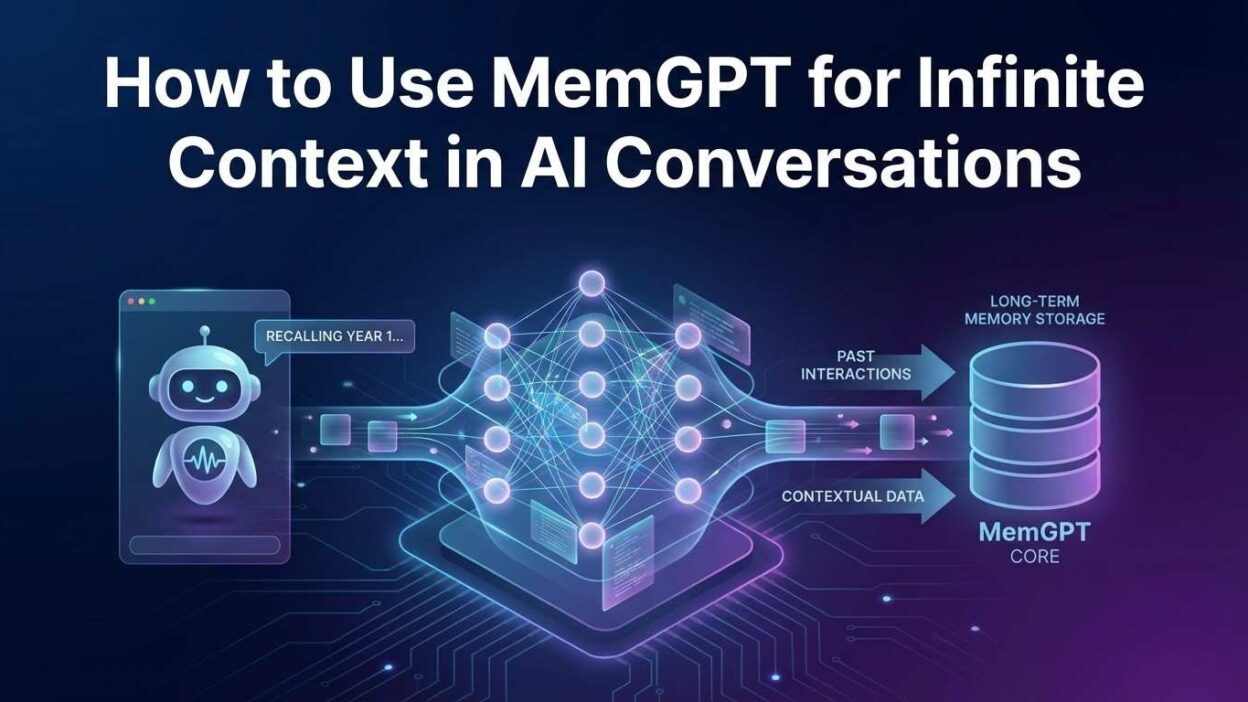
The core insight behind MemGPT is elegant. Operating systems manage RAM and disk storage using paging and virtual memory. When RAM fills up, the OS moves data to disk and retrieves it when needed again. MemGPT applies this exact logic to LLM context windows. When the active context fills, MemGPT moves information to external storage and retrieves it on demand.
This design means the model always operates within its token limit. But it also always has access to any information stored previously. The AI never truly forgets. It simply stores memories outside the active window and pulls them back when relevant. That is the foundation of MemGPT for infinite context in AI conversations.
The Operating System Analogy
Think of the LLM’s context window as RAM. Fast. Limited. Essential. Think of MemGPT’s external storage as a hard drive. Slower to access. Effectively unlimited in size. An OS decides what lives in RAM and what waits on disk. MemGPT makes the same decisions for AI memory. Important, recent, and frequently accessed information stays in context. Everything else moves to archival storage until the agent needs it again.
Memory Architecture
MemGPT’s Three-Tier Memory Architecture Explained
Understanding the memory architecture is essential before you deploy MemGPT for infinite context in AI conversations. The system uses three distinct memory layers. Each serves a specific purpose. Together they create the illusion of unlimited memory while keeping the LLM’s context window manageable.
MemGPT Memory Layers
⚡
Core Memory Always Active
Lives inside the LLM’s active context window. Contains the system prompt, current conversation, and key user facts. Updated continuously. Always available to the model without retrieval.
🗂️
Archival Memory Searchable Store
External vector database storage. Holds unlimited past conversations, documents, and knowledge. The agent searches and retrieves relevant chunks when needed using semantic similarity.
📋
Recall Memory Conversation History
Full conversation history stored externally. The agent can search past messages using text queries. Provides access to any prior exchange without keeping it all in active context.
Core Memory — The Always-On Layer
Core memory sits permanently inside the active context. It holds the agent’s persona, the current user’s key facts, and the ongoing conversation thread. The agent can write to and edit core memory at any time. When the agent learns that a user prefers formal tone, it writes that preference to core memory immediately. That preference stays accessible for every future message without any retrieval step.
Archival Memory — The Infinite Store
Archival memory is where MemGPT for infinite context in AI conversations truly shines. This layer uses a vector database — tools like Chroma, Pinecone, or pgvector — to store an unlimited number of memory objects. The agent searches archival memory using natural language queries. It retrieves the most semantically relevant chunks and loads them into active context temporarily. The conversation can reference events from months ago with perfect accuracy.
Recall Memory — The Conversation Log
Recall memory stores every message ever exchanged in a session or across sessions. The agent treats this like a searchable log. It issues queries against this log when a user references a past exchange. The matching messages load into active context for the current turn. Recall memory ensures no prior conversation detail ever truly disappears.
How It Works
How MemGPT Manages Memory Automatically
One of the most impressive aspects of MemGPT for infinite context in AI conversations is that memory management happens autonomously. The agent decides what to remember, what to archive, and what to retrieve. No human prompt engineering required during the conversation itself.
Function Calls as Memory Operations
MemGPT gives the underlying LLM a set of special functions to call. These functions control memory. The agent calls archival_memory_insert to store a new memory object. It calls archival_memory_search to retrieve past information. It calls core_memory_replace to update a key fact. Every memory action the agent takes flows through these structured function calls.
This design keeps memory management transparent and auditable. Developers can inspect every memory operation the agent performs. They see exactly what information the agent chose to retain and why. That transparency is rare in AI systems and extremely valuable in production deployments.
The Inner Monologue System
MemGPT agents maintain an inner monologue. Before responding to a user, the agent reasons through what it knows, what it needs to retrieve, and what it should remember. This reasoning step happens in a hidden scratchpad outside the user-facing output. The agent thinks before it speaks. That deliberation makes responses more coherent and contextually grounded.
The inner monologue is where the agent decides whether to search archival memory. If the current question references past information, the agent searches before answering. If the conversation reveals new important facts, the agent stores them before replying. This loop is what makes MemGPT for infinite context in AI conversations feel genuinely intelligent rather than stateless.
Getting Started
Using the Python SDK for Custom Applications
The CLI is great for testing. Production applications use the Python SDK directly. The SDK lets developers create agents programmatically, send messages, retrieve memory contents, and manage multiple agents in parallel. Enterprise teams build customer support systems, personal assistants, and knowledge management tools using the SDK as the core engine.
Real-World Use Cases for MemGPT Infinite Context
The technical architecture is compelling. The real-world applications are even more so. MemGPT for infinite context in AI conversations enables a class of products that was simply not viable with standard LLMs. Here are the most impactful use cases developers and companies are building today.
Use Case 01
Long-Term Personal AI Assistants
A personal assistant that remembers your preferences, past decisions, ongoing projects, and communication style is genuinely useful. Standard chatbots reset every session. A MemGPT assistant accumulates knowledge about you over months. It knows you prefer bullet-point summaries. It remembers your team structure. It recalls the outcome of last quarter’s project review. That depth of context makes assistance feel personal rather than generic.
Use Case 02
Customer Support Agents with Full History
Customer support agents built on standard LLMs lose context between tickets. A MemGPT-powered support agent remembers every interaction a customer ever had. It knows their product tier, past complaints, resolved issues, and communication preferences. First-contact resolution rates improve. Customers never repeat themselves. Support teams spend less time on context reconstruction and more time solving actual problems.
This is one of the strongest enterprise arguments for MemGPT for infinite context in AI conversations in production systems today.
Use Case 03
AI Research Assistants
Researchers ingest hundreds of papers, notes, and documents into a MemGPT agent’s archival memory. The agent then answers questions that require synthesizing information across all stored sources. Ask it to compare the methodology from three different papers. Ask it to identify contradictions across a literature review. The agent searches its archival store, pulls relevant chunks, and reasons across them. No standard RAG pipeline delivers this level of autonomous reasoning alongside memory management.
Use Case 04
Coding Assistants with Full Codebase Context
A MemGPT coding agent ingests an entire repository into archival memory. It remembers architectural decisions discussed in past sessions. It recalls why a specific function was written a certain way. It tracks technical debt notes added months ago. Developers ask questions about code they wrote last year and get accurate, contextually informed answers. This application alone justifies the investment in learning MemGPT for infinite context in AI conversations for engineering teams.
Advanced Topics
Advanced MemGPT Concepts for Production Deployments
Basic setup covers individual use. Production deployments require understanding several advanced concepts that determine reliability, performance, and cost at scale.
Choosing the Right Vector Database
Archival memory needs a vector database backend. MemGPT supports several options. Chroma works well for local development and small deployments. Pinecone handles large-scale production workloads with managed infrastructure. PostgreSQL with the pgvector extension suits teams already running Postgres in their stack. The choice affects retrieval speed, storage cost, and operational complexity. Match the vector database to your existing infrastructure rather than defaulting to a new service.
Managing Memory Cost at Scale
Every archival memory search triggers an embedding model call. Every memory insert does the same. At high conversation volumes, embedding costs accumulate quickly. Production teams use batching strategies to reduce API calls. They also set memory retention policies — expiring old, low-relevance memories after a defined period. Cost-aware memory management is essential before deploying MemGPT for infinite context in AI conversations at enterprise scale.
Multi-Agent Memory Sharing
Advanced MemGPT deployments use multiple specialized agents that share a common memory store. A customer service pipeline might run a triage agent, a technical agent, and a billing agent. All three share the same archival memory for a given customer. Each agent retrieves the context it needs without duplicating storage. This architecture enables sophisticated multi-step workflows while keeping individual agent context windows lean.
Human-in-the-Loop Memory Editing
Production systems need a way for humans to correct AI memory. MemGPT exposes memory contents via its API. Developers build admin interfaces that let supervisors view, edit, and delete specific memory entries. If an agent stores an incorrect fact about a user, a support manager corrects it directly. This oversight layer is critical for maintaining accuracy over long-running deployments of MemGPT for infinite context in AI conversations.
MemGPT vs Alternatives
MemGPT Versus Other Long-Context Solutions
Several approaches compete for the long-context problem. Each has distinct trade-offs. Understanding them helps developers choose the right tool for each application.
MemGPT vs Extended Context Window Models
Some models now offer 128K or even 1 million token context windows. These help. But they do not eliminate the problem entirely. Longer contexts mean higher per-call costs. Retrieval quality degrades as context fills with irrelevant information — a phenomenon called lost-in-the-middle. MemGPT keeps active context lean and relevant by storing the majority of information externally. The result is better reasoning quality at a lower cost per conversation turn.
MemGPT vs Standard RAG Pipelines
Retrieval-Augmented Generation pipelines retrieve documents before each model call. They work well for static knowledge bases. They struggle with dynamic, evolving conversation memory. RAG does not write new information back to storage during a conversation. MemGPT does. The agent continuously updates its memory as the conversation progresses. That bidirectional memory flow is what makes MemGPT for infinite context in AI conversations more powerful than RAG for conversational applications.
MemGPT vs LangChain Memory Modules
LangChain provides memory modules that persist conversation summaries or full message histories. These are simpler to implement than MemGPT. They also offer less sophistication. LangChain memory does not support autonomous agent-controlled memory operations. The agent cannot decide what to remember or forget. MemGPT gives the agent full agency over its own memory — a fundamentally different and more powerful model for complex applications.
FAQ
Frequently Asked Questions
What exactly is MemGPT and how does it achieve infinite context?
MemGPT is a framework that wraps around any large language model and gives it a tiered memory management system. It stores information across three layers — core memory inside the context window, archival memory in an external vector database, and recall memory as a searchable conversation log. The agent retrieves and inserts memories autonomously, creating effectively unlimited conversational context without exceeding the LLM’s token limit. This is the core mechanism behind MemGPT for infinite context in AI conversations.
Does MemGPT work with models other than GPT-4?
Yes. MemGPT supports OpenAI models, Anthropic Claude, Google Gemini, and local open-source models via Ollama or LM Studio. The framework is model-agnostic. The underlying LLM must support function calling or tool use to handle memory operations properly. Most modern capable models meet this requirement. GPT-4 and Claude are the most commonly used backends in production deployments.
Is MemGPT suitable for production enterprise applications?
Yes, with proper infrastructure planning. MemGPT’s Python SDK integrates into existing backend systems. Production deployments need a managed vector database, cost monitoring for embedding API calls, memory retention policies, and admin tools for human oversight of stored memories. Many teams run MemGPT-based agents at scale successfully for customer support, research, and internal knowledge management applications.
How is MemGPT different from simply using a model with a larger context window?
Larger context windows help but do not solve the problem fully. Longer contexts cost more per API call. Retrieval quality degrades when context contains too much irrelevant information. MemGPT keeps active context lean by storing most information externally and retrieving only what is needed for each turn. This produces better reasoning quality at lower cost compared to stuffing everything into a 128K context window.
What vector databases does MemGPT support for archival memory?
MemGPT supports Chroma for local and small-scale deployments, Pinecone for managed cloud-scale storage, and PostgreSQL with pgvector for teams already running Postgres. The framework also supports in-memory storage for testing and development. Teams choose their vector database based on scale requirements, existing infrastructure, and operational preferences.
Can multiple agents share the same MemGPT memory store?
Yes. Advanced MemGPT architectures share a common archival memory store across multiple specialized agents. Each agent retrieves relevant memories independently. This design supports complex multi-agent pipelines where different agents handle different tasks while maintaining a unified knowledge base about each user or topic. The SDK provides full control over memory scoping across agents.
How do I update or delete incorrect memories stored by a MemGPT agent?
The MemGPT Python SDK exposes full CRUD operations on stored memories. Developers build admin interfaces using these APIs. Support managers or system admins can view all stored memory objects, edit incorrect entries, and delete outdated facts. This human-in-the-loop oversight layer is a standard component of any production deployment of MemGPT for infinite context in AI conversations.
Read More:-How to Build a Custom AI Recruiter to Filter 10,000 Resumes
Conclusion

The context window limit has constrained AI applications since the beginning. Every workaround before MemGPT required compromise — shorter histories, lost nuance, frustrated users. MemGPT for infinite context in AI conversations changes the equation entirely.
The three-tier memory system is genuinely elegant. Core memory keeps critical context always available. Archival memory holds unlimited knowledge. Recall memory preserves every past exchange. The agent manages all three layers autonomously. Developers get persistent, intelligent behavior without manually engineering every memory decision.
The use cases are real and valuable. Personal assistants that truly know you. Customer support agents with full customer history. Research tools that synthesize across hundreds of documents. Coding assistants with complete codebase awareness. Every one of these applications becomes buildable with MemGPT for infinite context in AI conversations as the foundation.
Start with the CLI to understand how the memory layers work. Move to the Python SDK when you are ready to build something production-grade. Choose your vector database based on scale. Build in human oversight tools from day one. The investment in learning MemGPT pays back quickly in every application that requires an AI with genuine, lasting memory.
Memory is what separates a useful tool from a trusted assistant. MemGPT for infinite context in AI conversations gives every developer the architecture to build the latter.