Introduction
TL;DR Every business deals with documents. Invoices pile up. Purchase orders stack on desks. Forms arrive from clients, vendors, and regulators. Someone has to process all of it. For decades, that someone was a human being typing data into a system one field at a time.
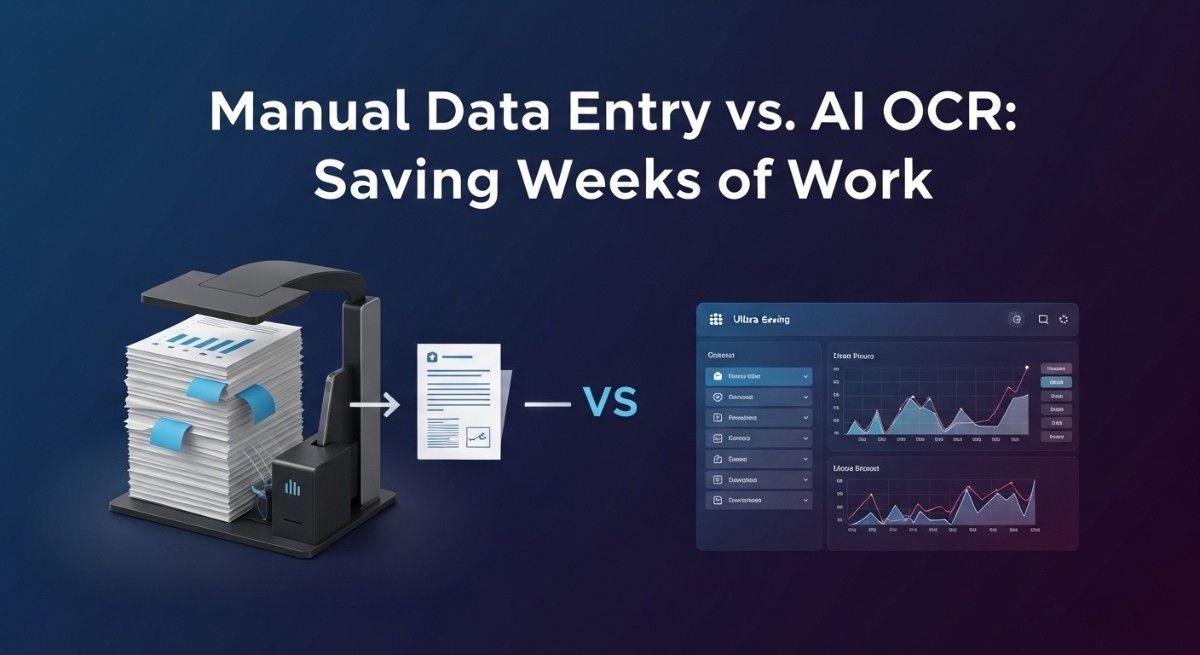
That era is ending. The debate around manual data entry vs AI OCR for business automation is no longer theoretical. It is playing out in finance departments, logistics operations, healthcare systems, and legal firms worldwide. The results are dramatic.
Businesses that switch from manual data entry to AI-powered optical character recognition report saving weeks of work every month. They cut error rates. They redeploy staff to higher-value roles. They process more documents with fewer resources.
This blog covers the full story. It examines what manual data entry actually costs, how AI OCR works, and where the real advantages appear when businesses make the switch. It also addresses the honest limitations of AI OCR so decision-makers can plan thoughtfully.
If your business still processes documents by hand, this guide will change how you think about that decision. Manual data entry vs AI OCR for business automation is a comparison with a clear winner in most scenarios. The evidence is compelling.
Table of Contents
The True Cost of Manual Data Entry in Modern Business
Manual data entry looks cheap on the surface. You hire a data entry clerk. You pay an hourly wage. Documents get processed. The system appears to work.
Dig deeper and the real cost picture looks very different. Manual data entry carries hidden costs that compound silently across the organization. Understanding these costs is the starting point for any serious manual data entry vs AI OCR for business automation evaluation.
Speed is the most obvious cost. A skilled data entry operator processes roughly 10,000 keystrokes per hour under ideal conditions. A typical invoice contains 15 to 25 fields. At that rate, processing 500 invoices per day requires multiple full-time staff members working at maximum capacity.
Error rates compound the cost further. Human data entry errors average between 1 and 4 percent under normal working conditions. At 3 percent error rate across 500 daily invoices, 15 invoices contain incorrect data. Those errors trigger downstream problems: payment disputes, audit findings, compliance failures, and customer complaints.
Fatigue degrades both speed and accuracy over the course of a workday. A data entry operator at the end of an eight-hour shift makes more errors than at the start. High-volume processing demands produce unsustainable pressure on human operators.
Scalability is a structural problem with manual data entry. When document volume doubles, headcount must increase proportionally. Hiring, training, and managing that headcount adds management cost and organizational complexity. The model does not scale efficiently.
Hidden Costs That Manual Data Entry Adds to Your Operations
Beyond wages, manual data entry generates costs in several other areas that rarely appear in direct cost analyses. Supervision and quality control require dedicated staff time. Someone must audit samples of entered data to catch errors. Someone must fix those errors when found.
Rework costs follow errors through the system. A wrongly entered invoice number triggers a payment failure. That failure requires investigation, correction, vendor communication, and reprocessing. A single data entry error can generate two to four hours of downstream correction work.
Storage and retrieval costs add up for paper-heavy organizations. Physical document storage requires space. Retrieval requires filing systems. Misfiled documents create search costs that are difficult to quantify but consistently frustrate staff.
Compliance risk carries potential cost far beyond operational expense. In regulated industries, data entry errors in compliance-related documents can trigger fines, audits, and legal exposure. The manual data entry vs AI OCR for business automation comparison becomes financially decisive when compliance risk enters the calculation.
Staff turnover in high-volume data entry roles is chronically high. The work is repetitive and mentally exhausting. Turnover costs include recruitment, onboarding, and the productivity gap while new staff reach full speed. These costs rarely appear in data entry cost analyses but consistently affect the real expense of manual processing.
What Is AI OCR and How Does It Work?
Optical character recognition has existed for decades. Early OCR systems read text from structured documents with fixed layouts. They required templates. They failed on handwriting. They struggled with poor scan quality and unusual fonts.
Modern AI OCR is fundamentally different technology. It uses deep learning models trained on millions of document examples. It recognizes text in dozens of languages and scripts. It handles handwriting, stamps, tables, checkboxes, and complex multi-column layouts without templates.
The AI OCR pipeline starts with document ingestion. The system accepts scanned images, PDFs, photographs, and even mobile camera captures. Pre-processing steps correct skew, enhance contrast, remove noise, and normalize image quality before recognition begins.
The recognition engine then identifies text regions, reads characters, and assembles words, lines, and paragraphs. Modern AI OCR systems achieve character recognition accuracy above 99.5 percent on clearly printed documents and above 95 percent on average-quality handwritten text.
Intelligent document processing builds on top of OCR. It does not just read text. It understands document structure. It identifies that a number near the word total represents an invoice amount. It recognizes that a date in a specific field position is the document date, not a due date. This semantic understanding is what separates modern AI OCR from legacy character recognition.
Understanding this technical foundation is essential when evaluating manual data entry vs AI OCR for business automation. AI OCR does not just digitize text. It extracts structured data intelligently and routes it to downstream systems automatically.
Key Technologies Behind Modern AI OCR Systems
Convolutional neural networks power the visual recognition layer of modern AI OCR. These networks learn feature representations from millions of document images. They identify characters regardless of font, size, rotation, or image quality variations.
Transformer models add contextual understanding on top of visual recognition. They interpret extracted text in context. A transformer model understands that a string of digits following an invoice number field is the invoice number, not a phone number or date.
Named entity recognition classifies extracted text into categories like company names, dates, currency amounts, addresses, and product codes. This classification maps raw extracted text to structured database fields automatically.
Layout analysis models understand document structure. They recognize that a table contains rows and columns with specific data relationships. They separate header information from line items. They handle multi-page documents by tracking context across pages.
These technologies combine to create AI OCR systems that deliver accuracy, speed, and structural understanding that no manual process can match. The manual data entry vs AI OCR for business automation comparison grows more decisive with every advancement in these underlying technologies.
Speed and Accuracy: Manual Data Entry vs AI OCR for Business Automation
Speed and accuracy are the two dimensions that matter most in document processing. Every organization processing documents at scale needs both. Manual data entry delivers neither at the level modern business demands.
Speed comparison starts with raw throughput. An AI OCR system processes a standard invoice in 2 to 5 seconds, including extraction, validation, and data routing. A human operator takes 3 to 8 minutes for the same invoice. At maximum manual throughput, a single AI OCR system replaces 30 to 60 full-time data entry operators on invoice processing alone.
The speed advantage compounds at scale. An AI OCR system runs 24 hours a day without breaks, weekends, or holidays. It processes 50 documents and 50,000 documents at the same per-document speed. Volume spikes during peak periods do not degrade performance.
Accuracy comparison favors AI OCR decisively on printed and digital documents. Modern AI OCR systems achieve 98 to 99.9 percent field-level accuracy on standard business documents. Human operators working under normal conditions average 96 to 98 percent accuracy. Human operators under deadline pressure, fatigue, or high volume drop below 95 percent.
These accuracy differences appear small in percentage terms. Their operational impact is substantial. On 10,000 invoices per month, moving from 97 percent to 99.5 percent accuracy reduces errors from 300 to 50. That represents 250 fewer error corrections per month, each potentially requiring 2 to 4 hours to resolve.
Where Manual Data Entry Still Outperforms AI OCR
An honest manual data entry vs AI OCR for business automation comparison acknowledges where human operators still have advantages. AI OCR is not perfect in every scenario.
Heavily degraded documents challenge AI OCR. Water-damaged records, very faint carbon copies, and extremely poor-quality scans can fall below AI OCR accuracy thresholds. Human operators often interpret degraded text through contextual reasoning that current AI systems cannot fully replicate.
Novel document formats without training examples pose challenges. AI OCR models perform best on document types they trained on. Unusual proprietary forms, non-standard layouts, or specialized industry documents may require model customization or human fallback.
Complex reasoning about ambiguous data remains a human strength. When a document contains conflicting information or requires judgment about which value to record, human operators apply contextual business knowledge. AI OCR systems escalate these cases for human review rather than making judgment calls.
The practical solution is a hybrid model. AI OCR handles the 90 to 95 percent of documents that fall within normal parameters. Human operators review the 5 to 10 percent of edge cases that require judgment. This hybrid approach captures most of the efficiency gains of automation while maintaining accuracy on difficult documents.
Business Use Cases Where AI OCR Saves Weeks of Work
The manual data entry vs AI OCR for business automation comparison becomes most concrete when examined through specific use cases. Across industries, the time and cost savings are consistently dramatic.
Accounts payable processing is the most common and impactful AI OCR use case. Finance departments process hundreds to thousands of invoices weekly. AI OCR extracts vendor names, invoice numbers, line items, amounts, and payment terms automatically. It matches invoices to purchase orders without human intervention. Approval workflows trigger automatically based on extracted data. Companies report 70 to 80 percent reductions in invoice processing time after AI OCR deployment.
Healthcare document processing represents another major opportunity. Patient intake forms, insurance claims, lab reports, and medical records contain dense structured data that must enter electronic health record systems accurately. Manual entry of healthcare documents carries patient safety implications beyond operational efficiency. AI OCR reduces processing time and removes human transcription errors that could affect care decisions.
Legal document review and contract data extraction consumes enormous staff hours in legal firms and corporate legal departments. AI OCR combined with natural language processing extracts key contract terms, parties, dates, obligations, and risk provisions automatically. What previously required paralegals spending weeks on contract review now takes hours.
Logistics and supply chain operations process shipping documents, customs forms, bills of lading, and delivery confirmations across global networks. AI OCR automates extraction from these documents in multiple languages, enabling real-time visibility into shipment status without manual data entry at each processing point.
Financial Services and AI OCR: A Detailed Look
Financial services represent one of the highest-value applications of manual data entry vs AI OCR for business automation. Banks, insurers, and investment firms process millions of documents daily under strict accuracy and compliance requirements.
Loan origination processing requires extracting data from income statements, tax returns, bank statements, and property documents. Manual extraction for a single loan application takes 3 to 5 hours. AI OCR reduces this to 10 to 20 minutes. Processing pipeline times drop from days to hours. Loan officers spend their time on credit analysis, not data transcription.
Insurance claims processing benefits similarly. Claims adjusters receive photos, police reports, medical records, and repair estimates. AI OCR extracts relevant data from each document type automatically. Claims that previously took days to process move through the system in hours. Customer satisfaction improves. Staff focus on complex claims requiring judgment rather than routine data extraction.
Know Your Customer document verification requires processing identity documents, utility bills, and financial statements from new customers. AI OCR extracts and validates this data against regulatory requirements automatically. Onboarding times drop from days to minutes. Compliance teams focus on exception handling rather than routine document review.
Implementing AI OCR: What Businesses Need to Know
The manual data entry vs AI OCR for business automation comparison only matters if AI OCR implementation succeeds. Understanding the implementation process helps businesses plan realistically and avoid common pitfalls.
Document assessment is the critical first step. Catalog every document type your organization processes regularly. Note volumes, sources, formats, and quality levels. Identify which document types contribute the most processing time. These high-volume, time-intensive document types should be your first automation targets.
Vendor selection requires careful evaluation. Major AI OCR providers include ABBYY FlexiCapture, Kofax, Google Document AI, Amazon Textract, Microsoft Azure Form Recognizer, and specialized players like Rossum and Instabase. Each platform offers different strengths in document type coverage, accuracy levels, integration capabilities, and pricing models.
Integration planning determines whether AI OCR delivers its theoretical efficiency gains. An OCR system that extracts data accurately but requires manual copying into your ERP or accounting system delivers only partial value. Deep integration with downstream systems through APIs enables fully automated end-to-end document processing.
Model training and customization improves accuracy on your specific document types. Generic AI OCR models deliver good baseline accuracy. Custom-trained models on your actual documents deliver better accuracy on your specific formats, fonts, and layouts. Most enterprise deployments invest in at least some degree of custom training.
Change Management and Staff Transition Planning
Technology is only half the implementation challenge. Change management determines whether the technical solution delivers operational value.
Staff communication must happen early. Employees who process documents manually often feel threatened by AI OCR deployments. Leadership must communicate clearly what roles will change, what new skills staff need, and what the transition timeline looks like. Transparency reduces resistance and accelerates adoption.
Redeployment planning preserves institutional knowledge while improving efficiency. Experienced data entry staff understand document types, exception patterns, and business rules better than any new hire. Transitioning these staff to exception handling, quality assurance, and process improvement roles retains their value while eliminating the most repetitive aspects of their work.
Training programs build confidence and competence with new systems. Staff who understand how AI OCR works, where it succeeds, and where it needs human review become effective partners in the automation process. They catch edge cases the system flags and feed those cases back into model improvement cycles.
Pilot deployments reduce implementation risk. Starting with one document type at one location allows the organization to learn, adjust, and build confidence before broader rollout. The pilot generates the performance data needed to justify expanded investment and refine the change management approach.
ROI of AI OCR: Calculating the Business Case
Every conversation about manual data entry vs AI OCR for business automation eventually reaches the ROI question. The business case calculation is straightforward but requires accurate input data to produce meaningful projections.
Start with current cost quantification. Count the full-time equivalents dedicated to manual data entry tasks. Include supervisory overhead at roughly 15 to 20 percent of operator headcount. Add error correction staff time, typically 10 to 20 percent of processing staff time. Multiply by fully loaded labor cost including benefits, overhead, and management.
For a mid-size company processing 1,000 invoices per day with 10 data entry operators at 50,000 dollars annual fully loaded cost each, the baseline labor cost is 500,000 dollars per year. Error correction and supervisory costs add another 100,000 to 150,000 dollars. Total manual processing cost reaches 600,000 to 650,000 dollars annually.
AI OCR platform costs for this volume typically range from 50,000 to 150,000 dollars annually depending on vendor and feature requirements. Implementation costs add 50,000 to 100,000 dollars as a one-time expense. Annual savings of 400,000 to 450,000 dollars per year with payback in 3 to 6 months is a typical outcome at this scale.
Error reduction generates additional value beyond direct labor savings. Reduced downstream correction work, fewer compliance findings, improved vendor relationships from faster and more accurate payments, and reduced audit costs all contribute to total ROI. These benefits are harder to quantify precisely but consistently add 20 to 40 percent to the direct labor savings figure.
Measuring Success After AI OCR Deployment
Defining success metrics before deployment ensures the organization captures proof of value and identifies areas for ongoing improvement. The manual data entry vs AI OCR for business automation comparison needs measurable outcomes to drive continued investment.
Processing speed per document is the most fundamental metric. Measure average time from document receipt to data available in downstream systems before and after AI OCR deployment. Speed improvements of 70 to 90 percent are typical for well-implemented deployments.
Field-level accuracy rate measures how often extracted data values match the correct values in the source document. Track this metric by document type. Field-level accuracy below 95 percent signals a need for additional model training on that document type.
Straight-through processing rate measures the percentage of documents that complete the full automation pipeline without human intervention. High straight-through processing rates indicate that the system handles the majority of documents without exception handling. Low rates indicate that exception rules need tuning or that human review thresholds need adjustment.
Staff redeployment effectiveness measures whether the productivity gains of automation translate into business value. Track what former data entry staff now do and measure the business impact of those new activities. This metric demonstrates organizational value beyond cost reduction.
Frequently Asked Questions
Is AI OCR accurate enough to replace manual data entry completely?
For standard business documents in good condition, modern AI OCR accuracy matches or exceeds careful human data entry. For high-volume routine documents like invoices, purchase orders, and standard forms, AI OCR delivers 98 to 99.9 percent field-level accuracy. A hybrid model where AI OCR handles routine documents and humans review exceptions is the most practical approach for most organizations evaluating manual data entry vs AI OCR for business automation.
How long does AI OCR implementation take?
A basic AI OCR deployment for a single document type takes 4 to 8 weeks from vendor selection to production. Full enterprise deployments covering multiple document types and complex integrations typically take 3 to 6 months. Phased implementations starting with highest-volume document types deliver early ROI while the broader deployment proceeds.
What document types does AI OCR handle best?
AI OCR performs best on printed documents with consistent layouts such as invoices, purchase orders, bank statements, and tax forms. It handles handwritten forms with good accuracy when writing is clear. It manages complex tables, multi-column layouts, and mixed print-handwrite documents effectively. Very poor quality scans and severely degraded physical documents remain challenging for any OCR system.
How does AI OCR integrate with existing business systems?
Modern AI OCR platforms offer REST APIs, webhook integrations, and pre-built connectors for common ERP, accounting, and document management systems. Integrations with SAP, Oracle, NetSuite, QuickBooks, Salesforce, and SharePoint are common and well-supported. Custom integrations require API development work but are straightforward for standard enterprise systems.
What happens when AI OCR makes an extraction error?
Well-designed AI OCR systems include confidence scoring for each extracted field. Fields below a confidence threshold route to human review automatically. Reviewers correct errors in a validation interface. Corrections feed back into model training, improving future accuracy on similar documents. Exception rates typically decrease over time as the model learns from corrections.
Can AI OCR handle documents in multiple languages?
Yes. Leading AI OCR platforms support 50 to 200 languages. Multilingual document processing is particularly valuable for global supply chain operations, international financial institutions, and multinational enterprises processing documents from multiple countries. Language detection can apply automatically without requiring operators to specify document language.
What is the difference between OCR and intelligent document processing?
Standard OCR converts document images into plain text. Intelligent document processing adds structured data extraction, classification, validation, and workflow routing on top of OCR. It understands document types, extracts specific fields into structured data, validates extracted values against business rules, and routes results to appropriate downstream systems. IDP is the complete solution for manual data entry vs AI OCR for business automation in enterprise contexts.
Secondary Topics and Related Subtopics for Comprehensive Coverage
A thorough content strategy for manual data entry vs AI OCR for business automation requires coverage of closely related secondary topics. These subtopics capture additional search intent and signal topical authority to search engines.
Intelligent document processing covers the broader category that includes AI OCR as a component. Content on IDP platforms, IDP vendors, and IDP implementation strategies attracts readers researching enterprise automation solutions beyond basic OCR.
Robotic process automation often pairs with AI OCR in document automation workflows. RPA bots extract data from AI OCR outputs and enter it into legacy systems that lack APIs. Content covering RPA and AI OCR integration captures readers working in complex legacy technology environments.
Document management systems represent another adjacent topic. Businesses comparing document storage, retrieval, and processing options often research AI OCR alongside document management solutions. Content addressing how AI OCR feeds into DMS platforms captures this combined search intent.
Invoice automation, accounts payable automation, and purchase order processing are specific sub-topics within the broader manual data entry vs AI OCR for business automation category. These specific use case pages attract decision-makers with immediate automation needs in finance departments.
Data extraction accuracy, confidence scoring, and exception handling are technical subtopics that attract implementation-stage readers. These topics signal content depth to search engines and attract technically sophisticated readers who influence purchase decisions.
Read More:-Traditional SEO vs. AI-Optimized Content: What Google Prefers in 2026
Conclusion

The debate over manual data entry vs AI OCR for business automation is not really a debate anymore. The data is clear. The technology is proven. The ROI is documented across industries, company sizes, and document types.
Manual data entry carries costs that most organizations underestimate significantly. The visible wages of data entry staff represent only part of the total expense. Error correction, rework, compliance risk, turnover, and scaling limitations multiply the real cost far beyond what appears in simple cost analyses.
AI OCR delivers speed, accuracy, scalability, and cost efficiency that no manual process can match at comparable volume. Modern AI OCR systems process documents in seconds with accuracy that meets or exceeds careful human operators under ideal conditions. They run continuously without fatigue, error accumulation, or scaling constraints.
The business case for most organizations processing more than 200 documents per day is compelling. Payback periods of 3 to 12 months and ongoing annual savings of 60 to 80 percent of current manual processing costs are typical outcomes for well-planned AI OCR deployments.
The practical path forward combines ambitious automation with realistic planning. Start with your highest-volume, most standardized document types. Measure performance rigorously. Redeploy staff thoughtfully. Expand automation incrementally based on demonstrated results.
Manual data entry vs AI OCR for business automation has a clear answer for most modern organizations. Every week your team spends on manual document processing is a week of productivity, accuracy, and competitive advantage left on the table. The technology exists. The ROI is proven. The right time to act is now.