Introduction
TL;DR Enterprise teams face a critical decision when building AI applications. The choice between LangChain and LlamaIndex can make or break your RAG implementation. Your company’s data deserves the right framework. Both tools promise seamless integration with large language models. Yet their approaches differ significantly. Let’s examine which framework truly delivers for enterprise needs.
Table of Contents
Understanding RAG and Its Importance for Enterprises
Retrieval-Augmented Generation transforms how businesses use AI. RAG connects language models to your proprietary data. The technology retrieves relevant information before generating responses. Companies gain accurate answers grounded in their actual documents. Traditional LLMs hallucinate facts when they lack context. RAG solves this problem by providing real-time data access.
Your enterprise holds valuable knowledge across multiple systems. Customer records sit in databases. Product documentation lives in wikis. Sales data fills spreadsheets. RAG frameworks bridge these information silos. Employees get instant answers from consolidated sources. The result is faster decision-making and improved productivity.
What Is LangChain?
LangChain emerged as a comprehensive framework for LLM applications. Developers use it to build complex AI workflows. The tool offers extensive flexibility and customization options. You can chain multiple operations together seamlessly. LangChain supports various integrations with external tools. The framework handles everything from simple queries to autonomous agents.
Harrison Chase created LangChain in late 2022. The open-source project gained rapid adoption. Thousands of developers contribute to its ecosystem. LangChain provides modules for prompts, memory, and chains. Each component serves a specific purpose in application development. The framework supports both Python and JavaScript implementations.
Core Features of LangChain
LangChain delivers powerful capabilities for AI development. The framework includes chains for sequential operations. Memory modules help maintain conversation context. Agents can make decisions and use external tools. Document loaders pull data from diverse sources. Vector store integrations enable semantic search functionality.
The modular architecture allows granular control. Developers pick and choose components as needed. Custom chains combine multiple LLM calls. Callback handlers provide visibility into execution. LangChain Expression Language simplifies complex workflows. The framework scales from prototypes to production systems.
LangChain’s Approach to RAG
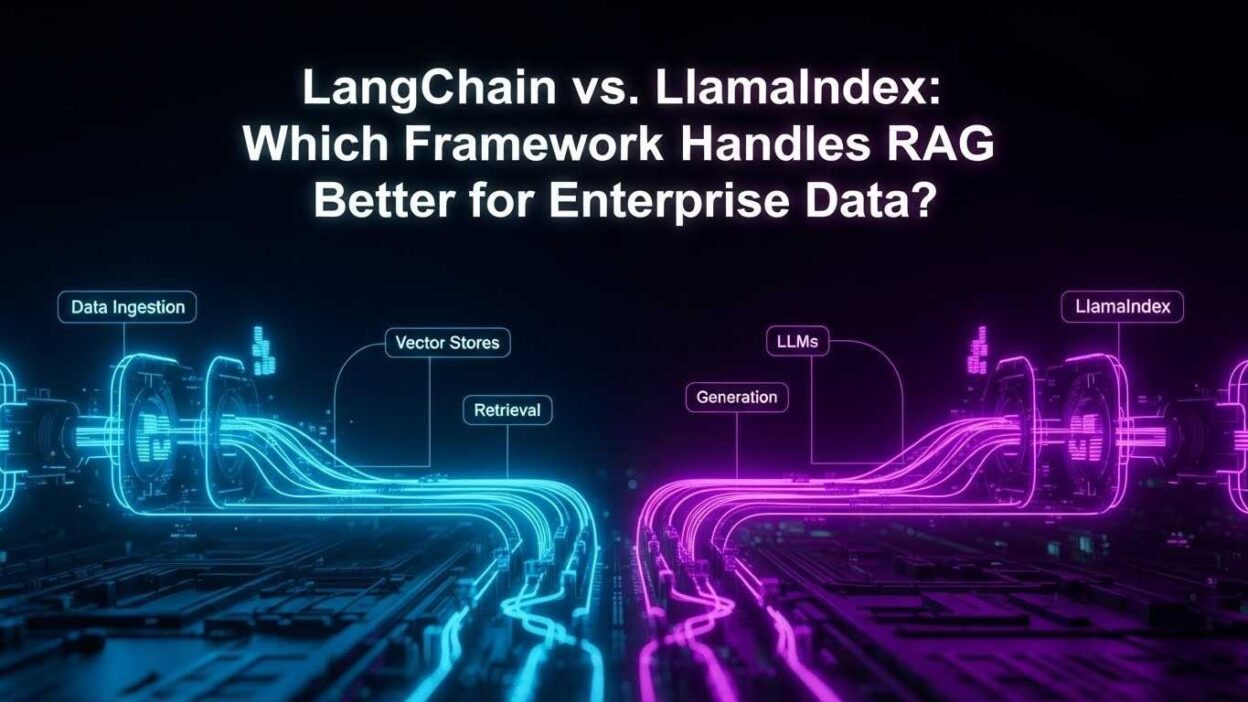
LangChain treats RAG as one capability among many. The framework offers building blocks rather than opinionated solutions. Developers construct retrieval pipelines from scratch. You select document loaders for your data sources. Text splitters break content into manageable chunks. Embedding models convert text into vector representations.
The retrieval process requires explicit configuration. You choose vector databases like Pinecone or Weaviate. Similarity search returns relevant document chunks. Retrieved content gets injected into prompts. The LLM generates responses using this context. LangChain provides flexibility but demands more setup work.
What Is LlamaIndex?
LlamaIndex focuses specifically on data indexing and retrieval. Jerry Liu designed it for RAG applications. The framework simplifies connecting LLMs to data sources. LlamaIndex handles the complexity of document processing. Your data becomes queryable through natural language. The tool emphasizes ease of use and quick deployment.
Previously known as GPT Index, LlamaIndex rebranded in 2023. The framework prioritizes intelligent data retrieval. Built-in optimizations improve query performance. LlamaIndex manages document parsing automatically. Context windows get utilized efficiently. The framework provides sensible defaults for common use cases.
Core Features of LlamaIndex
LlamaIndex excels at data connector functionality. The framework ingests documents from 100+ sources. Automatic parsing handles PDFs, HTML, and spreadsheets. Smart chunking strategies preserve document structure. Multiple index types suit different retrieval needs. Query engines optimize context selection.
The framework includes advanced retrieval techniques. Hybrid search combines keyword and semantic methods. Metadata filtering narrows down results. Re-ranking improves answer relevance. LlamaIndex handles complex document relationships. Parent-child hierarchies maintain information context.
LlamaIndex’s Approach to RAG
LlamaIndex treats RAG as its primary mission. The framework streamlines the entire retrieval pipeline. Data connectors automatically fetch and process documents. Intelligent indexing organizes information efficiently. Query engines understand user intent. Retrieved context gets optimized for token limits.
The opinionated design reduces decision fatigue. Best practices come built into the framework. You can launch RAG applications in minutes. LlamaIndex handles embedding generation automatically. Vector storage integrations work out of the box. The framework manages prompt construction intelligently.
LangChain vs LlamaIndex: Key Differences
The frameworks diverge in philosophy and execution. LangChain offers a Swiss Army knife approach. Every component remains customizable and extensible. LlamaIndex provides a specialized tool for data retrieval. The focused design accelerates RAG development specifically.
Architecture choices reflect different priorities. LangChain emphasizes flexibility across use cases. Developers assemble components like LEGO blocks. LlamaIndex optimizes the end-to-end RAG workflow. Pre-configured pipelines handle common scenarios. Your choice depends on project requirements.
Flexibility and Customization
LangChain wins for maximum customization needs. The modular design supports endless configurations. Custom chains implement unique business logic. Developers control every aspect of execution. The framework adapts to unconventional requirements. Complex multi-step workflows come naturally.
LlamaIndex prioritizes convenience over control. The opinionated structure accelerates standard implementations. Customization options still exist but feel more constrained. Predefined patterns handle most enterprise scenarios. Teams ship RAG applications faster. Less configuration means fewer potential errors.
Ease of Use and Learning Curve
LlamaIndex provides a gentler onboarding experience. The framework’s focused scope reduces complexity. Documentation emphasizes RAG-specific workflows. Sample code gets beginners running quickly. Sensible defaults eliminate guesswork. New developers achieve results in hours.
LangChain demands more initial investment. The broad feature set requires study. Understanding chains, agents, and memory takes time. Documentation covers numerous use cases. The learning curve steepens for advanced features. Experienced developers appreciate the power available.
Data Ingestion and Indexing
LlamaIndex dominates data connector capabilities. Over 100 built-in loaders support diverse sources. Automatic parsing handles document formats intelligently. Smart chunking preserves semantic meaning. Multiple index structures optimize different queries. The framework manages data pipelines end-to-end.
LangChain requires manual integration work. Document loaders exist but need configuration. Text splitting demands strategic decisions. Developers build custom ingestion pipelines. More control comes with more responsibility. The flexibility supports unusual data sources.
Query Performance and Optimization
LlamaIndex implements sophisticated retrieval techniques. Hybrid search blends multiple ranking methods. Automatic query transformation improves results. Context compression maximizes relevant information. Re-ranking models refine initial retrievals. The framework continuously optimizes performance.
LangChain leaves optimization to developers. Basic similarity search works out of the box. Advanced techniques require custom implementation. Retrieval quality depends on configuration choices. Experienced teams can match LlamaIndex performance. The process demands more expertise.
Integration and Ecosystem
LangChain boasts extensive third-party integrations. The large community contributes countless plugins. Compatibility with tools and services grows constantly. Agent capabilities extend beyond pure RAG. Chains combine LLMs with APIs and databases. The ecosystem supports diverse AI applications.
LlamaIndex focuses deeply on the RAG domain. Integration quality matters more than quantity. Core partnerships ensure reliable connections. The framework works seamlessly with major vector databases. LLM provider support covers leading options. Specialized tools enhance retrieval workflows.
Performance Comparison: LangChain vs LlamaIndex
Real-world performance varies by implementation. Both frameworks can deliver excellent results. Configuration quality impacts outcomes significantly. Let’s examine practical performance factors.
Speed and Latency
LlamaIndex optimizations reduce query latency. Smart caching minimizes redundant operations. Efficient indexing speeds up retrieval. Query engines select minimal necessary context. Response times often beat manual implementations.
LangChain performance depends on architecture choices. Poorly designed chains introduce delays. Multiple LLM calls increase latency. Caching requires explicit implementation. Well-optimized LangChain systems perform excellently. The framework’s flexibility allows performance tuning.
Accuracy and Relevance
LlamaIndex retrieval algorithms prioritize relevance. Multiple ranking stages filter results. Context compression maintains quality while reducing tokens. Query transformation handles ambiguous questions. Accuracy typically exceeds basic similarity search.
LangChain accuracy reflects retrieval strategy choices. Default implementations provide baseline performance. Custom retrieval chains improve specific scenarios. Developers can implement state-of-the-art techniques. The framework’s flexibility enables maximum accuracy potential.
Scalability for Enterprise Workloads
Both frameworks scale to enterprise demands. LlamaIndex handles millions of documents efficiently. Distributed indexing supports massive datasets. Query performance remains consistent at scale. The framework manages resource utilization intelligently.
LangChain scales through architectural design. Distributed chains process requests in parallel. External vector databases handle storage needs. Caching strategies reduce computational costs. Proper implementation supports high-volume production use.
Use Cases: When to Choose LangChain
LangChain excels for complex AI applications. Multi-agent systems benefit from its flexibility. Applications requiring diverse tool integrations favor LangChain. Custom business logic demands the framework’s extensibility.
Choose LangChain when building autonomous agents. The framework supports decision-making workflows naturally. External API calls integrate seamlessly. Memory modules maintain long conversation contexts. Complex state management works well.
Select LangChain for experimental projects. The modular design supports rapid prototyping. Developers can test novel approaches easily. Research teams appreciate the flexibility. Custom implementations become straightforward.
Use Cases: When to Choose LlamaIndex
LlamaIndex shines for pure RAG applications. Enterprise knowledge bases fit perfectly. Customer support chatbots benefit from optimized retrieval. Document analysis tools leverage intelligent indexing.
Choose LlamaIndex when speed matters most. The framework accelerates RAG development significantly. Teams with limited AI expertise succeed quickly. Production deployment happens faster. Maintenance overhead stays minimal.
Select LlamaIndex for data-heavy applications. Complex document relationships require sophisticated indexing. Large-scale knowledge retrieval benefits from optimizations. The framework handles enterprise data volumes gracefully.
Combining LangChain and LlamaIndex
Smart teams leverage both frameworks together. LlamaIndex handles data retrieval excellently. LangChain manages broader application logic. The combination delivers optimal results.
Use LlamaIndex as a retrieval engine within LangChain. Query engines become tools for LangChain agents. Document processing stays optimized. Application flexibility remains intact. Both frameworks contribute their strengths.
Integration requires careful architecture planning. Data flows between systems smoothly. LlamaIndex indexes stay synchronized. LangChain chains orchestrate overall workflows. The hybrid approach suits complex enterprise needs.
Implementation Considerations for Enterprises
Enterprise deployments require careful planning. Both frameworks support production requirements. Your specific needs guide framework selection.
Security and Data Privacy
Enterprise data demands robust security measures. Both frameworks support private deployments. On-premises installations keep data internal. Access controls protect sensitive information. Audit trails track data usage.
LangChain allows custom security implementations. Developers control data handling completely. Integration with enterprise auth systems works smoothly. The flexibility supports strict compliance requirements.
LlamaIndex provides security best practices. Built-in features reduce vulnerability risks. The framework respects data residency requirements. Metadata filtering prevents unauthorized access. Security updates arrive regularly.
Cost and Resource Management
LangChain vs LlamaIndex costs differ by approach. LangChain flexibility can increase development time. Custom implementations require more engineering hours. Ongoing maintenance demands skilled developers. Resource optimization needs manual tuning.
LlamaIndex reduces total cost of ownership. Faster development lowers initial investment. Built-in optimizations minimize compute costs. Smaller teams manage deployments successfully. The framework’s efficiency reduces infrastructure spending.
Monitoring and Maintenance
Production systems need observability. LangChain provides callback mechanisms. Custom logging captures execution details. Developers build monitoring dashboards. The flexibility supports any observability tool.
LlamaIndex includes built-in observability features. Query analytics track performance metrics. Retrieval quality monitoring identifies issues. The framework integrates with standard tools. Maintenance remains straightforward.
LangChain vs LlamaIndex: Making Your Decision
Your enterprise requirements dictate the right choice. Consider your team’s technical expertise. Evaluate project complexity and timeline. Budget constraints influence framework selection.
Choose LangChain for maximum control. Complex applications with diverse integrations benefit most. Experienced AI teams leverage the flexibility. Long-term custom development justifies the investment.
Select LlamaIndex for focused RAG needs. Faster time-to-value matters for many projects. Smaller teams accomplish more with less. Production-ready features reduce risk. The specialized focus delivers reliable results.
Future Outlook: Evolution of RAG Frameworks
Both frameworks continue evolving rapidly. LangChain expands its capabilities constantly. New integrations appear regularly. The community drives innovation forward. Agent capabilities grow more sophisticated.
LlamaIndex deepens its RAG specialization. Advanced retrieval techniques get added frequently. Performance optimizations continue improving. The framework stays current with research. Enterprise features receive ongoing attention.
The RAG landscape matures quickly. Hybrid approaches become more common. Best practices emerge from real deployments. Your chosen framework will improve over time. Both options invest heavily in development.
Real-World Success Stories
Many enterprises deploy these frameworks successfully. Financial services firms use LangChain for complex workflows. Insurance companies leverage LlamaIndex for claims processing. Technology startups build products on both platforms.
Customer support teams report significant improvements. Response accuracy increases with proper RAG implementation. Employee productivity gains measure in double digits. Knowledge workers spend less time searching. Customers receive better assistance faster.
Development teams appreciate framework maturity. Production deployments run reliably. Documentation quality enables self-service development. Community support helps overcome challenges. Both frameworks prove their enterprise readiness.
Best Practices for RAG Implementation
Success requires more than framework selection. Data quality impacts results dramatically. Clean, well-structured documents improve retrieval. Consistent formatting helps parsing accuracy. Metadata enrichment enhances filtering capabilities.
Chunk size selection affects answer quality. Small chunks lose context. Large chunks waste tokens. Experimentation identifies optimal settings. Different document types need different strategies.
Prompt engineering remains crucial. Clear instructions improve LLM responses. System prompts set proper context. Few-shot examples guide behavior. Testing reveals effective patterns.
Regular evaluation catches quality degradation. Retrieval relevance metrics track performance. Answer accuracy requires human review. User feedback identifies improvement opportunities. Continuous monitoring maintains system health.
Technical Architecture Recommendations
Both frameworks benefit from solid architecture. Vector databases should match workload characteristics. Pinecone suits cloud deployments. Weaviate offers self-hosting flexibility. Qdrant provides excellent performance. Choose based on infrastructure preferences.
Embedding model selection impacts quality. OpenAI embeddings offer excellent baseline performance. Open-source alternatives reduce costs. Domain-specific models improve specialized applications. Testing validates model effectiveness.
Caching strategies reduce latency and costs. Frequently requested information deserves caching. Semantic caching handles similar queries. Time-to-live settings balance freshness and efficiency. Distributed caches scale horizontally.
Frequently Asked Questions
What is the main difference between LangChain and LlamaIndex?
LangChain provides a general-purpose framework for building diverse LLM applications. LlamaIndex specializes specifically in data indexing and retrieval for RAG. LangChain offers broader capabilities but requires more configuration. LlamaIndex delivers faster RAG development with optimized defaults. Your project scope determines which fits better.
Can I use both frameworks together in one project?
Yes, combining LangChain and LlamaIndex works well. Use LlamaIndex as your retrieval engine. Let LangChain orchestrate broader application logic. This hybrid approach leverages each framework’s strengths. Many enterprises adopt this pattern successfully. The integration requires thoughtful architecture.
Which framework is better for beginners?
LlamaIndex provides an easier starting point. The focused scope reduces complexity. Built-in optimizations deliver good results quickly. Documentation emphasizes practical RAG implementation. Beginners achieve working systems faster. LangChain demands more learning investment upfront.
How do costs compare between the two frameworks?
Both frameworks are open-source and free. Costs come from cloud services and compute resources. LangChain flexibility can increase development time. Custom implementations need skilled developers. LlamaIndex reduces total ownership costs. Built-in optimizations minimize infrastructure spending. Development speed affects overall budget.
Which framework scales better for enterprise use?
Both scale effectively with proper architecture. LlamaIndex handles large document collections efficiently. LangChain supports high-volume request processing. Scalability depends more on implementation quality. Vector database choice impacts performance significantly. Either framework serves enterprise needs well.
Do these frameworks support multi-language documents?
Yes, both handle multiple languages. Embedding models determine language support. Multilingual models work with diverse content. Document parsing handles various character sets. Query translation enables cross-language retrieval. Enterprise deployments commonly serve multiple languages.
What vector databases work with these frameworks?
Both support major vector database options. Pinecone, Weaviate, and Qdrant work excellently. Milvus and Chroma provide open-source alternatives. FAISS offers local development simplicity. Cloud provider solutions integrate smoothly. Choose based on deployment requirements.
How often should I update my indexes?
Update frequency depends on data change rate. Real-time systems need continuous updates. Daily batch updates suit stable content. Incremental indexing handles frequent changes. Monitor staleness metrics for guidance. Balance freshness against computational costs.
Read More:-The Rise of Multi-Agent Systems: How One AI Manages Another
Conclusion
The LangChain vs LlamaIndex decision shapes your RAG implementation success. LangChain delivers unmatched flexibility for complex AI applications. Its modular design supports diverse use cases beyond retrieval. Experienced teams build sophisticated systems with granular control. The framework adapts to unique enterprise requirements beautifully.
LlamaIndex accelerates RAG development through focused optimization. Built-in best practices reduce time-to-value significantly. Smaller teams achieve production readiness faster. The specialized design handles enterprise data volumes excellently. Maintenance overhead stays manageable over time.
Your choice depends on specific project needs. Complex multi-agent systems favor LangChain’s flexibility. Pure document retrieval applications benefit from LlamaIndex’s optimization. Many enterprises succeed with either framework. Some combine both for optimal results.
Start with clear requirements before deciding. Evaluate your team’s expertise honestly. Consider development timeline constraints. Budget for ongoing maintenance costs. Both frameworks prove their enterprise worthiness.
The RAG landscape evolves rapidly. Your selected framework will improve continuously. Focus on solving business problems effectively. Either choice provides a solid foundation. Success comes from implementation quality more than framework selection.
Take time to prototype both options. Real experience reveals practical differences. Your specific data characteristics matter enormously. Testing validates theoretical advantages. Make decisions based on actual results.
Enterprise AI applications deserve thoughtful framework selection. LangChain vs LlamaIndex represents an important choice. Understanding their differences enables informed decisions. Your business gains competitive advantage through effective RAG implementation. Choose wisely and build confidently.