Introduction
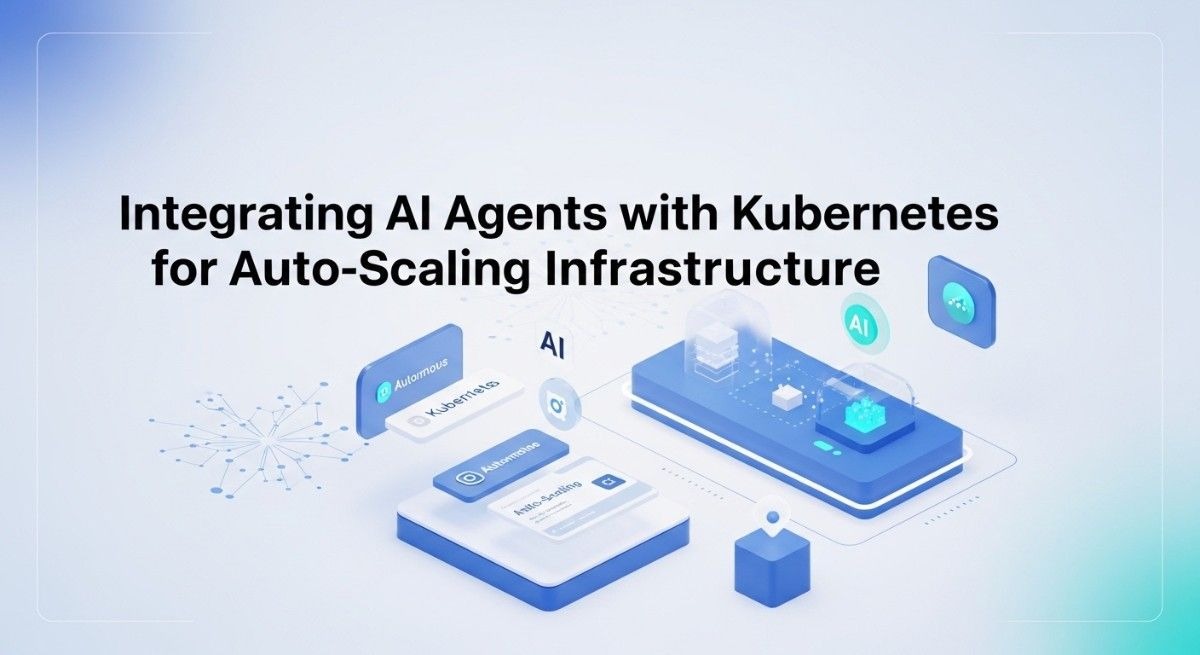
TL;DR Infrastructure teams fight the same battle every week. Traffic spikes hit without warning. Resources sit idle during quiet periods. Human operators cannot respond fast enough to dynamic workload changes. Kubernetes solves the orchestration problem but it needs intelligence to act proactively rather than reactively. That intelligence comes from AI agents. Integrating AI agents with Kubernetes for auto-scaling infrastructure transforms static rule-based scaling into a self-optimizing system that learns, predicts, and responds with precision. This guide explains how that integration works, why it outperforms traditional autoscaling, and how your team can build it from the ground up.
Table of Contents
Why Traditional Kubernetes Autoscaling Falls Short
Kubernetes ships with three built-in autoscalers. The Horizontal Pod Autoscaler scales the number of pod replicas based on CPU and memory thresholds. The Vertical Pod Autoscaler adjusts resource requests for individual pods. The Cluster Autoscaler adds or removes nodes based on pending pod demand. These tools work well for predictable, steady workloads. Real production workloads are rarely predictable. A flash sale doubles traffic in thirty seconds. A batch job finishes early and frees half the cluster. A microservice develops a memory leak that grows slowly over hours. Traditional autoscalers react to these events after metrics cross thresholds. By the time the scaler responds, users already experience latency or errors. The case for integrating AI agents with Kubernetes for auto-scaling infrastructure starts exactly here.
The Latency Problem With Reactive Scaling
Reactive scaling has a fundamental latency problem. The HPA scrapes metrics every fifteen seconds by default. It applies a cooldown period after each scaling decision. New pods take sixty to ninety seconds to start, pass health checks, and join the load balancer. Total response time from problem detection to traffic absorption runs two to four minutes in typical configurations. Four minutes of degraded performance costs real revenue for any e-commerce, SaaS, or financial platform. AI agents eliminate most of this latency. They predict demand increases before metrics spike. They trigger scaling actions minutes ahead of the actual load arrival. Integrating AI agents with Kubernetes for auto-scaling infrastructure is fundamentally a shift from reactive to predictive infrastructure management.
Cost Waste in Over-Provisioned Clusters
Over-provisioning is the defensive response to reactive scaling. Engineers set high resource requests and aggressive minimum replica counts to absorb unexpected demand. This keeps systems stable but wastes money. The average Kubernetes cluster runs at 40 to 60 percent utilization according to CNCF survey data. The rest sits idle. Cloud infrastructure bills for idle capacity the same as active capacity. AI-driven scaling eliminates defensive over-provisioning. The agent runs at the right capacity for actual demand. It scales up early enough to absorb real spikes and scales down aggressively during quiet periods. Teams report 30 to 50 percent cost reductions after deploying intelligent autoscaling. This financial impact makes integrating AI agents with Kubernetes for auto-scaling infrastructure a CFO-level conversation, not just an engineering one.
What AI Agents Bring to Kubernetes Infrastructure
An AI agent in the infrastructure context is an autonomous software system that observes cluster state, reasons about optimal actions, and executes changes without human intervention. It differs from a traditional controller in one critical way. A controller follows fixed rules. An agent learns from historical patterns and adapts its behavior continuously. The agent architecture for Kubernetes typically includes four components working together. An observation layer collects metrics from Prometheus, Kubernetes API, and cloud provider billing APIs. A prediction model forecasts future resource demand using time-series analysis or machine learning. A decision engine determines the optimal scaling action given the forecast and current cluster state. An execution layer implements the decision through Kubernetes API calls or infrastructure-as-code changes.
Machine Learning Models Powering Scaling Decisions
Several ML model types excel at infrastructure demand prediction. LSTM neural networks capture long-range temporal dependencies in time-series data. They learn that traffic spikes every Monday morning at 9am and pre-scale before it arrives. Prophet from Meta handles seasonality, holidays, and trend changes elegantly with minimal configuration. It suits teams without deep ML expertise. Gradient boosting models like XGBoost or LightGBM perform well on tabular infrastructure data when you include rich features like day of week, deployment events, and business metrics alongside raw resource utilization numbers. Reinforcement learning takes the most ambitious approach. The agent learns optimal scaling policies by receiving reward signals for cost savings and performance maintained. Google uses RL-based agents to optimize data center cooling and resource allocation at massive scale. Each model type suits different maturity levels when integrating AI agents with Kubernetes for auto-scaling infrastructure across different organization sizes.
Event-Driven vs. Prediction-Driven Agents
Two architectural patterns dominate AI-driven Kubernetes scaling. Event-driven agents respond to specific business events rather than infrastructure metrics alone. A payment processing service knows that a marketing email blast will trigger a transaction surge thirty minutes after send. The agent subscribes to the email platform webhook and pre-scales the payment service before transactions arrive. Prediction-driven agents rely purely on learned patterns from historical data. They continuously forecast demand for the next fifteen, thirty, and sixty minutes and adjust resource allocation accordingly. Most production systems combine both approaches. The prediction model provides a baseline forecast. Event subscriptions override that forecast when specific triggers occur. This hybrid architecture is the most robust pattern for integrating AI agents with Kubernetes for auto-scaling infrastructure in complex multi-service environments.
Architecture Overview: AI Agents and Kubernetes Working Together
Understanding the full system architecture before writing any code saves weeks of rework. The integration spans multiple layers of your stack. Each layer has specific responsibilities. Getting the boundaries right determines whether your system operates cleanly or becomes a tangled mess of competing controllers.
The Metrics Collection Layer
The metrics collection layer is the sensory system of your AI agent. Prometheus scrapes pod-level CPU, memory, network I/O, and custom application metrics every fifteen seconds. The Kubernetes Metrics Server provides cluster-level resource utilization. Node Exporter collects host-level metrics including disk pressure and network saturation. Cloud provider APIs supply node cost data so the agent can factor billing into scaling decisions. Business metrics matter as much as infrastructure metrics for accurate demand prediction. Request queue depth, active session count, shopping cart activity, and API call rate all correlate with future resource demand. Expose these through custom Prometheus metrics from your application code. The richer your feature set, the more accurate your prediction model becomes. This metrics richness is what separates a naive autoscaler from a genuinely intelligent one when integrating AI agents with Kubernetes for auto-scaling infrastructure properly.
The AI Decision Layer Architecture
The AI decision layer sits between your metrics store and the Kubernetes API. It runs as a Deployment inside the cluster for low-latency API access. The layer continuously ingests fresh metrics from Prometheus via its HTTP API. It runs inference on the prediction model every one to five minutes depending on the volatility of your workload. The decision engine compares the forecast against current allocation and calculates the required adjustment. It applies safety constraints before executing any action. Safety constraints define maximum scale-up rates, minimum replica counts per service, and maximum cluster size to prevent cost explosions. The layer also maintains a decision log that records every scaling action with its justification. This log serves two purposes. It provides an audit trail for postmortem analysis. It supplies training data for continuous model improvement. A well-designed decision layer is the intellectual core of integrating AI agents with Kubernetes for auto-scaling infrastructure at production scale.
Kubernetes Custom Resources and Operators
Kubernetes Operators extend the API with custom resource types and controllers. Your AI scaling system should expose its configuration through a custom resource definition. Define a ScalingPolicy CRD that captures service-level scaling parameters: minimum and maximum replicas, target latency SLO, cost budget per hour, and preferred scaling model type. The AI agent operator watches ScalingPolicy resources and reconciles cluster state to match the desired configuration. KEDA, the Kubernetes Event-Driven Autoscaler, provides a powerful foundation for this pattern. It supports scaling based on external event sources including Kafka lag, SQS queue depth, Prometheus queries, and dozens of others. Extend KEDA with a custom scaler that queries your AI prediction service for target replica counts. This approach integrates cleanly with existing GitOps workflows. Teams define their ScalingPolicy in version control. The operator handles the rest.
Step-by-Step Implementation Guide
This section walks through building a minimal but production-ready AI scaling agent. The implementation uses Python for the ML components, Prometheus for metrics, and the official Kubernetes Python client for API interactions. Complete this implementation in phases. Each phase delivers standalone value before the next begins.
Instrument Your Services With Predictive Metrics
Start by instrumenting your highest-traffic services with business-level metrics. Install the prometheus-client library in each service. Create a Counter for total request count and a Histogram for request duration. Add a Gauge for current queue depth if your service uses async processing. Expose a /metrics endpoint on port 8080 in each pod. Configure a ServiceMonitor custom resource to tell Prometheus to scrape it. Run your instrumented services for at least two weeks before training any models. You need enough data to capture daily and weekly seasonality patterns. During this period, also capture deployment events, infrastructure incidents, and business events as annotations in Prometheus. These annotations become training features that help the model understand why demand patterns changed on specific dates. Good instrumentation is the non-negotiable foundation for integrating AI agents with Kubernetes for auto-scaling infrastructure that actually works in production.
Build and Train the Prediction Model
Export two to four weeks of Prometheus data using the HTTP API range query endpoint. Transform the raw time-series into a supervised learning dataset. Each row represents a five-minute window. Features include the current timestamp encoded as hour-of-day, day-of-week, and day-of-month. Add rolling averages over the past one hour, six hours, and twenty-four hours. Add deployment event flags as binary features. The target variable is the maximum CPU utilization or request rate observed in the following fifteen minutes. Train a Prophet model as your baseline. Prophet requires minimal configuration and handles missing data gracefully. Evaluate it using the last three days of data as a hold-out set. Calculate mean absolute percentage error on your test set. Aim for below fifteen percent MAPE for reliable scaling decisions. If your workload shows complex patterns that Prophet misses, try LightGBM with hyperparameter tuning. Package the trained model using MLflow for reproducible deployment. Model management is critical when integrating AI agents with Kubernetes for auto-scaling infrastructure across multiple services.
Phase 3 — Deploy the Agent as a Kubernetes Operator
Build the agent as a Python service using the kopf framework for operator development. Kopf handles the Kubernetes watch loop and event routing so you focus on business logic rather than API plumbing. Create a ScalingAgent class with three methods. The observe method fetches current metrics from Prometheus using the prometheus-api-client library. The predict method loads your MLflow model and runs inference on the latest feature vector. The act method calls the Kubernetes Apps API to patch the Deployment spec with the new replica count. Deploy the agent as a Deployment with a single replica and leader election enabled for high availability. Grant it a ClusterRole with permissions to get and patch Deployments, read Pods, and read Services. Mount your MLflow model artifacts from a ConfigMap or persistent volume. Set resource requests conservatively. The agent runs continuously so stable performance matters. This deployment pattern completes the core loop for integrating AI agents with Kubernetes for auto-scaling infrastructure in your cluster.
Phase 4 — Add Safety Guardrails and Observability
Production systems need guardrails that prevent runaway scaling in both directions. Implement four safety mechanisms in your agent. First, apply a maximum scale-up rate of 50 percent per decision cycle. This prevents a bad prediction from quadrupling replicas in one step. Second, enforce minimum replica counts per service regardless of the model prediction. Zero replicas for a production service is never acceptable. Third, implement a circuit breaker that disables AI scaling and falls back to HPA when the agent encounters consecutive prediction errors. Fourth, require human approval for any scale-up action that exceeds ten times the current replica count. Instrument the agent itself with Prometheus metrics. Track prediction accuracy over time, decisions made per hour, and safety constraint activations. Create a Grafana dashboard showing these metrics alongside the services it manages. Good observability lets your team build confidence in the agent before removing manual oversight. Visibility is what earns trust in any system for integrating AI agents with Kubernetes for auto-scaling infrastructure in production environments.
Advanced Patterns for Production Scale
A single prediction model managing a single service is a proof of concept. Production environments run hundreds of services with different scaling behaviors. Scaling to this complexity requires architectural patterns beyond the basics.
Multi-Service Coordination and Resource Contention
Multiple AI agents competing for the same node capacity create resource contention. Service A scales up aggressively during a traffic spike. Service B simultaneously receives a prediction to scale up for an anticipated batch job. Both requests exceed available node capacity. The Cluster Autoscaler must provision new nodes, introducing the same latency problem you tried to eliminate. Solve this with a coordination layer above individual service agents. The coordination layer receives scaling proposals from all service agents and prioritizes them based on business criticality, SLO status, and cost budget. It allocates available capacity to the highest-priority requests first. Lower-priority services wait for new nodes to join the cluster. Implement the coordinator as a separate operator that watches a ScalingProposal custom resource. Each service agent writes its proposal to this resource. The coordinator updates the approved replica count field. Service agents only execute approved proposals. This coordination pattern is essential for reliably integrating AI agents with Kubernetes for auto-scaling infrastructure across large microservice architectures.
Continuous Learning and Model Retraining
A model trained on two weeks of data becomes stale as usage patterns evolve. Product launches change baseline traffic. Seasonal trends shift year over year. The agent must continuously update its models to stay accurate. Implement an automated retraining pipeline using Argo Workflows or Tekton. The pipeline runs weekly. It exports the latest thirty days of metrics from Prometheus. It retrains the model using the expanded dataset. It evaluates the new model against the previous seven days of data as a test set. If the new model improves MAPE by more than five percent, it promotes the new model to production. If accuracy degrades, it keeps the existing model and creates an alert for manual review. Version all models in MLflow with their training data window and evaluation metrics. Rollback capability is critical. A newly deployed model that makes bad predictions needs immediate reversal without downtime. Continuous learning keeps your system accurate long-term when integrating AI agents with Kubernetes for auto-scaling infrastructure in evolving production environments.
Cost Optimization With Spot and Preemptible Instances
AI agents unlock a cost optimization strategy that static autoscalers cannot implement. Spot and preemptible instances cost 60 to 90 percent less than on-demand nodes. They can be terminated with two minutes of notice. Static autoscalers avoid spot instances for stateful or latency-sensitive workloads because they cannot react fast enough to termination notices. AI agents change this calculus. The agent monitors spot interruption signals from the cloud provider metadata service. It receives a termination notice for a spot node. It immediately identifies which pods run on that node. It scales up equivalent capacity on on-demand nodes before moving traffic. It drains and cordons the terminating node gracefully. The entire process completes in under ninety seconds for well-designed services. Running sixty percent of your cluster on spot with intelligent failover can cut your Kubernetes compute bill in half. Cost intelligence is one of the highest-value capabilities unlocked by integrating AI agents with Kubernetes for auto-scaling infrastructure beyond simple HPA replacement.
Tools and Frameworks Worth Knowing
Several open-source projects accelerate AI-driven Kubernetes scaling without building everything from scratch. Know these tools before committing to a custom implementation.
KEDA, Karpenter, and Intelligent Scaling Tools
KEDA extends HPA with event-driven scaling based on external sources. It integrates natively with Prometheus, RabbitMQ, Azure Service Bus, AWS SQS, and over fifty other event sources. Build custom scalers in Go or HTTP to connect KEDA to your AI prediction service. Karpenter is a next-generation cluster autoscaler from AWS that provisions the right node types based on pod requirements rather than scaling fixed node groups. It integrates with spot markets and consolidates underutilized nodes aggressively. Pair Karpenter with KEDA for both pod-level and node-level intelligent scaling. Cortex and Seldon Core provide model serving infrastructure specifically designed for Kubernetes. They handle model versioning, canary deployments, and A/B testing of competing prediction models. Feast provides feature store capabilities for consistent feature computation between training and inference. OpenCost tracks per-namespace and per-workload spending in real time, giving your AI agent cost feedback for optimization decisions. Combining these tools dramatically reduces the engineering effort required for integrating AI agents with Kubernetes for auto-scaling infrastructure in a production-grade implementation.
Frequently Asked Questions
How long does it take to implement AI-driven Kubernetes autoscaling?
A minimal proof-of-concept with one service takes two to three weeks for an experienced platform engineer. A production-ready implementation covering ten or more services with retraining pipelines, observability, and coordination takes two to four months. Start with your highest-traffic, most cost-sensitive service. Validate the approach before scaling to the full cluster. Phased delivery reduces risk and builds organizational confidence in the system.
Do I need a data science team to implement this?
Not necessarily. Prophet and KEDA-based implementations require minimal data science expertise. A platform engineer with Python skills can implement and operate a Prophet-based prediction model. You need data science expertise if you want reinforcement learning, custom neural networks, or highly optimized feature engineering. Start with the simpler models. Add sophistication only when you have clear evidence that better models would deliver measurable improvements to your specific workloads.
What Kubernetes version do I need for AI agent integration?
Kubernetes 1.23 or newer covers all the features needed for a production AI scaling implementation. Custom Resource Definitions, the Metrics API, and leader election for operators all work reliably on 1.23 and above. KEDA requires version 2.6 or newer of its own operator, which supports Kubernetes 1.24 and above. Karpenter requires Kubernetes 1.25 or newer. Check your managed Kubernetes version in AWS EKS, GKE, or AKS before designing your architecture.
How do AI agents handle unpredictable traffic spikes?
AI agents handle two types of unpredictable spikes differently. Spikes that follow a learnable pattern, such as viral social media posts that historically drive traffic to your platform, get captured in the model over time as the agent sees more examples. Truly novel spikes, such as your first appearance on national television, require the event-driven approach. Subscribe to business event sources and trigger pre-scaling when specific conditions occur. Combine both approaches for the most robust protection against traffic surprises.
Can AI agents work alongside existing HPA configurations?
Yes. The safest migration path runs your AI agent in shadow mode first. The agent makes scaling decisions and logs them but does not execute them. Compare agent decisions against HPA behavior over two to four weeks. Measure which approach better predicts actual demand. After validating accuracy, switch one low-risk service to agent-controlled scaling. Keep HPA as a safety fallback by setting it to very conservative thresholds that the AI agent normally stays within. Gradually transfer control service by service as confidence grows.
What happens when the AI agent makes a wrong prediction?
Wrong predictions fall into two categories. Under-predictions leave insufficient capacity and cause latency or error rate increases. Your SLO alerting catches this quickly. The circuit breaker in the agent detects consecutive prediction misses and reverts to HPA control automatically. Over-predictions waste money by scaling too aggressively. This does not cause user-facing problems but does inflate your cloud bill. Monitor prediction MAPE weekly. If accuracy degrades significantly, trigger a model retraining run before problems compound.
Read More:-How to Use DSPy to Optimize LLM Prompts Programmatically
Conclusion

Kubernetes changed how teams deploy software. AI agents change how infrastructure manages itself. The combination of both creates a platform that grows smarter with every workload it manages. Integrating AI agents with Kubernetes for auto-scaling infrastructure is not a single project with a completion date. It is a continuous capability that improves as your models learn from more data and your team learns from more deployments.
Start with instrumentation. Collect rich metrics from your most important services. Train a simple prediction model. Deploy it as a Kubernetes operator with strong safety guardrails. Measure prediction accuracy and cost impact relentlessly. Expand to more services as confidence grows. Add continuous retraining pipelines. Integrate spot instance management for cost optimization. Each phase compounds the value of the previous one.
Teams that invest in integrating AI agents with Kubernetes for auto-scaling infrastructure today build a meaningful technical advantage. Competitors running static autoscaling pay more for worse performance. Your platform runs leaner, scales faster, and responds intelligently to demands that would overwhelm rule-based systems. The infrastructure becomes a competitive asset, not just a cost center. Start building it now. The tools exist. The patterns are proven. The only missing piece is execution.