Introduction
TL;DR Business leaders face mounting pressure to reduce operational expenses. Labor costs continue rising year over year. Manual processes consume countless employee hours. Mistakes from human error create expensive rework. Companies need solutions that deliver measurable cost savings.
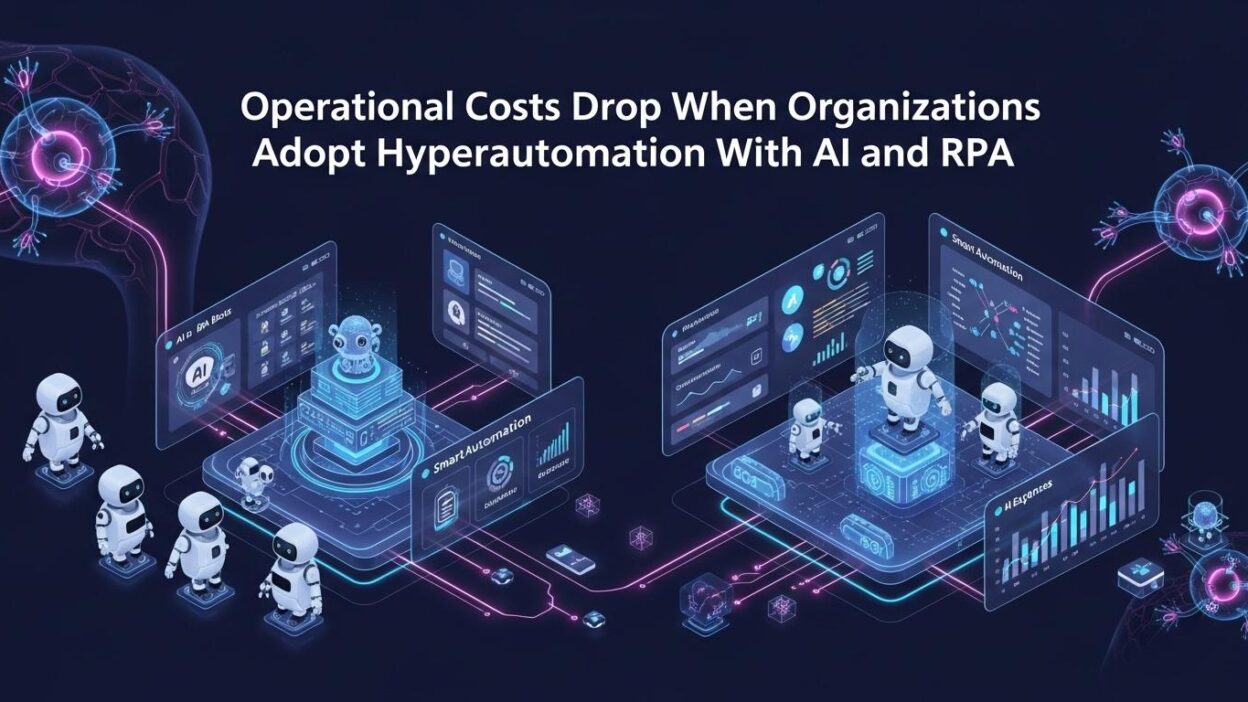
Hyperautomation with AI and RPA offers a powerful answer to these challenges. This technology combination automates complex business processes from end to end. Organizations report operational cost reductions of 40-60% within the first year. The savings come from multiple sources across various departments.
Traditional automation tools handled only simple, repetitive tasks. They required constant human oversight and intervention. Modern solutions combine robotic process automation with artificial intelligence. This pairing tackles complicated workflows that previously demanded skilled human workers.
Finance departments process invoices 10x faster with automated systems. Customer service teams handle triple the inquiry volume. HR departments onboard new employees in days instead of weeks. These efficiency gains translate directly to bottom-line savings.
The technology works around the clock without breaks or vacation time. It processes transactions with near-perfect accuracy. Your existing employees shift from mundane tasks to strategic initiatives. Productivity increases while headcount remains stable or even decreases through natural attrition.
Small errors in manual processes cost companies millions annually. A misplaced decimal point in financial records creates audit nightmares. Incorrect data entry delays customer orders. Hyperautomation with AI and RPA eliminates these costly mistakes through consistent, accurate execution.
Table of Contents
Understanding Hyperautomation With AI and RPA
Robotic process automation mimics human actions on computer systems. The software bots click buttons, enter data, and move information between applications. RPA excels at rules-based tasks following predictable patterns. It handles high-volume, repetitive work faster than any human worker.
Artificial intelligence adds cognitive capabilities to basic automation. Machine learning algorithms recognize patterns in unstructured data. Natural language processing understands customer emails and documents. Computer vision reads information from images and scanned files. These AI capabilities handle tasks requiring judgment and interpretation.
Hyperautomation with AI and RPA combines both technologies into integrated solutions. The RPA layer handles structured, repetitive actions. The AI layer makes decisions about exceptions and variations. Your processes flow smoothly from beginning to end without human intervention.
Process mining tools identify automation opportunities across your organization. They analyze how work currently flows through your systems. The software reveals bottlenecks, delays, and inefficiencies. You gain visibility into exactly where automation delivers the highest return.
Integration platforms connect your various business systems seamlessly. Legacy applications communicate with modern cloud software. Data flows automatically between finance, operations, and customer service tools. Your technology ecosystem works as a unified whole rather than isolated silos.
Low-code development platforms accelerate automation deployment. Business users create workflows without extensive programming knowledge. IT departments focus on complex integrations rather than simple automation tasks. Implementation timelines shrink from months to weeks.
Intelligent document processing extracts information from invoices, contracts, and forms. The technology understands document context and layout variations. It categorizes information and routes it to appropriate systems. Manual data entry becomes obsolete across your organization.
How Hyperautomation Reduces Labor Costs
Back-office operations require significant staffing under traditional models. Accounts payable teams manually process thousands of invoices monthly. Data entry clerks transfer information between systems for hours daily. Hyperautomation with AI and RPA performs these tasks at a fraction of the cost.
A single software bot handles the workload of three to five employees. The bot works 24 hours daily without overtime pay. It never calls in sick or takes vacation time. Your labor costs decrease immediately upon deployment.
Organizations redirect employees from repetitive tasks to value-added activities. Customer service representatives focus on complex issues requiring empathy. Accountants analyze financial trends instead of entering transactions. Your existing workforce becomes more productive and engaged.
Seasonal staffing needs disappear with scalable automation. Retail companies no longer hire temporary workers for holiday rushes. Tax preparation firms eliminate seasonal employee recruiting. Your software scales up and down based on demand without hiring or layoff costs.
Training expenses drop significantly with standardized automated processes. New employees learn streamlined workflows rather than complicated manual procedures. Onboarding time decreases from weeks to days. Your team reaches full productivity faster.
Turnover costs diminish when employees perform more interesting work. People leave jobs due to boring, repetitive tasks. Automation handles the mundane activities that drive employee dissatisfaction. Your retention rates improve along with morale.
Overtime expenses essentially disappear from automated departments. The technology processes work backlogs overnight and on weekends. Rush projects complete on schedule without expensive expedited labor. Your budget becomes more predictable and controllable.
Minimizing Error-Related Expenses
Manual data entry creates costly mistakes across every business function. A single transposed digit in a purchase order causes shipment delays. Incorrect customer addresses result in returned packages and reshipping fees. Hyperautomation with AI and RPA achieves 99.9% accuracy in data processing.
Financial errors trigger expensive audits and regulatory investigations. Incorrect tax filings lead to penalties and interest charges. Accounting discrepancies require hours of reconciliation work. Automated systems maintain perfect transaction records that satisfy auditors immediately.
Customer service mistakes damage relationships and revenue. Wrong product shipments create returns and refunds. Billing errors frustrate customers and prompt cancellations. Automation ensures consistent, accurate handling of every customer interaction.
Compliance violations result from human oversight and fatigue. Employees forget required approval steps in critical workflows. Documentation gaps create regulatory exposure. Automated processes follow compliance rules perfectly every single time.
Quality control issues multiply when humans perform repetitive inspections. Fatigue sets in after reviewing dozens of items. Attention wanders during monotonous tasks. Hyperautomation with AI and RPA maintains consistent quality standards throughout production runs.
Inventory management errors tie up working capital unnecessarily. Overstocking creates storage costs and obsolescence risk. Stockouts cause lost sales and disappointed customers. Automated inventory systems optimize stock levels based on real-time demand patterns.
Contract management mistakes leave money on the table. Missed renewal dates result in unfavorable automatic extensions. Forgotten discount clauses cost thousands per agreement. Intelligent automation tracks all contract terms and triggers timely actions.
Accelerating Process Cycle Times
Invoice processing takes days or weeks in manual environments. Documents sit in email inboxes awaiting review. Approval routing follows unclear, informal paths. Hyperautomation with AI and RPA completes invoice workflows in minutes instead of days.
Customer onboarding drags on through multiple departments and handoffs. New clients wait weeks before accessing services. Manual identity verification and documentation slow everything down. Automated onboarding welcomes customers in hours with superior experience.
Order-to-cash cycles compress dramatically with end-to-end automation. Orders enter your system and flow through fulfillment automatically. Inventory allocation, shipping, and invoicing happen without delays. Your cash conversion cycle improves by 30-40%.
Employee expense reimbursement transforms from a monthly ordeal to instant processing. Workers submit receipts through mobile apps. The system validates expenses against policy automatically. Approvals and payments happen within 24 hours.
IT support ticket resolution accelerates through intelligent triage and routing. Common issues receive automated fixes immediately. Complex problems reach the right specialist without manual assignment. Your help desk handles double the ticket volume.
Procurement cycles shrink from weeks to days. Purchase requests route through approval chains automatically. Supplier selection follows predefined criteria without manual research. Purchase orders generate and transmit to vendors instantly.
Report generation no longer consumes days of analyst time. Hyperautomation with AI and RPA compiles data from multiple sources automatically. Complex reports refresh hourly instead of monthly. Your leaders make decisions based on current information.
Infrastructure and Technology Cost Savings
Server and hardware requirements decrease with cloud-based automation platforms. You eliminate expensive on-premise infrastructure investments. Maintenance costs disappear along with data center expenses. Your IT budget shifts from capital expenditures to predictable operational costs.
Software licensing consolidates when integrated platforms replace point solutions. You need fewer specialized tools for different functions. Vendor management becomes simpler with fewer relationships. Annual true-up exercises no longer reveal surprise costs.
IT support demands diminish as automation reduces system complexity. Automated processes follow standardized patterns requiring less troubleshooting. Your help desk focuses on strategic projects rather than routine tickets. Support staff requirements decrease over time.
Development costs drop through low-code automation platforms. Business analysts build workflows without programmer involvement. Professional developers tackle only the most complex integrations. Your application backlog clears faster with existing resources.
System integration expenses decline with modern hyperautomation tools. Pre-built connectors link common business applications instantly. Hyperautomation with AI and RPA platforms include hundreds of integration templates. Custom API development becomes unnecessary for standard connections.
Disaster recovery and business continuity costs decrease significantly. Cloud-based automation platforms include redundancy by default. Your processes continue running even during local outages. Expensive backup systems and procedures become obsolete.
Security infrastructure expenses optimize through automated monitoring and response. The technology detects anomalies and threats in real-time. Automated remediation handles common security events without human intervention. Your security team focuses on advanced threats rather than routine issues.
Real-World Cost Reduction Examples
A multinational insurance company automated claims processing across 12 countries. Manual claims handling required 450 full-time employees. Hyperautomation with AI and RPA reduced staffing needs to 180 people. The company saved $18 million annually in labor costs.
A regional bank transformed its mortgage origination process completely. Application processing previously took 45 days on average. Automated workflows reduced cycle time to 12 days. The bank doubled loan volume without adding staff.
A healthcare provider automated patient record management and billing. Manual processes required 85 administrative employees. Automation handled the workload with 30 people. Annual savings exceeded $4.5 million.
A manufacturing company eliminated quality control errors on production lines. Defect rates dropped from 3.2% to 0.4%. Warranty claims decreased by 75%. The company saved $2.3 million annually in rework and replacements.
A retail chain automated inventory management across 200 stores. Overstock situations decreased by 60%. Stockouts fell by 80%. Working capital improvements totaled $12 million.
A telecommunications company transformed customer service operations. Call handling capacity increased by 150% per representative. Hyperautomation with AI and RPA resolved 40% of inquiries without human involvement. Customer satisfaction scores improved while costs dropped 35%.
A government agency automated benefits application processing. Application backlogs that took 90 days cleared in 15 days. Staff reallocated to fraud prevention and applicant support. Citizen satisfaction ratings increased dramatically.
Implementation Cost Considerations
Software licensing represents the primary direct expense. Enterprise platforms range from $50,000 to $500,000 annually. Costs vary based on bot count, transaction volume, and feature requirements. Most organizations achieve positive ROI within 8-12 months.
Professional services accelerate initial deployment and best practice adoption. Implementation partners charge $150-$300 per hour typically. A medium-complexity project requires 500-1,000 consulting hours. This investment prevents costly mistakes and delays.
Internal resource allocation impacts project success and timeline. You need business analysts to document current processes. IT staff handles system integrations and infrastructure. Project managers coordinate activities across departments. Hyperautomation with AI and RPA implementation requires dedicated team attention.
Training expenses ensure your team maximizes platform capabilities. Vendor-provided training costs $1,000-$3,000 per person. Custom training for your specific processes adds value. Well-trained teams achieve better results faster.
Change management activities smooth organizational adoption. Employees need help understanding how automation affects their roles. Communication campaigns address concerns and build enthusiasm. Investment in change management improves success rates significantly.
Infrastructure costs remain minimal with cloud-based platforms. You need reliable internet connectivity and modern workstations. Legacy system upgrades may be necessary for optimal integration. Most organizations use existing infrastructure without major investments.
Ongoing maintenance requires fewer resources than traditional software. Platform updates happen automatically with cloud solutions. Bot maintenance takes 2-3 hours weekly per production workflow. Your support requirements stay manageable as automation scales.
Measuring Cost Reduction Results
Labor cost savings appear immediately in payroll expenses. Track full-time equivalent reductions or reallocation to higher-value work. Calculate fully loaded employee costs including benefits and overhead. Hyperautomation with AI and RPA typically reduces department labor needs by 40-60%.
Error rate improvements translate to measurable financial impact. Document baseline error frequencies before automation. Track errors, rework hours, and associated costs post-implementation. Quality improvements often justify automation investments alone.
Cycle time reductions create capacity and revenue opportunities. Measure process duration from start to finish. Calculate throughput increases after automation deployment. Faster processes enable growth without proportional cost increases.
Customer satisfaction metrics reveal indirect financial benefits. Track Net Promoter Scores and customer retention rates. Measure support ticket volumes and resolution times. Happy customers cost less to serve and buy more products.
Compliance and audit costs decrease with better controls and documentation. Track audit finding counts before and after automation. Measure time spent preparing for regulatory examinations. Document penalty and fine reductions from improved compliance.
IT infrastructure expenses show clearly in budget comparisons. Compare data center costs before and after cloud migration. Track software licensing expenses year over year. Infrastructure savings often exceed 30% annually.
Employee satisfaction and retention impact recruiting and training costs. Measure turnover rates in automated departments. Track time-to-productivity for new hires. Hyperautomation with AI and RPA often reduces turnover by 20-30%.
Scaling Automation for Maximum Savings
Start with high-volume, rules-based processes for quick wins. Finance and accounting offer numerous automation opportunities. Customer service workflows provide immediate impact. Early successes build momentum for broader adoption.
Create a center of excellence to standardize automation practices. Centralize technical expertise and best practices. Develop reusable components and templates. Your automation program scales faster with coordinated governance.
Prioritize processes based on cost-benefit analysis. Calculate potential savings for each automation candidate. Consider implementation complexity and timeline. Focus resources on opportunities delivering the highest returns.
Build automation capabilities gradually within your organization. Train business analysts in process optimization and bot development. Develop internal expertise rather than depending on consultants. Your cost per automation decreases dramatically over time.
Establish clear success metrics for every automation project. Define baseline costs and performance before implementation. Set specific targets for improvement. Regular measurement keeps teams focused on value delivery.
Leverage automation platforms that support enterprise scalability. Cloud-based solutions grow with your needs automatically. Infrastructure constraints shouldn’t limit your expansion. Hyperautomation with AI and RPA platforms handle thousands of bots seamlessly.
Create feedback loops for continuous improvement. Monitor bot performance and identify optimization opportunities. Gather user input on pain points and enhancements. Your automation program evolves to deliver increasing value.
Overcoming Implementation Challenges
Process documentation gaps slow automation deployment. Many organizations lack clear understanding of current workflows. Invest time in detailed process mapping before automation. Accurate documentation ensures successful implementation.
Legacy system integration presents technical obstacles. Older applications may lack modern APIs. Screen scraping techniques work but require more maintenance. Plan additional time for legacy system connections.
Resistance from employees threatens adoption success. Workers fear job loss from automation initiatives. Communicate honestly about workforce changes and opportunities. Emphasize how automation eliminates frustrating repetitive work.
Data quality issues undermine automation effectiveness. Hyperautomation with AI and RPA requires clean, consistent information. Address data problems before automating problematic processes. Poor data quality produces poor automation results.
Security and compliance concerns require careful attention. Automated processes need appropriate access controls. Audit trails must meet regulatory requirements. Work closely with security teams throughout implementation.
Vendor selection confusion stems from crowded marketplace. Dozens of automation platforms compete for your business. Focus on vendors with proven success in your industry. Request references and conduct thorough evaluations.
Unrealistic expectations lead to disappointment with results. Automation delivers significant benefits but requires proper implementation. Set realistic timelines and success criteria. Celebrate wins while acknowledging areas for improvement.
Future Cost Reduction Opportunities
Generative AI will expand automation to creative and strategic tasks. The technology drafts correspondence, creates presentations, and summarizes documents. Tasks previously requiring human expertise become candidates for automation. Hyperautomation with AI and RPA will tackle increasingly sophisticated workflows.
Autonomous decision-making reduces management overhead. Systems will approve transactions within defined parameters automatically. Exception handling will improve through advanced machine learning. Supervisory roles will focus on strategy rather than operational oversight.
Predictive maintenance prevents costly equipment failures. Sensors feed data to AI systems monitoring asset health. Automation schedules repairs before breakdowns occur. Unplanned downtime costs will decrease substantially.
Supply chain optimization through real-time automation responds to market changes. Systems will adjust procurement and production automatically. Inventory levels will optimize across complex distribution networks. Working capital requirements will decrease significantly.
Customer experience personalization at scale becomes economically viable. Automation will tailor every interaction to individual preferences. Mass customization will happen at mass production costs. Revenue per customer will increase while service costs decrease.
Energy management automation reduces facility operating expenses. Smart systems will optimize heating, cooling, and lighting automatically. Energy consumption will drop 20-30% in automated buildings. Environmental benefits accompany financial savings.
Regulatory reporting automation eliminates manual compliance work. Systems will compile required information and submit reports automatically. Compliance staff will focus on strategic risk management. Regulatory burden will decrease despite increasing complexity.
Industry-Specific Applications
Healthcare organizations automate patient scheduling, billing, and records management. Claims processing happens faster with fewer errors. Prior authorization requests complete in hours instead of days. Hyperautomation with AI and RPA reduces administrative costs by 40% typically.
Financial services firms deploy automation for account opening, loan processing, and fraud detection. Regulatory reporting happens automatically with perfect accuracy. Customer onboarding completes in minutes rather than weeks. Operating expense ratios improve dramatically.
Manufacturing companies automate production scheduling, quality control, and supply chain coordination. Machines communicate maintenance needs before failures occur. Inventory optimizes automatically across global facilities. Production costs decrease while output increases.
Retail businesses use automation for inventory management, pricing optimization, and order fulfillment. E-commerce operations scale efficiently during peak seasons. Customer service bots handle routine inquiries 24/7. Labor costs remain stable despite revenue growth.
Telecommunications providers automate network monitoring, customer service, and billing operations. Service issues receive automated diagnosis and resolution. Provisioning new services happens instantly without technician dispatch. Operational efficiency improves continuously.
Government agencies transform citizen services through intelligent automation. Benefits applications process faster with greater accuracy. Public records requests complete in days instead of months. Hyperautomation with AI and RPA helps agencies do more with limited budgets.
Building Your Business Case
Calculate fully loaded labor costs for processes targeted for automation. Include salaries, benefits, facilities, and management overhead. Compare current costs to projected automation expenses. Most organizations find 60-70% cost reduction opportunities.
Quantify error costs by tracking rework, refunds, and penalties. Document time spent correcting mistakes in manual processes. Project error rate improvements from automation implementation. Quality benefits often equal or exceed labor savings.
Estimate productivity gains from faster cycle times. Calculate revenue impact from increased throughput capacity. Measure customer satisfaction improvements and retention effects. Growth enabled by automation multiplies financial returns.
Factor in infrastructure cost reductions from cloud migration. Include eliminated data center expenses and hardware refresh costs. Account for reduced IT support requirements. Technology savings enhance overall project returns.
Project the timeline for achieving positive return on investment. Most hyperautomation with AI and RPA projects break even within 12 months. Savings accumulate and grow in subsequent years. Three-year returns typically exceed 300-500%.
Consider competitive risks of not automating. Competitors implementing automation gain significant cost advantages. Market share and margins come under pressure. Investment in automation is defensive as well as offensive.
Present multiple scenarios showing conservative and aggressive assumptions. Demonstrate strong returns even under worst-case projections. Include sensitivity analysis for key variables. Thorough financial analysis builds executive confidence.
Frequently Asked Questions
What is hyperautomation with AI and RPA?
Hyperautomation with AI and RPA combines robotic process automation with artificial intelligence technologies. RPA handles repetitive, rules-based tasks automatically. AI adds cognitive capabilities for decision-making and unstructured data processing. The integration creates end-to-end automation of complex business processes.
How much money can organizations save with hyperautomation?
Organizations typically reduce operational costs by 40-60% in automated departments. Labor savings represent the largest component. Error reduction and cycle time improvements add substantial value. Most companies achieve positive ROI within 8-12 months of implementation.
Will automation eliminate jobs in my organization?
Automation typically transforms roles rather than eliminating them completely. Employees shift from repetitive tasks to higher-value activities. Natural attrition handles staffing reductions over time. Companies rarely lay off workers due to automation implementation.
How long does hyperautomation implementation take?
Simple automation projects deploy in 4-6 weeks. Complex enterprise implementations require 3-6 months. Results appear quickly with iterative deployment approaches. Hyperautomation with AI and RPA delivers value throughout the implementation process.
What processes should we automate first?
Start with high-volume, rules-based processes showing clear cost savings. Finance, customer service, and HR offer excellent initial opportunities. Choose processes causing current pain points or bottlenecks. Early wins build support for broader automation initiatives.
Do we need to replace our existing systems?
No, automation works with your current technology infrastructure. RPA connects systems without requiring replacements. Integration platforms enable communication between legacy and modern applications. Most organizations automate successfully with existing systems.
What skills do employees need for hyperautomation?
Business analysts need process mapping and workflow design skills. IT staff require integration and platform administration knowledge. Most platforms offer low-code tools requiring minimal programming expertise. Vendors provide training to build internal capabilities quickly.
Read More:-Why 100+ Companies Choose AI Call Centers Over Traditional Solutions
Conclusion

Operational costs strain budgets across every industry and company size. Manual processes consume excessive resources while producing inconsistent results. Organizations need proven solutions that deliver measurable financial improvements quickly.
Hyperautomation with AI and RPA provides the answer business leaders seek. The technology combination handles complex workflows from beginning to end. Companies implementing these solutions report 40-60% cost reductions within 12 months.
Labor expenses decrease dramatically when software bots perform repetitive tasks. Your employees focus on work requiring human judgment and creativity. Productivity increases while headcount requirements stabilize or decline through natural attrition.
Error-related costs disappear with automated processes executing tasks perfectly. Financial mistakes, compliance violations, and quality issues become rare events. Your organization operates more reliably while spending less on corrections and rework.
Technology infrastructure costs optimize through modern cloud-based platforms. Expensive data centers and hardware investments become unnecessary. Your IT budget becomes more predictable and controllable.
Implementation requires thoughtful planning and realistic expectations. Start with high-impact processes showing clear returns. Build internal capabilities through training and knowledge transfer. Scale your automation program systematically across the organization.
The competitive landscape demands operational excellence and cost efficiency. Companies refusing to embrace automation face mounting disadvantages. Market leaders invest in hyperautomation with AI and RPA to secure their positions.
Calculate the potential savings available in your organization. Identify processes consuming excessive time and resources. Build a compelling business case for executive approval. Your automation journey starts with a single automated workflow.
The technology continues advancing rapidly. Tomorrow’s capabilities exceed today’s imagination. Early adopters gain experience and expertise competitors lack. Your investment in automation compounds over time.
Hyperautomation with AI and RPA represents the future of business operations. Organizations embracing this technology thrive in competitive markets. Those clinging to manual processes struggle with rising costs and declining margins.
Take action now to secure your operational cost advantages. Evaluate automation platforms suited to your requirements. Start small with a pilot project demonstrating clear value. Scale successful approaches across your entire enterprise.
Your stakeholders expect operational excellence and financial discipline. Hyperautomation with AI and RPA delivers both outcomes simultaneously. The question isn’t whether to automate your operations. The question is how quickly you can implement automation to start capturing savings.Retry