Introduction
TL;DR Artificial intelligence has revolutionized how organizations operate across every industry. Machines now perform tasks that once required human expertise exclusively. Healthcare systems diagnose diseases through image analysis. Financial institutions detect fraud in milliseconds. Manufacturing plants optimize production schedules autonomously. This AI revolution brings tremendous benefits.
Yet relying entirely on AI for critical decisions creates significant risks. Algorithms make mistakes that humans would easily catch. AI systems lack common sense and contextual understanding. They cannot explain their reasoning in ways stakeholders trust. Fully automated systems fail catastrophically when encountering scenarios outside their training data.
A Human-in-the-Loop AI System solves these challenges elegantly. This approach combines machine efficiency with human judgment. AI handles high-volume processing while humans oversee critical decisions. The collaboration produces better outcomes than either could achieve alone. This comprehensive guide shows you exactly how to build effective human-in-the-loop systems for your most important AI applications.
Table of Contents
Understanding Human-in-the-Loop AI Systems
Defining the Core Concept
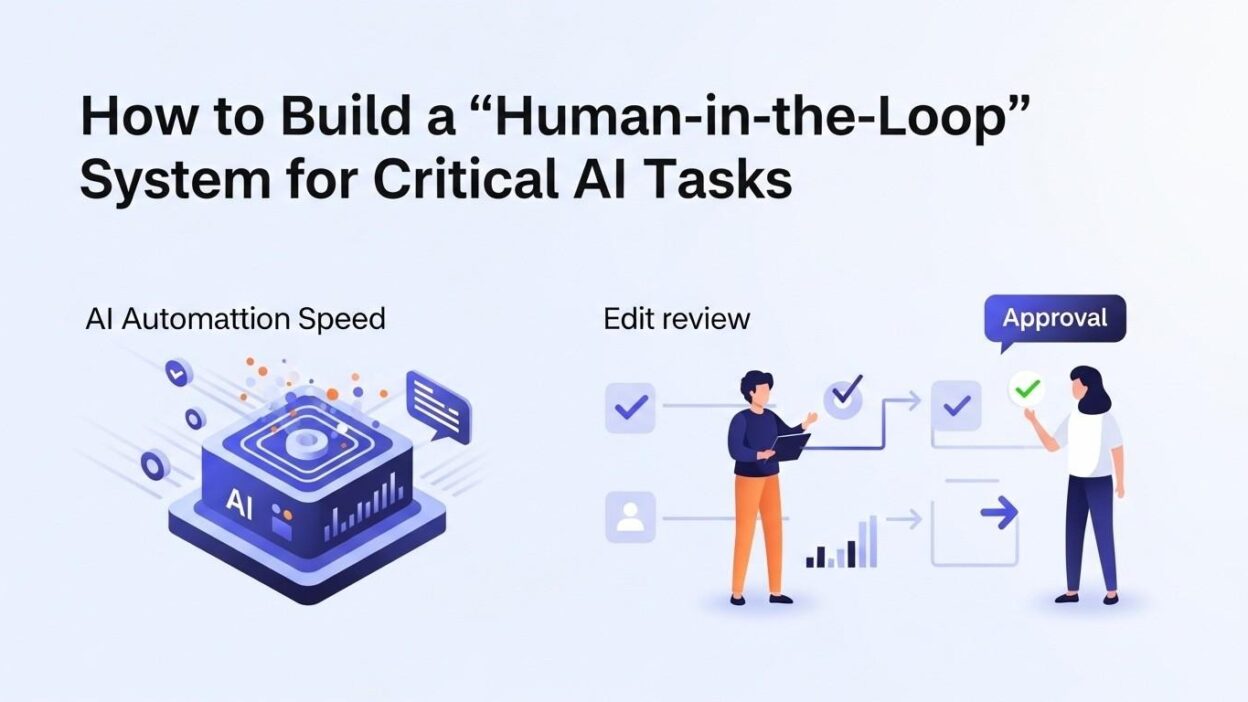
A Human-in-the-Loop AI System integrates human judgment into automated decision-making processes. The AI performs initial analysis and generates recommendations. Humans review these recommendations before final implementation. This collaboration happens at strategically chosen intervention points.
The human role varies based on application requirements. Some systems require approval for every AI decision. Others involve humans only when AI confidence scores fall below thresholds. Critical applications might demand multiple human reviewers for important decisions.
The loop aspect refers to continuous improvement through human feedback. Every human decision trains the AI system further. Corrections and approvals teach the algorithm which choices humans prefer. The AI becomes more accurate over time through this collaborative learning.
Why Critical Tasks Require Human Oversight
Critical AI tasks involve high-stakes decisions with serious consequences. Medical diagnosis errors endanger patient lives. Loan approval mistakes violate fair lending laws. Autonomous vehicle failures cause injuries or deaths. Content moderation errors spread harmful misinformation.
AI systems fail in predictable and unpredictable ways. Training data biases create systematic discrimination. Edge cases confuse algorithms trained on common scenarios. Adversarial attacks manipulate AI into making desired wrong decisions. No amount of testing eliminates all failure modes.
Legal and regulatory requirements mandate human involvement in many domains. Healthcare regulations require physician oversight of diagnostic AI. Financial regulators demand human accountability for credit decisions. Employment law restricts fully automated hiring choices. Your Human-in-the-Loop AI System ensures compliance.
Stakeholder trust depends on human accountability. Customers feel more comfortable when humans review important decisions. Employees trust systems they can question and appeal. Regulators accept outcomes from human-supervised processes more readily. Public acceptance of AI requires visible human control.
Types of Human-in-the-Loop Architectures
Active learning represents one common architecture pattern. The AI identifies examples it finds most confusing. Humans label these difficult cases to improve model training. This approach maximizes learning from limited human time.
Human-in-the-command architectures give people strategic oversight. Humans set objectives, constraints, and ethical guidelines. AI optimizes decisions within these human-defined parameters. People maintain control over values while delegating execution.
Human-in-the-verification designs have AI execute decisions provisionally. Humans audit a sample of decisions after implementation. Problematic patterns trigger increased oversight or system retraining. This balances efficiency with safety.
Hybrid architectures combine multiple patterns for different decision types. Routine low-risk decisions run fully automated. Medium-risk choices go to single human reviewers. High-stakes decisions require multiple expert approvals. Your Human-in-the-Loop AI System architecture matches your specific risk profile.
Identifying Where to Place Human Intervention
Risk Assessment and Decision Mapping
Start by mapping all decisions your AI system will make. Document the inputs, processing steps, and outputs for each decision type. Identify the business impact of correct and incorrect decisions. This comprehensive inventory guides intervention point selection.
Quantify the potential harm from AI errors. Financial losses, safety risks, regulatory penalties, and reputational damage all matter. Create a risk matrix that categorizes decisions by likelihood and severity of failure. High-risk decisions clearly require human oversight.
Consider the irreversibility of decisions. Some choices can be undone if mistakes emerge later. Others create permanent consequences. Irreversible high-impact decisions demand human review before implementation. Reversible low-impact choices can proceed automatically.
Regulatory requirements often mandate specific intervention points. Review applicable laws and industry standards carefully. Healthcare AI must have physician oversight at defined stages. Financial AI needs human approval for credit denials. Employment AI requires human involvement in hiring decisions. Compliance drives many Human-in-the-Loop AI System design choices.
Balancing Efficiency and Safety
Complete human review of every AI decision eliminates automation benefits. The system becomes a bottleneck rather than an accelerator. Humans tire from reviewing thousands of routine cases. Fatigue leads to careless approvals that defeat the safety purpose.
Statistical sampling provides efficient oversight for high-volume decisions. Humans review a percentage of AI choices randomly. This detects systematic problems while maintaining throughput. Sample sizes adjust based on observed error rates.
Confidence-based routing sends uncertain cases to humans. The AI calculates how confident it feels about each recommendation. Low-confidence decisions automatically go to human reviewers. High-confidence choices proceed with lighter oversight. This focuses human attention where it adds most value.
Exception-based review triggers human involvement for unusual cases. The system flags decisions that differ significantly from typical patterns. Humans evaluate whether these outliers represent opportunities or risks. Your Human-in-the-Loop AI System learns to recognize its own limitations.
Determining Appropriate Response Times
Some applications demand real-time human decisions. Autonomous vehicles cannot wait for remote operator approval. Medical emergency systems need immediate responses. Content moderation must act quickly to prevent harm spread.
Near-real-time architectures provide human oversight within minutes or hours. Fraud detection systems flag suspicious transactions for rapid review. Customer service AI escalates complex inquiries to human agents. The slight delay remains acceptable for these use cases.
Batch review processes handle less time-sensitive decisions. Credit applications get human review within business days. Resume screening systems queue candidates for recruiter evaluation. Research applications allow thorough expert analysis. Your Human-in-the-Loop AI System timing matches operational requirements.
Asynchronous review enables global operations. Human reviewers in different time zones provide continuous coverage. The system queues decisions when primary reviewers are unavailable. Backup reviewers maintain service levels around the clock.
Designing the Human Review Interface
Creating Intuitive Decision Dashboards
Human reviewers need clear, actionable information to make good decisions. Cluttered interfaces overwhelm people with irrelevant data. Well-designed dashboards surface the most important factors. Your interface directly impacts review quality and speed.
Display AI recommendations prominently with confidence scores. Reviewers immediately see what the system suggests and how certain it feels. Color coding helps humans quickly assess risk levels. Green indicates high-confidence routine approvals. Yellow signals uncertainty requiring attention. Red flags high-risk decisions needing careful evaluation.
Provide the reasoning behind AI recommendations transparently. Explain which factors most influenced the decision. Show relevant data points that contributed to the conclusion. Reviewers need context to judge whether AI logic seems sound. Explainable AI techniques make this transparency possible.
Include relevant historical context for informed decisions. Show similar past cases and their outcomes. Display the user’s history for personalized decisions. Present relevant policy guidelines and regulations. Your Human-in-the-Loop AI System gives reviewers everything they need.
Streamlining the Review Workflow
Minimize clicks and cognitive load for reviewers. The most common action should require the least effort. Single-click approval for clear-cut cases maintains efficiency. More complex interfaces appear only when needed for difficult decisions.
Keyboard shortcuts accelerate power user workflows. Experienced reviewers can process cases rapidly. Mouse-free operation prevents repetitive strain injuries. Customizable hotkeys accommodate individual preferences.
Batch review capabilities handle similar cases efficiently. Reviewers can process multiple related decisions together. Pattern recognition becomes easier when viewing cases side-by-side. Group approval features speed up routine processing.
Mobile-friendly interfaces enable review from anywhere. Reviewers can work during commutes or between meetings. Mobile access extends coverage without requiring office presence. Your Human-in-the-Loop AI System supports modern flexible work arrangements.
Handling Reviewer Disagreements
Multiple reviewers sometimes reach different conclusions. Clear escalation procedures resolve these conflicts constructively. Senior reviewers or subject matter experts provide tiebreaking judgments. Consensus mechanisms balance multiple perspectives.
Document dissenting opinions for future learning. Understanding why reviewers disagreed improves system design. Disagreement patterns reveal ambiguous cases needing clearer guidelines. Your AI learns from resolution of conflicting human judgments.
Review calibration sessions ensure consistent standards. Teams discuss challenging cases together regularly. Shared examples illustrate how to apply guidelines correctly. Calibration reduces arbitrary variation in human decisions.
Implementing Effective Feedback Loops
Capturing Human Decisions as Training Data
Every human review generates valuable training information. Document not just the final decision but the reasoning behind it. Record which factors reviewers found most important. Note any information they wished the system had provided. This rich feedback improves your Human-in-the-Loop AI System continuously.
Structure feedback in formats AI can process effectively. Categorical labels train classification models directly. Numerical scores enable regression learning. Free-text explanations require natural language processing. Design feedback mechanisms that match your AI architecture.
Track reviewer confidence explicitly alongside decisions. Humans feel certain about some choices and uncertain about others. AI should learn which cases have clear answers versus genuine ambiguity. Confidence data prevents overtraining on difficult edge cases.
Timestamp all feedback to track concept drift over time. Business rules change as companies evolve. Regulatory requirements shift with new laws. Social norms develop making previously acceptable content inappropriate. Time-aware learning keeps AI current.
Retraining Models with Human Input
Establish regular retraining schedules based on feedback volume. Models trained on hundreds of new examples improve noticeably. Waiting for thousands of examples delays improvements unnecessarily. Your retraining cadence balances model stability and continuous improvement.
Validate retrained models before production deployment. Performance on test sets must exceed current production models. Check for unintended regression on existing capabilities. A/B testing compares new and old models on live traffic.
Version control tracks all model iterations systematically. Document what changed between versions and why. Maintain ability to roll back if new models underperform. Your Human-in-the-Loop AI System treats models as critical code requiring careful management.
Communicate model updates to human reviewers. Explain what the AI learned from their feedback. Describe how the new model should behave differently. This transparency builds trust in the improvement process.
Measuring System Improvement Over Time
Track key performance indicators across model versions. Classification accuracy, precision, and recall metrics show learning progress. False positive and false negative rates indicate specific weaknesses. Your metrics demonstrate ROI from human review efforts.
Monitor the human review burden over time. Effective learning should reduce the percentage of cases needing human intervention. Decreasing review volumes prove AI is learning from feedback. Sustained high review rates suggest training problems.
Measure decision consistency between AI and humans. Agreement rates indicate how well AI mimics human judgment. Divergence patterns reveal where AI struggles most. Your Human-in-the-Loop AI System aims for increasing harmony.
Survey reviewer satisfaction with system usability. Happy reviewers provide better feedback and stay engaged longer. Frustration with tools leads to cursory reviews and turnover. User experience directly impacts system effectiveness.
Recruiting and Training Human Reviewers
Defining Reviewer Qualifications
Domain expertise requirements vary by application. Medical AI needs qualified healthcare providers. Legal AI requires attorneys or paralegals. Technical AI benefits from engineering backgrounds. Match reviewer credentials to decision criticality.
Judgment and reasoning skills matter more than pure knowledge. Reviewers must think critically about AI recommendations. They need to spot flawed logic even when conclusions seem plausible. Analytical ability predicts review quality better than credentials alone.
Communication skills enable effective feedback. Reviewers must articulate why they disagree with AI. Their explanations train both the system and other reviewers. Writing ability contributes directly to your Human-in-the-Loop AI System improvement.
Availability and reliability ensure consistent coverage. Part-time reviewers must commit to regular schedules. Full-time reviewers need backup for vacations and illnesses. Your staffing model maintains service levels continuously.
Developing Comprehensive Training Programs
Onboarding introduces reviewers to system purpose and design. Explain how their work fits into the larger operation. Describe the AI’s capabilities and known limitations. Set expectations about decision volume and difficulty.
Hands-on practice with actual cases builds practical skills. Start with clear-cut examples that illustrate correct decisions. Progress to edge cases that challenge judgment. Supervised practice with feedback accelerates learning.
Policy and guideline training ensures consistent standards. Document decision criteria as explicitly as possible. Provide examples illustrating how to apply rules to specific scenarios. Update training as policies evolve.
Technical training covers interface usage and workflow. Show reviewers all features and shortcuts. Explain how to access supporting information. Practice until reviewers can work efficiently. Your Human-in-the-Loop AI System training directly impacts reviewer productivity.
Preventing Reviewer Fatigue and Bias
Decision fatigue degrades judgment quality after extended sessions. Limit consecutive review time before mandatory breaks. Vary review tasks to maintain mental freshness. Monitor individual reviewer accuracy patterns for fatigue indicators.
Automation bias makes humans overtrust AI recommendations. Reviewers may approve AI choices without genuine evaluation. Seed obvious errors into workflows to test attentiveness. Provide feedback when reviewers miss planted mistakes.
Confirmation bias leads reviewers to seek information supporting AI recommendations. Interface design must present contrary evidence equally. Prompt reviewers to consider alternative interpretations. Devil’s advocate exercises strengthen critical thinking.
Burnout from repetitive work reduces reviewer engagement. Rotate reviewers through different case types. Provide opportunities for input on system improvements. Recognition programs celebrate reviewer contributions. Your Human-in-the-Loop AI System treats reviewers as valued partners.
Building Trust and Transparency
Making AI Decisions Explainable
Black box models undermine human oversight effectiveness. Reviewers cannot evaluate logic they cannot see. Explainable AI techniques reveal decision factors. LIME and SHAP methods show feature importance for individual predictions.
Natural language explanations translate technical factors into plain English. Instead of showing feature weights, explain what the model noticed. Describe patterns in terms reviewers understand intuitively. Your Human-in-the-Loop AI System communicates clearly.
Visual explanations help humans grasp complex patterns. Highlight relevant portions of images or documents. Graph network connections showing relationship patterns. Display timelines revealing temporal factors. Multiple explanation modalities serve different cognitive styles.
Confidence calibration ensures AI uncertainty matches actual accuracy. The system should be right ninety percent of the time when reporting ninety percent confidence. Calibrated confidence lets reviewers trust AI self-assessment. Miscalibrated systems create confusion and distrust.
Documenting System Decisions
Audit trails record complete decision histories. Capture the AI recommendation, human decision, and supporting rationale. Include timestamps, reviewer identities, and all accessed information. Your documentation satisfies regulatory and legal requirements.
Decision logs enable retrospective analysis of system performance. Identify patterns in where AI and humans disagree. Discover edge cases that confuse the system repeatedly. Learn which decision types need additional training data.
Privacy protections prevent misuse of sensitive decision data. Anonymize personal information in logs where possible. Restrict audit trail access to authorized personnel. Encryption protects stored decision records. Your Human-in-the-Loop AI System balances transparency and privacy.
Retention policies maintain logs for appropriate periods. Legal requirements often mandate years of record preservation. Storage costs argue for eventual deletion. Define retention schedules that satisfy obligations without unnecessary expense.
Communicating with Stakeholders
End users deserve to know when AI participates in decisions affecting them. Disclosure builds trust even when AI performs perfectly. Surprise discoveries of hidden AI damage reputation severely. Your transparency policy explains AI’s role clearly.
Explain the human oversight process to build confidence. Describe what humans review and how often. Clarify that people can appeal or question decisions. Stakeholders feel more comfortable knowing humans maintain control.
Report system performance metrics publicly where appropriate. Share accuracy statistics and improvement trends. Acknowledge failures and describe corrective actions. Honest communication about your Human-in-the-Loop AI System builds credibility.
Provide channels for stakeholder feedback on AI decisions. Allow people to report when AI seems wrong. Investigate complaints systematically. Responsive engagement with concerns demonstrates accountability.
Addressing Legal and Ethical Considerations
Regulatory Compliance Requirements
Different industries face varying AI oversight regulations. Healthcare follows FDA guidelines for clinical decision support. Financial services comply with fair lending laws. Employment adheres to anti-discrimination statutes. Your Human-in-the-Loop AI System design reflects applicable rules.
Document compliance with required human involvement. Maintain records proving humans reviewed critical decisions. Track reviewer qualifications demonstrating competence. Audit trails show decision authority rested with people.
Right-to-explanation laws require interpretable AI decisions. European GDPR mandates meaningful information about automated decisions. Your system provides explanations meeting legal standards. Explainability serves both regulatory and operational purposes.
Liability considerations influence human involvement levels. Organizations remain responsible for AI failures. Human oversight demonstrates due diligence in risk management. Your documented review processes protect against negligence claims.
Ensuring Fairness and Reducing Bias
AI systems inherit biases from training data and design choices. Historical discrimination becomes embedded in algorithms. Protected characteristics correlate with decisions creating disparate impact. Your Human-in-the-Loop AI System catches and corrects bias.
Bias testing examines AI performance across demographic groups. Compare accuracy rates for different populations. Identify when protected classes receive worse treatment. Regular audits detect emerging fairness problems.
Diverse reviewers bring different perspectives to decisions. Varied backgrounds reduce systematic blind spots. Multiple viewpoints catch bias individuals might miss. Your reviewer team composition matters for fairness.
Bias reporting mechanisms let anyone flag suspected discrimination. Internal employees and external stakeholders can raise concerns. Serious investigation follows credible reports. Responsive bias correction demonstrates commitment to fairness.
Protecting Individual Privacy
AI systems often process sensitive personal information. Medical records, financial data, and behavioral patterns enable decisions. Privacy protections prevent unauthorized access or misuse. Your Human-in-the-Loop AI System safeguards individual data.
Data minimization limits information collection to necessary items. Request only the data actually needed for decisions. Delete information when no longer required. Privacy-preserving techniques enable analysis without exposing raw data.
Access controls restrict who can review personal information. Reviewers see only cases assigned to them. Role-based permissions prevent unauthorized access. Encryption protects data at rest and in transit.
Anonymization removes identifying information when possible. Aggregate reporting conceals individual identities. Your Human-in-the-Loop AI System balances operational needs and privacy rights. De-identification techniques protect people while enabling oversight.
Scaling Human-in-the-Loop Systems
Planning for Growth
Early systems handle manageable decision volumes easily. Growth strains reviewer capacity quickly. Your scaling strategy anticipates increasing workload. Plan reviewer recruitment before hitting bottlenecks.
Automation should increase as AI improves. The percentage of decisions needing review should decrease over time. Tracking this metric guides scaling decisions. Persistent high review rates indicate learning problems.
Geographic distribution of reviewers provides scalability and resilience. Multiple locations cover more time zones. Regional expertise matches local decision contexts. Distributed teams eliminate single points of failure. Your Human-in-the-Loop AI System scales globally.
Cloud infrastructure handles computational scaling automatically. Processing capacity expands with decision volume. Storage grows to accommodate decision logs. Infrastructure costs scale with usage under cloud models.
Optimizing Costs and Efficiency
Reviewer compensation represents significant operating expense. Balance quality requirements with budget constraints. Geographic wage arbitrage reduces costs without sacrificing capabilities. Hybrid staffing mixes full-time and contract reviewers flexibly.
Automation of pre-review tasks saves reviewer time. AI can gather supporting information automatically. Relevant context appears without manual research. Reviewers focus purely on decision-making. Your Human-in-the-Loop AI System eliminates busywork.
Prioritization algorithms route urgent cases first. Time-sensitive decisions get immediate attention. Less critical cases queue for batch processing. Resource allocation maximizes business impact.
Continuous improvement reduces long-term oversight costs. Better AI needs less human intervention. Initial high review costs decrease as learning progresses. Your return on human review investment grows over time.
Maintaining Quality at Scale
Quality assurance reviews check reviewer performance. Senior staff audit a sample of decisions. Catch training needs and policy misunderstandings early. Feedback helps reviewers improve continuously.
Inter-rater reliability metrics show reviewer consistency. Calculate agreement rates between different reviewers. Low agreement indicates unclear guidelines or inadequate training. Your Human-in-the-Loop AI System maintains standards across growing teams.
Gamification encourages quality through friendly competition. Leaderboards show top performers. Achievements recognize milestones and accuracy. Rewards motivate sustained excellence.
Frequently Asked Questions
How much does it cost to build a Human-in-the-Loop AI System?
Costs vary dramatically based on decision volume and complexity. Simple systems with low volumes might cost tens of thousands annually. Enterprise implementations handling millions of decisions run into millions yearly. Reviewer compensation typically dominates operating expenses. Technology costs pale compared to human staffing. Calculate costs based on expected decision volume, required expertise, and review time per case.
Can Human-in-the-Loop systems work in real-time applications?
Real-time applications require creative architectural approaches. Pre-compute AI decisions for anticipated scenarios. Route only unexpected situations to human reviewers. For truly unpredictable real-time needs, accept that some decisions proceed without human approval. Focus human oversight on post-decision auditing. Your Human-in-the-Loop AI System balances speed and safety appropriately.
How do you prevent humans from becoming rubber stamps?
Rubber-stamping defeats the entire purpose of human oversight. Combat this through multiple strategies. Seed obvious errors to test attentiveness. Vary case difficulty to maintain engagement. Provide feedback on individual reviewer accuracy. Limit consecutive review time to prevent fatigue. Your system design actively maintains reviewer vigilance.
What qualifications do human reviewers need?
Qualification requirements depend entirely on decision domain and risk. Medical decisions need licensed healthcare providers. Legal decisions require law degrees or paralegal training. Lower-risk decisions accept general analytical ability. Match credentials to potential harm from errors. Your Human-in-the-Loop AI System hiring standards reflect risk tolerance.
How many human reviewers does a system typically need?
Reviewer count depends on decision volume and review time per case. Calculate daily decision volume multiplied by average review seconds. Divide by available reviewer hours. Add buffer for absences and vacations. Small systems might need one or two reviewers. Enterprise systems employ hundreds. Your staffing scales with throughput requirements.
Can AI eventually eliminate the need for human oversight?
Fully autonomous AI remains dangerous for critical decisions indefinitely. Regulations will likely require human involvement for high-stakes choices. Stakeholders demand human accountability even if AI becomes perfectly accurate. Edge cases and novel situations always benefit from human judgment. Your Human-in-the-Loop AI System provides permanent value, not temporary scaffolding.
How do you measure ROI on human review efforts?
ROI calculations compare costs of human review against value created. Quantify prevented errors in financial terms. Include avoided legal penalties and reputational damage. Measure improved customer satisfaction from better decisions. Track AI improvement from human feedback. Your Human-in-the-Loop AI System ROI includes both direct error prevention and long-term learning benefits.
What happens when AI and humans consistently disagree?
Persistent disagreement indicates fundamental problems. The AI may be wrong about a decision category. Humans might misunderstand policy requirements. Review these cases carefully to diagnose root causes. Retrain AI on corrected examples. Provide additional reviewer training. Resolve systematic conflicts through explicit policy clarification.
How do you handle reviewer turnover?
Turnover disrupts Human-in-the-Loop AI System operations. Comprehensive documentation enables faster onboarding. Record decision examples and rationales. Create detailed policy guides. Implement shadowing programs where new reviewers learn from experienced ones. Build redundancy so no single reviewer is irreplaceable. Exit interviews identify improvements that reduce future turnover.
Can you use crowdsourcing for human review?
Crowdsourcing works for non-sensitive low-stakes decisions. Image labeling and content categorization suit crowd workers. Critical decisions requiring expertise need qualified reviewers. Privacy concerns preclude crowdsourcing personal data. Your Human-in-the-Loop AI System uses crowds selectively for appropriate tasks.
Read More:-v0.dev vs. Lovable vs. Bolt.new: The Best AI Frontend Generators Compared
Conclusion

Building effective Human-in-the-Loop AI Systems requires thoughtful design across multiple dimensions. Technical architecture must support seamless collaboration between machines and people. Interface design empowers reviewers to make informed decisions efficiently. Feedback loops channel human judgment into continuous AI improvement.
Success depends equally on people and technology. Recruit qualified reviewers who bring necessary expertise. Train them thoroughly on policies, procedures, and tools. Support their wellbeing to prevent fatigue and maintain quality. Your reviewers make the entire system work.
Start small with pilot implementations in contained domains. Learn what works before scaling organization-wide. Measure everything and adjust based on data. Celebrate successes and learn from failures. Your Human-in-the-Loop AI System evolves through experience.
The collaboration between human and artificial intelligence produces outcomes neither achieves alone. Machines bring speed, consistency, and pattern recognition. Humans contribute judgment, ethics, and contextual understanding. This partnership represents the future of critical decision-making.
Organizations that master Human-in-the-Loop AI Systems gain competitive advantages. They deploy AI confidently in high-stakes applications. Stakeholders trust their decisions. Regulators approve their approaches. The business moves faster without sacrificing safety.
Your journey toward effective human-AI collaboration begins now. Apply these principles to your specific challenges. Build systems that make your organization smarter and more trustworthy. The future rewards those who combine technological power with human wisdom. Your Human-in-the-Loop AI System makes that future real today.