Introduction
TL;DR Business leaders face intense pressure to automate operations. AI promises cost savings and efficiency gains. The fear of mistakes holds many organizations back from full adoption.
Human in the loop AI automation for business processes provides the answer. This approach combines machine speed with human judgment. Critical decisions receive expert oversight while routine work runs automatically.
Complete automation works perfectly for simple tasks. Complex business operations demand different thinking. Mistakes in critical processes create legal liability and customer disasters.
This guide reveals how to automate safely. You’ll understand which tasks need human oversight. Implementation strategies ensure both efficiency and reliability. Your business gains competitive advantage without unacceptable risk.
Table of Contents
Understanding Critical Business Tasks
Not all business operations carry equal consequences. Some mistakes cause minor inconvenience. Others create catastrophic outcomes. Understanding this distinction guides automation strategy.
Defining Criticality in Business Context
Financial transactions affect company resources directly. Errors result in monetary loss immediately. Regulatory violations follow improper handling. Wire transfers demand absolute accuracy.
Customer-facing decisions impact brand reputation permanently. Poor service experiences spread through social media rapidly. Negative reviews influence potential customers significantly. Recovery from public relations disasters takes years.
Compliance-related processes carry legal consequences. Healthcare regulations impose strict penalties. Financial reporting errors trigger audits and fines. Data privacy violations result in massive settlements.
Safety-critical operations affect human wellbeing. Manufacturing defects injure users. Medical decisions impact patient outcomes. Transportation systems must operate flawlessly.
Human in the loop AI automation for business processes recognizes these distinctions. High-stakes decisions always involve qualified humans. Low-risk routine tasks automate completely. Risk assessment determines appropriate oversight levels.
Risk Assessment Framework
Potential impact magnitude requires careful evaluation. Financial exposure gets quantified precisely. Reputational damage estimation proves more subjective. Legal liability research identifies regulatory requirements.
Probability of errors affects risk calculation. AI accuracy varies across different task types. Historical error rates provide baseline data. Testing reveals system reliability levels.
Recovery difficulty influences automation decisions. Easily reversible mistakes pose less danger. Irreversible consequences demand prevention. Correction costs factor into risk analysis.
Frequency of occurrence matters significantly. High-volume tasks multiply small error impacts. Rare events receive more careful attention. Volume and consequence combine in risk scoring.
Stakeholder Impact Analysis
Internal stakeholders experience operational consequences. Employees depend on accurate information. Management makes decisions based on data. System failures disrupt everyone’s work.
External stakeholders face different impacts. Customers suffer from service failures. Suppliers need reliable order processing. Partners require accurate data exchange.
Regulatory bodies monitor compliance continuously. Violations trigger investigations immediately. Enforcement actions damage business operations. Preventive oversight protects against penalties.
Human in the loop AI automation for business processes considers all stakeholder interests. Protection extends beyond company boundaries. Responsible automation serves entire ecosystems. Ethical considerations guide implementation choices.
Why Full Automation Fails Critical Tasks
Complete automation attempts ignore operational realities. Complex business environments resist pure algorithmic solutions. Predictable failure patterns emerge across industries.
Edge Cases and Exceptions
Standard procedures cover common situations adequately. Unusual circumstances occur more frequently than expected. AI systems trained on normal cases struggle with anomalies.
Customer requests sometimes combine multiple issues. Each individual problem has known solutions. The combination creates unprecedented situations. AI lacks frameworks for novel problem-solving.
Market conditions change suddenly and unpredictably. Economic shocks alter business fundamentals. Competitor actions require strategic responses. Historical patterns no longer predict outcomes.
Regulatory updates modify operational requirements. Compliance rules evolve continuously. Grace periods allow adjustment time. AI systems cannot interpret new regulations independently.
Context and Nuance Requirements
Business decisions require understanding multiple factors. Quantitative data provides incomplete pictures. Qualitative considerations affect appropriate actions. Relationships and history inform choices.
Customer relationships develop over years. Loyal clients deserve different treatment than new prospects. Purchase history reveals preferences and patterns. Generic responses damage valuable connections.
Cultural sensitivity affects communication approaches. Different markets require adapted messaging. Language translation alone proves insufficient. Local customs and values need consideration.
Human in the loop AI automation for business processes incorporates contextual awareness. Humans provide understanding AI lacks. Cultural competency comes from experience. Judgment develops through repeated exposure.
Ethical and Moral Dimensions
Some decisions involve ethical considerations. Right and wrong extend beyond legal compliance. Moral reasoning requires human consciousness. Algorithms cannot replace ethical judgment.
Fairness concerns affect many business choices. Resource allocation involves competing interests. Prioritization decisions help some while disadvantaging others. Values guide these difficult choices.
Transparency and honesty build trust. Customers deserve truthful information. Mistakes require acknowledgment and correction. Accountability demands human responsibility.
Social responsibility influences business operations. Environmental impact matters to stakeholders. Community relationships require nurturing. Purpose-driven decisions need human values.
Accountability and Legal Responsibility
Organizations remain liable for automated decisions. Legal systems hold humans accountable ultimately. “The AI did it” provides no defense. Responsibility cannot transfer to algorithms.
Regulatory frameworks demand human oversight. Financial services require licensed professionals. Healthcare mandates physician involvement. Legal practice restricts to qualified attorneys.
Documentation requirements necessitate human validation. Audit trails must show appropriate review. Attestations come from individuals. Signatures carry legal weight.
Human in the loop AI automation for business processes maintains clear accountability. Humans make final decisions on critical matters. Authority structures remain intact. Legal compliance becomes straightforward.
Core Principles of Human-in-the-Loop Systems
Effective hybrid automation follows specific design principles. These guidelines ensure safety and efficiency. Understanding fundamentals enables successful implementation.
Appropriate Division of Labor
Machines excel at speed and consistency. They process large data volumes instantly. Pattern recognition across datasets works excellently. Repetitive tasks execute without fatigue.
Humans provide judgment and flexibility. Complex situation interpretation comes naturally. Creative problem-solving remains uniquely human. Empathy and emotional intelligence matter enormously.
Optimal systems leverage both strengths. AI handles high-volume routine processing. Humans focus on nuanced decision-making. Neither component wastes effort on unsuitable tasks.
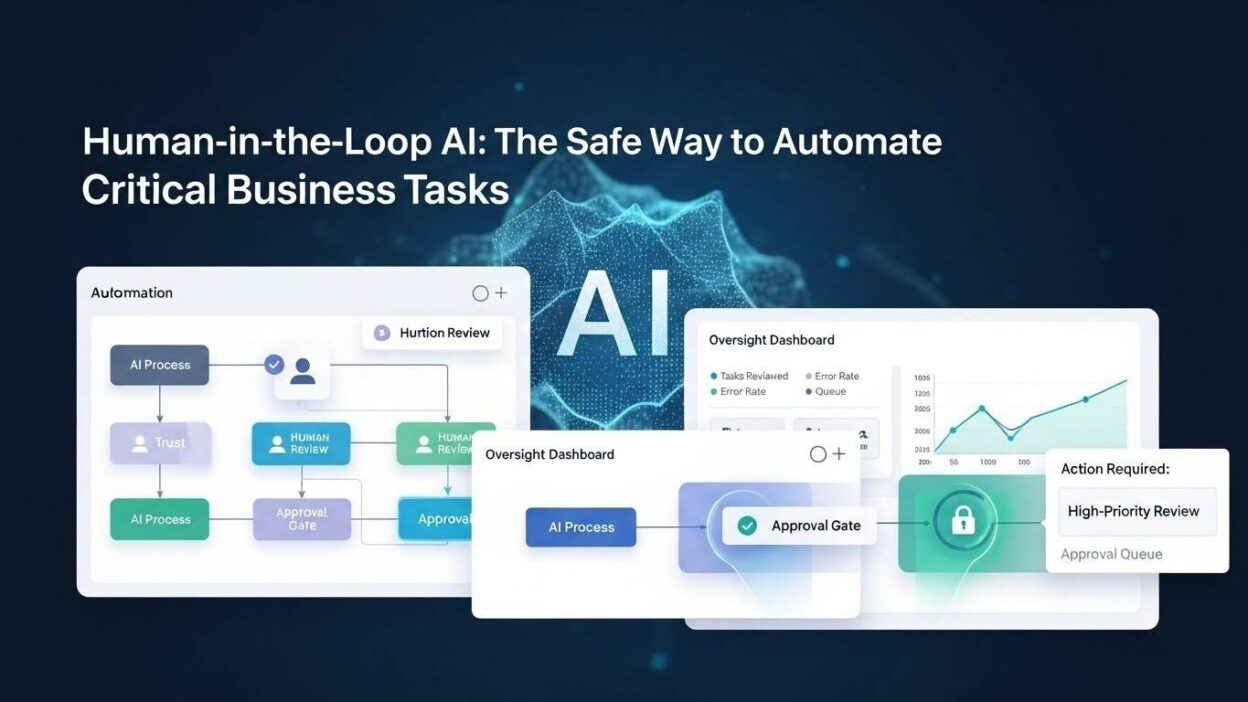
Clear boundaries between AI and human work prevent confusion. Decision trees route tasks appropriately. Confidence thresholds trigger human review. Workflow design determines collaboration patterns.
Confidence-Based Routing
AI systems estimate their own certainty levels. High confidence suggests reliable predictions. Low confidence indicates unusual situations. Confidence scoring enables intelligent routing.
Routine cases with high confidence proceed automatically. The system handles straightforward situations independently. Processing speed maximizes for standard scenarios. Human involvement creates unnecessary delays.
Borderline cases trigger human review. Moderate confidence suggests potential problems. Expert evaluation ensures accuracy. False positives decrease with appropriate thresholds.
Human in the loop AI automation for business processes uses dynamic routing. Complex cases always reach qualified reviewers. Simple matters process automatically. Resource allocation optimizes continuously.
Meaningful Human Oversight
Human review must enable genuine evaluation. Rubber-stamping defeats oversight purposes. Reviewers need complete context and information. Interfaces support informed decision-making.
Time pressure undermines review quality. Rushed evaluations miss important details. Adequate review periods get allocated. Workload management prevents overwhelm.
Training ensures reviewers understand their role. Technical system knowledge supports effective oversight. Domain expertise enables proper evaluation. Continuous education maintains competency.
Feedback mechanisms close learning loops. Human decisions train AI systems. Corrections improve future performance. The system evolves through collaboration.
Continuous Monitoring and Improvement
Performance tracking reveals system effectiveness. Accuracy metrics show prediction quality. Error rates identify problem areas. Monitoring happens in real-time continuously.
Bias detection prevents unfair outcomes. Statistical analysis reveals disparate impacts. Regular audits maintain fairness. Corrections address discovered issues promptly.
A/B testing validates system changes. Experimental modifications undergo controlled evaluation. Data drives optimization decisions. Improvements roll out based on evidence.
Human in the loop AI automation for business processes requires ongoing refinement. Technology advances enable new capabilities. Business needs evolve over time. Adaptive systems maintain relevance.
Implementation Strategies by Function
Different business areas need tailored approaches. Each function has unique critical tasks. Specific strategies optimize outcomes.
Financial Operations
Payment processing demands extreme accuracy. Wire transfers move real money instantly. Reversal proves difficult or impossible. Mistakes create significant financial exposure.
AI verifies payment details automatically. Account numbers get validated. Amounts check against expected ranges. Routine transactions process without human intervention.
Large or unusual payments trigger review. Finance managers verify high-value transfers. Unexpected recipients receive extra scrutiny. New vendor payments always need approval.
Fraud detection combines AI and human expertise. Algorithms flag suspicious patterns immediately. Fraud analysts investigate concerning transactions. Speed and accuracy both matter critically.
Month-end closing requires human oversight. AI generates preliminary financial statements. Accountants verify accuracy and completeness. Sign-offs come from qualified professionals.
Customer Service Operations
Chatbots handle common inquiries efficiently. Product information requests resolve instantly. Order status updates automate completely. FAQ topics process without human involvement.
Complex customer issues escalate to agents. Problems requiring judgment need human attention. Angry or frustrated customers receive personal service. Relationship preservation demands empathy and flexibility.
Human in the loop AI automation for business processes enhances customer satisfaction. Quick answers arrive for simple questions. Difficult situations receive expert handling. Customers appreciate both speed and quality.
Service quality monitoring combines automated and manual review. AI analyzes conversation sentiment. Supervisors review concerning interactions. Coaching improves agent performance.
Healthcare and Medical Services
Diagnostic support systems assist physicians. AI analyzes medical images rapidly. Potential problems get flagged immediately. Doctors make actual diagnoses independently.
Treatment recommendations consider multiple factors. AI suggests evidence-based protocols. Physicians account for individual patient circumstances. Personal medical history influences decisions.
Prior authorization processing speeds with AI assistance. Algorithms verify coverage eligibility. Complex cases route to nurses. Clinical judgment determines medical necessity.
Medication dosing requires careful oversight. AI calculates doses based on patient parameters. Pharmacists verify calculations independently. Safety checks prevent dangerous errors.
Manufacturing Quality Control
Visual inspection combines AI with human expertise. Cameras photograph every product. Algorithms detect potential defects instantly. Inspectors verify flagged items.
Statistical process control monitors production continuously. AI tracks quality metrics in real-time. Trends trigger alerts automatically. Engineers investigate concerning patterns.
Human in the loop AI automation for business processes improves defect detection. Automated systems never fatigue. Human judgment handles ambiguous cases. Quality increases while costs decrease.
Root cause analysis requires human insight. AI identifies correlations in data. Engineers determine actual causation. Corrective actions need strategic thinking.
Legal and Compliance
Contract review accelerates with AI assistance. Algorithms highlight concerning clauses. Attorneys evaluate flagged provisions. Legal judgment remains essential.
Regulatory compliance monitoring happens continuously. AI tracks requirement changes automatically. Compliance officers assess impact. Implementation plans require human expertise.
Discovery processes analyze massive document sets. AI identifies potentially relevant materials. Attorneys review documents for privilege. Strategy decisions need professional judgment.
Technology Architecture and Tools
Successful implementation requires appropriate technology. Architecture decisions affect system effectiveness. Tool selection impacts outcomes significantly.
Platform Selection Criteria
Ease of integration with existing systems matters enormously. Your current infrastructure needs compatibility. API availability enables connections. Migration complexity affects feasibility.
Scalability ensures growth accommodation. Initial volumes may be modest. Success drives increased usage. Systems must handle expansion gracefully.
Explainability enables effective oversight. Black box systems create accountability problems. Transparent decision-making builds trust. Reviewers understand AI reasoning.
Human in the loop AI automation for business processes demands interpretable systems. Humans cannot oversee what they don’t understand. Explanations support meaningful review. Trust develops through transparency.
User Interface Design
Review interfaces determine oversight effectiveness. Cluttered screens overwhelm reviewers. Clear presentation aids decision-making. Intuitive design accelerates work.
Relevant context appears prominently. AI recommendations show clearly. Supporting evidence displays accessibly. Historical information enriches understanding.
Action options require minimal clicks. Approve or reject with simple selections. Comments capture reasoning briefly. Efficiency multiplies across many reviews.
Mobile accessibility supports flexible workflows. Reviewers work from various locations. Urgent items receive immediate attention. Device independence enables continuity.
Feedback Mechanism Design
Correction methods must be straightforward. Reviewers fix AI mistakes easily. Changes propagate to training systems. Learning happens automatically.
Rating systems capture review confidence. High-certainty corrections train strongly. Uncertain fixes receive less weight. Nuanced feedback improves learning quality.
Batch feedback enables efficient training. Common error patterns get addressed systematically. Targeted improvements fix specific problems. Efficiency increases through thoughtful design.
Security and Access Control
Role-based permissions protect sensitive operations. Only qualified individuals review critical tasks. Authorization prevents unauthorized actions. Audit trails track all activities.
Data encryption protects information throughout. Information in transit stays secure. Stored data receives protection. Privacy compliance becomes manageable.
Authentication ensures identity verification. Multi-factor authentication prevents impersonation. Session management limits exposure. Security layers protect comprehensively.
Human in the loop AI automation for business processes maintains enterprise-grade security. Sensitive operations demand protection. Compliance requirements need satisfaction. Trust depends on robust security.
Training and Change Management
Technology alone doesn’t ensure success. People make systems work effectively. Investment in human capital determines outcomes.
Preparing Teams for Hybrid Workflows
Role evolution requires clear communication. Jobs change but don’t disappear. New responsibilities replace old tasks. Career development opportunities emerge.
Value proposition needs articulation. Time savings enable higher-value work. Reduced drudgery increases job satisfaction. Professional growth accelerates.
Fear management addresses concerns directly. Job security fears are natural. Leadership must provide reassurance. Transparent communication builds confidence.
Skill Development Programs
Technical training covers system operation. Interfaces require familiarity. Features and functions need understanding. Hands-on practice builds comfort.
AI literacy helps teams understand capabilities. Strengths and limitations become clear. Appropriate skepticism develops naturally. Blind trust and fear both decrease.
Domain expertise remains crucial. Technical skills complement rather than replace existing knowledge. Subject matter understanding enables effective oversight. Professional development continues.
Human in the loop AI automation for business processes enhances rather than replaces expertise. Human judgment becomes more valuable. Scarce expert time focuses on important decisions. Careers evolve positively.
Performance Measurement
Individual metrics track review quality. Accuracy of human decisions gets measured. Consistency across reviewers matters. Training addresses performance gaps.
System-level metrics show overall effectiveness. Automation rates indicate efficiency. Quality scores reveal accuracy. Both dimensions need tracking.
Continuous feedback guides improvement. Regular performance discussions identify issues. Coaching develops capabilities. Recognition rewards excellence.
Measuring Success and ROI
Investment in human-in-the-loop systems requires justification. Metrics demonstrate value clearly. Multiple dimensions deserve measurement.
Efficiency Metrics
Processing speed shows throughput improvements. Time per transaction decreases significantly. Volume capacity increases substantially. Throughput gains prove impressive.
Cost per transaction demonstrates financial benefits. Labor costs decrease through automation. Quality costs drop with error reduction. Total savings justify investment.
Resource allocation improves measurably. Expert time focuses on complex cases. Junior staff handle fewer routine tasks. Talent utilization optimizes.
Quality and Accuracy Metrics
Error rates compare before and after implementation. Mistakes decrease with careful oversight. Catch rates improve through AI assistance. Quality improvements prove substantial.
Customer satisfaction reflects service quality. Net Promoter Scores indicate loyalty. Complaint volumes reveal problem frequencies. Satisfaction improvements validate approaches.
Human in the loop AI automation for business processes delivers measurable quality gains. Accuracy increases beyond pure automation. Speed exceeds manual processing. Both dimensions improve simultaneously.
Risk Reduction Metrics
Compliance violations decrease with better oversight. Regulatory penalties become less frequent. Audit findings show improvement. Risk exposure drops measurably.
Financial losses from errors diminish. Fraud detection improves substantially. Payment errors nearly disappear. Risk metrics trend positively.
Reputational damage incidents decrease. Negative reviews occur less often. Brand sentiment improves measurably. Public perception enhances continuously.
Real-World Success Stories
Actual implementations demonstrate practical value. Diverse industries benefit from hybrid approaches. Results speak louder than theory.
Healthcare Claims Processing
Major insurance company implemented hybrid adjudication. AI processes straightforward claims automatically. Complex cases route to experienced adjusters. Processing speed increased 300%.
Accuracy improved despite faster processing. Human review caught edge cases. AI handled volume efficiently. Customer satisfaction scores rose significantly.
Fraud detection improved dramatically. AI flagged suspicious patterns. Investigators focused on genuine threats. Losses decreased by 40%.
Financial Services Risk Management
Global bank deployed hybrid credit decisions. AI scores applications instantly. Borderline cases receive analyst review. Approval times dropped from days to hours.
Default rates actually decreased. Human judgment improved edge case handling. Risk models learned from corrections. Portfolio quality improved measurably.
Human in the loop AI automation for business processes enabled growth. Application volume doubled. Staff headcount increased only 20%. Profitability improved substantially.
Manufacturing Quality Assurance
Automotive supplier automated visual inspection. Cameras photograph every part. AI detects potential defects. Inspectors verify flagged items.
Defect detection rates increased 50%. Human inspectors never tire. AI never loses focus. Quality escaped to customers decreased.
False positive rates dropped over time. Inspectors corrected AI mistakes. System learned continuously. Efficiency improved while quality increased.
Future of Human-in-the-Loop Automation
Technology capabilities advance continuously. Emerging developments promise further improvements. Strategic planning prepares for evolution.
Advancing AI Capabilities
Model accuracy improves steadily. Training methods become more sophisticated. Error rates decrease over time. Confidence calibration gets better.
Explainability advances enable better oversight. Transparent reasoning supports effective review. Reviewers understand AI logic clearly. Trust builds through understanding.
Adaptive learning speeds improvement cycles. Systems learn from corrections immediately. Retraining happens automatically. Performance gains accelerate.
Expanding Application Areas
New domains adopt hybrid approaches. Complex industries embrace automation carefully. Critical tasks automate safely. Risk management improves across sectors.
Human in the loop AI automation for business processes becomes industry standard. Responsible automation wins acceptance. Stakeholder confidence grows. Adoption accelerates appropriately.
Regulatory Evolution
Frameworks for AI governance emerge. Standards codify best practices. Compliance requirements become clearer. Legal uncertainty decreases.
Human oversight may become mandatory. High-stakes decisions could require human involvement. Regulations might mandate review thresholds. Prepared organizations gain competitive advantage.
Read More:-Jasper AI vs. Copy.ai vs. Custom LLMs: When to Build Your Own Writing Bot
Conclusion

Critical business tasks demand careful automation approaches. Complete automation creates unacceptable risks. Human judgment remains essential for complex decisions.
Human in the loop AI automation for business processes provides the optimal solution. Machine efficiency combines with human wisdom. Speed and accuracy both increase. Risk decreases through appropriate oversight.
Understanding criticality guides implementation. High-stakes operations need human review. Routine tasks automate completely. Risk assessment determines appropriate strategies.
Full automation fails predictably. Edge cases confuse AI systems. Context and nuance require human understanding. Ethical dimensions demand conscious judgment. Accountability stays with humans ultimately.
Core principles ensure effective implementation. Appropriate labor division leverages strengths. Confidence-based routing optimizes resources. Meaningful oversight maintains quality. Continuous improvement drives evolution.
Function-specific strategies maximize value. Financial operations gain accuracy and speed. Customer service improves satisfaction. Healthcare enhances safety. Manufacturing increases quality.
Technology selection affects outcomes significantly. Platform capabilities enable effectiveness. Interface design determines efficiency. Feedback mechanisms support learning. Security protects operations.
Training prepares teams for success. Skills development enables effective participation. Change management addresses concerns. Performance measurement guides improvement.
Success metrics demonstrate value clearly. Efficiency gains prove cost-effectiveness. Quality improvements validate approaches. Risk reduction justifies investment.
Real-world examples inspire confidence. Healthcare, finance, and manufacturing show results. Diverse applications prove broad applicability. Success stories multiply continuously.
The future promises continued advancement. AI capabilities improve steadily. Application areas expand continuously. Regulatory frameworks provide clarity.
Human in the loop AI automation for business processes represents responsible innovation. Progress happens without compromising safety. Efficiency increases while maintaining quality. Your organization gains competitive advantage.
Start implementing hybrid automation today. Identify critical processes carefully. Design appropriate oversight mechanisms. Train teams thoroughly. Monitor results continuously.
Success requires commitment to both efficiency and safety. Technology serves human purposes. Automation enhances rather than replaces judgment. The future belongs to thoughtful hybrid approaches.
Your competitive advantage depends on smart automation. Human in the loop AI automation for business processes delivers sustainable results. Speed and safety advance together. Excellence becomes achievable at scale.