Introduction
TL;DR Every entrepreneur loves finding free tools that promise to revolutionize their business. ChatGPT responds to questions instantly. Canva generates designs in seconds. Google’s Gemini drafts emails effortlessly. The price tag says zero dollars.
Your finance team celebrates avoiding another software subscription. Your operations manager quickly uploads customer data to test capabilities. Three months pass before anyone notices the real problems emerging. Your proprietary sales strategies now appear in competitor pitches. Your customer data lives on servers you don’t control. Your workflows depend entirely on tools that could disappear tomorrow.
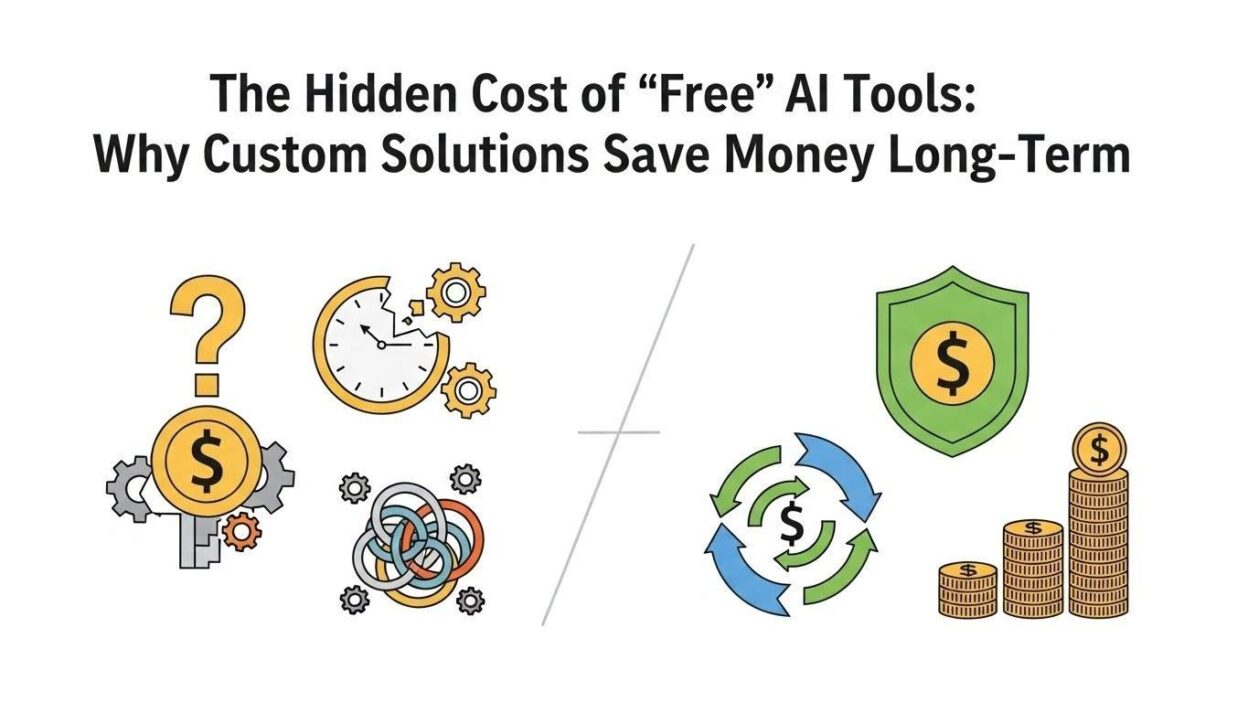
The hidden cost of free AI tools for businesses extends far beyond monthly subscription fees. These platforms extract value through channels most companies never examine closely. Your data becomes training material. Your intellectual property feeds their algorithms. Your operational dependence creates switching costs that dwarf any saved subscription money.
Understanding these dynamics protects your business from expensive mistakes. This guide reveals what you actually pay when tools cost nothing. Smart leaders recognize that strategic AI investments deliver returns free platforms never can.
Table of Contents
Why Free AI Tools Exist and What They Really Want
The Business Model Behind Zero-Dollar Software
No company operates AI infrastructure out of pure generosity. Training large language models costs millions of dollars upfront. Running inference servers consumes massive computational resources. Technical teams command premium salaries across the industry. Someone pays these bills regardless of user pricing.
Free AI platforms monetize through three primary mechanisms simultaneously. They sell your data to advertisers and data brokers. They use your inputs to train proprietary models. They study your behavior to develop premium features they’ll charge for later.
Your brilliant sales pitch fed into a free tool becomes training data. That detailed customer analysis you generated enriches their dataset. Every prompt, upload, and interaction improves their models. You provide unpaid labor disguised as product usage.
The hidden cost of free AI tools for businesses manifests in asymmetric value exchange. You receive basic capabilities while surrendering competitive intelligence. They gain insights worth thousands while investing minimal infrastructure per user. The relationship favors the platform provider overwhelmingly.
Data monetization generates substantial revenue streams for these companies. Your usage patterns reveal industry trends worth millions to analysts. Your prompt history exposes business strategies competitors would pay to access. Aggregated user data becomes a product sold without your explicit knowledge.
Venture capital funds many free AI services temporarily. Investors tolerate losses while platforms gather users and data. Once dependency builds sufficiently, pricing models shift dramatically. Free tiers shrink while premium features multiply rapidly. Your workflows already depend on the platform completely.
How Your Data Becomes Their Product
Most free AI tools claim broad rights to user inputs in their terms. Legal language buried in service agreements grants sweeping usage permissions. Few business owners read these documents before clicking accept. The fine print authorizes practices that would horrify most users.
Your uploaded files may train models accessible to all users. Confidential reports you summarize become part of shared knowledge bases. Product development ideas you explore could inform your competitors indirectly. The separation between your data and their training corpus remains dangerously thin.
Privacy policies use vague language around “improving our services” strategically. This phrase justifies nearly unlimited data usage legally. Training AI models counts as service improvement under most interpretations. Your proprietary information fuels algorithm development you never approved explicitly.
The hidden cost of free AI tools for businesses includes permanent intellectual property exposure. Once data enters these systems, retrieval becomes impossible practically. Deletion requests may remove your account but not training data. Your business secrets persist in model weights indefinitely.
Enterprise agreements offer better protections at premium prices. Free tiers provide minimal data security and zero ownership guarantees. The quality gap between free and paid services reflects this distinction. Companies serious about data protection pay for contractual safeguards.
Anonymization claims provide false comfort to many users. AI systems detect patterns that reveal identities despite anonymization attempts. Supposedly anonymous data can reconstruct sensitive information through inference. True privacy requires keeping data out of these systems entirely.
The True Costs Nobody Talks About Initially
Data Privacy Risks That Threaten Your Business
Uploading sensitive information to free platforms creates legal exposure immediately. Client confidentiality agreements typically prohibit sharing data with third parties. Most free AI services count as third parties under these contracts. Every usage potentially violates your existing legal obligations.
GDPR and CCPA impose strict rules on data handling and storage. Free tools often store information on international servers beyond your control. Compliance becomes impossible when you can’t specify data locations. Regulatory fines for violations run into millions of dollars annually.
Your customers trust you to protect their personal information carefully. Free AI tools may analyze customer data without proper consent. This breach of trust damages relationships you spent years building. Reputation recovery costs far exceed any subscription savings realized.
Industry-specific regulations create additional compliance burdens for many sectors. Healthcare organizations must follow HIPAA requirements strictly. Financial services face SEC and banking regulations constantly. Free AI tools rarely meet these specialized compliance standards.
The hidden cost of free AI tools for businesses includes potential lawsuits from affected parties. Clients discover their confidential information appeared in AI outputs elsewhere. Partners learn their trade secrets informed your competitor’s strategies. Legal defense alone costs hundreds of thousands regardless of outcomes.
Data breaches at free platforms expose your information to malicious actors. Security investments at free services lag behind enterprise solutions significantly. Your sensitive business data sits alongside millions of other users’ information. Hackers target these centralized repositories for maximum impact.
Performance Limitations That Kill Productivity
Free tiers impose usage restrictions that interrupt workflows constantly. Rate limits force teams to wait between requests unnecessarily. Token restrictions cut off responses mid-sentence requiring multiple attempts. Quality caps ensure free users receive inferior outputs consistently.
Your team starts a task using available free queries quickly. Midway through the project, the rate limit hits unexpectedly. Productivity stops while everyone waits for limits to reset. Deadlines slip because tool availability became unpredictable.
Response quality varies dramatically between free and paid tiers. Free users receive outputs from older, less capable models. Paid subscribers access the latest, most powerful algorithms available. The gap in results quality justifies premium pricing clearly.
The hidden cost of free AI tools for businesses includes wasted employee time managing limitations. Staff members develop workarounds to circumvent usage caps inefficiently. They create multiple accounts to access more free queries. These tactics consume hours that could generate actual revenue.
Downtime affects free users more severely than paying customers. Platforms prioritize paid user requests during high-traffic periods. Free tier users experience slower response times and frequent errors. Mission-critical workflows can’t depend on unreliable infrastructure.
Feature access creates artificial productivity barriers across free tiers. Advanced capabilities remain locked behind paywalls deliberately. Your team works inefficiently using basic features while better tools exist. The opportunity cost of reduced productivity exceeds subscription costs quickly.
Support Gaps That Leave You Stranded
Free platforms provide minimal customer support by design intentionally. Most issues require self-service troubleshooting through documentation searches. Community forums offer peer help with no guaranteed solutions. Critical problems may remain unresolved for weeks or months.
Your business process breaks due to a platform bug unexpectedly. Paid users receive dedicated support within hours of reporting issues. Free tier users submit tickets that languish in queues indefinitely. Revenue loss during downtime far exceeds any saved subscription fees.
Implementation assistance simply doesn’t exist for free users at all. You figure out integrations through trial and error alone. Paid enterprise customers receive dedicated onboarding and setup help. The time difference between these experiences measures in weeks.
The hidden cost of free AI tools for businesses includes failed implementations wasting staff time. Your team spends dozens of hours configuring free tools incorrectly. A paid solution with proper support would have launched successfully immediately. Opportunity costs compound as projects drag on unnecessarily.
Training resources for free tiers remain basic and generic. Advanced use cases lack documentation entirely. Paid platforms invest in comprehensive training programs and certification. Your team operates at reduced efficiency without proper education.
Updates and improvements prioritize paying customers exclusively. Free tiers receive updates months after premium users benefit. Bug fixes come slowly if at all for non-paying accounts. Your workflows stagnate while competitors advance using better tools.
Why Custom AI Solutions Deliver Superior ROI
Long-Term Cost Savings Through Ownership
Custom AI solutions require upfront investment ranging from $50,000 to $300,000 typically. This price point intimidates many business owners accustomed to free tools. The calculation changes dramatically when examining five-year total cost of ownership.
Free tools create subscription dependencies once your workflows adapt fully. Platforms increase pricing once switching costs make leaving difficult. Monthly fees compound over years into substantial ongoing expenses. Custom solutions eliminate recurring payments after initial development completes.
Your custom system operates on infrastructure you control entirely. Cloud costs run $200-$1,000 monthly depending on usage volumes. These expenses remain predictable and scale linearly with business growth. No vendor can suddenly triple your costs through pricing changes.
Studies show businesses achieve 25-35% operational cost savings through custom AI. Automation eliminates repetitive tasks consuming expensive employee hours. Error reduction cuts costly mistakes that plague manual processes. Efficiency gains compound annually as systems optimize over time.
The hidden cost of free AI tools for businesses includes mounting subscription expenses as teams scale. Adding users to paid tiers multiplies costs exponentially. Custom solutions serve unlimited users without per-seat pricing. The economic advantage grows as your organization expands.
Return on investment for custom AI typically materializes within 12-18 months. Initial development costs get recovered through productivity improvements and cost reductions. Subsequent years deliver pure profit from continued efficiency gains. Free tools never generate positive ROI despite zero upfront costs.
Data Security and Compliance Control
Custom solutions keep your sensitive data within controlled environments completely. Deploy on your own servers or private cloud infrastructure exclusively. No third-party vendor accesses your proprietary information ever. Your data security posture improves dramatically overnight.
Compliance requirements become achievable when you control the entire stack. Healthcare organizations can ensure HIPAA compliance through proper architecture. Financial services meet stringent regulatory standards without vendor cooperation. Your legal team can audit systems thoroughly and confidently.
Intellectual property protection justifies custom development costs alone for many companies. Your trade secrets never leave your infrastructure boundary. Competitive advantages derived from AI remain proprietary indefinitely. The value of protected IP exceeds development costs significantly.
Client confidentiality agreements become enforceable with custom implementations straightforwardly. You demonstrate data handling practices through technical documentation clearly. Customers gain confidence knowing their information stays secure absolutely. Trust translates directly into client retention and referrals.
The hidden cost of free AI tools for businesses includes IP theft that undermines competitive positioning. Custom solutions eliminate this risk entirely through complete data isolation. Your innovations remain yours exclusively without leakage concerns. Market advantages persist because competitors can’t access your methodologies.
Data sovereignty concerns affect international businesses particularly severely. Custom deployments ensure data stays in approved jurisdictions legally. Free platforms may store information across multiple countries unpredictably. Regulatory compliance demands this level of control increasingly.
Performance Optimized for Your Specific Needs
Generic free tools attempt serving millions of use cases simultaneously. This broad focus dilutes effectiveness for any specific application. Your unique business processes receive inadequate attention from general platforms. Performance suffers because the tool wasn’t designed for your context.
Custom AI solutions address your exact workflows and requirements precisely. Algorithms optimize for metrics that matter to your business specifically. Training data comes from your actual operations and customer interactions. The result delivers superior accuracy and relevance consistently.
Integration with existing systems happens seamlessly through custom development work. Your AI connects directly to databases, CRM platforms, and operational tools. Free services require manual data transfers and awkward workarounds constantly. Native integrations eliminate friction and reduce error rates substantially.
Speed advantages emerge when systems run on dedicated infrastructure properly. Free platforms share resources across millions of users simultaneously. Your custom solution allocates computing power exclusively to your needs. Response times improve by 10-50x in many implementations.
The hidden cost of free AI tools for businesses includes process inefficiencies from poor tool fit. Staff waste time adapting workflows to tool limitations unnecessarily. Custom solutions adapt to your processes instead of forcing changes. Productivity gains justify investment through reduced operational friction.
Continuous improvement becomes possible when you control the development roadmap. Add features addressing emerging needs as your business evolves. Free platforms only improve in ways benefiting their entire user base. Your competitive advantages grow through ongoing customization investments.
Calculating the Real ROI of Custom Solutions
Direct Cost Savings Across Operations
Labor costs decrease dramatically when AI automates repetitive tasks effectively. Customer service teams handle 30-40% more inquiries with AI assistance. Data entry requirements drop by 50-70% through intelligent automation. Each eliminated hour translates directly into bottom-line savings.
Error reduction saves money through fewer costly mistakes and rework. Manual processes generate errors requiring expensive corrections regularly. AI systems maintain consistent accuracy above 95% in most applications. Quality improvements protect profit margins and customer relationships simultaneously.
Time savings compound across your entire organization systematically. Marketing teams create campaigns in days instead of weeks. Finance departments close books faster with automated reconciliation. Every department gains hours that redirect toward revenue generation.
The hidden cost of free AI tools for businesses includes opportunity costs from inefficient operations. Custom solutions eliminate these productivity drains through optimized workflows. Employees focus on high-value activities requiring human judgment exclusively. Revenue per employee increases substantially with proper AI implementation.
Inventory optimization through custom AI reduces carrying costs by 10-15% typically. Predictive analytics prevent both stockouts and overstock situations. Working capital gets deployed more efficiently across your operations. Cash flow improvements fund additional growth initiatives organically.
Customer acquisition costs decline when AI personalizes marketing efforts effectively. Conversion rates improve 10-25% through better targeting and messaging. Lifetime value increases as AI predicts and prevents customer churn. Revenue growth accelerates while marketing spend remains constant or decreases.
Productivity Gains That Transform Business Capabilities
Employee productivity jumps 20-35% in departments implementing custom AI solutions. Tedious tasks get eliminated completely from daily workflows. Staff focuses on creative problem-solving and strategic initiatives instead. Job satisfaction improves alongside output quality and quantity.
Decision-making speed accelerates when AI provides instant insights from data. Executives access real-time analytics without waiting for reports. Strategic pivots happen in days rather than quarters. Agility becomes a competitive advantage in fast-moving markets.
Scale becomes economically viable without proportional headcount increases. Serve 10x more customers using the same team size. Process larger transaction volumes without operational chaos. Growth happens profitably instead of requiring constant hiring.
Innovation cycles shorten when AI handles routine research and analysis. Product development teams test more ideas in less time. Market research that took weeks now completes in hours. Time-to-market advantages capture opportunities competitors miss entirely.
The hidden cost of free AI tools for businesses includes stagnant capabilities from tool limitations. Custom solutions enable breakthrough improvements free platforms can’t deliver. Your business gains capabilities that competitors using free tools lack. Market positioning strengthens through demonstrable operational superiority.
Customer experience improves through personalization only custom AI enables. Every interaction adapts to individual preferences and history. Satisfaction scores rise alongside retention rates consistently. Referrals increase as customers share exceptional experiences widely.
Competitive Advantages Worth Protecting
Proprietary AI systems become defensible moats protecting your market position. Competitors can’t replicate what they can’t access or observe. Your operational efficiency remains mysterious to outside observers. Sustainable advantages emerge from technology others can’t copy easily.
First-mover advantages in AI implementation compound over time significantly. Early data collection trains better models than competitors build later. Organizational learning curves create expertise barriers for followers. Market share gains become increasingly difficult to reverse.
Brand differentiation emerges from superior service delivery powered by AI. Customers recognize and value your operational excellence consistently. Premium pricing becomes justifiable through demonstrably better experiences. Margins expand while competitive pressure decreases through differentiation.
The hidden cost of free AI tools for businesses includes competitive disadvantages from shared tools. Every competitor using the same free platform gains identical capabilities. Differentiation becomes impossible when everyone uses identical systems. Custom solutions create unique advantages that separate you from competitors.
Talent attraction improves when your company leads in AI adoption. Top performers want working with cutting-edge technology and tools. Recruitment costs decrease as candidates seek you out specifically. Retention improves because employees enjoy productivity-enhancing tools.
Strategic flexibility increases when you control your technology stack completely. Pivot quickly as market conditions change without vendor limitations. Experiment with novel approaches impossible on generic platforms. Innovation becomes your core competency rather than borrowed capabilities.
Making the Transition from Free to Custom
Assessing Your Current AI Tool Usage
Document every free AI tool your organization uses currently. Survey teams about what they’ve adopted without formal approval. Shadow IT creates risks you must identify before solving. Comprehensive audits reveal the true scope of exposure.
Evaluate which use cases justify custom development versus paid subscriptions. Mission-critical workflows demand custom solutions for reliability and control. Experimental projects might continue using free tools appropriately. Strategic importance determines the right investment level.
Calculate total cost of ownership for your current free tool usage. Include wasted time, productivity losses, and security risks in analysis. Factor in opportunity costs from competitive disadvantages. Real costs exceed zero despite the appearance of savings.
Identify data that absolutely cannot enter third-party systems under any circumstances. Customer personally identifiable information tops this list for most companies. Proprietary algorithms and trade secrets require complete protection. Clear boundaries guide tool selection decisions effectively.
The hidden cost of free AI tools for businesses becomes quantifiable through thorough analysis. Present findings to leadership with specific dollar amounts attached. ROI calculations for custom solutions look compelling when compared accurately. Investment approval becomes easier with complete cost transparency.
Benchmark your performance against competitors using custom AI solutions. Gap analysis reveals where free tools limit your capabilities. Competitive intelligence informs investment priorities and urgency. Market position considerations override pure financial calculations often.
Building Your Custom Solution Roadmap
Start with a single high-value use case for your first project. Customer service automation delivers clear ROI and manageable scope. Sales lead qualification provides measurable results quickly. Early wins build organizational confidence and momentum.
Partner with experienced AI development firms for your initial implementation. Their expertise accelerates delivery and ensures quality outcomes. Learning curves that would take months internally compress into weeks. Technical risks decrease dramatically with proper guidance.
Plan for 3-6 month development timelines for typical projects. Complex systems may require 9-12 months depending on scope. Realistic expectations prevent disappointment and maintain stakeholder support. Phased rollouts deliver value incrementally throughout development.
Budget $50,000-$150,000 for small business implementations initially. Mid-market companies typically invest $150,000-$500,000 for comprehensive solutions. Enterprise deployments range from $500,000 to several million dollars. Scope and complexity drive costs more than company size.
The hidden cost of free AI tools for businesses justifies these investments through eliminated risks and increased capabilities. Custom solutions pay for themselves through cost savings and productivity gains. Calculate ROI conservatively and you’ll still see positive returns within 18 months.
Establish internal capabilities for maintaining and improving your systems over time. Hire AI specialists or train existing technical staff appropriately. Long-term success requires organizational competency beyond initial deployment. Technology investments fail without supporting human capabilities.
Measuring Success and Scaling Strategically
Define clear KPIs before launching your custom AI solution. Track specific metrics tied to business objectives directly. Cost savings, productivity improvements, and revenue impact all matter. Measurement frameworks prove ROI and guide optimization efforts.
Monitor system performance daily through automated dashboards. Response accuracy, processing speed, and uptime all require tracking. Issues surface quickly when you watch metrics closely. Proactive maintenance prevents small problems becoming major failures.
Gather user feedback systematically through surveys and interviews. Adoption rates indicate whether systems deliver promised value. Satisfaction scores guide feature prioritization and improvement roadmaps. Employee input ensures systems serve actual needs effectively.
Calculate realized ROI quarterly against initial projections. Document savings and productivity gains with specific examples. Share success stories across the organization widely. Demonstrated results secure funding for additional AI initiatives.
Expand successful implementations to additional use cases gradually. Leverage learnings from initial projects for faster subsequent deployments. Build momentum through visible wins that justify continued investment. Strategic scaling compounds benefits across your entire organization.
Continuously optimize algorithms as more data accumulates over time. Performance improvements happen automatically through proper architecture. Your competitive advantages grow stronger as systems mature. Long-term value creation justifies initial development investments many times over.
Common Mistakes to Avoid During Implementation
Underestimating Data Requirements
Custom AI systems require substantial high-quality training data. Many companies lack sufficient historical data initially. Rushing deployment with inadequate data produces disappointing results. Plan for 6-12 months of data collection before development begins.
Data quality matters far more than quantity in most applications. Clean, well-labeled datasets train better models than massive messy ones. Invest in data preparation and cleaning upfront. This foundational work determines ultimate system performance.
Privacy and security considerations affect data collection strategies significantly. Obtain proper consent for using customer information in training. Anonymize sensitive data appropriately before processing. Legal compliance protects your organization from future liabilities.
The hidden cost of free AI tools for businesses includes data exposure that custom solutions avoid completely. Your proprietary training data remains secure within controlled systems. Competitive intelligence stays protected while delivering system improvements. Data security justifies custom development for this reason alone.
Ongoing data collection sustains system performance over time. Models degrade as real-world conditions change gradually. Continuous training with fresh data maintains accuracy indefinitely. Plan for permanent data pipelines supporting your AI systems.
Documentation practices determine long-term system maintainability significantly. Record data sources, processing steps, and quality metrics thoroughly. Future improvements require understanding how current systems work. Technical debt accumulates rapidly without proper documentation.
Choosing the Wrong Development Partner
Not all AI development firms deliver equivalent quality or value. Some prioritize speed over robustness with disastrous results. Others lack domain expertise relevant to your industry. Due diligence prevents costly mistakes that delay ROI.
Evaluate portfolios showing similar projects to your requirements. Client references reveal whether promises match actual delivery. Technical capabilities must extend beyond marketing claims significantly. Verify expertise through detailed technical discussions before contracting.
Communication styles affect project success as much as technical skills. Choose partners who explain concepts clearly without excessive jargon. Cultural fit ensures smooth collaboration throughout development. Mismatched working styles create friction that delays projects.
Pricing structures should align with value delivery, not just inputs. Fixed-price contracts provide cost certainty for defined scopes. Time-and-materials works better for exploratory development phases. Understand exactly what you’re paying for before signing agreements.
The hidden cost of free AI tools for businesses pales compared to failed custom development projects. Choosing the wrong partner wastes hundreds of thousands of dollars. Delayed time-to-value compounds opportunity costs significantly. Careful partner selection protects your investment and timeline.
Post-launch support arrangements must be clear from the start. Systems require ongoing maintenance and optimization indefinitely. Understand what’s included in initial pricing versus ongoing fees. Total cost of ownership includes several years of support.
Read More:-Smart Call Routing Strategies to Delight Customers
Conclusion: Investing Wisely in AI for Long-Term Success

Free AI tools seduce businesses with zero upfront costs. The hidden cost of free AI tools for businesses emerges gradually through data exposure, productivity losses, and competitive disadvantages. What appears economical initially becomes expensive through accumulated inefficiencies and risks.
Custom AI solutions require substantial investment that frightens many leaders. Upfront development costs seem prohibitive compared to free alternatives. The calculation changes completely when examining five-year horizons realistically. Custom systems deliver returns that free tools never approach.
Data security alone justifies custom development for most businesses. Protecting intellectual property and client information from third-party access proves invaluable. Compliance requirements become achievable through controlled implementations. Your reputation depends on handling sensitive information responsibly.
Performance advantages from custom solutions compound over years. Optimized workflows eliminate inefficiencies that plague generic tools. Employees accomplish more in less time with proper systems. Productivity gains justify investment through pure bottom-line impact.
Competitive advantages emerge from capabilities others can’t replicate easily. Proprietary systems create moats protecting your market position. First-mover advantages in AI adoption compound through organizational learning. Custom solutions enable differentiation impossible with shared free tools.
The hidden cost of free AI tools for businesses includes foregone opportunities from limited capabilities. Custom implementations unlock business models that generic platforms can’t support. Strategic flexibility increases when you control your technology completely. Innovation accelerates beyond what borrowed tools enable.
Calculate total cost of ownership including all hidden expenses accurately. Factor in security risks, productivity losses, and opportunity costs thoroughly. Custom solutions look economically attractive when compared honestly. ROI timelines of 12-18 months make investments financially prudent.
Start your custom AI journey with a single high-value use case. Early wins build organizational confidence and momentum. Successful pilots secure funding for broader implementation initiatives. Strategic scaling compounds benefits across your entire operation.
Partner with experienced developers who understand your industry deeply. Technical expertise combined with domain knowledge delivers superior outcomes. Cultural fit ensures smooth collaboration throughout development cycles. Choose partners who prioritize your success over their convenience.
Measure results rigorously through defined KPIs and regular tracking. Documented ROI justifies continued investment and expansion. Success stories create organizational enthusiasm for AI adoption. Data-driven decision-making guides optimization and scaling efforts.
The future belongs to companies that own their AI capabilities. Dependence on free tools creates vulnerability as platforms evolve unpredictably. Custom solutions provide control, security, and competitive advantages. Smart investment today delivers returns for years ahead.
Stop accepting the hidden cost of free AI tools for businesses as inevitable. Take control through strategic custom development that serves your needs exclusively. Protect your data, enhance your capabilities, and build sustainable advantages. The question isn’t whether to invest but how quickly you can begin.
Your competitors are making this transition right now. First movers gain advantages that become increasingly difficult to overcome. Market leadership in AI adoption translates into market leadership overall. Begin your custom AI journey today before falling irreversibly behind.