Introduction
TL;DR The AI inference hardware race is heating up fast. Groq vs NVIDIA LPU vs GPU AI inference is the comparison every ML engineer, AI architect, and technology executive needs to understand right now. Speed, cost, memory, and scalability — the answers will shape your AI deployment strategy for years ahead..
Table of Contents
Why AI Inference Hardware Matters More Than Ever
Training large language models grabs most of the headlines. Inference, however, is where AI actually earns its value. Every query a user sends, every response a model generates, every decision an AI system makes — all of it runs on inference hardware.
Inference speed affects user experience directly. A chatbot that responds in 50 milliseconds feels magical. One that takes four seconds feels broken. Customers notice. Product teams measure it. Business leaders care deeply about it.
Inference cost also shapes business viability. Running millions of requests daily on expensive hardware erodes margins fast. The choice of chip architecture determines whether AI features are profitable or punishing.
For decades, NVIDIA dominated the AI hardware conversation. Its GPU architecture became the default for deep learning, training, and inference workloads alike. Then Groq arrived with a fundamentally different idea — a chip built exclusively for inference, not adapted for it.
The Groq vs NVIDIA LPU vs GPU AI inference debate is not simply about specs on a datasheet. It reflects two completely different philosophies about what modern AI computation should look like.
This blog examines both architectures honestly. It covers what each chip does well, where each one struggles, and which workloads favor one over the other. By the end, you will have a clear framework for making the right hardware decision for your AI systems.
Understanding the Architecture: What Is a GPU?
GPU stands for Graphics Processing Unit. NVIDIA originally designed GPUs to render complex 3D graphics for video games and visual computing. The architecture relied on massive parallelism — thousands of smaller cores working simultaneously on many small tasks at once.
AI researchers discovered that this parallel architecture maps surprisingly well to matrix math. Neural networks rely heavily on matrix multiplications. GPUs handle matrix multiplications at enormous scale. The match created an entire industry.
NVIDIA’s CUDA platform, launched in 2007, gave developers a way to program GPUs for general-purpose computation. That decision turned NVIDIA from a gaming chip company into the backbone of the global AI industry.
Today’s NVIDIA data center GPUs — the A100 and H100 — are extraordinary machines. The H100 offers up to 80GB of HBM3 memory and delivers around 3,958 TOPS of INT8 performance. It handles training and inference across virtually every AI framework and model architecture.
The GPU’s strength lies in its flexibility. It can train models, run inference, process images, render video, and simulate physics — all on the same chip. That versatility made it the universal tool of the AI era.
The GPU’s Inference Limitation
Flexibility comes at a cost. GPUs were not designed with inference latency as the primary objective. When generating text token by token, GPUs face a fundamental challenge: memory bandwidth bottleneck.
Each token generation step requires loading large model weights from memory into compute cores. For a 70-billion parameter model, those weights occupy tens of gigabytes. Moving that data on every step slows the process significantly.
GPU utilization during inference is often low — sometimes below 30%. The chip is powerful but idle much of the time, waiting for data to arrive from memory. This inefficiency drives up cost per token and limits throughput for real-time applications.
Understanding this limitation is essential for the Groq vs NVIDIA LPU vs GPU AI inference comparison. NVIDIA’s GPU is brilliant at many things. Optimal serial token generation is not its strongest suit.
What Is Groq’s LPU? A New Architecture for a New Problem
Groq designed its chip from scratch with one goal in mind — deterministic, ultra-low latency AI inference. The company named it the LPU, which stands for Language Processing Unit. Every architectural decision reflects that singular focus.
The LPU is not a general-purpose chip. It does not render graphics. It does not train models from scratch. It does exactly one thing: run inference on large language models as fast as physically possible.
The Core Innovation: Deterministic Execution
Traditional chips, including GPUs, handle memory access dynamically. The chip decides at runtime which data to fetch, when to fetch it, and where to route it. This flexibility creates unpredictable latency — sometimes called jitter.
Groq’s LPU uses a completely different model. It schedules every memory access at compile time, not runtime. The compiler determines exactly what data the chip needs, when it needs it, and how to route it through the hardware. At execution time, the chip follows that schedule with zero deviation.
This deterministic approach eliminates the unpredictable delays that plague GPU inference. The result is consistent, repeatable, ultra-low latency on every single request.
The SRAM Advantage
GPUs store model weights in external HBM (High Bandwidth Memory). Accessing external memory introduces latency, even with fast memory stacks. Groq places massive amounts of on-chip SRAM directly inside the LPU die.
On-chip SRAM is dramatically faster to access than external memory. When the model weights live on-chip, the memory bandwidth bottleneck that cripples GPU inference largely disappears. The compute cores get their data almost instantly.
The trade-off is chip size and cost. On-chip SRAM is expensive to manufacture at scale. Groq accepts that trade-off because their target is inference latency, not training flexibility.
Benchmarks That Turn Heads
750+ Tokens per second on Llama 3 70B — Groq’s publicly demonstrated throughput rate, significantly ahead of standard GPU inference setups
~18ms Time to first token on Groq — compared to 200–400ms on comparable GPU cloud deployments for the same model size
These numbers make the Groq vs NVIDIA LPU vs GPU AI inference debate very concrete. For real-time user-facing applications, the latency difference is enormous and immediately noticeable.
Head-to-Head: LPU vs GPU Across Key Dimensions
Groq LPU
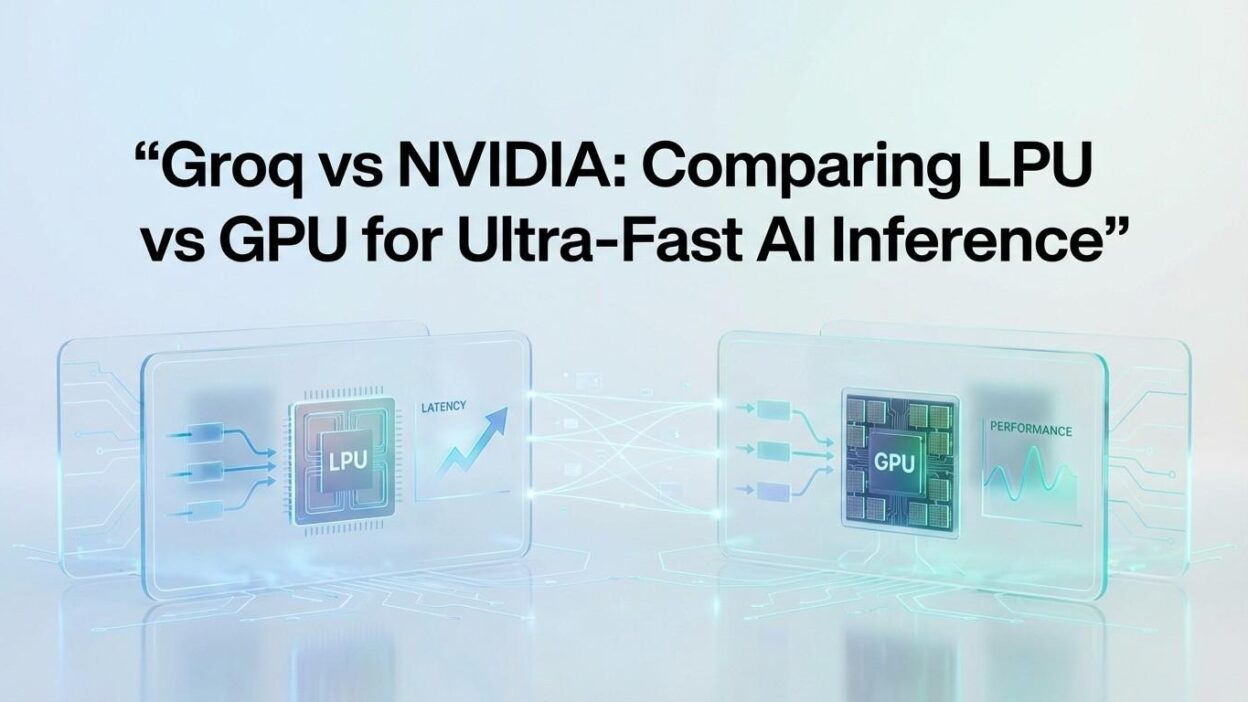
Architecture: Deterministic, compiler-scheduled, SRAM-based
Primary use: Ultra-low latency LLM inference
Memory: Large on-chip SRAM, no HBM bottleneck
Latency profile: Consistent, jitter-free, predictable
Flexibility: Narrow — inference-specific workloads
Ecosystem: Growing, GroqCloud API available
NVIDIA GPU
Architecture: Dynamic, runtime-scheduled, HBM-based
Primary use: Training, inference, rendering, simulation
Memory: External HBM2e/HBM3, up to 80GB per GPU
Latency profile: Variable, depends on batch size and memory load
Flexibility: Extremely broad — nearly every AI workload
Ecosystem: Dominant — CUDA, cuDNN, TensorRT, all frameworks
Inference Throughput
Groq demonstrates remarkable throughput for autoregressive token generation. Running Llama 3 70B, Groq publicly delivers over 750 tokens per second per user. A standard GPU cluster running the same model achieves roughly 40 to 80 tokens per second per user in optimized configurations.
For single-user, real-time conversations, Groq’s LPU wins this dimension decisively. The Groq vs NVIDIA LPU vs GPU AI inference gap in per-request speed is not marginal — it is an order of magnitude in many scenarios.
Batch Processing Efficiency
The story shifts when batch processing enters the picture. GPUs excel at handling hundreds or thousands of inference requests simultaneously. Their large memory capacity and parallel architecture make them efficient at high-concurrency workloads.
Groq’s on-chip SRAM is faster but physically limited in total capacity. Running extremely large models or batching thousands of simultaneous requests pushes against the LPU’s memory ceiling. For high-volume batch inference pipelines, GPU clusters remain a strong choice.
Energy Efficiency
Energy cost is a real concern at scale. Groq’s deterministic architecture eliminates wasted cycles. The chip does not burn power waiting for data. Every clock cycle is productive. This translates to better performance per watt for inference-specific workloads.
NVIDIA’s H100 draws up to 700 watts under full load. Its efficiency for pure inference is lower because much of its architecture — the tensor cores, the large cache hierarchy — sits idle during token generation. Groq extracts more inference output per joule of energy consumed.
Ecosystem and Tooling
NVIDIA’s ecosystem is the biggest moat in technology. CUDA has been the standard for AI development for nearly two decades. Every major framework — PyTorch, TensorFlow, JAX — runs natively and optimally on NVIDIA hardware. The tooling, profiling, debugging, and deployment infrastructure is unmatched.
Groq’s ecosystem is younger and narrower. GroqCloud offers API access. Groq supports popular model formats. Developers can deploy Llama, Mistral, Gemma, and other open models with relatively low friction. The tooling is improving rapidly but cannot yet match NVIDIA’s depth.
For teams already invested in NVIDIA toolchains, switching entirely to Groq for inference carries real migration cost. That cost needs honest accounting in any Groq vs NVIDIA LPU vs GPU AI inference decision.
“Speed without ecosystem is a prototype. Ecosystem without speed is a compromise. The best AI infrastructure gives you both.”
Real-World Use Cases: Where Each Architecture Wins
Where Groq’s LPU Excels
Real-time conversational AI is Groq’s natural home. Customer service chatbots, AI copilots, voice assistants, and live coding assistants all benefit enormously from sub-100ms response times. Users experience AI that feels instant rather than labored.
Financial trading systems need microsecond-level decision making. AI models running on Groq can generate signals faster than GPU-based competitors. In latency-sensitive financial applications, the Groq vs NVIDIA LPU vs GPU AI inference advantage directly translates to competitive edge.
Medical diagnostic tools that require rapid AI-assisted analysis benefit from deterministic latency. Consistent response times help clinicians integrate AI into workflows without unpredictable delays disrupting patient care.
Any developer building a product where the AI response time is part of the user experience metric should evaluate Groq seriously. The speed advantage is real, measurable, and immediately felt by end users.
Where NVIDIA GPUs Still Dominate
Model training remains entirely GPU territory. Groq’s LPU does not support backpropagation or gradient computation. Training a foundation model or fine-tuning a large model requires NVIDIA hardware. That reality will not change soon.
Multi-modal workloads — combining text, image, video, and audio — rely on GPU flexibility. The LPU’s specialized design handles transformer-based text models well but lacks the architectural breadth for complex multi-modal pipelines.
Research environments favor GPUs for their flexibility. Researchers experiment with novel architectures, custom operators, and non-standard computation patterns. CUDA’s programmability supports that experimentation. Groq’s compiler-scheduled approach is less adaptable to experimental workloads.
High-concurrency batch inference at scale — serving thousands of simultaneous users — benefits from GPU clusters’ large memory capacity. NVIDIA multi-GPU setups with NVLink can distribute model weights and serve massive request volumes efficiently.
The Cost Equation: Total Cost of Ownership
Hardware speed means little without understanding the full cost picture. Groq vs NVIDIA LPU vs GPU AI inference decisions must include cost analysis across acquisition, operation, and opportunity.
GPU Acquisition Cost
A single NVIDIA H100 GPU retails between $25,000 and $40,000 depending on the variant and supplier. Building a multi-GPU inference cluster for production workloads requires significant capital expenditure. Cloud rental on platforms like AWS, Azure, and Google Cloud runs between $2 and $8 per GPU-hour for H100 instances.
Groq’s API Pricing Model
Groq operates primarily as a cloud service through GroqCloud. Pricing is token-based. For Llama 3 70B, Groq charges approximately $0.59 per million input tokens and $0.79 per million output tokens at current pricing. For many production workloads, this competes favorably with GPU cloud costs while delivering dramatically faster response times.
The Hidden Cost of Latency
Latency has a direct business cost that rarely appears in hardware comparisons. Slower AI responses reduce user engagement. They increase session abandonment. They require more complex frontend engineering to mask delays. These indirect costs are real and compound over time.
When Groq vs NVIDIA LPU vs GPU AI inference is framed purely as chip cost, Groq may appear expensive. When the comparison includes business impact of response time, the calculus often shifts.
Groq’s Roadmap and NVIDIA’s Response
Groq’s Path Forward
Groq is scaling its GroqCloud infrastructure aggressively. The company plans to deploy hundreds of thousands of LPU chips across data centers globally. Its second-generation chip architecture targets even higher memory capacity and broader model support.
Groq is also expanding model support beyond text. Supporting multi-modal models would significantly expand the LPU’s addressable market. The company’s compiler technology is its deepest asset — and improving it remains a top engineering priority.
Partnerships with hyperscale cloud providers could accelerate Groq’s deployment. If GroqCloud becomes available through AWS Marketplace or Azure, enterprise adoption would jump significantly without requiring capital investment in dedicated hardware.
NVIDIA’s Counter-Strategy
NVIDIA is not standing still. The Blackwell architecture, announced in 2024, targets inference efficiency directly. NVIDIA’s NIM microservices framework optimizes inference deployment on GPU clusters. TensorRT-LLM squeezes better per-token performance from existing GPU hardware.
NVIDIA also benefits from its CUDA ecosystem’s gravity. Developers build on CUDA. Frameworks optimize for CUDA. Enterprise buyers trust CUDA. That institutional momentum is difficult for any competitor to overcome quickly.
The Groq vs NVIDIA LPU vs GPU AI inference competition is pushing both companies to innovate faster. That competition benefits every developer and business deploying AI at scale.
How to Choose: A Decision Framework
The right hardware choice depends entirely on your specific workload, scale, and business priorities. There is no universal answer. There is, however, a clear set of questions that lead to the right decision.
Choose Groq’s LPU When:
Your primary requirement is the lowest possible inference latency. Real-time user interactions drive your product value. You deploy well-supported open models like Llama, Mistral, or Gemma. Your workload is inference-only with no training requirements on the same hardware. You want predictable, jitter-free response times for user-facing applications. Cost per token at low concurrency is competitive with your current GPU spend.
The Groq vs NVIDIA LPU vs GPU AI inference decision tips toward Groq in all these scenarios. The LPU delivers exactly what it promises for this class of workload.
Choose NVIDIA GPUs When:
You run training and inference on the same infrastructure. Your team uses custom model architectures or experimental operators. You require multi-modal capabilities across text, image, and video in a single pipeline. Your workload requires serving thousands of concurrent users with large batch sizes. Deep CUDA ecosystem integration is already embedded in your engineering stack. You need maximum flexibility as your AI strategy evolves.
Consider a Hybrid Architecture
Many leading AI companies use both. GPUs handle training, fine-tuning, and batch inference jobs. Groq handles real-time, latency-sensitive inference for user-facing features. The two architectures complement rather than compete with each other in a well-designed AI infrastructure.
A hybrid approach lets you optimize each layer of your AI stack independently. It is a sound strategy for any organization serious about both performance and flexibility.
Frequently Asked Questions
What is the main difference between Groq LPU and NVIDIA GPU for AI inference?
The LPU uses deterministic, compiler-scheduled execution with on-chip SRAM to minimize latency. The GPU uses dynamic runtime scheduling with external HBM memory and prioritizes flexibility and throughput across diverse workloads. In the Groq vs NVIDIA LPU vs GPU AI inference comparison, Groq wins on per-request latency while NVIDIA wins on architectural breadth and ecosystem depth.
Is Groq faster than NVIDIA for all AI inference tasks?
No. Groq is significantly faster for autoregressive token generation in large language models — particularly for real-time, single-user interactions. For high-concurrency batch inference, multi-modal workloads, and tasks requiring large memory capacity, optimized NVIDIA GPU setups remain highly competitive or superior.
Can Groq replace NVIDIA for model training?
No. Groq’s LPU does not support model training. It is an inference-only chip by design. Organizations that train their own models will continue to require NVIDIA GPUs for that workload. Groq targets the inference deployment phase, not the research and training phase. Understanding this distinction is critical in any Groq vs NVIDIA LPU vs GPU AI inference evaluation.
How does Groq handle memory limitations compared to NVIDIA?
Groq uses on-chip SRAM, which is faster but physically limited in capacity compared to NVIDIA’s external HBM. For very large models or workloads requiring high memory capacity per chip, NVIDIA offers more headroom. Groq addresses this through multi-chip configurations in GroqRack, but NVIDIA retains an advantage for memory-intensive inference scenarios.
Is GroqCloud accessible for startups and small teams?
Yes. GroqCloud offers API access with competitive per-token pricing. Small teams and startups can access Groq’s LPU performance without purchasing hardware. This lowers the barrier to entry significantly and makes the Groq vs NVIDIA LPU vs GPU AI inference comparison practically testable for any development team within days.
Will Groq expand to support multi-modal AI models?
Groq has indicated plans to expand its model support over time. Multi-modal capabilities would significantly expand the LPU’s market reach. Currently, Groq focuses on transformer-based text models. The timeline for robust multi-modal support depends on architectural improvements to the compiler and chip design that Groq continues to develop.
Does NVIDIA have a response to Groq’s inference speed advantage?
Yes. NVIDIA’s Blackwell architecture, TensorRT-LLM framework, and NIM microservices all target inference optimization directly. NVIDIA is actively reducing the latency gap. However, Groq’s architectural head start in deterministic inference gives it a meaningful advantage that software optimization alone cannot fully close in the short term.
The Bigger Picture: Specialized vs General-Purpose AI Chips
The Groq vs NVIDIA LPU vs GPU AI inference debate reflects a broader trend in the semiconductor industry. General-purpose chips dominated computing for decades. Specialized chips are now reclaiming ground as AI workloads become better defined.
Google’s TPU is inference-optimized for specific model architectures. Apple’s Neural Engine runs on-device inference efficiently. Cerebras builds massive wafer-scale chips for training at extreme scale. Intel’s Gaudi targets training and inference cost efficiency.
Each of these chips bets on a specific workload becoming large enough to justify specialization. Groq bets that LLM inference is that workload. Given the explosive growth of language model deployment across industries, that bet looks increasingly well-placed.
NVIDIA’s advantage is that it does not need to bet. Its GPUs handle everything well enough for almost every customer. That “good enough for everything” position is incredibly powerful in a market where customer needs span training, inference, multi-modal AI, and scientific computing simultaneously.
The intelligent read on the Groq vs NVIDIA LPU vs GPU AI inference landscape is that both companies will grow. AI inference demand is expanding faster than any single chip company can serve. There is room for specialization and generalization to coexist and thrive in the same market.
Read More:-The Best Open-Source Alternatives to GitHub Copilot for Teams
Conclusion

The hardware layer of AI is not a solved problem. It is a rapidly evolving competition with enormous stakes. Groq vs NVIDIA LPU vs GPU AI inference represents two legitimate philosophies — deterministic speed against flexible power — and both philosophies have merit depending on what you are building.
Groq’s LPU is a remarkable engineering achievement. It delivers inference speed that was practically unimaginable three years ago. For real-time, latency-sensitive AI applications, it sets a new standard. Any team building user-facing AI products should test GroqCloud. The performance numbers are not marketing — they are real and measurable.
NVIDIA’s GPU ecosystem remains the bedrock of AI infrastructure. Its flexibility, tooling depth, ecosystem gravity, and continuous hardware innovation make it indispensable for training workloads and versatile inference deployments. No organization running serious AI at scale can ignore NVIDIA hardware.
The smartest AI teams do not pick a side in the Groq vs NVIDIA LPU vs GPU AI inference debate. They map their workloads to the hardware that serves each workload best. Training on GPUs. Real-time inference on LPUs. Batch pipelines where economics favor them. That architectural clarity is what separates high-performing AI systems from expensive ones.
The AI inference hardware race is far from over. Groq will improve memory capacity and model support. NVIDIA will close the latency gap with new architecture and software. Customers benefit from both. Your job is to stay informed, test both options honestly, and build AI infrastructure that serves your users — not just your vendor’s roadmap.
Speed wins users. Ecosystem wins developers. The team that masters both wins the market.