Introduction
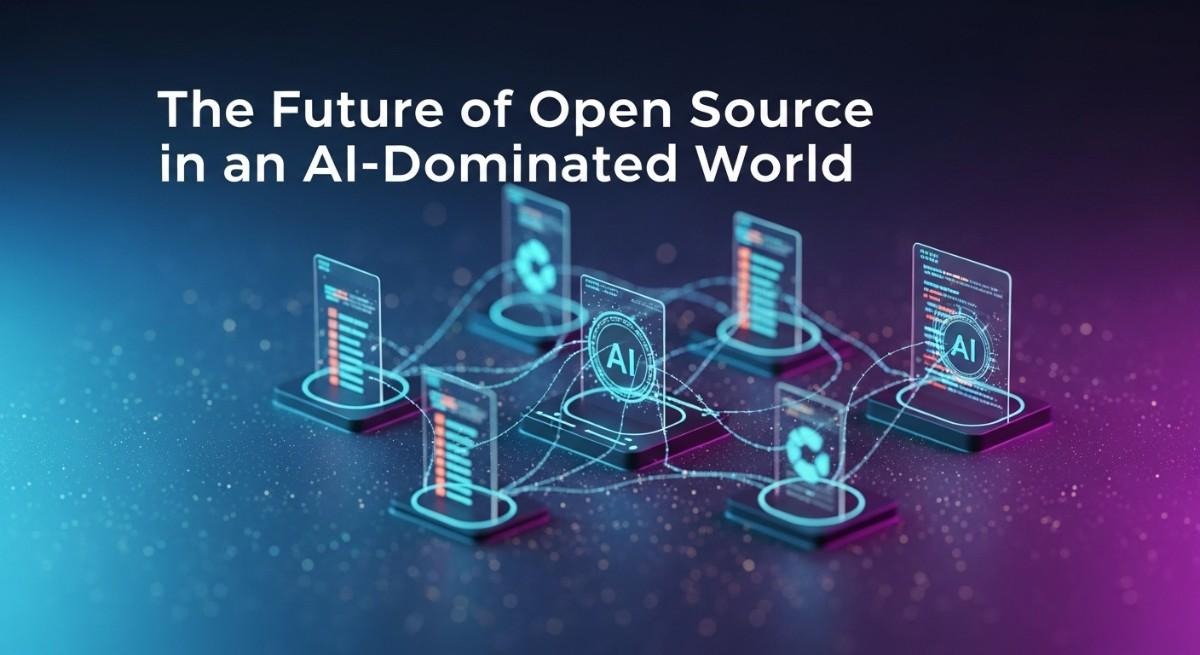
TL;DR Technology does not sit still. It accelerates. Artificial intelligence now shapes every part of the software landscape. Developers, enterprises, and governments all ask the same question. What happens to open source software when AI controls more of the stack?
The future of open source in an AI-dominated world is not a distant concern. It is happening right now. AI tools write code. AI models train on open source repositories. AI companies build proprietary products on open foundations.
This creates tension. It raises questions about ownership, fairness, sustainability, and control. Open source communities that once thrived on shared contribution now face new pressures from powerful AI systems and well-funded corporations.
This blog explores these pressures in depth. It examines where open source stands today, how AI is reshaping it, and what the path forward looks like for developers, businesses, and the broader tech ecosystem.
Table of Contents
Understanding the Current State of Open Source Software
Open source software powers the modern world. Linux runs most servers on earth. Apache, PostgreSQL, and Kubernetes form the backbone of enterprise infrastructure. Mozilla Firefox, Python, and React shape user experiences across billions of devices.
The open source model works on a simple principle. Code is public. Anyone can read it, use it, modify it, and contribute to it. Collaboration drives improvement. Communities maintain projects over years and sometimes decades.
This model produced extraordinary results. It democratized software development. A student in Nairobi could build on the same codebase as an engineer at Google. That level playing field changed everything about who could participate in technology.
But the future of open source in an AI-dominated world puts pressure on this model. AI changes who creates code, how code gets maintained, and who profits from shared work. The old assumptions no longer hold as firmly as they once did.
How Open Source Communities Built the Internet’s Foundation
The 1990s and 2000s saw explosive growth in open source adoption. Linus Torvalds released the Linux kernel in 1991. Richard Stallman’s GNU project laid ethical groundwork. Apache Software Foundation organized collaborative development at scale.
These early communities worked on pure collaboration and shared values. Contributors volunteered their time. Companies eventually joined and contributed back. The ecosystem grew stronger with each passing year.
GitHub transformed open source contribution in 2008. It gave developers a social platform for code. Pull requests became the lingua franca of collaboration. Millions of repositories became publicly accessible overnight.
Today, open source is the default starting point for most software development. No serious developer builds entirely from scratch. The shared ecosystem saves billions of hours annually. That foundation now faces scrutiny in the age of AI.
How AI Is Disrupting the Open Source Ecosystem
AI disrupts open source from multiple directions at once. Large language models train on vast repositories of open source code. These models generate new code without crediting original authors or contributing back to projects.
The future of open source in an AI-dominated world depends heavily on how this dynamic resolves. Right now, it remains deeply unresolved. Legal battles are brewing. Licensing debates intensify. Communities feel the strain.
GitHub Copilot sparked the most public debate. It trained on billions of lines of open source code. It suggests code completions to developers. Critics argue this violates the spirit of open source licenses. Supporters argue it falls within fair use.
This is not a minor disagreement. It touches the core principle of open source: shared work deserves shared credit. When AI extracts value without contributing back, the sustainability of open source communities comes into question.
AI companies also release some models as open source while keeping critical components proprietary. They gain the community trust of openness while retaining commercial control. This hybrid approach blurs the line between open and closed.
AI Code Generation and Its Impact on Developer Communities
AI code generation tools now write functional code in seconds. Tools like GitHub Copilot, Tabnine, and Amazon CodeWhisperer complete functions, suggest fixes, and generate boilerplate at remarkable speed.
This changes the role of developers. Junior developers rely on AI suggestions more heavily. Senior developers use AI to accelerate tedious tasks. The nature of contribution to open source projects shifts.
Some maintainers report receiving more AI-generated pull requests. These contributions often lack context. They fix surface symptoms without understanding root causes. Reviewing them requires more effort than reviewing human-written contributions.
The future of open source in an AI-dominated world includes this new dynamic. Maintainers must now evaluate both human and AI contributions. That increases their burden. Many maintainers already work without pay. Adding AI review overhead risks further burnout.
The Licensing Crisis at the Heart of AI and Open Source
Licensing sits at the center of the open source and AI conflict. Open source licenses exist to govern how software gets used, modified, and distributed. AI training complicates every assumption these licenses were built on.
The GPL requires derivative works to carry the same license. The MIT license allows almost any use. Creative Commons governs content. None of these licenses anticipated a world where AI would train on millions of files simultaneously.
When an AI model trains on GPL-licensed code, does the resulting model become a derivative work? Legal scholars disagree. Courts have not yet settled the question definitively. This ambiguity creates risk for every company using AI tools trained on open source.
The future of open source in an AI-dominated world requires new licensing frameworks. Several projects already responded. The Server Side Public License, the Commons Clause, and various AI-specific addenda attempt to close loopholes. These efforts are imperfect but necessary.
The Open Source Initiative sparked controversy when it debated whether AI-specific licenses qualify as truly open source. Some licenses restrict AI training use. The OSI argues that any restriction on use violates open source principles. Others argue that without such protections, open source becomes a free resource for commercial AI with no reciprocity.
New Licensing Models Emerging for the AI Era
Several new license types emerged specifically to address AI and open source tensions. The Responsible AI License family adds ethical use restrictions. The RAIL license prohibits uses that cause harm. The Open RAIL-M license applies specifically to AI models.
Hugging Face adopted RAIL licenses for several models. This acknowledged that model licensing requires different thinking than software licensing. A model trained on data is not quite code and not quite content. It occupies a new legal category.
Some developers and companies created source-available licenses. These licenses share code publicly but restrict commercial use without a paid license. HashiCorp adopted the Business Source License for Terraform. Elastic made a similar move. These decisions sparked fierce community reactions.
The future of open source in an AI-dominated world will produce more licensing innovation. The current frameworks are insufficient. New models must balance openness, sustainability, and protection against extractive commercial use.
Open Source AI Models and the Democratization Debate
Open source AI models represent one of the most exciting developments in modern technology. Meta released the LLaMA family of models with open weights. Mistral AI released powerful small models openly. Stability AI released Stable Diffusion.
These releases democratized access to powerful AI capabilities. Researchers, startups, and hobbyists could run state-of-the-art models on consumer hardware. This reflected classic open source values: powerful tools for everyone.
But the future of open source in an AI-dominated world raises hard questions about what open AI truly means. Releasing model weights is not the same as releasing training data, training code, and full reproducibility details. Many so-called open models are only partially open.
True openness in AI requires more than sharing a model file. It requires sharing training data provenance, compute requirements, fine-tuning details, and evaluation methodology. Very few AI releases meet this full standard of openness.
The community debate around open versus closed AI models mirrors older debates in software. But the stakes feel higher. AI systems influence hiring, lending, healthcare, and criminal justice. Opacity in these systems carries significant social risk.
Why Open Source AI Models Matter for Innovation
Open source AI models accelerate research dramatically. When researchers can examine model internals, they identify problems faster. They propose improvements. They build benchmarks. The entire field moves forward more quickly.
Open models also enable customization at scale. A hospital can fine-tune an open medical language model on its own data. A legal firm can adapt an open model for contract analysis. This customization would be impossible with purely proprietary systems.
Security researchers depend on open models. They probe for vulnerabilities, jailbreaks, and biases. This adversarial testing makes AI safer. Closed models receive far less external scrutiny. Problems go undetected longer.
The future of open source in an AI-dominated world benefits enormously from thriving open model ecosystems. Communities that maintain open models create shared infrastructure everyone can build on. That shared infrastructure is the same gift Linux gave the software world decades ago.
Sustainability Challenges for Open Source in the AI Age
Open source sustainability was already fragile before AI arrived. Many critical projects run on volunteer labor. Maintainers burn out. Funding gaps appear. The Log4Shell vulnerability in 2021 exposed how dangerously under-resourced critical open source infrastructure had become.
AI amplifies these sustainability challenges. AI companies extract enormous value from open source foundations. They build billion-dollar products on freely available code. Many contribute very little back in proportion to what they gain.
The future of open source in an AI-dominated world demands a rethinking of how open source gets funded. Several models show promise. Sponsorship platforms like GitHub Sponsors and Open Collective provide direct funding paths. Some projects adopt open core models where the core is free but enterprise features carry a price.
Large tech companies like Google, Microsoft, and Red Hat employ developers to work on open source projects full-time. This corporate sponsorship helps but creates dependency. When corporate priorities shift, contributions can disappear suddenly.
Foundations like the Linux Foundation, Apache Software Foundation, and OpenSSF provide stability and funding coordination. These organizations pool resources from multiple companies to sustain shared infrastructure. Their role grows more critical as AI raises the stakes.
How Developers and Companies Can Support Open Source Sustainability
Individual developers can support sustainability by contributing code, documentation, and bug reports. Even small contributions reduce maintainer burden. Filing clear bug reports saves hours of debugging time. Writing documentation helps new contributors onboard faster.
Companies benefit most from open source and carry the greatest responsibility for its health. Contributing code back upstream is the gold standard. Funding maintainers directly through sponsorship programs is equally impactful.
Participating in foundations and standards bodies helps shape open source governance. Corporate voices carry weight in these organizations. Companies that engage constructively push the ecosystem toward healthier norms.
The future of open source in an AI-dominated world depends on companies treating open source as an investment, not a free resource. The returns on that investment are enormous. The cost of neglect could be catastrophic for the entire tech ecosystem.
Governance and Ethics in Open Source AI Development
Governance structures determine how open source projects make decisions. For software projects, governance evolved over decades. Benevolent dictators, foundations, steering committees, and RFC processes all emerged organically.
AI development demands more structured governance. The decisions made during AI training have broader social impact than most software decisions. Training data choices, safety measures, and deployment restrictions all require careful deliberation.
The future of open source in an AI-dominated world requires governance frameworks that match the social stakes of AI. This means diverse representation in decision-making. It means transparency about training data and model behavior. It means accountability mechanisms for harmful outputs.
The Hugging Face community model offers one template. Researchers share models and datasets with model cards documenting limitations and intended uses. Community standards enforce ethical norms. Violations get flagged publicly.
Government regulation adds another layer. The EU AI Act creates obligations for high-risk AI systems regardless of whether they use open source components. The US Executive Order on AI directs agencies to engage with open source AI safety. Regulatory frameworks will shape open source AI governance significantly in coming years.
Building Ethical Open Source AI Communities
Ethical open source AI communities share several characteristics. They document their training data sources honestly. They acknowledge model limitations clearly. They set explicit usage restrictions for harmful applications.
Community codes of conduct matter more in AI than in traditional software. The potential for AI systems to cause harm at scale makes behavioral norms critical. Projects that take ethics seriously attract more responsible contributors.
Diverse contributor communities produce better AI systems. Models trained and evaluated by diverse teams show fewer demographic biases. Open source communities that actively recruit globally and inclusively build better products.
The future of open source in an AI-dominated world improves when ethics becomes a first-class consideration alongside performance and efficiency. The communities that embed ethics into their development culture will build AI systems the world can trust.
Frequently Asked Questions
Is open source software at risk from AI dominance?
Open source faces real pressure from AI but remains vital. AI companies depend on open source infrastructure. The risk comes from extractive use without contribution back. The future of open source in an AI-dominated world improves when communities enforce stronger reciprocity norms and update licensing frameworks.
Can AI tools be considered truly open source?
Open source AI requires more than sharing model weights. True openness includes training data, training code, evaluation details, and reproducibility. Most current AI releases fall short of this standard. The definition of open source for AI continues to evolve actively.
How does AI affect open source licensing?
Current licenses were not designed with AI training in mind. GPL, MIT, and Apache licenses do not clearly address whether training an AI on licensed code creates a derivative work. New license types like RAIL and BSL attempt to fill these gaps with varying degrees of success.
What is the role of open source in AI safety?
Open source plays a critical role in AI safety. External researchers can audit open models for vulnerabilities, biases, and failure modes. Closed models receive less scrutiny and carry higher undetected risk. Openness enables the adversarial testing that makes AI systems safer over time.
Which companies lead open source AI contributions?
Meta, Hugging Face, Mistral AI, Google DeepMind, and EleutherAI lead meaningful open source AI contributions. Meta’s LLaMA models and Google’s Gemma represent significant releases. Hugging Face hosts the largest open model repository with millions of community contributions.
How will open source communities evolve with AI?
Open source communities will develop new roles and norms around AI. Maintainers will set explicit AI contribution policies. Licensing will evolve to address training data use. Foundations will create AI-specific working groups. The future of open source in an AI-dominated world belongs to communities that adapt proactively rather than reactively.
What secondary keywords relate to this topic for SEO?
Related secondary keywords include open source AI models, AI licensing challenges, open source sustainability, AI code generation tools, open source governance, ethical AI development, and AI and developer communities. Content covering these subtopics signals topical authority and captures broader search traffic.
What the Next Five Years Look Like for Open Source and AI
The next five years will define the future of open source in an AI-dominated world more decisively than the last twenty years of software development. The pace of change is that significant.
Expect licensing frameworks to stabilize. Courts will issue rulings on AI training and copyright. Legislatures in the EU and US will pass regulations touching open source AI. These decisions will create clearer rules even if communities disagree with them.
Open source AI models will become more capable and more accessible. Running powerful AI locally will become routine. This reduces dependence on cloud AI providers. It returns control to individual developers and small organizations.
Corporate investment in open source AI will grow. Companies that try to compete with closed proprietary systems against thriving open source alternatives will struggle. Open source moves faster when communities coordinate effectively.
New funding mechanisms will emerge. AI companies that extract value from open source will face increasing pressure to contribute financially. Some will do so voluntarily. Regulatory frameworks may eventually require it.
Developer roles will shift significantly. AI handles more implementation work. Developers focus more on architecture, ethics, and product thinking. Open source contribution will emphasize design decisions and governance over raw code volume.
The communities that thrive will be those that embrace AI as a tool while defending the principles that made open source powerful: transparency, collaboration, shared ownership, and the belief that knowledge belongs to everyone.
Preparing Your Organization for the Open Source AI Future
Organizations should audit their open source dependencies immediately. Understand which projects underpin your stack. Identify which are under-resourced. Begin contributing or funding them before problems emerge.
Establish clear internal policies on AI-generated code contributions. Decide whether your teams will contribute AI-generated code to upstream projects. Document your policy and communicate it to engineering teams.
Engage with licensing changes proactively. When critical dependencies change licenses, understand the implications immediately. Legal teams need AI literacy to evaluate new license types accurately.
Invest in open source literacy across your engineering organization. Developers who understand open source governance make better contribution decisions. They navigate licensing questions with greater confidence.
The future of open source in an AI-dominated world rewards organizations that engage thoughtfully and generously. Those organizations shape the ecosystem rather than simply consuming it.
Read More:-How “Agentic Workflows” Will Replace Traditional Software
Conclusion

The future of open source in an AI-dominated world holds enormous promise and genuine risk in equal measure. Open source gave the world shared infrastructure that powered decades of innovation. AI now both depends on that foundation and threatens to undermine it.
The tension between openness and extraction will not resolve itself. Communities, companies, and governments must make deliberate choices. Licensing frameworks need updating. Funding models need rethinking. Governance structures need strengthening.
None of this is impossible. The open source community adapted before. It grew from scattered hobbyist projects into the backbone of global technology. That same adaptability can carry it through the AI transition.
The future of open source in an AI-dominated world improves with every developer who contributes back, every company that funds maintainers, and every organization that chooses open tools over proprietary alternatives.
Open source is not just a development methodology. It is a philosophy about how knowledge should flow. AI makes that philosophy more relevant, not less. The fight for open knowledge in an AI world is worth having. The stakes are higher than ever.
Stay engaged. Contribute. Fund. Advocate. The future of open source in an AI-dominated world belongs to those who show up to build it.