Introduction
TL;DR Large language models transformed how applications understand natural language. Users express intent through conversational interfaces easily. Traditional programming required rigid command structures. Modern LLMs interpret requests flexibly and intelligently. Your applications become more intuitive instantly.
Function calling bridges language understanding and concrete actions. LLMs decide which APIs to invoke automatically. Parameters extract from user messages naturally. Real-world integrations happen through structured interfaces. Function Calling in LLMs enables practical applications.
The technology moves beyond simple chatbots significantly. Weather queries trigger actual API requests. Database searches execute from natural questions. Payment processing initiates through conversational commands. Your applications perform useful work rather than just talking.
This comprehensive guide walks through implementation thoroughly. You’ll learn architecture patterns and best practices. Real code examples demonstrate practical approaches. Common pitfalls get addressed proactively. Your function calling implementation will succeed.
Table of Contents
Understanding Function Calling Fundamentals
Function calling represents structured tool use. LLMs examine user messages carefully. Available functions get evaluated for relevance. Best matches get selected automatically. Parameters populate from message content intelligently.
The process differs from prompt engineering fundamentally. Prompts generate unstructured text outputs. Function calls produce JSON with defined schemas. APIs consume structured data reliably. Function Calling in LLMs creates actionable outputs.
OpenAI pioneered the approach in 2023. GPT-3.5 and GPT-4 gained capability. Anthropic added similar features to Claude. Open-source models adopted the pattern. Industry standardization emerged rapidly.
Reliability exceeds traditional prompt parsing. Function names select deterministically. Required parameters rarely get omitted. Type validation happens automatically. Your integration logic becomes simpler.
Cost efficiency improves through optimization. Shorter prompts reduce token usage. Structured outputs eliminate parsing overhead. Retry logic needs less complexity. Token consumption decreases measurably.
Architecture Patterns for Function Calling
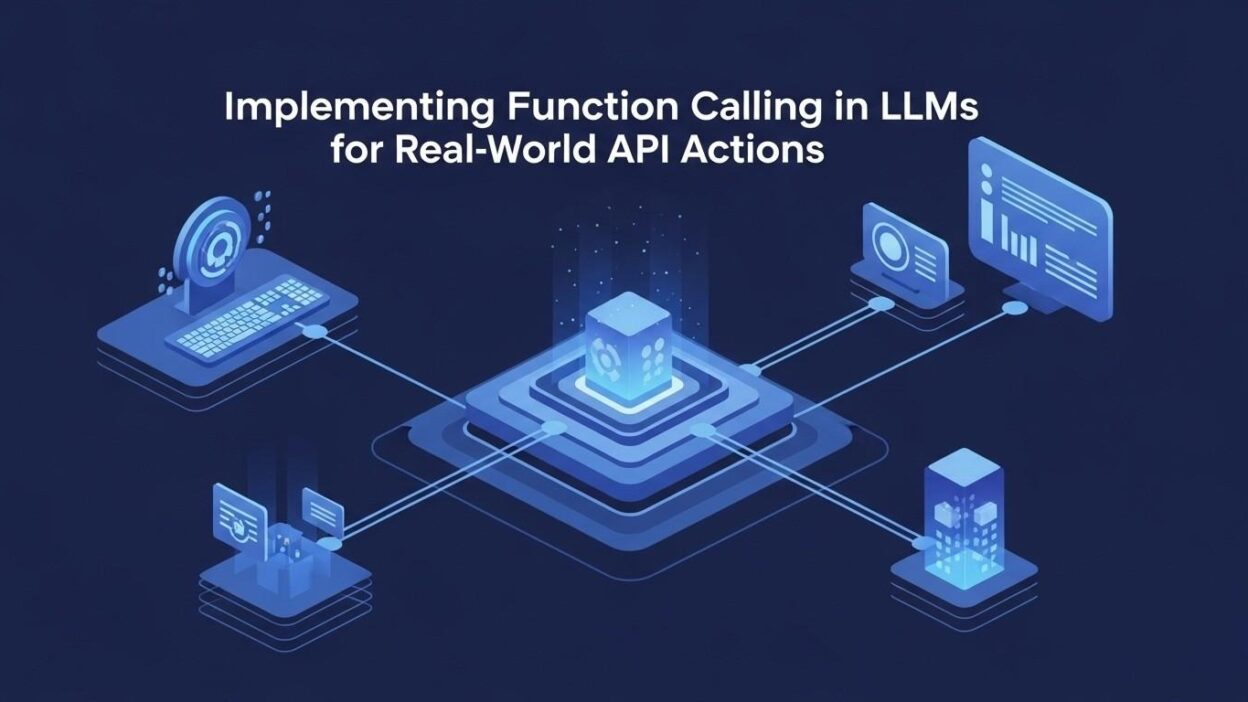
Request-response cycles form the basic pattern. User messages arrive at your application. LLM API receives message and function definitions. Model decides whether to call functions. Responses return function calls or text.
Your application executes selected functions. External APIs get invoked with parameters. Results return to your application. Function results send back to LLM. Final responses incorporate execution outcomes. Function Calling in LLMs orchestrates this flow.
Stateless designs simplify implementation significantly. Each request contains complete context. Previous conversation history includes explicitly. Function definitions repeat every call. Scaling becomes straightforward through statelessness.
Stateful approaches maintain conversation context. Session storage persists across requests. Function history informs future calls. Memory reduces token consumption. Complexity increases but efficiency improves.
Multi-turn conversations enable complex workflows. Initial calls gather information requirements. Subsequent calls execute actions. Confirmation steps prevent mistakes. User experience stays natural throughout.
Defining Functions for LLM Consumption
Function schemas follow JSON Schema format. Name fields identify functions uniquely. Description fields explain purpose clearly. Parameters get defined with types. Function Calling in LLMs requires precise definitions.
Descriptive naming improves selection accuracy. Verbs indicate actions clearly. Nouns specify targets explicitly. Ambiguity decreases through specificity. LLMs choose correctly more often.
Detailed descriptions guide model behavior. Explain when to use functions. Describe what operations accomplish. Include example use cases. Clarity improves calling decisions.
Parameter definitions enforce structure rigorously. Required fields prevent incomplete calls. Optional parameters add flexibility. Type specifications ensure validation. Default values provide fallbacks.
Enum values constrain inputs appropriately. Valid options list explicitly. Invalid inputs get prevented. Error rates decrease substantially. Your API receives clean data.
Implementing Function Calling with OpenAI
OpenAI API provides straightforward integration. Chat completions endpoint accepts functions. Tools parameter contains function definitions. Messages array includes conversation history. Function Calling in LLMs happens through simple requests.
Authentication requires API key configuration. Environment variables store credentials securely. Headers include authorization tokens. Rate limits apply per organization. Billing tracks token consumption.
Function definitions construct programmatically. JSON objects describe each function. Names use snake_case convention. Parameters follow JSON Schema strictly. Validation happens client-side first.
Response handling checks for function calls. Choices array contains model output. Message object includes function call. Tool calls property lists functions. Arguments contain extracted parameters.
Execution logic invokes actual functions. Parameter validation prevents errors. External APIs get called safely. Results format into responses. Error handling maintains robustness.
Results return to model for synthesis. Function call results append to messages. Model generates natural language response. Users receive coherent answers. Function Calling in LLMs completes full cycle.
Using Claude’s Function Calling Features
Anthropic implements function calling similarly. Claude API accepts tool definitions. System prompts can enhance behavior. Structured outputs ensure reliability. Integration patterns mirror OpenAI closely.
Tool definitions use consistent schema. Name and description fields match. Input schemas define parameters. Required arrays enforce completeness. Your implementation stays portable.
Claude excels at complex reasoning tasks. Multi-step function sequences work well. Context understanding runs deep. Edge case handling improves. Reliability increases for difficult scenarios.
Prompt engineering complements function calling. System messages guide model behavior. Examples demonstrate desired patterns. Instructions clarify edge cases. Function Calling in LLMs combines techniques effectively.
Response formats accommodate various needs. Text blocks contain natural language. Tool use blocks indicate calls. Stop reasons signal completion. Your application parses appropriately.
Error recovery mechanisms matter greatly. Retry logic handles transient failures. Fallback functions provide alternatives. Graceful degradation maintains service. User experience stays smooth.
Building Function Registries
Centralized registries organize functions systematically. Dictionary structures map names to implementations. Metadata stores definitions. Validation logic ensures correctness. Function Calling in LLMs scales through organization.
Dynamic registration enables extensibility. Decorators mark callable functions. Metadata extraction happens automatically. Runtime discovery builds registries. Your codebase stays maintainable.
Type safety prevents runtime errors. Static analysis catches mistakes early. Parameter validation enforces contracts. Return types ensure consistency. Bugs decrease through strictness.
Documentation generation automates maintenance. Function definitions convert to schemas. Comments become descriptions. Type hints inform parameters. Your documentation stays synchronized.
Versioning supports evolution gracefully. Multiple function versions coexist. Deprecation warnings guide migration. Breaking changes isolate impact. Backward compatibility preserves.
Handling Multi-Function Workflows
Sequential execution chains operations logically. First function output feeds next input. Dependencies determine ordering. Results accumulate across steps. Function Calling in LLMs coordinates sequences.
Parallel execution optimizes performance. Independent functions run simultaneously. Results aggregate at completion. Latency decreases substantially. Throughput increases significantly.
Conditional logic enables decision trees. Function results determine next actions. Branches handle different scenarios. Loops iterate until completion. Complex workflows become possible.
Transaction semantics ensure consistency. All-or-nothing execution prevents partial states. Rollback mechanisms undo failures. Idempotency enables safe retries. Data integrity maintains.
Error propagation requires careful design. Failures bubble up appropriately. Retry logic applies selectively. Compensation actions undo changes. Robustness increases through planning.
Securing Function Call Execution
Authentication verifies caller identity. API keys authenticate requests. JWT tokens carry user context. OAuth flows handle authorization. Function Calling in LLMs respects permissions.
Authorization controls function access. Role-based rules determine availability. User permissions gate execution. Sensitive operations require elevation. Security policies enforce consistently.
Input validation prevents injection attacks. Parameter sanitization removes threats. Type checking ensures correctness. Length limits prevent overflows. Your APIs stay protected.
Rate limiting prevents abuse. Per-user quotas apply. Burst allowances accommodate spikes. Throttling protects resources. Costs stay controlled.
Audit logging tracks all activity. Function calls get recorded. Parameters log for forensics. Results capture for compliance. Accountability ensures throughout.
Optimizing Performance and Cost
Function definition optimization reduces tokens. Minimal descriptions convey intent. Parameter schemas stay concise. Unnecessary fields get removed. Function Calling in LLMs costs less.
Caching eliminates redundant calls. Identical requests serve cached responses. TTL policies balance freshness. Hit rates optimize over time. Latency decreases dramatically.
Batching groups related operations. Multiple function calls combine. API round trips decrease. Network overhead amortizes. Efficiency improves substantially.
Lazy evaluation defers expensive operations. Cheap checks happen first. Expensive calls trigger conditionally. Resources conserve effectively. Performance optimizes naturally.
Model selection balances capability and cost. GPT-4 handles complex reasoning. GPT-3.5 executes simple tasks. Right-sizing saves money. Quality requirements determine choice.
Error Handling and Recovery
Validation errors catch problems early. Schema mismatches get detected. Required parameters enforce. Type errors prevent execution. Function Calling in LLMs validates thoroughly.
Execution errors need graceful handling. Try-catch blocks contain failures. Error messages explain problems. Fallback logic provides alternatives. Users experience resilience.
Timeout handling prevents hanging. Maximum execution time enforces. Long-running operations get cancelled. Resources release properly. System stability maintains.
Retry strategies improve reliability. Exponential backoff prevents overload. Circuit breakers stop cascades. Dead letter queues capture failures. Recovery happens systematically.
User communication maintains trust. Error messages explain clearly. Suggestions guide next steps. Apologies acknowledge failures. Transparency builds confidence.
Testing Function Calling Systems
Unit tests verify individual functions. Input variations test thoroughly. Edge cases get covered. Error conditions validate. Function Calling in LLMs needs testing.
Integration tests validate end-to-end flows. Mock LLM responses enable testing. Real APIs get called in staging. Results verify correctness. Confidence builds through coverage.
Property-based testing discovers edge cases. Random inputs generate automatically. Invariants get verified. Unexpected failures surface. Robustness increases substantially.
Load testing validates scalability. Concurrent requests simulate production. Performance metrics collect. Bottlenecks identify clearly. Capacity planning informs.
Monitoring detects production issues. Error rates track continuously. Latency percentiles measure. Success rates quantify. Alerts notify problems.
Real-World Implementation Examples
Weather applications demonstrate basics well. User queries trigger API calls. Location extraction happens automatically. Weather APIs return current data. Function Calling in LLMs fetches real information.
E-commerce integrations enable transactions. Product searches query databases. Cart operations modify state. Checkout processes payments. Conversational commerce becomes practical.
Customer support automates common tasks. Ticket creation happens conversationally. Status checks query systems. Information retrieval serves answers. Human escalation handles complexity.
Data analysis tools generate insights. SQL queries construct from questions. Visualizations generate automatically. Statistical analysis executes. Business intelligence becomes accessible.
Home automation controls devices. Voice commands trigger actions. State queries report status. Scheduling programs behavior. Smart homes become truly intelligent.
Advanced Patterns and Techniques
Streaming responses improve user experience. Partial results display progressively. Function calls interleave with text. Latency perception decreases. Function Calling in LLMs feels responsive.
Function composition builds complexity. Small functions combine powerfully. Higher-order functions enable abstraction. Reusability increases substantially. Maintainability improves dramatically.
Adaptive function selection optimizes behavior. Usage patterns inform availability. Popular functions prioritize. Rare functions defer loading. Performance optimizes automatically.
Context-aware parameter extraction improves accuracy. Conversation history informs extraction. User preferences apply automatically. Previous interactions guide decisions. Personalization emerges naturally.
Feedback loops enhance quality. User corrections inform improvements. Success rates track per function. Models fine-tune on feedback. Accuracy increases over time.
Debugging and Troubleshooting
Logging captures execution details. Function calls log with parameters. Results record systematically. Timestamps enable correlation. Function Calling in LLMs becomes observable.
Trace IDs connect related operations. Requests track across systems. Distributed tracing reveals flows. Bottlenecks identify clearly. Understanding deepens substantially.
Interactive debugging explores behavior. Breakpoints pause execution. Variables inspect at runtime. Step-through reveals logic. Issues resolve faster.
Replay capabilities reproduce problems. Request logs enable replay. Deterministic execution aids debugging. Root causes identify. Fixes validate thoroughly.
Metrics dashboards visualize health. Success rates display prominently. Error rates alert problems. Latency trends show performance. Operations teams stay informed.
Best Practices and Guidelines
Start simple and iterate continuously. Basic functions prove concept. Complexity adds gradually. Learning compounds through practice. Function Calling in LLMs mastery develops.
Documentation maintains quality. Function purposes explain clearly. Parameter meanings describe. Examples demonstrate usage. Teams align through clarity.
Version control tracks changes. Function definitions version. Breaking changes communicate. Migration paths provide. Evolution happens smoothly.
Security reviews happen regularly. Permissions audit periodically. Vulnerabilities scan continuously. Compliance verifies. Protection maintains consistently.
Performance monitoring guides optimization. Metrics inform decisions. Bottlenecks get addressed. Efficiency improves systematically. Excellence pursues relentlessly.
Frequently Asked Questions
What models support Function Calling in LLMs?
OpenAI GPT-3.5 and GPT-4 support natively. Claude from Anthropic includes capability. Google PaLM 2 offers similar features. Open-source models add support gradually. LLaMA-based models gain functionality. Compatibility expands continuously. Most modern LLMs include now. Your options grow regularly.
How reliable is function parameter extraction?
Accuracy depends on definition clarity. Well-described functions extract reliably. Required parameters rarely get omitted. Type validation catches errors. Optional parameters handle appropriately. Edge cases need testing. Overall reliability exceeds 95% typically. Your testing validates thoroughly.
Can I call multiple functions simultaneously?
Sequential calling works universally. Parallel execution requires custom orchestration. Some APIs support tool choice arrays. Your application logic coordinates. Multiple calls chain naturally. Results aggregate appropriately. Concurrency patterns apply. Optimization opportunities exist.
How do I handle function execution failures?
Try-catch blocks contain errors. Error messages return to LLM. Model explains failures naturally. Retry logic attempts again. Fallback functions provide alternatives. Users receive clear communication. Graceful degradation maintains service. Function Calling in LLMs needs robustness.
What security risks exist with function calling?
Injection attacks target parameters. Validation prevents most issues. Authorization controls access. Rate limiting prevents abuse. Audit logging tracks activity. Security reviews catch vulnerabilities. Best practices mitigate risks. Your vigilance protects.
How much does function calling cost?
Token usage determines pricing. Function definitions consume tokens. Responses include overhead. Optimization reduces costs. Caching eliminates redundancy. Model selection impacts significantly. Typical increase runs 10-30%. Your usage varies.
Can I use custom models for function calling?
Fine-tuning enables custom models. Training requires function examples. Smaller models cost less. Accuracy may decrease slightly. Testing validates thoroughly. Open-source options exist. Self-hosting provides control. Function Calling in LLMs adapts.
How do I debug function calling issues?
Logging captures all interactions. Request-response pairs record. Function calls track completely. Error messages guide diagnosis. Trace IDs connect flows. Replay enables reproduction. Metrics quantify behavior. Your visibility increases.
Read more:-Make.com vs n8n: Which Automation Tool Scales Better for Enterprises?
Conclusion
Function Calling in LLMs revolutionizes application development. Natural language interfaces trigger real actions. APIs integrate through conversational commands. User experience improves dramatically. Practical applications multiply rapidly.
The technology transforms countless domains. Customer service automates efficiently. E-commerce becomes conversational. Data analysis grows accessible. Home automation gains intelligence. Possibilities expand continuously.
Implementation requires thoughtful architecture. Function schemas define precisely. Execution logic handles robustly. Error recovery maintains reliability. Security protects consistently.
OpenAI and Anthropic provide capable platforms. APIs standardize gradually. Integration patterns emerge. Best practices develop. Ecosystem maturity increases.
Optimization balances cost and performance. Token usage minimizes strategically. Caching eliminates redundancy. Model selection right-sizes. Efficiency maximizes naturally.
Testing ensures quality rigorously. Unit tests verify components. Integration tests validate flows. Load tests confirm scalability. Monitoring detects issues.
Real-world applications demonstrate value. Weather apps fetch data. Shopping assistants complete transactions. Support bots resolve issues. Proof points multiply.
Advanced patterns unlock capabilities. Streaming improves responsiveness. Composition enables complexity. Adaptation optimizes performance. Innovation continues.
Debugging tools aid development. Logging captures details. Tracing reveals flows. Metrics quantify health. Observability empowers.
Best practices guide success. Simplicity starts projects. Documentation maintains clarity. Security protects assets. Excellence pursues always.
Your implementation journey begins now. Start with simple functions. Test thoroughly before expanding. Learn from production behavior. Iterate toward excellence.
Function Calling in LLMs represents the future. Conversational interfaces become standard. Natural language drives applications. Intelligence enhances everywhere. Your competitive advantage grows.
Remember that reliability matters most. Users trust consistent behavior. Errors handle gracefully. Recovery happens automatically. Quality sustains success.
Begin implementing today. Choose your platform carefully. Define functions precisely. Test rigorously always. Your applications will transform.
The technology matures rapidly. Capabilities expand continuously. Standards emerge gradually. Ecosystem grows substantially. Early adoption provides advantages.
Your users deserve better experiences. Natural interaction feels intuitive. Powerful actions happen easily. Complexity hides behind simplicity. Satisfaction increases measurably.
Invest in function calling infrastructure. Architecture decisions determine scalability. Quality gates ensure reliability. Monitoring enables operations. Success builds systematically.
Function Calling in LLMs changes everything. Language becomes interface. Actions follow naturally. Applications grow intelligent. The future arrives now.