Introduction
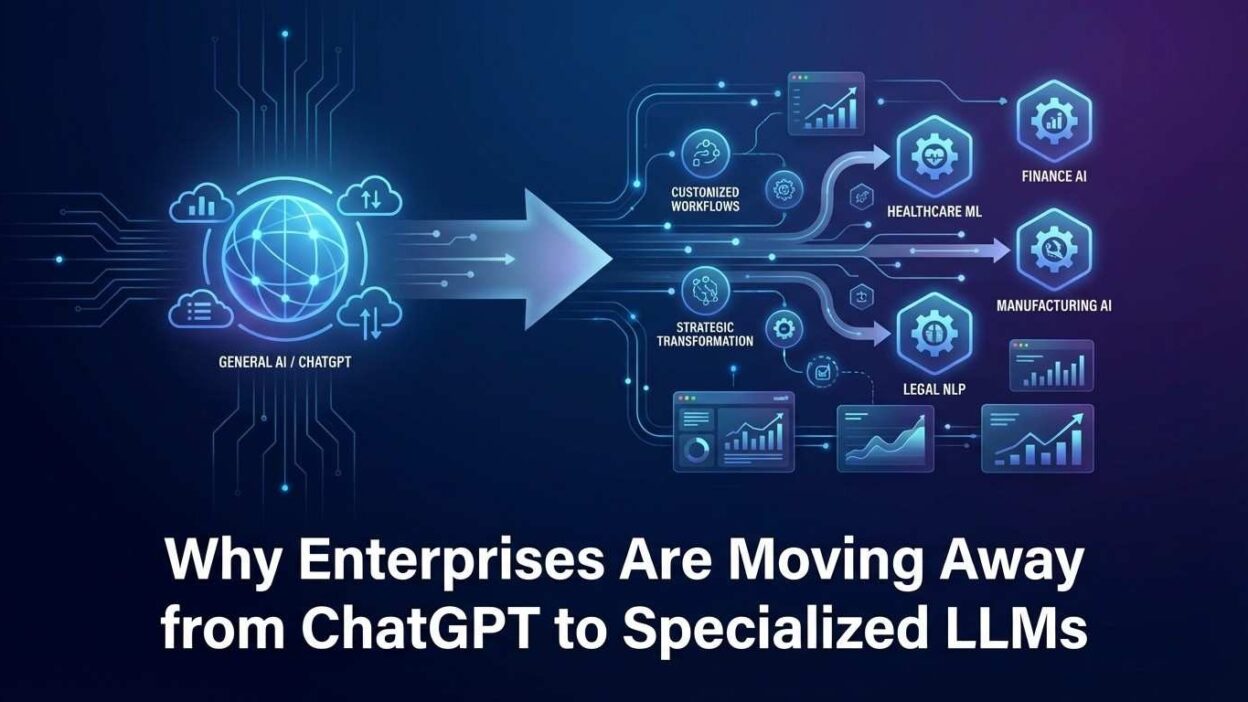
TL;DR The AI landscape is shifting fast. Enterprises around the world are rethinking their AI strategy. ChatGPT once looked like the obvious choice for every business. That is no longer the case. Today, enterprises moving away from ChatGPT to specialized LLMs is one of the biggest trends reshaping enterprise technology.
This blog breaks down why this shift is happening. It explores the real business drivers, technical challenges, and what this means for the future of enterprise AI.
Table of Contents
The ChatGPT Era in Enterprise AI: A Quick Look Back
When OpenAI launched ChatGPT, businesses rushed to experiment. The tool felt magical. It could draft emails, write code, summarize reports, and answer questions. Enterprises loaded it into internal tools and customer-facing products almost overnight.
For a while, it worked. Teams saved hours on repetitive writing tasks. Developers used it to accelerate code reviews. HR teams drafted policies faster. The productivity gains looked real and measurable.
ChatGPT was designed as a general-purpose AI assistant. It was built for broad audiences, not specific industries. That generality was its greatest strength at first. It was also the root of its limitations later.
Enterprise needs are never general. A legal firm needs precision. A hospital needs accuracy grounded in medical knowledge. A bank needs compliance-aware responses. ChatGPT could not reliably deliver that depth. The cracks started showing.
What Made ChatGPT Popular in Business Settings
ChatGPT offered three things businesses loved immediately. First, it was easy to access with zero setup. Second, it handled natural language with remarkable fluency. Third, it reduced the need for specialist knowledge in content-heavy tasks.
These features made it attractive for SMBs and large companies alike. Piloting AI required no complex infrastructure. That speed of adoption was unmatched in enterprise tech history.
Where ChatGPT Began to Fall Short
Enterprises soon hit walls. ChatGPT hallucinated facts. It gave confident but wrong answers on legal, medical, and financial topics. Data privacy became a major concern. Sending sensitive enterprise data to a third-party API violated compliance requirements in many regulated industries.
Customization was also limited. Companies wanted the model to reflect their brand voice, internal terminology, and domain knowledge. ChatGPT was not built for deep customization at the enterprise level.
Why Enterprises Are Moving Away from ChatGPT to Specialized LLMs
The trend of enterprises moving away from ChatGPT to specialized LLMs is driven by real performance gaps. General AI models do many things adequately. Specialized models do specific things exceptionally. For enterprise use, that difference matters enormously.
Domain Accuracy Is Non-Negotiable in Enterprise Environments
When a radiologist uses an AI model for medical image report drafting, accuracy is life-critical. When a compliance officer needs regulatory language reviewed, a hallucinated clause could cost millions in fines.
Specialized LLMs are trained or fine-tuned on domain-specific corpora. A medical LLM is fed on clinical notes, medical journals, and diagnostic guidelines. A legal LLM is trained on case law, contracts, and regulatory documents. This focus produces measurably better accuracy in targeted tasks.
General-purpose models like ChatGPT are trained on the broad internet. That breadth creates surface-level competence across topics but insufficient depth for high-stakes professional work.
Data Privacy and Compliance Demand Local or Private Models
GDPR, HIPAA, SOC 2, and industry-specific regulations govern how enterprises handle data. Sending employee records, patient data, or financial information to a public API is a compliance violation in most regulated sectors.
Specialized LLMs can be deployed on-premise or in private cloud environments. The enterprise retains full control over data flows. No data leaves the organization’s security perimeter. This is a requirement, not a preference, for healthcare, finance, and government sectors.
This compliance need alone explains why enterprises moving away from ChatGPT to specialized LLMs has become so widespread. It is not just about AI quality. It is about legal and operational risk management.
Cost Efficiency at Scale Favors Smaller, Focused Models
Running GPT-4 level models at enterprise scale is expensive. Token costs accumulate fast when millions of API calls are made daily. A specialized, smaller model fine-tuned for a specific task can match or exceed ChatGPT’s performance on that task. It costs a fraction of the price.
Many enterprises run small 7B or 13B parameter models on internal servers. These models handle the exact use cases the business needs. They do not pay for the general capabilities they never use.
This cost calculus is shifting enterprise AI procurement decisions industry-wide.
Customization and Brand Alignment Require Model Control
Enterprises have distinct identities. They have proprietary knowledge, unique workflows, and specific communication standards. Specialized LLMs can be fine-tuned on internal documentation, past interactions, and brand guidelines.
ChatGPT does not allow this depth of customization. Even with system prompts and custom GPTs, the underlying model behavior is fixed. It reflects OpenAI’s training data, not the enterprise’s institutional knowledge.
A specialized LLM can be tuned to speak in the company’s tone, follow its approval workflows, and reference its internal data accurately.
Industries Leading the Shift to Specialized LLMs
The movement of enterprises moving away from ChatGPT to specialized LLMs is visible across multiple sectors. Each industry has unique requirements that general AI simply cannot meet.
Healthcare: Precision Over Everything
Healthcare organizations demand models trained on medical evidence. Institutions use models like Med-PaLM, BioMedLM, and proprietary clinical AI systems. These tools understand ICD codes, drug interactions, and clinical terminology with precision ChatGPT cannot match.
Patient data cannot touch public AI infrastructure. Specialized deployment protects HIPAA compliance. The stakes of an AI error are clinical, not just reputational.
Legal: Accuracy and Source Traceability Are Essential
Law firms and corporate legal teams need AI that cites real sources. Hallucinated case law is professionally dangerous. Legal-specific LLMs are fine-tuned on verified legal databases, court records, and regulatory filings.
Tools like Harvey AI and CoCounsel are built specifically for legal professionals. They perform contract analysis and legal research with accuracy that generic models cannot consistently achieve.
Finance: Risk and Compliance Drive AI Decisions
Banks and investment firms operate under strict regulatory frameworks. Financial LLMs are fine-tuned on earnings reports, risk disclosures, market analyses, and compliance documentation.
Bloomberg’s BloombergGPT is a clear example. It outperforms general models on financial NLP tasks. It was trained on Bloomberg’s decades of financial data. That institutional knowledge cannot be replicated by a general-purpose model.
Manufacturing and Engineering: Technical Depth Is Required
Industrial enterprises need AI that understands technical manuals, equipment logs, and engineering specifications. General AI struggles with proprietary equipment terminology and failure pattern analysis.
Specialized models trained on sensor data, maintenance logs, and technical documentation support predictive maintenance and quality control with meaningful accuracy.
What Specialized LLMs Offer That ChatGPT Cannot Match
The pattern of enterprises moving away from ChatGPT to specialized LLMs is grounded in concrete performance advantages. These are measurable, not theoretical.
Retrieval-Augmented Generation with Private Knowledge Bases
Specialized LLMs pair with internal vector databases. This approach is called Retrieval-Augmented Generation (RAG). The model answers questions by pulling from real company documents, policies, and databases.
ChatGPT cannot access your internal systems in this way. Its knowledge is frozen at a training cutoff. Your company’s knowledge grows daily. A specialized, RAG-enabled LLM stays current with internal updates automatically.
Model Interpretability and Auditability
Regulated industries require AI decisions to be explainable. When an AI model denies a loan application or flags a clinical anomaly, compliance officers must understand why.
Open-source specialized models allow enterprises to audit model behavior. ChatGPT is a black box. Its decision logic cannot be examined or documented for regulatory review.
Reduced Latency for Mission-Critical Applications
Calling an external API adds latency. For real-time applications — fraud detection, patient monitoring, live customer support — milliseconds matter. A specialized model running on local infrastructure eliminates API round-trip delays.
This performance edge is significant for applications where speed directly affects business outcomes.
Open-Source Models Fueling the Enterprise Transition
The availability of powerful open-source models is a major catalyst for enterprises moving away from ChatGPT to specialized LLMs. Meta’s Llama 3 family and Mistral’s models have changed the math completely.
These models can be downloaded, fine-tuned, and deployed internally. The enterprise owns the model weights. There is no vendor dependency, no API cost, and no data sharing with a third party.
Llama 3.1 at 70 billion parameters matches GPT-4 performance on many benchmarks. Fine-tuned on domain-specific data, it can exceed ChatGPT on targeted tasks. The cost of running it internally is a fraction of GPT-4 API costs at scale.
Mistral’s models are exceptionally efficient. Mixtral 8x7B uses a mixture-of-experts architecture. It delivers strong performance at lower compute costs. European enterprises appreciate Mistral’s EU-based data residency commitments.
Google’s Gemma, Alibaba’s Qwen, and Microsoft’s Phi series offer additional options at various size and performance points. Enterprises now have a rich ecosystem of models to choose from. ChatGPT is no longer the default answer.
Building an Enterprise LLM Strategy After ChatGPT
Deciding to join the trend of enterprises moving away from ChatGPT to specialized LLMs requires a structured approach. Jumping to a new model without a clear strategy creates its own problems.
Map Your Use Cases with Precision
Not every task needs a specialized model. Start by cataloging AI use cases across departments. Identify which ones require domain accuracy, data privacy, or real-time performance. Those are your priority candidates for specialized LLMs.
General tasks like internal communication drafting or basic summarization may still work fine with a general-purpose model. Build a tiered AI strategy that matches model type to task criticality.
Evaluate Build vs. Buy vs. Fine-Tune
Building a model from scratch is expensive and time-consuming. Most enterprises should not do it. Buying a specialized vendor solution is faster but creates dependency and ongoing cost.
Fine-tuning an open-source base model is often the best path. It requires internal ML expertise but gives full ownership and customization depth. This is where most mature enterprises are heading.
Establish AI Governance from Day One
Model governance is not optional in enterprise AI. Define who owns the model. Set evaluation criteria for performance and safety. Create audit trails for AI-assisted decisions.
Build a model update cadence. Specialized LLMs need retraining as domain knowledge evolves. Establish a cycle for data refresh and model evaluation that keeps the AI accurate over time.
Measure ROI with Domain-Specific Benchmarks
Do not measure your specialized LLM against generic benchmarks. Build evaluation datasets from your own domain. Measure accuracy on the specific tasks the model must handle in production.
Track error rates, latency, user adoption, and cost per task. These metrics tell you whether your specialized model investment is delivering returns over general-purpose alternatives.
Challenges Enterprises Face When Transitioning to Specialized LLMs
The path of enterprises moving away from ChatGPT to specialized LLMs is not without friction. Organizations must be realistic about the hurdles involved.
Talent is the biggest challenge. Fine-tuning and deploying LLMs requires ML engineers, data scientists, and AI infrastructure expertise. Many enterprises lack this internal capability. Building it takes time and competitive hiring budgets.
Data readiness is another barrier. Specialized models need high-quality, labeled, domain-specific data. Many enterprises have siloed, unstructured, or poorly maintained data. Preparing that data for model training is a significant project in itself.
Change management matters too. Employees accustomed to ChatGPT need training on new tools. AI tools that feel less intuitive will face adoption resistance regardless of their technical superiority.
Despite these challenges, the business case for specialized AI is strong enough that leading enterprises are investing anyway. The question is not whether to transition but how fast and how carefully.
The Future of Enterprise AI: Specialized, Sovereign, and Scalable
The shift of enterprises moving away from ChatGPT to specialized LLMs points to a clear future state. Enterprise AI will be multi-model, private, and deeply integrated into business processes.
AI sovereignty will become a boardroom priority. Owning the models, the data, and the infrastructure reduces dependency on any single vendor. It protects the enterprise from pricing changes, API deprecations, and regulatory risks tied to third-party AI services.
Multi-model architectures will become standard. Enterprises will route tasks to the most appropriate model. A coding task goes to a code-specialized model. A contract review goes to the legal LLM. A customer support query goes to a fine-tuned service model. Orchestration layers will manage this routing automatically.
AI agents will amplify this shift. Autonomous agents that complete multi-step workflows will rely on specialized models for each step. Generalist AI is too unreliable for high-stakes autonomous operation.
The enterprises that build specialized AI capabilities now will lead their industries. Those that remain dependent on general-purpose public AI will face widening competitive gaps.
Frequently Asked Questions (FAQs)
Why are enterprises moving away from ChatGPT to specialized LLMs?
Enterprises need domain accuracy, data privacy, and deep customization. ChatGPT is a general-purpose model that cannot consistently meet these requirements at the enterprise level. Specialized LLMs are fine-tuned on domain-specific data and can be deployed privately, making them more suitable for regulated, high-stakes industries.
What is a specialized LLM?
A specialized LLM is a large language model trained or fine-tuned on a specific domain or task. Examples include medical LLMs for healthcare, legal LLMs for law firms, and financial LLMs for banking. They offer superior accuracy and reliability compared to general models in their target domain.
Is ChatGPT still useful for enterprises?
ChatGPT remains useful for general-purpose tasks that do not require deep domain expertise or strict data privacy. For non-critical use cases like drafting internal communications, brainstorming, or content creation, it is still a viable tool. High-stakes enterprise applications generally demand more specialized solutions.
What are the best open-source LLMs for enterprises in 2025?
Meta’s Llama 3 family, Mistral’s models, Google’s Gemma, and Microsoft’s Phi series are leading open-source options for enterprises in 2025. The best choice depends on task requirements, compute budget, and privacy needs. Each model family offers different parameter sizes and performance tradeoffs.
How much does it cost to deploy a specialized LLM?
Costs vary widely. Fine-tuning an open-source model can range from a few thousand dollars for simple tasks to hundreds of thousands for complex, large-scale deployments. Infrastructure costs depend on model size and usage volume. At enterprise scale, specialized models typically cost significantly less than paying per-token API fees to public AI providers.
How do specialized LLMs handle data security better than ChatGPT?
Specialized LLMs can be deployed on private cloud or on-premise infrastructure. This means sensitive data never leaves the enterprise’s security perimeter. ChatGPT operates as a public API where data is processed on OpenAI’s servers, creating compliance risks for regulated industries handling personal, financial, or medical data.
Read More:-Groq vs NVIDIA: Comparing LPU vs GPU for Ultra-Fast AI Inference
Conclusion

The movement of enterprises moving away from ChatGPT to specialized LLMs is not a fad. It is a strategic evolution driven by performance demands, compliance requirements, cost efficiency, and competitive pressure.
ChatGPT opened the door to enterprise AI adoption. It proved that natural language AI could add real business value. That contribution is significant and should not be dismissed. The technology earned its place in the enterprise toolkit.
The market has matured past that entry point. Enterprises now want AI that knows their industry, protects their data, fits their workflows, and scales economically. Specialized LLMs deliver on all four fronts in ways that general-purpose models cannot.
The winning enterprise AI strategy in 2025 and beyond is not a single model. It is a curated portfolio of specialized, purpose-built AI tools governed by clear policies and measured by domain-specific performance standards.
Enterprises that understand this shift and act on it today will build durable AI advantages. Those that wait will find competitors using AI that genuinely outperforms anything a general-purpose chatbot can offer.