Introduction
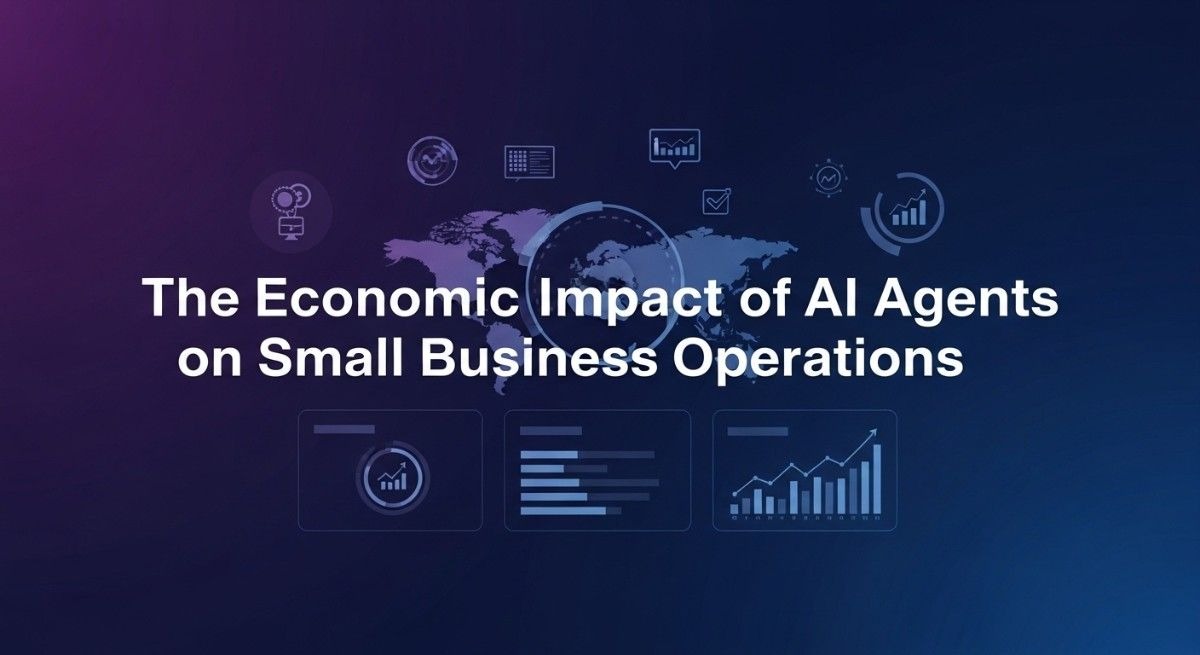
TL;DR Small businesses have always operated under a fundamental constraint. They cannot afford the specialist staff that large enterprises hire to handle marketing, finance, customer service, legal review, and operations. A founder doing it all burns out. A lean team stretched across too many functions makes costly mistakes. Until recently, this constraint was simply the price of being small. The economic impact of AI agents on small businesses is changing that reality in ways that are genuinely significant.
AI agents are not just automation tools. They are autonomous systems that take actions, make decisions within defined parameters, and complete complex multi-step tasks without constant human oversight. For small businesses, this means access to capabilities that previously required hiring specialized staff or paying for expensive professional services. The economic implications reach far beyond simple cost cutting.
This blog examines exactly how AI agents affect the economics of small business operations. You will see where the real savings come from, which functions deliver the strongest ROI, how risks balance against benefits, and what owners need to know before committing to AI agent adoption.
Table of Contents
Understanding What Makes AI Agents Different for Small Business
Small business owners hear the term AI constantly. Chatbots, automation tools, and AI writing assistants have been available for years. AI agents are fundamentally different from these earlier tools and the distinction matters for understanding the economic impact of AI agents on small businesses.
An AI agent does not just respond to prompts. It receives a goal, breaks that goal into steps, calls tools, makes decisions based on intermediate results, and continues until the task is complete or it needs human input. A business owner who tells an AI agent to research and compile a competitive analysis receives a finished document. The agent searched, read, synthesized, and formatted without step-by-step human guidance.
The Leverage Problem AI Agents Solve
Small businesses run on owner and employee time. Every hour spent on administrative tasks, routine communications, and repetitive operational work is an hour not spent on revenue-generating activity. This is the leverage problem. Large companies solve it by hiring specialists. Small businesses historically had no equivalent solution.
The economic impact of AI agents on small businesses addresses this leverage problem directly. An AI agent working on customer inquiry management handles fifty customer emails in the time a human employee handles five. An AI agent managing social media content research and drafting completes in two hours what a part-time marketing coordinator takes two days to finish. This time leverage is the primary economic mechanism through which AI agents create value for small businesses.
Accessibility at Small Business Price Points
Enterprise AI implementations have historically cost hundreds of thousands of dollars. That price point excluded small businesses entirely. AI agent platforms in 2026 price at subscription levels ranging from $50 to $500 per month for capable small business solutions. This pricing democratizes access to capabilities that were previously reserved for companies with dedicated technology budgets.
A small business paying $200 per month for an AI agent platform that saves 20 hours of owner time monthly generates positive ROI if the owner values their time above $10 per hour. Almost every small business owner values their time far above that threshold. The economic impact of AI agents on small businesses starts with this straightforward economics calculation.
Where AI Agents Create Measurable Economic Value
The economic impact of AI agents on small businesses shows up across multiple operational functions. Each function has distinct value drivers that translate into specific financial outcomes for small business owners.
Customer Service and Communication
Customer inquiries arrive at all hours. A small business with two employees cannot staff a customer service function around the clock. Slow response to customer questions costs sales and damages relationships. Many small businesses lose customers who never received timely answers to pre-purchase questions.
AI customer service agents handle initial inquiry responses, answer frequently asked questions from a knowledge base, triage complex issues for human attention, and follow up on unresolved cases. A retail small business using an AI customer service agent reduces response time from hours to minutes. Customer satisfaction scores improve. Conversion rates on pre-purchase inquiries increase.
One independent e-commerce seller reported that implementing an AI customer service agent reduced customer inquiry response time from 18 hours to under 4 minutes. Monthly sales increased 22 percent within 90 days. The economic impact of AI agents on small businesses in customer service is immediate and measurable in revenue terms rather than just cost terms.
Marketing and Content Operations
Marketing is one of the highest-leverage activities a small business can invest in. It is also one of the most time-consuming when done well. Research, writing, scheduling, and performance analysis consume hours that most small business owners cannot spare without sacrificing other priorities.
AI marketing agents draft social media content calendars, write email newsletter copy, research competitors, and analyze campaign performance data. They maintain consistent output quality regardless of how busy the business owner becomes. A restaurant owner who previously posted on social media twice a week when time allowed now has an AI agent maintaining a daily content schedule.
The economic value here operates through two channels simultaneously. Direct cost savings come from reduced spending on freelance writers and marketing contractors. Revenue impact comes from more consistent marketing presence that maintains brand visibility and drives customer acquisition. The economic impact of AI agents on small businesses in marketing compounds over time as consistent effort builds audiences and improves organic search visibility.
Administrative and Back-Office Operations
Administrative work is the silent killer of small business productivity. Scheduling, email management, data entry, document preparation, and record keeping consume enormous amounts of owner and staff time. None of it generates revenue directly. All of it is necessary.
AI administrative agents schedule appointments, draft routine correspondence, extract data from documents, prepare invoices, and manage follow-up workflows. A professional services firm using an AI administrative agent reduced owner administrative time by 12 hours per week. At $150 per hour consulting rate, those 12 hours represent $1,800 in weekly capacity shifted from administrative work to billable client work.
This reallocation effect is central to the economic impact of AI agents on small businesses in administration. The value is not just cost reduction. It is capacity creation that owners can deploy toward revenue-generating activity.
Financial Management and Bookkeeping Support
Many small businesses run months behind on accurate financial records. Owners who lack accounting backgrounds find bookkeeping overwhelming and deprioritize it despite the legal and operational necessity. This creates financial blind spots that lead to cash flow problems, tax filing errors, and poor pricing decisions.
AI financial agents reconcile transactions, categorize expenses, generate cash flow projections, flag unusual spending patterns, and prepare financial summaries for owner review. They do not replace accountants for tax filing and strategic financial advice. They reduce the cost and time required to keep records current enough for an accountant to work efficiently with them.
A small business that previously spent $400 per month on bookkeeping services and an additional 8 hours of owner time gathering records for the bookkeeper can reduce bookkeeping costs by 40 to 60 percent while improving record accuracy. The economic impact of AI agents on small businesses in financial management shows up in both direct cost savings and reduced accountant fees.
Sales Prospecting and Lead Management
Finding new customers is the most critical activity for most small businesses. It is also frequently the first thing that falls off the priority list when existing customer demands fill the schedule. The result is a boom-bust revenue cycle where business is good until existing clients wrap up and the pipeline is empty.
AI sales agents research prospect lists, draft personalized outreach messages, follow up on initial contacts, and track where each prospect sits in the sales process. They maintain consistent prospecting activity regardless of how busy the business becomes. A financial advisor who previously sent 20 prospecting emails per month when time allowed implemented an AI sales agent that maintains 150 personalized monthly outreach touchpoints.
Pipeline growth from consistent prospecting is a compounding economic benefit. The economic impact of AI agents on small businesses in sales operations shows up as steadier revenue growth and reduced revenue volatility over time.
Calculating the Real Economic Impact
Abstract claims about AI value do not help small business owners make investment decisions. Concrete economic modeling does. The economic impact of AI agents on small businesses can be estimated with reasonable accuracy using a straightforward framework.
The Time Savings Calculation
Start by identifying which tasks AI agents will handle. Estimate the weekly hours currently spent on those tasks. Assign a dollar value to those hours based on your effective hourly rate as a business owner or the wage rate of the employee who currently performs these tasks.
A business owner billing clients at $100 per hour who spends 15 hours per week on administrative, marketing, and customer service tasks carries an opportunity cost of $1,500 per week from that administrative work. If AI agents handle 10 of those 15 hours, the opportunity cost reduction is $1,000 per week or $52,000 annually. Even accounting for the $200 per month AI subscription cost, the net annual economic benefit exceeds $49,000.
This calculation shows why the economic impact of AI agents on small businesses is so compelling for owner-operated businesses where the owner’s time is the scarcest and most valuable resource.
The Quality Improvement Calculation
Time savings are only part of the economic picture. AI agents often improve output quality alongside increasing output volume. Faster customer responses improve conversion rates. More consistent social media presence improves organic reach. More accurate financial records improve cash flow management.
Quality improvements translate into revenue increases that are harder to model than time savings but are equally real. A 5 percent improvement in customer inquiry conversion rate for a business generating $500,000 in annual revenue from inquiries produces $25,000 in additional annual revenue. If AI agent implementation drove that improvement, it belongs in the economic impact calculation.
The Cost Substitution Calculation
Many small businesses use AI agents to replace services they previously purchased. Freelance writing services, virtual assistant services, answering services, and bookkeeping services all carry monthly costs that AI agents can partially or fully substitute.
Calculate your current spending on services that AI agents could replace or reduce. Compare this against AI subscription costs. The difference is direct cost savings. A small business spending $800 per month on a part-time virtual assistant, $300 per month on freelance social media management, and $400 per month on answering service totaling $1,500 per month can potentially replace much of this with AI agents at $200 per month. The annual savings of $15,600 represents direct economic impact measurable to the dollar.
Industry-Specific Economic Impact Patterns
The economic impact of AI agents on small businesses varies by industry. Different business types face different operational bottlenecks and derive different economic benefits from AI agent deployment.
Professional Services
Consultants, attorneys, accountants, therapists, and other professional services providers generate revenue by delivering expert time to clients. Every hour of their time spent on non-client administrative work is an hour not billed. The economic impact is direct.
AI agents in professional services handle client intake, appointment scheduling, document preparation, proposal drafting, and follow-up communication. A management consultant who recovers 15 hours per week of billable capacity through AI administrative support at a $200 hourly rate generates $3,000 per week in additional billing capacity. The economic leverage is exceptional.
Retail and E-Commerce
Retail small businesses face intense competition from large platforms with enormous technology advantages. AI agents help level the playing field by automating customer service, personalizing product recommendations, managing inventory alerts, and handling return processing workflows.
The economic impact of AI agents on small businesses in retail shows up in customer lifetime value improvements alongside cost reductions. Customers who receive personalized service and fast responses from a small business develop loyalty that outpaces what large platform sellers offer. An independent retailer who achieves customer retention rates competitive with major platforms gains a structural economic advantage.
Food and Hospitality
Restaurants, cafes, catering operations, and hospitality businesses run on thin margins with high operational complexity. Reservation management, menu updates, supplier communication, staff scheduling support, and customer review management all consume management time.
AI agents handle reservation inquiries, respond to online reviews, draft supplier order communications, and manage social media presence. A restaurant owner who recovers five hours per week from these tasks can invest that time in menu development, staff training, and customer relationship building that directly affect the dining experience and revenue performance.
Health and Wellness
Personal trainers, nutritionists, massage therapists, and other wellness professionals struggle with the administrative demands of client management alongside their service delivery work. Appointment scheduling, program documentation, progress tracking, and client communication can consume 30 to 40 percent of a solo practitioner’s working hours.
AI agents manage scheduling, send automated program reminders, track client progress data, and draft personalized check-in communications. A personal trainer who recovers 12 hours per week of administrative time at a $75 session rate can add 6 new client sessions weekly if capacity allows. The annualized revenue impact reaches $23,400 per year. The economic impact of AI agents on small businesses in wellness services is particularly strong for solo practitioners.
Risks and Limitations Honest Assessment
The economic impact of AI agents on small businesses is genuinely positive for most adopters. It is not universally so. Honest assessment of risks and limitations helps owners make better adoption decisions.
Implementation and Learning Curve Costs
AI agent deployment is not plug-and-play for most small businesses. Configuring agents to handle your specific workflows, training them on your business knowledge base, and integrating them with your existing tools takes time. This setup investment is real and should be factored into economic calculations.
Expect four to eight weeks of part-time owner involvement to configure and test AI agents properly before they operate reliably. Rushing this setup phase produces poorly performing agents that frustrate customers and staff. The upfront investment in proper configuration protects the long-term economic returns.
Quality Monitoring Requirements
AI agents make mistakes. They occasionally misinterpret customer requests. They sometimes generate content with factual errors. They may handle edge cases in ways you did not anticipate. These errors require monitoring and correction.
Small business owners who deploy AI agents and stop monitoring their outputs expose their business to customer-facing quality failures. A customer service agent that repeatedly gives wrong information damages reputation in ways that are expensive to repair. Budget time for regular quality review of AI agent outputs, especially in the first six months of deployment.
Customer Experience Risks
Some customers react negatively to AI-handled communications when they discover or suspect the interaction is automated. In industries where personal relationship is central to the value proposition, excessive AI automation can undermine the human connection that differentiated the small business in the first place.
The economic impact of AI agents on small businesses depends on thoughtful deployment that preserves the human elements of customer relationships that matter most. Use AI to handle informational and administrative interactions. Keep genuinely personal relationship moments human. This balance protects the brand premium that small businesses command over impersonal large competitors.
Data Privacy and Security Considerations
AI agents that handle customer data, financial records, and business communications create data privacy responsibilities. Customer information shared with AI platforms must comply with applicable privacy regulations. GDPR in Europe, CCPA in California, and sector-specific regulations in healthcare and finance affect how small businesses can use AI agent platforms.
Before deploying AI agents with access to sensitive data, review the data handling practices of your chosen platform. Confirm they meet the regulatory requirements applicable to your business and location. Data security incidents involving AI platforms can create legal liability that far exceeds the economic benefits of AI adoption.
How to Start Capturing AI Agent Economic Benefits
Understanding the economic impact of AI agents on small businesses is valuable. Capturing those benefits requires a practical starting approach. Small businesses that approach AI agent adoption systematically achieve better outcomes than those who experiment randomly.
Start With Your Highest-Pain Operational Function
Identify the operational function that consumes the most time relative to the value it produces. For most small businesses, this is either customer communication management or administrative task management. Start your AI agent adoption in this function.
Focusing your initial deployment on your highest-pain function produces the most visible economic impact in the shortest time. This early win builds confidence in the technology and generates organizational learning that improves subsequent deployments in other functions.
Measure Before and After
Establish baseline measurements before deploying AI agents. Track weekly hours spent on the target function. Record current quality metrics like response times, customer satisfaction scores, or error rates. Document current costs for any services you plan to substitute.
These baseline measurements let you calculate actual economic impact rather than estimated impact. Real data from your own business is more compelling than industry benchmarks when communicating to partners, investors, or advisors about the value AI agents create.
Choose Platforms Designed for Small Business
Enterprise AI platforms require technical expertise and IT infrastructure that most small businesses do not have. Purpose-built small business AI agent platforms offer simpler setup, better documentation, and support teams who understand the constraints and requirements of small business operations.
Popular small business AI agent platforms in 2026 include Zapier AI, Make.com with AI components, Relevance AI, and industry-specific solutions for retail, professional services, and hospitality. Evaluate platforms based on ease of setup, integration with tools you already use, quality of support, and pricing transparency.
Build Gradually, Not All at Once
The temptation to automate everything simultaneously is strong once a business owner sees the potential of AI agents. Resist it. Each AI agent deployment requires configuration, testing, and monitoring. Deploying multiple agents simultaneously creates management complexity that exceeds most small business operators’ capacity to handle well.
Deploy one agent. Run it for 60 days. Measure the economic impact. Fix the problems. Then deploy the next agent. This sequential approach builds operational competence and organizational confidence at a sustainable pace. The economic impact of AI agents on small businesses accumulates fastest when each deployment is done well rather than when many deployments are done quickly and poorly.
Frequently Asked Questions
How much do AI agents cost for small businesses?
AI agent platforms for small businesses typically cost between $50 and $500 per month depending on capability level and usage volume. Entry-level platforms offering basic automation and customer service capabilities start around $50 to $100 per month. More capable platforms with multiple agent types, broader integrations, and higher usage limits range from $200 to $500 per month. Industry-specific AI agent solutions may charge differently based on transaction volume or user seats. The economic impact of AI agents on small businesses is positive at almost all these price points given the time savings and quality improvements most adopters achieve.
Do small businesses need technical expertise to use AI agents?
Most modern AI agent platforms for small businesses require no coding or technical expertise. Setup involves configuring agent behavior through plain-language instructions, connecting integrations through point-and-click interfaces, and training the agent on business knowledge through document uploads and guided conversations. Owners with basic computer literacy can configure and operate most small business AI agent platforms. Complex custom deployments may benefit from professional setup assistance, which many platforms offer as an onboarding service.
Can AI agents handle sensitive customer information safely?
AI agent platforms vary significantly in their data security and privacy practices. Reputable platforms offer data encryption, access controls, privacy policy compliance documentation, and data deletion capabilities. Before sharing sensitive customer information with any AI platform, review their privacy policy and security certifications. Look for SOC 2 Type II certification as a baseline security standard. Confirm the platform’s compliance with regulations applicable to your industry and customer location. The economic impact of AI agents on small businesses depends on using platforms that handle customer data responsibly.
Which type of small business benefits most from AI agents?
Service businesses where owner time is the primary revenue-generating asset benefit most from AI agents because time savings translate directly into increased revenue capacity. This includes consultants, coaches, attorneys, therapists, financial advisors, and creative professionals. E-commerce businesses benefit strongly from AI customer service and marketing agents. Retail businesses with significant customer inquiry volume benefit from AI customer service. The economic impact of AI agents on small businesses is smallest for businesses where the owner’s personal relationship is the central value proposition and where customers would react negatively to AI interaction.
How quickly can a small business expect to see economic returns from AI agents?
Most small businesses see measurable economic impact within 30 to 90 days of proper AI agent deployment. Time savings are visible almost immediately once the agent handles its first tasks. Customer response time improvements show up in the first week of customer service agent deployment. Cost substitution benefits appear in the first monthly billing cycle after replacing paid services with AI agents. Revenue improvements from better marketing consistency and faster customer response take 60 to 120 days to show up in sales figures. The economic impact of AI agents on small businesses is not a long-term speculative investment. It is a near-term operational improvement with a short payback period.
What happens when AI agents make mistakes that affect customers?
AI agents will make mistakes and some of those mistakes will reach customers. When this happens, response determines outcome. Acknowledge the error promptly and personally. Correct the mistake with direct human communication. Review what caused the agent to err and update its configuration to prevent recurrence. Most customers accept honest acknowledgment and prompt correction of AI errors more readily than they accept slow human responses. The economic impact of AI agents on small businesses stays positive even accounting for occasional errors when monitoring is in place and error correction is prompt and genuine.
Read More:-How to Upskill Your Engineering Team for the AI Era
Conclusion
The economic impact of AI agents on small businesses is real, measurable, and accessible today. This is not a technology that requires waiting for further development or larger budgets. Small businesses across professional services, retail, hospitality, and wellness are capturing genuine economic value from AI agent deployment right now.
The value comes through three channels simultaneously. Time savings free owner and staff capacity for revenue-generating work. Quality improvements drive better customer outcomes that convert to revenue and retention. Cost substitution reduces spending on services that AI agents can handle at a fraction of the price.
The risks are manageable with proper attention. Setup investment is real and should be planned for. Quality monitoring is necessary and should be ongoing. Customer experience design requires thoughtfulness about where AI helps and where human interaction should remain. Data privacy requirements must be respected.
Small businesses that approach AI agent adoption systematically — starting with their highest-pain function, measuring before and after, choosing appropriate platforms, and deploying sequentially — consistently outperform those who experiment randomly or avoid adoption entirely.
The competitive landscape is shifting. Small businesses using AI agents effectively operate with capabilities that were previously available only to larger, better-funded competitors. The economic impact of AI agents on small businesses includes this competitive positioning benefit alongside the direct financial returns.
The window for early mover advantage in AI agent adoption for small businesses is open now. Owners who start capturing these economic benefits today build operational competence, customer experience advantages, and cost structures that compound over time. The economic impact of AI agents on small businesses rewards those who start. Begin with one function, measure the results, and build from there.