Introduction
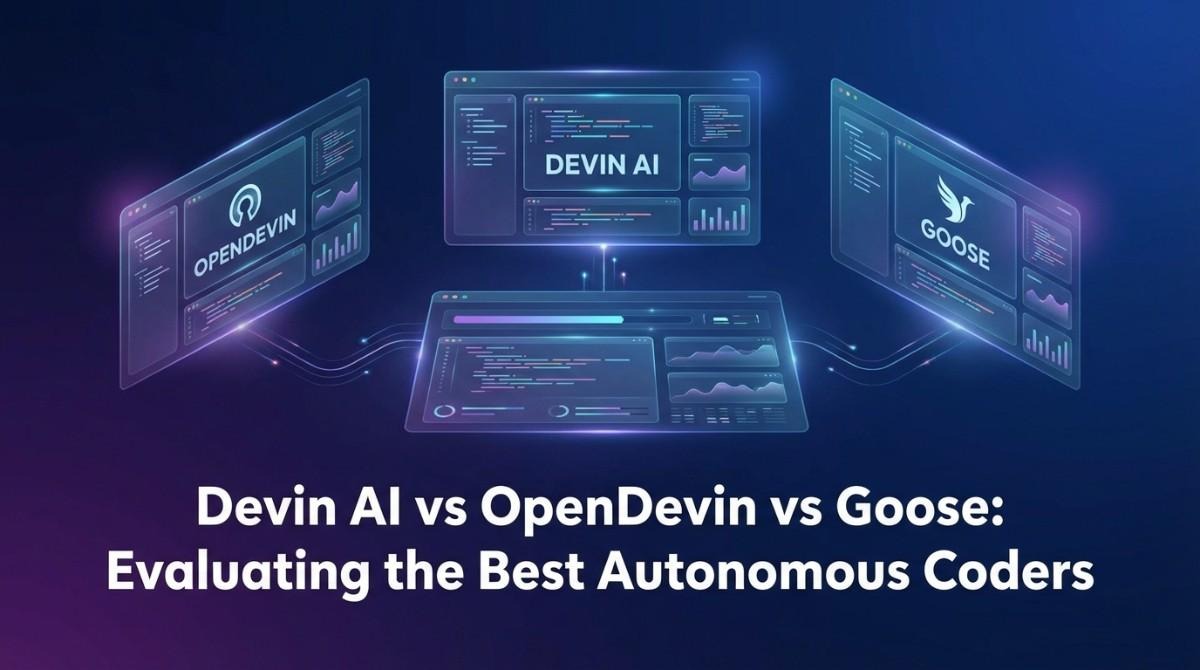
TL;DR Autonomous coding agents crossed from research curiosity to engineering reality in under two years. The Devin AI vs OpenDevin vs Goose autonomous coders comparison is the conversation that matters most for software teams evaluating whether to adopt one of these tools right now. Each agent takes a different approach to solving the same core problem: replacing or augmenting the human developer for specific software engineering tasks. This guide breaks down what each agent actually does, where each one excels, where each one falls short, and which one belongs in your workflow based on your specific situation.
Table of Contents
The Rise of Autonomous Coding Agents
The idea of an AI that writes, tests, and ships code without constant human supervision sounded like science fiction three years ago. The benchmarks changed that perception fast. SWE-bench measures how well AI agents resolve real GitHub issues from popular open-source repositories. Human developers resolve about thirteen percent of issues when given the same time constraints. Top autonomous coding agents now exceed that benchmark consistently.
This performance shift attracted serious investment and serious attention from engineering teams. Cognition AI launched Devin and claimed it was the first AI software engineer. The open-source community responded with OpenDevin, which brought the same architecture to anyone willing to self-host. Block’s developer tools team built Goose, a local-first autonomous developer agent designed for everyday developer tasks rather than isolated benchmark challenges.
The Devin AI vs OpenDevin vs Goose autonomous coders comparison is not academic. Engineering teams making adoption decisions need honest assessments of capability, cost, infrastructure requirements, and fit for specific use cases. Marketing claims from each project’s launch announcements do not answer those questions. Real capability analysis does.
Devin AI: The Commercial Autonomous Software Engineer
What Devin AI Is and How It Works
Cognition AI built Devin as a commercial AI software engineer. Devin operates in a sandboxed environment that includes a code editor, a terminal, a browser, and a persistent memory system. You assign Devin a task in natural language. It plans the work, writes code, runs tests, debugs failures, searches documentation, and iterates until it completes the assignment. The agent works asynchronously, which means you can check back on progress rather than waiting in real time.
Devin’s long-horizon task handling is its defining capability. Most AI coding tools assist with individual functions or files. Devin handles multi-file, multi-step engineering tasks that require understanding a full codebase, making coordinated changes across many files, and validating that those changes work end-to-end. This capability range is what justified the original claim of an AI software engineer rather than an AI coding assistant.
Devin AI’s Strengths
Devin’s sandboxed environment handles the full software development lifecycle within a single session. It installs dependencies, sets up development environments, runs build systems, executes test suites, and interprets results without requiring any manual environment configuration. This self-sufficiency makes Devin genuinely useful for tasks that would otherwise require significant developer setup time before any actual coding begins.
The persistent memory system gives Devin context across tasks within a project. It remembers architectural decisions, naming conventions, and project-specific patterns from previous sessions. A developer does not need to re-explain the codebase structure every time they assign a new task. This continuity improves the quality of Devin’s output on established codebases over time.
Devin’s browser integration lets it research documentation, read Stack Overflow answers, access GitHub issues, and consult external resources the same way a human developer would. When it encounters an unfamiliar library or API, it reads the documentation rather than hallucinating syntax. This research capability significantly reduces the rate of confident but incorrect code generation that plagues simpler AI coding tools.
Devin AI’s Limitations
The cost structure creates real friction for many teams. Devin operates as a commercial service with pricing that reflects its infrastructure requirements and Cognition AI’s development investment. Access requires approval and pricing is tiered based on usage. For engineering teams evaluating autonomous agents at scale, the total cost of Devin across many tasks can exceed the budget allocated for AI tooling.
Data privacy creates adoption barriers for teams working on proprietary codebases. Devin processes code on Cognition AI’s infrastructure. Organizations with strict data handling policies, regulated industries, or contractual confidentiality obligations need careful review before sending proprietary code to any external service. Self-hosted alternatives eliminate this concern entirely.
Performance on ambiguous or underspecified tasks is inconsistent. Devin performs best on well-defined tasks with clear success criteria. Vague requests like improve the performance of this application produce variable results. Human-in-the-loop oversight remains necessary for tasks that require significant judgment about scope, approach, or quality standards.
OpenDevin: The Open-Source Community Answer
What OpenDevin Is and Its Community Origin
OpenDevin, now developed under the All-Hands AI organization, is the open-source autonomous software development agent that emerged directly in response to Devin’s launch. The project aimed to replicate Devin’s capabilities in an open, self-hostable architecture that any developer or organization could run on their own infrastructure. The GitHub repository accumulated over thirty thousand stars within weeks of launch, reflecting genuine developer interest in open alternatives to commercial autonomous coding tools.
The architecture mirrors Devin’s core design. A sandboxed environment with a code editor, terminal, and browser gives the agent the same tool access Devin uses. An orchestration layer coordinates the agent’s actions across multiple steps. State management tracks what the agent has done, what it has found, and what remains to complete. The key difference is that everything runs on your hardware under your control.
OpenDevin’s Technical Architecture
OpenDevin deploys via Docker, which encapsulates the sandboxed execution environment. The agent executes code inside the container, isolating agent-generated code from the host system. This sandboxing is essential for safe autonomous code execution. An agent that runs shell commands autonomously needs isolation to prevent unintended system modifications.
The framework supports multiple LLM backends. Claude, GPT-4o, and locally served open-source models all work as OpenDevin’s reasoning engine. This flexibility is a significant advantage over Devin’s opaque commercial LLM. Teams can choose the model that best fits their cost, quality, and data privacy requirements. Running OpenDevin with a self-hosted Llama 3.1 70B model produces a fully on-premise autonomous coding agent with no external API calls.
OpenDevin’s evaluation framework deserves specific attention in the Devin AI vs OpenDevin vs Goose autonomous coders comparison. The project maintains rigorous SWE-bench evaluations that let teams compare performance across different LLM backends and agent configurations. This transparency enables informed model selection rather than relying on vendor claims.
OpenDevin’s Strengths and Gaps
Self-hosting gives organizations complete data control. Proprietary codebases never leave the internal network. Compliance requirements for regulated industries satisfy automatically when the agent runs on compliant internal infrastructure. This data sovereignty advantage makes OpenDevin the clear choice for teams whose data handling requirements exclude commercial cloud AI services.
The active open-source community contributes integrations, bug fixes, and capability improvements at a pace that reflects genuine developer enthusiasm. GitHub issues receive responses. Pull requests merge regularly. The development velocity is high by open-source standards. Teams adopting OpenDevin benefit from improvements contributed by hundreds of developers who use the tool themselves.
The operational overhead of self-hosting is the honest trade-off. Someone on your team needs to manage the Docker deployment, keep it updated, monitor resource usage, and handle configuration. This is not a significant burden for teams with DevOps capabilities but it is real friction compared to a managed commercial service. Teams without infrastructure management capacity should factor this overhead honestly into their evaluation.
Goose: The Local Developer’s Autonomous Agent
What Goose Is and Block’s Design Philosophy
Block, the financial technology company behind Square and Cash App, built Goose as an autonomous developer agent for everyday engineering work. The design philosophy differs meaningfully from both Devin and OpenDevin. Where those tools aim to complete complex, isolated engineering tasks, Goose aims to work alongside developers continuously as an intelligent local assistant that executes multi-step tasks within a developer’s actual working environment.
Goose runs locally on the developer’s machine. It accesses the local filesystem, executes shell commands, interacts with local development tools, and integrates with the developer’s existing workflow. This local-first design eliminates the data privacy concerns of cloud-based agents entirely. Code stays on the developer’s machine. Goose interacts with it in place rather than uploading it to an external environment.
Goose’s Core Capabilities
Goose handles the category of tasks that occupy a surprising portion of developer time but receive insufficient attention in most AI coding tool evaluations. Setting up development environments. Running test suites and interpreting failures. Executing database migrations. Managing dependency updates. Writing and running scripts to automate repetitive tasks. These operational development tasks are exactly where Goose delivers clear, immediate value for working developers.
The toolkit system lets developers extend Goose with custom capabilities specific to their project or organization. A toolkit wraps a set of related capabilities as a discrete plugin. Teams build toolkits for their internal build systems, deployment pipelines, and proprietary APIs. Goose calls these custom tools alongside its built-in capabilities when working through tasks. This extensibility makes Goose adaptable to diverse development environments rather than optimizing only for generic open-source workflows.
Goose supports multiple LLM backends. Developers configure it to use their preferred model. Claude 3.5 Sonnet consistently performs well for code reasoning tasks. GPT-4o works well for developers already in the OpenAI ecosystem. Local models work for developers with strong privacy requirements or limited API budgets. The model flexibility puts cost and quality control in each developer’s hands.
Goose’s Position in the Autonomous Coder Landscape
The Devin AI vs OpenDevin vs Goose autonomous coders comparison reveals that Goose occupies a distinct product category from the other two. Devin and OpenDevin target complex, multi-session software engineering tasks. Goose targets daily developer workflow automation. This distinction matters more than it might seem.
A developer using Goose gets a capable autonomous assistant for the dozens of small-to-medium tasks that fill a workday. A developer using Devin or OpenDevin delegates larger, more isolated engineering assignments that might take hours or days. The two use case categories overlap but do not fully substitute for each other. Teams that understand this distinction get more value from both categories of tool rather than choosing one and underusing it.
Block’s internal use of Goose provides confidence in its production readiness. When the company building the tool uses it internally on real engineering work, the feedback loop between usage and development accelerates quality improvements. This internal deployment validates Goose beyond benchmark performance and positions it well in the Devin AI vs OpenDevin vs Goose autonomous coders comparison for teams evaluating tools for real daily use.
Direct Comparison: Devin AI vs OpenDevin vs Goose
Task Complexity and Scope
Devin handles the most complex isolated engineering tasks among the three. Multi-file refactoring across a large codebase, implementing a new feature from a GitHub issue description, and setting up a new service from scratch all fall within Devin’s demonstrated capability range. OpenDevin matches Devin’s task scope when configured with powerful LLM backends like GPT-4o or Claude. Performance scales with the underlying model quality. Goose handles task complexity up to multi-step workflow automation and targeted feature implementation within a familiar local codebase.
Data Privacy and Security
The data privacy ranking in this comparison is clear. Goose runs locally by default, keeping all code and context on the developer’s machine. OpenDevin self-hosted keeps all data within your own infrastructure with no external network calls when using local models. Devin sends code to Cognition AI’s cloud infrastructure, which requires careful review for teams with data sensitivity requirements. For regulated industries, government organizations, or teams with strict IP protection policies, this ranking directly determines which tools are available for consideration.
Infrastructure and Operational Requirements
Devin requires no infrastructure management beyond a subscription account. Cognition AI handles everything. OpenDevin requires Docker and GPU or CPU infrastructure to run the agent and optionally to serve local models. Goose requires only a developer’s local machine with API access to a supported LLM. The operational burden scales inversely with cost. Devin costs money to use but requires no operational work. Goose is free to use but requires each developer to configure their own environment.
Cost Structure
Cost comparison across the Devin AI vs OpenDevin vs Goose autonomous coders comparison requires separating infrastructure from usage costs. Devin charges for agent usage time with pricing that varies by access tier. OpenDevin is free software but incurs infrastructure and LLM API costs that vary with usage volume and model choice. Goose is free software with LLM API costs per session that the developer controls through model selection. At high usage volumes, OpenDevin and Goose with efficient model selection cost significantly less than Devin. At low or occasional usage, Devin’s managed service convenience may justify its premium.
Benchmark Performance
SWE-bench is the standard benchmark for autonomous coding agent evaluation. All three projects publish or reference SWE-bench results. Devin’s original reported performance of thirteen-plus percent on SWE-bench verified established a baseline that competitors measure against. OpenDevin with Claude or GPT-4o backends achieves comparable benchmark performance. Goose has not prioritized SWE-bench optimization because its design targets different use cases than the benchmark measures. Teams evaluating benchmark performance should weight SWE-bench results for complex task assignment use cases and evaluate Goose on workflow automation tasks that better represent its actual design targets.
Real-World Use Cases for Each Agent
When to Use Devin AI
Devin fits best for clearly defined, complex engineering tasks that a developer would assign to a junior engineer with full autonomy. Implement this feature according to these specifications. Fix these failing tests. Migrate this service from library A to library B. Refactor these modules to follow this pattern. These task types have clear inputs, clear success criteria, and benefit from Devin’s sandboxed environment and long-horizon execution capability.
Teams that lack DevOps resources to self-host OpenDevin benefit from Devin’s managed infrastructure. The operational simplicity of a cloud service means any developer can use it without infrastructure support. Agencies and consultancies building projects for clients with less restrictive data policies find Devin’s capability range immediately productive without infrastructure investment.
When to Use OpenDevin
OpenDevin is the right choice when Devin’s capability range matches your use cases but data privacy requirements prohibit using a commercial cloud service. Legal firms, healthcare organizations, defense contractors, and financial services companies all have data handling requirements that make self-hosted infrastructure mandatory for AI tools that process proprietary code.
Research teams studying autonomous coding agents benefit from OpenDevin’s transparent architecture and evaluation framework. The ability to swap LLM backends, inspect agent reasoning, and measure performance across configurations makes OpenDevin far more useful for research than black-box commercial alternatives. Academic and enterprise research teams building on top of autonomous coding capabilities should start with OpenDevin.
When to Use Goose
Goose belongs in every developer’s local toolkit for daily workflow automation. The category of tasks Goose handles best — environment setup, test execution and interpretation, dependency management, script writing, and iterative debugging — represents a large fraction of developer working hours. Reducing the friction of these tasks through autonomous execution compounds into significant productivity gains over weeks and months of regular use.
Teams where developers work on local codebases with sensitive data get Goose’s full capability range without any data privacy trade-offs. Local execution means the code never leaves the machine. Goose’s toolkit extensibility lets teams build custom integrations for proprietary internal tools that cloud-based agents cannot access.
Combining Agents for Maximum Developer Productivity
The Devin AI vs OpenDevin vs Goose autonomous coders comparison frames the three tools as competitors. In practice, the best engineering teams use multiple tools for different parts of their workflow. Goose handles daily operational automation on every developer’s local machine. OpenDevin or Devin handles complex, isolated feature development tasks that justify longer autonomous execution cycles.
A developer might use Goose in the morning to set up a development environment, run migrations, and execute the test suite after a branch merge. They might assign a larger feature implementation task to OpenDevin or Devin that runs in the background while they work on other priorities. The results of the longer-running agent task arrive hours later for review and integration. This combination captures the strengths of both approaches.
Tool selection should match task characteristics rather than organizational loyalty to a single platform. Short, frequent, local tasks suit Goose. Long, complex, isolated tasks suit Devin or OpenDevin. Sensitive data contexts require self-hosted tools. Budget-constrained contexts favor open-source options. Mapping tool strengths to task characteristics produces better outcomes than picking one agent and forcing all work through it.
What to Evaluate Before Adopting Any Autonomous Coder
Define Your Most Common Task Types
Autonomous coding agents deliver value proportional to how well their strengths match your actual task distribution. Before choosing between Devin AI, OpenDevin, and Goose, inventory the tasks your team performs most frequently. What percentage involve complex multi-file feature development? What percentage involve daily workflow automation? What percentage involve isolated bug fixes versus architectural changes? The agent whose strength profile matches your highest-frequency tasks delivers the most aggregate value.
Assess Your Data Requirements
Determine which of your codebases and development tasks carry data sensitivity requirements before evaluating tools. Some projects may permit commercial cloud tools. Others may require self-hosted infrastructure. Still others may require fully local execution. Having a clear data classification framework for your codebase lets you match tool options to project requirements rather than applying a single blanket policy that either over-restricts or under-protects.
Pilot Before Committing
Every team that evaluates autonomous coding agents through real pilot projects makes better adoption decisions than teams that rely on demos and benchmark numbers. Run a thirty-day pilot with your specific codebase, your specific task types, and your specific team. Measure actual completion rates, output quality, and developer time saved. Extrapolate from measured results rather than vendor-provided benchmarks. The tool that performs best on your actual work is the right tool for your team regardless of how it ranks on general benchmarks.
Frequently Asked Questions
Is Devin AI worth the cost compared to free alternatives?
Devin’s cost justification depends on your use case, your team’s infrastructure capacity, and your data privacy requirements. Teams that need complex autonomous task completion, lack infrastructure resources to self-host OpenDevin, and work on codebases without strict data policies find Devin’s managed service convenience worth the premium. Teams with DevOps capacity, strict data requirements, or high usage volumes should evaluate OpenDevin with capable LLM backends before committing to Devin’s cost structure. The Devin AI vs OpenDevin vs Goose autonomous coders comparison shows genuine capability parity between Devin and well-configured OpenDevin deployments.
How does OpenDevin compare to Devin on SWE-bench?
OpenDevin with high-capability LLM backends like Claude 3.5 Sonnet or GPT-4o achieves SWE-bench performance comparable to Devin’s reported scores. The key variable is the underlying model. OpenDevin with a small local model underperforms. OpenDevin with frontier models matches or approaches Devin’s benchmark performance. This parity means the choice between them for complex task use cases reduces to data privacy requirements and infrastructure investment tolerance rather than fundamental capability differences.
Can Goose handle the same tasks as Devin?
Goose handles a different task profile than Devin. For daily workflow automation, operational development tasks, and iterative local development assistance, Goose is purpose-built and excellent. For complex, long-horizon feature development from scratch, Devin’s isolated sandboxed environment and persistent memory give it structural advantages. Teams should not choose one expecting it to fully replace the other. The Devin AI vs OpenDevin vs Goose autonomous coders comparison shows these tools occupy overlapping but distinct capability niches.
What LLM works best with OpenDevin and Goose?
Claude 3.5 Sonnet consistently delivers the best results for autonomous coding tasks across both OpenDevin and Goose. Its strong instruction-following, careful reasoning, and code generation quality make it the default recommendation for teams evaluating these tools with frontier models. GPT-4o performs comparably for many coding tasks and suits teams already in the OpenAI ecosystem. For fully self-hosted deployments with no external API calls, Llama 3.1 70B delivers the best open-source performance for complex coding tasks requiring strong reasoning capability.
How secure is it to run autonomous coding agents on production codebases?
Autonomous coding agents should always run in isolated environments with limited access permissions. Sandboxed Docker containers prevent agent-generated code from affecting the host system. Code review by a human developer should precede any agent-generated code merging into production branches. Agents should have read-write access to development environments and read-only access to production configuration. Goose’s local execution model with filesystem access requires careful directory scoping to prevent agents from reading or modifying files outside the intended project scope. Treat autonomous coding agent access with the same principle of least privilege you apply to human contractor access.
Will autonomous coding agents replace software developers?
The evidence from current deployments suggests autonomous coding agents augment developer productivity rather than replace developer judgment. They handle well-defined execution tasks faster and with less fatigue than human developers. They cannot reliably make architectural decisions, define product requirements, evaluate business trade-offs, or maintain the contextual understanding of a large complex system that experienced engineers carry. The Devin AI vs OpenDevin vs Goose autonomous coders comparison shows tools at varying stages of maturity but all requiring human oversight for production work. The more realistic near-term scenario is developers who use autonomous agents handling ten to thirty percent more work through automation, not teams shrinking as agents replace headcount.
Read More:-Why Your Company Needs a Private LLM: Data Privacy in the AI Era
Conclusion

The Devin AI vs OpenDevin vs Goose autonomous coders comparison reveals a landscape where three genuinely distinct tools serve overlapping but different developer needs. No single agent wins across all dimensions. The right choice depends on what you need to automate, what your data requirements permit, what your infrastructure supports, and what your budget allows.
Devin AI delivers a polished, managed service for complex autonomous engineering tasks with no infrastructure overhead and a growing capability set backed by significant commercial investment. OpenDevin delivers comparable task capability in a self-hosted architecture that satisfies data privacy requirements and fits teams with infrastructure management capacity. Goose delivers local-first daily workflow automation that fits alongside every developer’s existing tools without infrastructure complexity or data privacy trade-offs.
The development teams getting the most from autonomous coding agents today do not treat this comparison as a single-answer question. They deploy Goose for local daily automation across the engineering organization. They use Devin or OpenDevin for complex isolated development tasks based on their data policies and budget. They measure results honestly and adjust tool selection as capabilities evolve.
The autonomous coding agent space moves fast. The Devin AI vs OpenDevin vs Goose autonomous coders comparison that is accurate today will look different twelve months from now. Benchmark scores will improve. New capabilities will appear. Pricing models will evolve. Build evaluation habits that measure actual productivity impact for your specific workflow. Those habits let you adopt improvements quickly regardless of which tool delivers them.
Start with a pilot. Pick one tool that fits your highest-priority use case. Measure the real results. Expand from there. The future of software development includes autonomous agents as standard tools. The teams that build fluency with these tools now gain advantages that compound over years of continued AI capability growth.