Introduction
TL;DR The AI landscape is shifting rapidly. Businesses now face critical decisions about which language models to deploy for their private data operations.
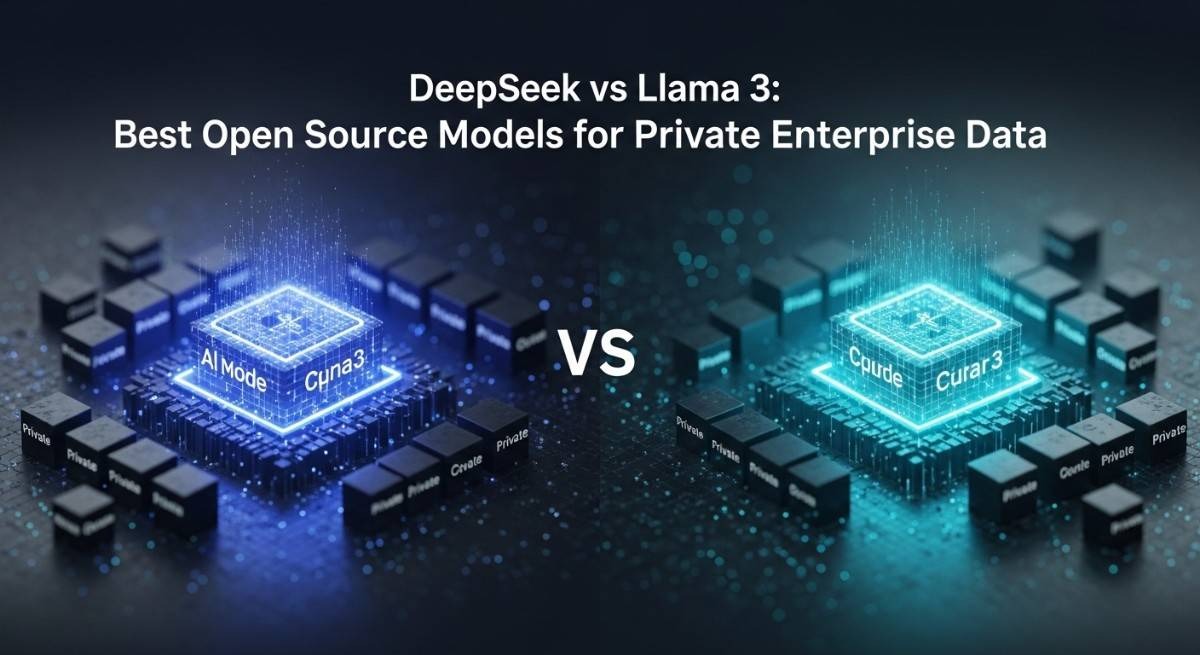
DeepSeek vs Llama 3 has become the central debate among enterprise technology leaders seeking robust, secure AI solutions. Both models promise powerful capabilities while maintaining the flexibility of open-source architecture.
Your organization’s data privacy depends on choosing the right foundation model. This comparison cuts through the marketing hype to deliver actionable insights.
Table of Contents
What Makes Open Source Models Essential for Enterprise Privacy
Open source language models have transformed how companies approach AI implementation. Traditional proprietary solutions force businesses to send sensitive data to external servers.
This creates immediate compliance concerns. Financial institutions, healthcare providers, and government agencies cannot risk exposing confidential information.
Open source models solve this fundamental problem. You deploy them entirely within your infrastructure. Your data never leaves your controlled environment.
The transparency factor matters equally. Your security team can inspect every line of code. No hidden backdoors exist. No mysterious data collection happens behind the scenes.
Cost considerations drive many enterprises toward open source solutions. Proprietary API calls accumulate expenses quickly at scale. Open source models require upfront investment but eliminate ongoing usage fees.
Customization capabilities set these models apart from closed alternatives. Your team can fine-tune them specifically for your industry terminology and use cases. Banking language differs from medical jargon. Generic models struggle with specialized contexts.
Understanding DeepSeek: Architecture and Core Capabilities
DeepSeek emerged from China as a serious contender in the AI space. The development team focused on creating models that balance performance with computational efficiency.
The architecture employs mixture-of-experts technology. This approach activates only relevant neural network portions for each task. Resource utilization improves dramatically compared to traditional dense models.
DeepSeek’s training methodology emphasizes reasoning capabilities. The model excels at multi-step problem solving and logical deduction tasks. Mathematical computations represent a particular strength.
Context window size reaches impressive lengths in recent versions. Processing longer documents becomes feasible without losing coherence. Your teams can analyze extensive legal contracts or research papers in single passes.
The model supports multiple languages natively. Chinese and English receive the most comprehensive training. European languages show strong performance in benchmark tests.
Inference speed stands out as a major advantage. DeepSeek processes requests faster than many competing models of similar capability. This matters tremendously for real-time applications.
Memory requirements have been optimized for enterprise deployment. You don’t need the most expensive GPU clusters to run it effectively. Mid-range hardware delivers acceptable performance for many use cases.
Llama 3: Meta’s Evolution in Open Source AI
Meta released Llama 3 as the third generation of their groundbreaking open model series. Previous versions established credibility. This iteration pushes boundaries significantly further.
The training dataset spans an enormous token count. Meta invested heavily in data quality and diversity. Web scraping combines with curated sources to create balanced training material.
Llama 3 architecture represents a refined transformer design. Meta engineers eliminated inefficiencies discovered in earlier versions. Parameter allocation focuses on areas that drive practical performance.
Safety mechanisms are baked into the base model. Meta learned from controversies surrounding earlier AI releases. Guardrails prevent generation of harmful or biased content in most scenarios.
The model family includes multiple size variants. Smaller versions run on modest hardware. Larger configurations compete with the most advanced proprietary models available.
Instruction following capabilities received particular attention during development. Llama 3 understands complex prompts with nuanced requirements. Your employees can interact naturally without learning specialized prompt engineering.
Code generation shows remarkable improvement over Llama 2. Software development teams leverage it for writing, debugging, and explaining code. Python, JavaScript, and other popular languages receive excellent support.
DeepSeek vs Llama 3: Performance Benchmarks Compared
Benchmark scores tell only part of the story. Real-world enterprise applications demand different metrics than academic tests.
MMLU scores measure multitask language understanding across diverse subjects. Llama 3 achieves higher raw scores in most MMLU categories. The difference ranges from marginal to significant depending on the specific domain.
Mathematical reasoning tests reveal DeepSeek’s specialized strengths. GSM8K and MATH benchmarks show DeepSeek outperforming Llama 3 consistently. Financial modeling and data analysis tasks benefit from this advantage.
Coding benchmarks present a mixed picture. HumanEval tests demonstrate Llama 3’s edge in general programming tasks. DeepSeek shows competitive performance in algorithm design and optimization problems.
Multilingual capabilities favor different models for different languages. Llama 3 dominates in Romance and Germanic language families. DeepSeek excels with Asian languages, particularly Chinese variants.
Response latency measurements under enterprise conditions matter more than theoretical speeds. DeepSeek maintains lower latency across various prompt lengths. Llama 3 requires slightly more processing time for equivalent quality outputs.
Throughput capacity determines how many simultaneous users your deployment can support. Hardware configurations influence this metric substantially. Both models scale reasonably well with appropriate infrastructure investment.
Accuracy in domain-specific tasks requires custom evaluation. Generic benchmarks miss industry-specific requirements. Healthcare terminology recognition differs from legal document analysis. Your evaluation should include your actual use cases.
Privacy and Security Architecture Comparison
Data sovereignty concerns dominate enterprise AI decisions. DeepSeek vs Llama 3 presents different privacy implications based on deployment choices.
On-premises deployment represents the gold standard for sensitive data. Both models support complete local installation. No external connections are required for core functionality.
Model weight transparency allows security audits. Llama 3 provides comprehensive documentation of architecture choices. DeepSeek offers similar transparency with detailed technical papers.
Training data provenance raises important questions. Meta discloses high-level information about Llama 3 training sources. DeepSeek provides less detailed documentation about their training corpus.
Compliance certification varies by jurisdiction. Neither model arrives pre-certified for HIPAA, GDPR, or SOC 2. Your implementation determines compliance status. Proper deployment and access controls enable certification for both options.
Vulnerability management differs between the two ecosystems. Llama 3 benefits from Meta’s extensive security team and bug bounty program. DeepSeek has a smaller but growing security community.
Encryption support for model weights and inference data requires implementation at the infrastructure level. Both models work within encrypted environments. Your DevOps team controls these security layers.
Access logging and audit trails are not built into the base models. Your deployment architecture must include these essential enterprise features. Many organizations implement these controls at the API gateway level.
Resource Requirements and Infrastructure Costs
Hardware specifications directly impact your total cost of ownership. DeepSeek vs Llama 3 shows meaningful differences in resource consumption.
GPU memory requirements vary significantly across model sizes. DeepSeek’s 67B parameter version needs approximately 134GB VRAM for full precision. Llama 3’s comparable variant demands similar resources.
Quantization reduces memory footprint substantially. 4-bit quantized versions run on consumer-grade GPUs. Some quality degradation occurs but remains acceptable for many applications.
CPU-only deployment becomes possible with optimization. Inference speeds drop dramatically without GPU acceleration. This approach suits low-volume applications where response time is not critical.
Storage costs for model weights are relatively modest. DeepSeek requires 120-140GB disk space for full versions. Llama 3 footprints are comparable. Quantized variants shrink to 30-40GB.
Network bandwidth matters primarily during initial model download. Ongoing operations consume minimal bandwidth for local deployments. Cloud deployments may incur data transfer costs.
Power consumption affects operational expenses. GPU clusters consume substantial electricity. DeepSeek’s efficiency optimizations reduce power draw by approximately 15-20% versus comparable dense models.
Cooling infrastructure represents a hidden cost. High-performance GPUs generate significant heat. Your data center cooling capacity may require upgrades for larger deployments.
Fine-Tuning Capabilities for Enterprise Use Cases
Custom training transforms generic models into specialized business assets. Both DeepSeek and Llama 3 support comprehensive fine-tuning approaches.
Parameter-efficient methods like LoRA reduce computational requirements. You train small adapter layers rather than full model weights. This approach needs 10-100x less GPU memory than full fine-tuning.
Domain adaptation improves accuracy for industry-specific terminology. Healthcare organizations fine-tune on medical literature and clinical notes. Legal firms train on case law and contracts.
Instruction tuning shapes how models respond to prompts. You can enforce company communication standards and formatting preferences. Consistent output style becomes achievable across your organization.
Few-shot learning accelerates adaptation to new tasks. Providing just a handful of examples often suffices. This matters when labeled training data is scarce or expensive to produce.
Continual learning allows models to incorporate new information over time. Your model stays current with evolving company knowledge and industry developments. This prevents knowledge staleness.
Training data preparation requires significant effort. Your team must clean, format, and validate training examples. Poor quality training data produces poor quality models regardless of the base model choice.
Evaluation frameworks validate improvement from fine-tuning. You need metrics specific to your use case. General benchmarks may not reflect performance on your actual tasks.
Integration with Existing Enterprise Systems
Successful AI deployment requires seamless connection to your technology stack. API compatibility determines integration difficulty.
REST API implementations provide straightforward access. Both DeepSeek and Llama 3 work with standard inference servers. FastAPI and Flask deployments are common approaches.
OpenAI API compatibility simplifies migration from proprietary services. Many open source inference servers implement OpenAI-compatible endpoints. Your existing application code requires minimal changes.
Batch processing capabilities handle high-volume offline tasks. Document classification, summarization, and data extraction often work better in batch mode. Both models support this operational pattern.
Streaming responses improve user experience for conversational applications. Users see text appear progressively rather than waiting for complete responses. Implementation complexity increases slightly versus batch processing.
Database integration allows models to query and update enterprise data. Vector databases enable semantic search capabilities. SQL database connectivity supports data-driven responses.
Authentication and authorization must be enforced at the infrastructure level. The base models lack built-in user management. Your API gateway or inference server handles these security functions.
Monitoring and observability tools track model performance in production. Latency metrics, error rates, and quality scores require instrumentation. This visibility enables proactive problem resolution.
Real-World Enterprise Use Case Performance
Practical application performance reveals strengths beyond benchmark scores. DeepSeek vs Llama 3 shows distinct patterns across common enterprise scenarios.
Customer service automation benefits from natural conversation ability. Llama 3 demonstrates stronger performance in open-ended customer interactions. DeepSeek excels when queries involve calculations or structured data retrieval.
Document analysis and summarization represent common enterprise needs. Both models handle this effectively after appropriate fine-tuning. Legal and financial documents see particularly strong results.
Code generation and review assist development teams. Llama 3 produces more idiomatic code in popular languages. DeepSeek shows advantages in algorithmic problem-solving and optimization tasks.
Data extraction from unstructured text saves manual effort. Converting emails, PDFs, and scanned documents into structured data works well with both models. Accuracy improves with domain-specific fine-tuning.
Report generation automates repetitive writing tasks. Sales reports, status updates, and summary documents can be largely automated. Human review remains necessary for accuracy verification.
Knowledge base query systems help employees find information quickly. Both models power effective semantic search and question-answering systems. Response accuracy depends heavily on retrieval system quality.
Compliance and risk detection identify problematic content. Contract review and regulatory compliance checking benefit from AI assistance. Domain expertise still requires human-in-the-loop workflows.
Licensing and Legal Considerations
Open source does not mean completely unrestricted use. License terms create important boundaries for commercial deployment.
Llama 3 operates under Meta’s custom community license. Commercial use is permitted for most organizations. Companies with over 700 million monthly active users face additional restrictions.
DeepSeek uses the MIT license for most model releases. This represents one of the most permissive open source licenses available. Commercial deployment faces minimal restrictions.
Model outputs and intellectual property rights remain a complex area. Generated content ownership depends on multiple factors. Your input data, the model, and the generation process all contribute to the output.
Indemnification clauses in commercial agreements require careful attention. Neither Meta nor DeepSeek provides warranties or indemnification for model outputs. Your organization assumes liability for how you deploy and use these models.
Export control regulations affect model deployment in some jurisdictions. U.S. export controls on AI technology continue evolving. International deployments may face regulatory scrutiny.
Data protection regulations like GDPR impose obligations on model deployment. Your implementation must include appropriate data handling procedures. The models themselves are tools that must be used compliantly.
Third-party dependencies may introduce additional license obligations. Inference servers, quantization libraries, and other tools carry their own licenses. Your legal team should review the complete software stack.
Community Support and Ecosystem Maturity
Developer communities provide crucial support for open source technologies. Ecosystem strength influences long-term viability.
Llama 3 benefits from massive community adoption. Thousands of developers contribute tools, tutorials, and improvements. This creates a robust support network.
Model derivatives and specialized variants expand capabilities. The community has created Llama 3 versions optimized for specific tasks. Medical, legal, and coding-specific variants are available.
Integration libraries simplify common implementation tasks. LangChain, LlamaIndex, and similar frameworks support both models. Llama 3 receives slightly more attention due to larger user base.
Pre-trained adapters and LoRA weights save training time. Community members share fine-tuned versions for various domains. This accelerates your deployment timeline significantly.
Documentation quality varies between official and community sources. Meta provides comprehensive technical documentation for Llama 3. DeepSeek’s English documentation is improving but less extensive.
Conference presentations and research papers advance understanding. Academic researchers actively study both models. Published findings inform best practices and optimization techniques.
Commercial support options provide enterprise-grade assistance. Several companies offer paid support for Llama 3 deployments. DeepSeek commercial support options are more limited currently.
Cost-Benefit Analysis for Enterprise Deployment
Financial calculations extend beyond immediate expenses. Total cost of ownership includes many factors over the model’s operational lifetime.
Initial setup costs encompass hardware procurement and software configuration. A production-grade deployment might require $50,000-$200,000 in infrastructure. Cloud deployments spread costs over time.
Personnel expenses for model operations often exceed infrastructure costs. Machine learning engineers, DevOps specialists, and domain experts all contribute. Annual personnel costs easily reach $300,000-$500,000 for dedicated teams.
Opportunity costs from delayed deployment matter significantly. Choosing the wrong model may require migration later. This wastes months of effort and delays business value realization.
Value creation from AI capabilities varies dramatically by use case. Customer service automation might save $1 million annually. Sales enablement tools could drive $5 million in revenue growth.
Risk reduction through improved compliance and quality control provides less tangible benefits. Avoiding a single regulatory penalty might justify entire AI program costs.
Scalability economics favor models with lower per-inference costs. DeepSeek’s efficiency advantages compound over millions of queries. This can represent substantial savings at enterprise scale.
Future-proofing considerations should influence model selection. Ecosystem momentum suggests which models will receive continued development. Llama 3’s larger community provides some confidence in longevity.
Making the Right Choice: Decision Framework
Selecting between DeepSeek vs Llama 3 requires systematic evaluation aligned with your priorities.
Start by defining your primary use cases precisely. Vague requirements lead to suboptimal choices. Document specific tasks the model must perform successfully.
Benchmark both models on your actual data. Generic performance numbers may not reflect your reality. Create evaluation datasets from real enterprise content.
Assess your team’s technical capabilities honestly. Complex deployments require substantial expertise. Simpler implementations may sacrifice some performance for maintainability.
Consider your organization’s risk tolerance. Bleeding-edge technology delivers capabilities but introduces uncertainty. Proven solutions offer stability at the cost of innovation speed.
Evaluate vendor relationship preferences. Some organizations prefer backing from established companies like Meta. Others value independence from large tech corporations.
Project your scaling requirements over a three-year horizon. Infrastructure adequate for initial deployment may become inadequate. Plan for growth in users, data volume, and use cases.
Conduct a pilot program before full deployment. Small-scale testing reveals integration challenges early. This de-risks the broader rollout significantly.
Frequently Asked Questions
Which model is better for financial services applications?
DeepSeek shows advantages in mathematical reasoning and numerical tasks. Financial modeling, risk calculations, and quantitative analysis benefit from these strengths. Llama 3 performs better for customer-facing applications requiring natural conversation.
Can I use both models in my organization?
Absolutely. Many enterprises deploy multiple models for different purposes. DeepSeek might power analytical tools while Llama 3 handles customer service. This approach maximizes strengths of each model.
How long does fine-tuning typically take?
Timeline depends on dataset size and computational resources. Small domain adaptation projects complete in days. Comprehensive custom training might require weeks. Parameter-efficient methods like LoRA reduce time substantially.
What happens if the project gets discontinued?
Open source licenses ensure models remain available even if development stops. Your deployed instances continue functioning indefinitely. Community forks often continue development of valuable projects.
Do I need a data science team to implement these models?
Basic implementations are possible with strong software engineering skills. Production-grade deployments benefit tremendously from machine learning expertise. Many organizations hire consultants for initial setup then build internal capabilities.
How often should I update the model?
Update frequency depends on your change tolerance and improvement pace. Critical applications might update quarterly after thorough testing. Less sensitive uses can adopt new versions more aggressively.
What about hallucination and accuracy issues?
Both models occasionally generate incorrect or fabricated information. Implementation must include verification mechanisms. Human review, fact-checking systems, and confidence scoring mitigate this risk.
Can these models replace all human workers?
No. These tools augment human capabilities rather than replacing people entirely. They handle routine tasks efficiently while humans focus on complex judgment and creative work.
Read More:-Deploying AI Models on AWS vs. Google Cloud vs. Azure in 2026
Conclusion

The DeepSeek vs Llama 3 decision shapes your AI infrastructure for years to come. Neither model is universally superior across all dimensions.
DeepSeek excels in computational efficiency and mathematical reasoning. Organizations focused on analytical applications and resource optimization should seriously consider it. The MIT license offers maximum deployment flexibility.
Llama 3 provides broader community support and stronger general-purpose capabilities. Customer-facing applications and diverse use cases benefit from its versatility. Meta’s backing suggests long-term development commitment.
Your specific requirements ultimately determine the right choice. Evaluate both models against your actual data and use cases. Pilot testing reveals practical differences that benchmarks miss.
The open source model landscape continues evolving rapidly. Today’s choice is not permanent. Many organizations successfully migrate or deploy multiple models as needs change.
Start your evaluation today. The competitive advantages from effective AI deployment compound over time. Delaying costs your organization opportunities that early adopters are already capturing.
Your private enterprise data deserves the protection and performance that the right model provides. Make an informed choice based on thorough analysis rather than hype or assumptions.
The future of enterprise AI is open source. The question is not whether to adopt these technologies but how to deploy them most effectively for your unique situation.