Introduction
TL;DR You want to build something with AI. The problem is not the idea. The problem is the decision.
Do you create a Custom GPT inside ChatGPT and launch it in hours? Or do you build a full-stack AI application from the ground up with your own infrastructure, database, and frontend?
Both paths lead to AI-powered products. The experience of building them is completely different. The capabilities you end up with are different. The cost, the timeline, the flexibility, and the long-term potential all diverge significantly depending on which path you choose.
The Custom GPTs vs full-stack AI app debate shows up in every startup Slack channel, every product strategy meeting, and every AI hackathon. Developers argue about it. Founders stress about it. Non-technical builders feel overwhelmed by it.
This blog gives you a clear, honest answer. You will understand what each approach actually involves. You will see where each one wins and where each one breaks down. You will get guidance on matching the right approach to your specific situation. And you will walk away with a decision framework that makes the choice obvious.
Whether you have never written a line of code or you lead an engineering team, this guide gives you what you need to make a confident, informed decision about Custom GPTs vs full-stack AI app development.
Table of Contents
What Is a Custom GPT?
A Custom GPT is a personalized version of ChatGPT. OpenAI introduced GPT Builder to let anyone configure a specialized AI assistant without writing code. You open the builder. You describe what the assistant should do. You upload relevant files for knowledge. You configure actions if you want external integrations. You publish it.
The result is a ChatGPT-powered assistant that behaves according to your instructions. A customer support GPT that knows your product documentation. A legal research assistant trained on case law summaries. A fitness coach GPT that follows a specific methodology. These all build on the same underlying GPT-4 model with customized behavior on top.
How GPT Builder Works
The GPT Builder interface is conversational. You describe your assistant to the builder. It generates a name, a personality, and initial instructions. You refine from there. You can add files that the GPT references when answering questions. You can connect API actions that let the GPT call external services — fetch weather data, look up product prices, submit support tickets.
The configuration lives entirely within OpenAI’s platform. Your users access the Custom GPT through ChatGPT. They need a ChatGPT account. They interact through the standard ChatGPT interface. You control the instructions and knowledge. OpenAI controls everything else.
Who Custom GPTs Are For
Custom GPTs serve a specific profile of builder. They suit individuals and small teams who need a functional AI assistant fast. They work well for internal tools, personal productivity, and niche community use cases. A solopreneur creating a customer onboarding assistant. A consultant packaging their expertise into a GPT for clients. A community manager building a resource assistant for members.
In the Custom GPTs vs full-stack AI app comparison, Custom GPTs win clearly on speed and simplicity. A functional GPT goes live in hours. No code. No server. No deployment pipeline. The barrier is as low as AI development gets.
What Is a Full-Stack AI App?
A full-stack AI app is a complete software application that uses AI as a core component. You own the infrastructure. You write the code. You manage the database. You build the frontend. You deploy and maintain everything yourself.
The AI capabilities come from integrating LLM APIs — OpenAI, Anthropic, Google, or an open-source model you host yourself. You call those APIs programmatically. Your application logic controls what gets sent to the model, what gets done with the response, and how the results reach the user.
What Full-Stack AI App Development Involves
A full-stack AI application has multiple layers. The backend handles API calls, business logic, data storage, and authentication. The frontend delivers the user experience — the interface your users actually interact with. The AI layer manages prompt construction, model selection, response parsing, and context management.
Building a full-stack AI app requires engineering skill. You choose a backend framework — Node.js, Python with FastAPI, or Ruby on Rails. You select a database. You configure cloud hosting on AWS, GCP, or Azure. You write, test, and deploy code. This is traditional software development with an AI API as one of many service integrations.
Who Full-Stack AI Apps Are For
Full-stack AI apps serve builders who need capabilities that no off-the-shelf platform provides. Startups building SaaS products. Enterprise teams creating proprietary internal tools. Developers building AI features into existing applications. Product teams that need deep user authentication, persistent memory, complex data relationships, and complete UI control.
In the Custom GPTs vs full-stack AI app decision, the full-stack path wins when your requirements exceed what a platform like ChatGPT can offer. If you need your own domain, your own brand, your own data storage, and your own monetization logic, a full-stack approach is not optional. It is necessary.
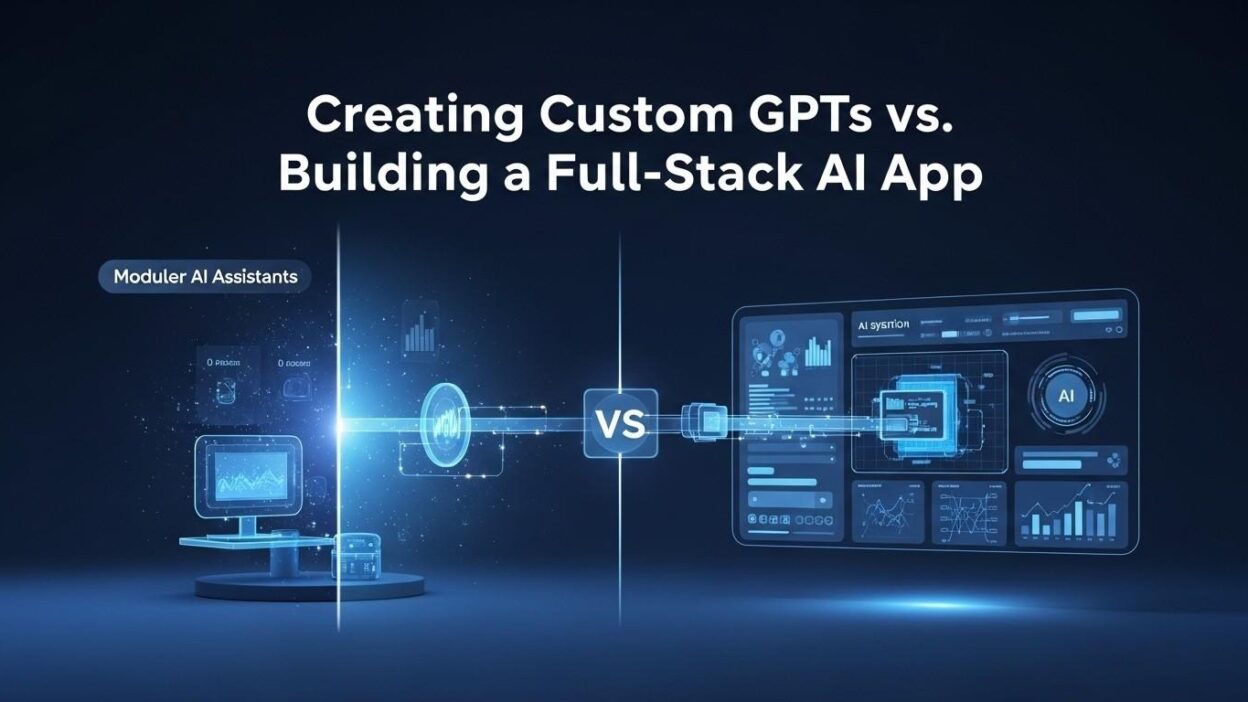
Custom GPTs vs Full-Stack AI App: The Core Differences
The Custom GPTs vs full-stack AI app comparison comes down to a set of fundamental trade-offs. Understanding each one helps you identify which matters most for your specific situation.
Speed to Launch
Custom GPTs launch in hours. You write instructions. You upload files. You publish. The GPT is live. There is no deployment configuration, no server setup, no frontend development. For rapid prototyping or internal tools, this speed is transformative.
Full-stack AI apps take weeks to months. You scaffold the project. You build the API layer. You design the database schema. You write the frontend. You set up CI/CD. You manage security. Each of these steps adds time. The result is a more capable product. The path there is longer.
Customization and Control
Custom GPTs have hard limits on customization. You control the system prompt and the knowledge files. You do not control the interface. Users always see the ChatGPT UI. You do not control authentication — users need OpenAI accounts. You cannot build complex data workflows. You cannot store user-specific data persistently. You cannot control the model version or inference parameters beyond basic settings.
Full-stack AI apps give you complete control. You design every aspect of the user experience. You choose your own authentication system. You store and query your own data. You call whichever AI model fits your needs. You update model providers without disrupting users. You build the exact product logic your use case requires. In the Custom GPTs vs full-stack AI app comparison, control lives entirely on the full-stack side.
Cost Structure
Custom GPTs require no infrastructure spend. OpenAI handles compute, hosting, and model inference. Users with ChatGPT Plus accounts access your GPT at no additional cost to you. If you monetize through the GPT Store, OpenAI manages the transaction infrastructure. Your cost is essentially zero beyond the time you invest in configuration.
Full-stack AI apps carry real infrastructure costs. You pay for cloud hosting. You pay for database services. You pay for API calls to the LLM provider. You pay for CDN, storage, monitoring, and security tooling. At low user volumes, costs are manageable. At scale, the costs grow but so does revenue potential. The economics work differently — you own the margin rather than sharing it with a platform.
Data Privacy and Ownership
Custom GPTs run on OpenAI’s infrastructure. Your users’ conversation data passes through OpenAI’s systems. You have no control over data retention, storage location, or processing. For use cases involving sensitive user information, this creates compliance complications. Regulated industries with HIPAA, GDPR, or SOX obligations cannot use Custom GPTs for sensitive workflows.
Full-stack AI apps give you data sovereignty. You choose where data lives. You implement the encryption standards your users require. You negotiate data processing agreements with your AI API provider. You control retention policies. For enterprise products and regulated industries, this control is non-negotiable. It is one of the most decisive factors in the Custom GPTs vs full-stack AI app decision.
Monetization
Custom GPTs offer limited monetization options. The GPT Store provides revenue sharing for qualifying creators. Indirect monetization — using the GPT to support a paid service — is possible but constrained by platform terms. You cannot charge directly for GPT access outside of OpenAI’s framework.
Full-stack AI apps support any monetization model you design. Subscription tiers. Usage-based billing. Enterprise licensing. One-time purchases. API access for other developers. You own the payment infrastructure. You keep the margin. This flexibility makes the full-stack path essential for serious commercial AI products.
When Custom GPTs Win
Custom GPTs are the right choice in specific, well-defined scenarios. Recognizing these scenarios prevents overbuilding when a simpler solution delivers the same value.
Rapid Internal Tools
A marketing team needs a brand voice assistant. An HR department wants a policy lookup tool. A sales team needs a objection handling reference. These internal tools serve known users in a controlled environment. Everyone already has ChatGPT Plus access. Speed matters more than customization. A Custom GPT delivers value in a day. A full-stack app would take months to justify.
Personal Productivity and Expert Packaging
Consultants, coaches, and subject matter experts can package their methodology into a Custom GPT. Clients access structured expertise through a familiar interface. The GPT reinforces frameworks, answers common questions, and delivers consistent guidance. For knowledge workers selling expertise, Custom GPTs provide a fast way to scale their impact without hiring developers.
Proof of Concept Validation
Before investing in full-stack development, a Custom GPT lets you test whether users find the core AI interaction valuable. You build the concept in hours. You gather real feedback. If users engage with the core interaction and request features that require full-stack capabilities — persistent memory, custom interface, payment integration — you have validated the need before writing production code. In the Custom GPTs vs full-stack AI app decision journey, Custom GPTs often serve best as the validation step before full-stack investment.
Community and Niche Tools
Niche communities benefit from specialized GPTs that understand their vocabulary, their use cases, and their needs. A GPT for tabletop role-playing game masters. A research assistant for a specific academic discipline. A compliance checker for a niche regulatory framework. These tools serve small audiences where building full-stack infrastructure would be economically unjustifiable.
When Full-Stack AI Apps Win
The full-stack path becomes necessary when your product requirements exceed what any platform can provide. These scenarios make the investment in development time and infrastructure worthwhile.
Commercial AI Products
Any product you plan to sell to external customers requires full-stack development. Custom GPTs cannot support the subscription management, usage tracking, customer authentication, and support infrastructure that a commercial product needs. If you are building a SaaS AI product, the Custom GPTs vs full-stack AI app question resolves immediately in favor of full-stack.
Complex Data Integrations
Many AI applications need to interact with real-time data sources. A financial analysis tool pulling live market data. A customer service AI reading your CRM records. A supply chain assistant querying inventory databases. Custom GPT actions can connect to some APIs, but the integration depth and reliability required for production business tools demand a full-stack backend. You need custom data pipelines, error handling, caching, and security layers that Custom GPTs cannot support.
Branded User Experiences
Enterprise clients and paying consumers expect a branded experience. They want your logo, your color palette, your domain, and your interface — not the ChatGPT interface. Brand consistency signals credibility and professionalism. No amount of Custom GPT configuration can remove the ChatGPT interface. A full-stack app lets you design every pixel of the user experience.
Enterprise and Regulated Industries
Enterprise sales require security questionnaires, data processing agreements, and compliance certifications. Custom GPTs cannot satisfy these requirements. Enterprise buyers demand control over data residency, access management, audit logging, and vendor contracts. A full-stack AI app built on enterprise-grade cloud infrastructure with proper security design can meet these requirements. Custom GPTs cannot. This is one of the clearest lines in the Custom GPTs vs full-stack AI app decision for teams selling to enterprise customers.
Advanced AI Features
Fine-tuning, RAG with proprietary vector databases, multi-agent orchestration, streaming responses with custom UI, and model fallback strategies all require full-stack development. These advanced capabilities deliver competitive differentiation that Custom GPTs cannot replicate. If your AI product’s value depends on sophisticated AI architecture, the full-stack path is not optional.
The Hybrid Path: Start With Custom GPTs, Scale to Full-Stack
The smartest teams in the Custom GPTs vs full-stack AI app debate often reject the binary framing. They treat the two approaches as sequential stages rather than competing options.
Stage one is validation. Build a Custom GPT in hours. Share it with target users. Gather feedback on the core AI interaction. Identify the feature requests that Custom GPTs cannot fulfill. This stage costs nothing and produces real user insight.
Stage two is selective expansion. If validation shows strong demand, begin building the full-stack components that unlock the missing capabilities. Start with the highest-impact missing feature. Authentication. Persistent memory. Custom interface. Payment processing. Build each component incrementally rather than rebuilding everything at once.
This staged approach reduces risk. You invest development resources only after confirming user demand. You launch faster. You iterate based on real feedback rather than assumptions. Many successful AI products follow this exact path.
When to Make the Transition
Three signals indicate readiness to move from Custom GPT to full-stack. First, users consistently request features the Custom GPT platform cannot support. Second, you have identified a monetization model that requires infrastructure you own. Third, you have validated the core AI interaction well enough to justify development investment. When all three signals appear, the Custom GPTs vs full-stack AI app debate is over. Full-stack wins.
Frequently Asked Questions
Q1: Can non-technical founders build a full-stack AI app?
Non-technical founders can build basic full-stack AI apps using low-code and no-code tools. Platforms like Bubble, Webflow with logic extensions, and Glide support AI API integrations without traditional coding. These platforms handle hosting and infrastructure. You focus on product logic and design. The result is more capable than a Custom GPT but less flexible than a hand-coded application. For technical products with complex requirements, bringing a technical co-founder or hiring a developer remains the most reliable path.
Q2: How much does it cost to build a full-stack AI app?
Costs vary enormously by complexity and team composition. A solo developer using affordable cloud services can launch a basic full-stack AI app for a few hundred dollars per month in infrastructure costs. A startup with a small engineering team spending three months building a production product invests significantly more in personnel time. Enterprise-grade AI applications with custom security requirements, high availability, and dedicated support can cost hundreds of thousands annually to build and operate. The Custom GPTs vs full-stack AI app cost comparison favors Custom GPTs for low-budget validation and full-stack for commercial products with revenue to support infrastructure.
Q3: Can Custom GPTs be monetized effectively?
Direct monetization through the GPT Store provides revenue sharing for qualifying creators in eligible regions. Indirect monetization works by using a Custom GPT as a lead generation or client service tool within a broader paid offering. Direct, flexible monetization — subscription tiers, usage billing, enterprise licensing — requires a full-stack approach. If monetization flexibility matters to your business model, the Custom GPTs vs full-stack AI app decision favors full-stack for commercial ambitions.
Q4: Which approach is better for AI product startups raising funding?
Investors evaluating AI startups look for defensibility and proprietary technology. A Custom GPT is difficult to defend. Any competitor can build a similar GPT in hours. A full-stack AI app with proprietary data pipelines, fine-tuned models, or unique workflow integrations demonstrates technical differentiation. Most early-stage AI investors expect founding teams to build full-stack products, not Custom GPT wrappers. If raising funding is part of your roadmap, the Custom GPTs vs full-stack AI app answer leans toward full-stack almost universally.
Q5: How long does it take to build a full-stack AI app?
A minimal viable full-stack AI app with basic authentication, an LLM API integration, a simple frontend, and cloud deployment takes one to three months for an experienced developer. A production-ready product with robust security, scalable infrastructure, advanced AI features, and polished UX takes three to twelve months depending on team size and complexity. Custom GPTs take hours. The timeline difference is the most concrete trade-off in the Custom GPTs vs full-stack AI app comparison.
Q6: What technology stack works best for a full-stack AI app?
Python with FastAPI or Flask handles the AI backend efficiently because the major AI libraries — LangChain, LlamaIndex, and the official OpenAI and Anthropic SDKs — all support Python natively. Node.js with Express works well for JavaScript-native teams. Next.js serves as a strong full-stack framework for teams comfortable with React. PostgreSQL with pgvector handles both relational data and vector embeddings in a single database for many AI applications. Cloud hosting on AWS, GCP, or Azure provides the reliability and services enterprise products require.
Q7: Do Custom GPTs have access to real-time information?
Custom GPTs with web browsing enabled can access real-time internet data. Custom GPTs with configured API actions can pull data from external services at query time. However, the integration depth is limited compared to a full-stack backend. Real-time data pipelines, custom caching strategies, and complex multi-source data aggregation require a full-stack approach. For applications where real-time data accuracy is mission-critical, full-stack development provides the control and reliability that Custom GPTs cannot match.
Making the Decision: A Practical Framework
The Custom GPTs vs full-stack AI app decision simplifies when you answer a few direct questions about your specific situation.
Who Are Your Users?
If your users already have ChatGPT Plus accounts and your use case is internal or niche, a Custom GPT works. If your users are external customers who should not need a ChatGPT account, full-stack is required.
Do You Need Brand Control?
If your product must carry your brand identity and live on your domain, full-stack is the only path. Custom GPTs live permanently inside the ChatGPT interface. That does not change regardless of how sophisticated your configuration becomes.
How Sensitive Is the Data?
If your use case involves personal health information, financial records, legal documents, or other regulated data categories, Custom GPTs create compliance risk. Full-stack development with proper security design is the responsible choice.
Question Four: What Is Your Commercial Ambition?
If you want to build a business around this product — sell subscriptions, license to enterprises, or raise funding — you need full-stack. The Custom GPTs vs full-stack AI app comparison resolves in favor of full-stack for any serious commercial product.
What Is Your Timeline?
If you need something working this week to test with users or present to stakeholders, a Custom GPT delivers. If you have three to twelve months to build something defensible and scalable, invest that time in a full-stack product.
Read More:-6 AI Platforms for High-Volume Data Extraction and Scraping
Conclusion
The Custom GPTs vs full-stack AI app debate does not have a universal winner. Both approaches solve real problems. Both serve specific types of builders in specific situations.
Custom GPTs win when speed, simplicity, and zero infrastructure overhead matter most. They are the fastest path from idea to working AI assistant. They cost nothing to launch. They serve internal teams, niche communities, and expert packaging use cases exceptionally well.
Full-stack AI apps win when commercial ambition, data control, brand ownership, and technical flexibility are non-negotiable. They take longer to build. They cost more to operate. But they deliver capabilities that no platform-hosted solution can match. Serious AI products live on full-stack infrastructure.
The smartest approach often combines both. Use a Custom GPT to validate the core interaction. Build full-stack when validation confirms the need for capabilities that platforms cannot provide. This staged path reduces risk, accelerates learning, and focuses engineering investment on validated opportunities.
You now have a clear framework for the Custom GPTs vs full-stack AI app decision. You understand the trade-offs. You know which scenarios favor which approach. You have the questions to ask about your own product and your own constraints.
Start where your resources, timeline, and ambition align. Validate fast with what you can build quickly. Scale deliberately when your users show you where more capability is worth the investment.
The best AI product you can build today is the one that reaches real users and creates real value. The architecture can evolve. The learning you gain from real users cannot be replicated in planning documents. Choose your starting point. Start building. Iterate from there.