Introduction
TL;DR Prompt engineering was the first real skill of the AI era. Engineers learned to craft inputs that made language models behave predictably. Product teams built features on top of clever prompts. Results improved. Costs dropped. Everyone called it a win. But something shifted. Applications grew more complex. User expectations rose. Business workflows demanded more than a well-worded instruction. Prompt engineering started showing its limits. Teams began hitting walls they could not write their way out of. The answer sitting on the other side of those walls is custom AI agents. This blog makes the case for why prompt engineering alone is no longer enough and why custom AI agents represent the next essential layer in building capable, scalable AI systems.
Table of Contents
What Prompt Engineering Actually Does Well
Prompt engineering deserves credit. It unlocked enormous value from general-purpose language models. Before it became a discipline, getting consistent output from an LLM required luck as much as skill. Prompt engineering changed that. It gave teams repeatable methods for shaping model behavior.
The Real Wins of Prompt Engineering
A well-engineered prompt controls tone, format, and scope. It sets context. It guides the model toward a specific output structure. It prevents common failure modes like hallucination and off-topic responses. For many tasks, this control is sufficient. Customer support drafts, marketing copy variations, document summaries, and simple Q&A all respond well to prompt-based control.
Few-shot prompting extended this further. Showing the model two or three examples of the desired output format dramatically improved consistency. Chain-of-thought prompting improved reasoning on multi-step problems. Retrieval-augmented prompting added external knowledge. Each technique extended the ceiling on what a prompted model could do.
For single-turn, clearly defined tasks, prompt engineering remains the right tool. It is fast. It is cheap. It requires no infrastructure beyond API access. Teams should still invest in strong prompt design. Nothing in this blog argues against that.
Where Prompt Engineering Stops Working
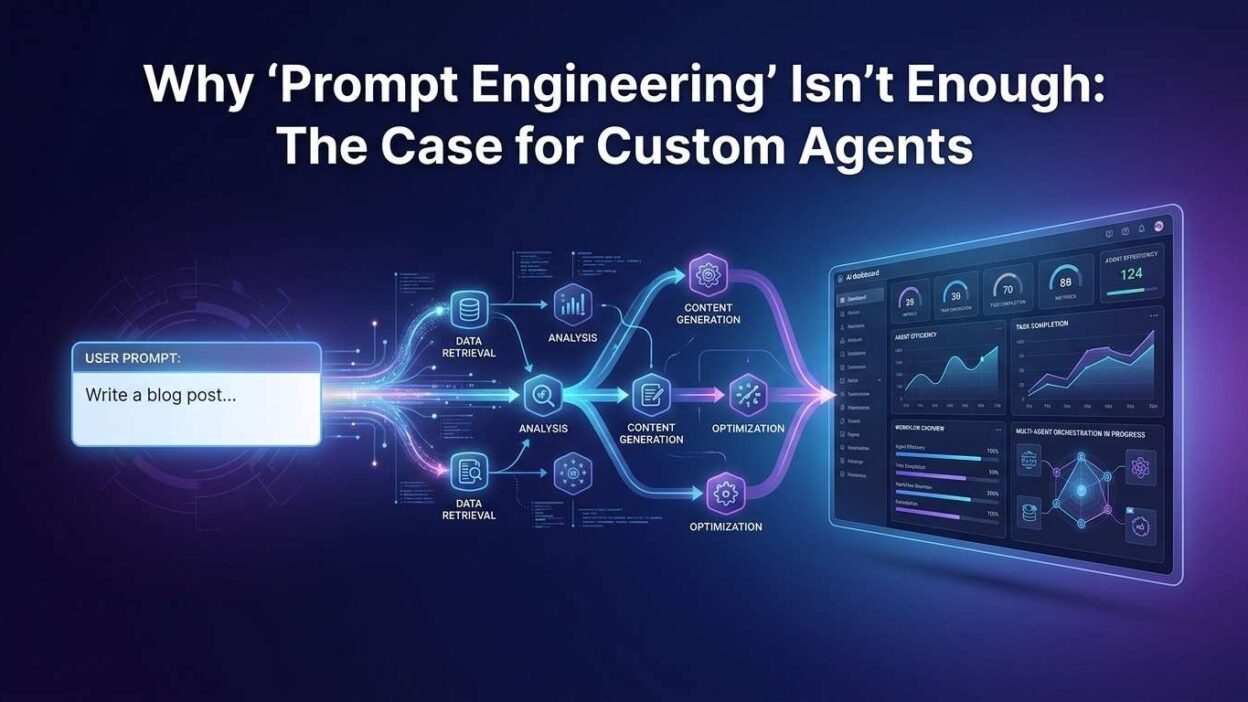
The limitations appear when tasks grow complex. Multi-step workflows break down. Dynamic decision trees cannot fit neatly inside a prompt. Tasks requiring real-world action fall completely outside a prompt’s scope. Prompts do not browse the web. They do not write to databases. They do not trigger API calls or send emails. They generate text. Full stop. When your AI application needs to do more than generate text, prompt engineering alone cannot carry the load. This is where custom AI agents enter the picture.
What Custom AI Agents Actually Are
The term “agent” gets overused. It helps to define it clearly. A custom AI agent is an LLM-powered system that perceives inputs, plans a course of action, uses tools, and executes steps toward a goal. It does not just respond. It acts. It loops. It adapts based on intermediate results. It keeps working until it achieves an objective or hits a defined stopping condition.
The Core Components of a Custom AI Agent
Every custom AI agent has four essential components. It has a brain, which is the LLM responsible for reasoning and planning. It has a memory system, which stores context across steps. It has a set of tools, which let it interact with the world. It has an execution loop, which drives it forward from one step to the next.
The brain decides what to do next. The memory holds what already happened. The tools take action in external systems. The loop keeps the process running. These four components combine to create something qualitatively different from a prompted model. A prompted model responds once. A custom AI agent works until the job is done.
Custom Versus General Agents
A general agent is built to handle broad tasks across many domains. AutoGPT and early BabyAGI experiments were attempts at general agents. They were impressive as demonstrations. They failed in production because they drifted, hallucinated plans, and could not stay reliably on task.
A custom AI agent focuses on a specific domain or workflow. It has predefined tools relevant to that domain. Its prompts constrain it to a clear operational scope. Its memory structure fits its task pattern. This specificity is not a limitation. It is a design choice that makes the agent reliable enough to deploy in real products. Custom scope produces reliable behavior. General scope produces interesting demos.
The Five Limits of Prompt Engineering That Agents Solve
Limit One: Single-Turn Thinking
A prompt generates one response. If the task requires ten steps of reasoning with real-world checks between each step, a single prompt cannot handle it. You could chain prompts manually. Engineers often do this. But manual chaining breaks when logic branches or when external data changes mid-task. Custom AI agents solve this with a dynamic execution loop. The agent reasons about what to do next based on current state. It does not need a human to design every branch in advance.
Limit Two: No Access to Real-World Tools
A prompt cannot call an API. It cannot query a database. It cannot check the current time or look up a live stock price. It cannot send an email or update a CRM record. This keeps prompt-based systems locked inside a text-in, text-out box. Custom AI agents use tools. Tool calling lets agents query databases, hit external APIs, read files, execute code, and interact with any system that exposes an interface. This is a fundamentally different capability class.
Limit Three: No Persistent Memory
Prompts have a context window. When the window fills, earlier context disappears. Long conversations lose coherence. Complex workflows lose state. Prompt engineering workarounds like context compression help at the margins. They do not solve the core problem. Custom AI agents use structured memory systems. Short-term memory holds the active task state. Long-term memory stores facts and past results in vector databases or structured storage. The agent retrieves relevant memory on demand. It does not lose state as tasks grow longer.
Limit Four: No Error Recovery
When a prompted model makes a wrong assumption, the output reflects that error. There is no mechanism for self-correction within a single prompt response. You must prompt again with corrected inputs. In automated workflows, this breaks pipelines and requires human intervention. A custom AI agent can evaluate its own outputs. It can detect failures, try alternative approaches, and retry failed steps. This self-correction loop makes agents far more robust in production environments than any prompt chain.
Limit Five: No Goal Persistence
A prompt responds to one input. It has no concept of an ongoing objective. If the task spans hours or requires waiting for an external event, a prompt cannot handle it. Custom AI agents maintain goal state across time. They can pause, wait for an external trigger, resume, and continue working toward the original objective. This persistence is essential for automating complex business workflows that unfold over time.
Real-World Use Cases Where Custom AI Agents Win
Automated Research and Competitive Intelligence
A prompted model can summarize text you paste into it. A custom AI agent can search the web autonomously, pull competitor pricing pages, extract structured data, compare it against your internal database, and generate a weekly competitive report. All without human input after the initial trigger. The agent uses search tools, scraping tools, and data transformation tools in sequence. No static prompt can replicate this workflow.
Software Development Assistance
Prompt engineering helps developers write individual code snippets. Custom AI agents go further. A coding agent reads a GitHub issue, explores the relevant codebase, drafts a fix, writes unit tests, runs the tests, reads the output, and iterates until tests pass. Tools like Devin and Claude Code demonstrate this architecture in production. The agent does not generate code once. It works through an engineering workflow autonomously.
Customer Support Automation
A prompted chatbot generates draft responses. A custom AI agent handles the full support ticket lifecycle. It reads the ticket, queries the customer database, checks order history, applies refund policy rules, decides on an action, executes the action in the support system, and closes the ticket. Each step uses a different tool. The agent coordinates them based on intermediate results. This is automation, not augmentation. It replaces a workflow, not just a sentence.
Data Enrichment at Scale
Marketing and sales teams maintain large contact databases. Enriching each record with current information requires visiting multiple sources per contact. A custom AI agent handles this at scale. It takes a contact record, searches LinkedIn, company websites, and news sources, extracts relevant facts, structures the data, and writes it back to the CRM. Run this at 10,000 contacts and the agent saves hundreds of hours of manual research time.
Financial Analysis and Reporting
Finance teams spend significant time pulling data from multiple sources and assembling it into reports. A custom AI agent connects to financial data APIs, pulls structured data, runs calculations, compares against prior periods, flags anomalies, and drafts a narrative summary. The agent replaces a three-hour manual process with a five-minute automated run. This is where custom AI agents deliver measurable ROI directly tied to time savings on high-skill knowledge work.
How to Build a Custom AI Agent: Key Architecture Decisions
Choose the Right LLM Brain
The LLM at the center of your agent determines its reasoning quality. GPT-4o, Claude Sonnet, and Gemini Pro handle complex multi-step planning well. Smaller models struggle with tool selection and sequential reasoning. For production custom AI agents, use a frontier model for the planning layer. You can use smaller models for execution subtasks where reasoning demands are lower.
Design Tools with Clear Boundaries
Every tool your agent uses needs a precise definition. Define the tool’s name, description, input parameters, and expected output format. Vague tool descriptions confuse the model. It selects the wrong tool or calls it with incorrect parameters. Sharp tool definitions reduce errors dramatically. Treat each tool definition like an API contract. Precise inputs. Predictable outputs. No ambiguity.
Build a Memory Architecture That Fits the Task
Not every custom AI agent needs all memory types. A short-lived research agent needs only working memory for the current session. A long-running customer relationship agent needs long-term memory storing past interactions. A knowledge-intensive agent needs a retrieval layer connected to a vector database. Design memory to match the task’s time horizon and information complexity.
Implement Guardrails and Stopping Conditions
Agents can loop indefinitely without stopping conditions. Define explicit exit criteria. The agent stops when it completes the goal, exhausts its step budget, or encounters an unrecoverable error. Add content guardrails to prevent the agent from taking actions outside its authorized scope. Production custom AI agents need these constraints as much as they need capable tools. Unbounded agents create unpredictable behavior and uncontrolled costs.
Plan for Observability from Day One
You cannot debug an agent you cannot observe. Log every step. Record every tool call, its inputs, its outputs, and the model’s reasoning for making the call. Capture latency and cost per step. Build a trace viewer that lets you replay any agent run step by step. This observability infrastructure separates teams that can maintain and improve their custom AI agents from teams that abandon them when they misbehave.
Prompt Engineering Inside Custom AI Agents
Prompt engineering does not disappear when you build agents. It becomes more important. Every component of a custom AI agent uses prompts. The system prompt defines the agent’s role and constraints. The tool descriptions are prompts. The reasoning instructions are prompts. The output format specifications are prompts. All of these require careful engineering.
The difference is scope. Prompt engineering in an agent context shapes a specific step or capability. It does not try to do everything in one shot. The planning prompt focuses purely on decision-making. The tool-calling prompt focuses purely on parameter selection. The summarization prompt focuses purely on synthesizing results. Each prompt has a narrow, well-defined job. This modularity makes prompts easier to write, test, and improve.
Teams often find that building custom AI agents makes them better at prompt engineering. The modular structure forces clarity. You cannot hide vague instructions behind complexity. Each prompt either works or it does not. You can test each one independently. This specificity improves overall prompt quality across the entire system.
Choosing Between Frameworks for Building Custom AI Agents
Several frameworks exist for building agents. Each makes different trade-offs between abstraction and control.
LangChain and LangGraph
LangChain provides a rich ecosystem of agent templates, tool integrations, and memory modules. LangGraph extends this with stateful multi-agent workflows using a graph execution model. Teams that want a broad ecosystem with many pre-built connectors find LangChain productive. The abstraction level is high. This speeds up early development. It can limit fine-grained control in production. For teams new to custom AI agents, LangChain is a reasonable starting point.
LlamaIndex
LlamaIndex focuses on the retrieval and data layer of agent workflows. It excels at connecting agents to document stores, databases, and APIs. Teams building knowledge-intensive custom AI agents find LlamaIndex’s data connectors and query pipeline extremely valuable. It pairs well with LangGraph for the orchestration layer.
CrewAI and AutoGen
CrewAI and AutoGen focus on multi-agent collaboration. Multiple agents with different roles work together on a task. One agent researches. Another writes. A third reviews. These frameworks suit complex tasks that benefit from role specialization. They add overhead for simpler single-agent workflows. Use them when the problem genuinely requires multiple perspectives working in parallel.
Building from Scratch
Teams with very specific requirements sometimes build their agent runtime from scratch. This gives maximum control over every loop, memory read, and tool call. It requires more engineering time upfront. It delivers the cleanest, most optimized result. Teams running custom AI agents at production scale with strict latency and cost requirements often move toward custom runtimes over time.
Supporting Concepts
Agentic AI Workflows
Agentic workflows describe processes where an AI system takes sequential, adaptive actions toward a goal. They differ from static pipelines. Each step informs the next. The system adjusts based on real-time results. Agentic workflows are the operational environment where custom AI agents do their work.
Tool Calling and Function Calling
Tool calling lets an LLM invoke external functions. The model identifies which tool to use, formats the required parameters, and returns a structured call. The application executes the call and feeds results back to the model. Tool calling is the mechanism that gives custom AI agents their ability to act in real-world systems.
Multi-Agent Orchestration
Complex tasks benefit from multiple specialized agents working together. One agent handles data retrieval. Another handles analysis. A third handles writing. An orchestrator coordinates their work. Multi-agent orchestration scales the capability of individual custom AI agents by enabling collaboration and parallelism across specialized roles.
Retrieval-Augmented Generation in Agents
RAG gives agents access to current, specific knowledge beyond the model’s training data. An agent with RAG can answer questions grounded in your company’s latest documents. It can retrieve relevant policies before making decisions. RAG integration is a standard component in production custom AI agents that need reliable domain knowledge.
Frequently Asked Questions
What is the difference between a chatbot and a custom AI agent?
A chatbot responds to messages. It generates text based on the current input and conversation history. A custom AI agent takes actions. It uses tools, plans multi-step workflows, and works toward goals over time. A chatbot is a user interface. An agent is an autonomous system.
Do I need to know how to code to build custom AI agents?
Basic agents are now accessible through no-code tools like Zapier AI and Make.com. Production-grade custom AI agents for complex workflows require engineering. You need to define tools, manage state, build error handling, and implement observability. Python is the dominant language for agent development. LangChain and LlamaIndex reduce the required boilerplate significantly.
How much do custom AI agents cost to run?
Cost depends on task complexity, model choice, and tool call frequency. A simple research agent running on Claude Haiku might cost a few cents per run. A complex multi-step coding agent on GPT-4o might cost several dollars per run. Caching, model routing, and step budgets control costs in production custom AI agents. Monitor cost per run from day one.
Are custom AI agents safe to use in production?
Yes, with proper guardrails. Define clear tool permissions. Limit what actions the agent can take without human approval. Implement step budgets to prevent infinite loops. Log everything. Test thoroughly before deployment. Human-in-the-loop checkpoints add safety for high-stakes decisions. Custom AI agents run safely in production every day across thousands of enterprise applications.
What industries benefit most from custom AI agents?
Software development, financial services, legal research, customer support, marketing, and healthcare administration see strong returns. Any domain with complex, repeatable knowledge workflows benefits. If a task takes a human analyst three hours and follows a consistent process, a custom AI agent can likely automate most of it.
How is a custom AI agent different from RPA?
Robotic Process Automation follows rigid, rule-based scripts. It breaks when interfaces change or when edge cases appear. Custom AI agents handle variability. They reason about unexpected inputs. They adapt their approach when standard paths fail. Agents complement RPA. They handle the parts of workflows where judgment and language understanding matter.
Read More:-Transitioning from Manual QA to AI-Driven Automated Testing
Conclusion
Prompt engineering gave teams their first real grip on LLM behavior. It remains a valuable skill. No serious AI team should abandon it. The problem is that it was never designed to carry the full weight of complex AI applications. It generates text. It does not take action. It does not maintain state. It does not recover from errors. It does not work toward goals over time.
Custom AI agents do all of those things. They combine the reasoning power of language models with the action capability of software systems. They maintain memory across long workflows. They use tools to interact with real-world data. They adapt when conditions change. They keep working until the job is done.
The teams building durable AI products are moving past prompts as their primary architectural tool. They are designing custom AI agents with clear goals, sharp tools, reliable memory, and robust observability. This shift is not complicated. It is a natural evolution. Every application that outgrows prompt engineering is an application ready for an agent.
Start with your highest-value, most repetitive knowledge workflow. Define the goal. Identify the tools. Build the loop. Observe the results. Improve from there. That first working custom AI agent will change how your team thinks about what AI can actually do inside your product.