Introduction
TL;DR Software spending drains budgets faster than ever. Companies pay for dozens of subscriptions they barely use. Monthly fees add up while features remain generic and inflexible. The traditional SaaS model no longer serves modern business needs effectively.
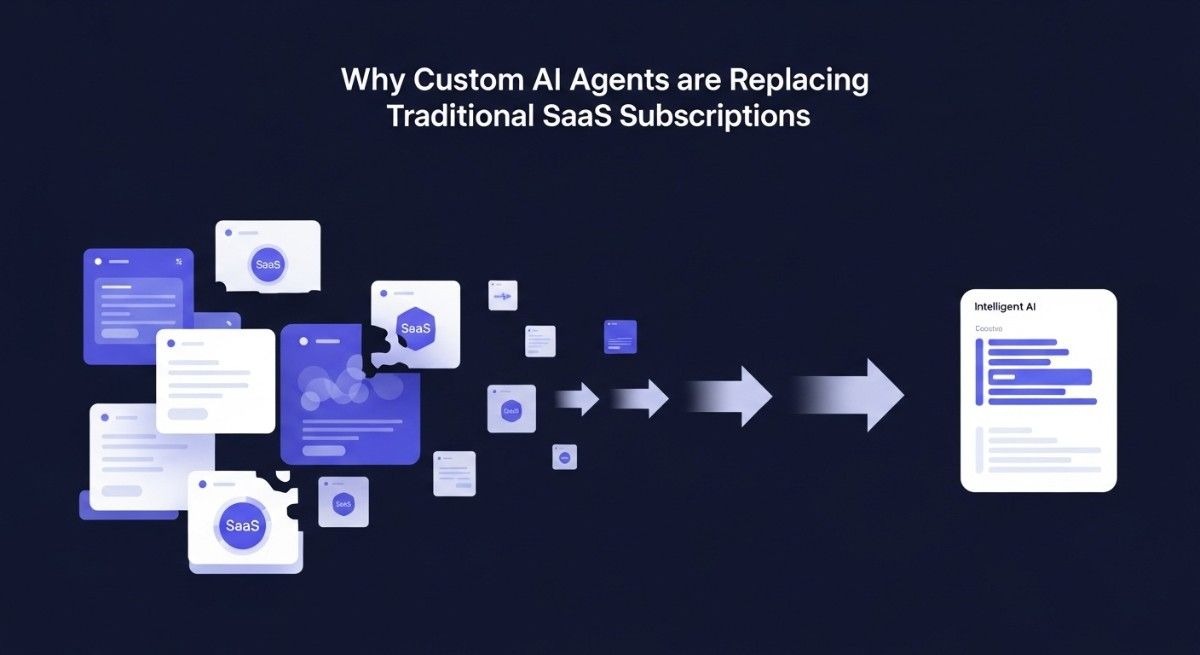
Custom AI agents are changing the software landscape entirely. These intelligent systems adapt to your specific workflows and requirements. They solve unique problems without forcing you into someone else’s vision. The shift from subscription software to personalized AI represents the biggest transformation in business technology since cloud computing emerged.
This guide explores why custom AI agents are replacing traditional SaaS platforms. You’ll discover the economics, capabilities, and strategic advantages driving this revolution. Let’s examine how intelligent automation is reshaping software economics forever.
Table of Contents
The Traditional SaaS Model and Its Limitations
Software as a Service promised simplicity and affordability. Companies could access powerful tools without massive upfront investments. Pay a monthly fee and get instant access to business applications. This model dominated the 2010s and created trillion-dollar valuations.
Reality rarely matched the promise. SaaS platforms force every customer into identical workflows. Your unique business processes must conform to their standardized features. Customization options exist but cost extra and require technical expertise. Most companies settle for suboptimal workflows because changing the software proves too expensive.
Subscription fatigue now plagues every organization. The average company uses 110 different SaaS applications. Finance teams struggle to track spending across countless vendors. Employees forget passwords and waste time switching between disconnected tools. Integration becomes a nightmare as each platform protects its data fortress.
The Cost Problem Nobody Talks About
SaaS pricing escalates rapidly as your business grows. Per-user pricing sounds reasonable until you hit 100 employees. Feature tiers trap you into paying for capabilities you don’t need. Want that one critical feature? You must upgrade to the enterprise plan costing ten times more.
Hidden costs multiply beyond base subscriptions. API access costs extra. Data storage limits force expensive upgrades. Professional services fees appear whenever you need actual support. Training employees on complex interfaces drains productivity. The total cost of ownership far exceeds initial budget projections.
Companies spend an average of $15,000 per employee annually on SaaS subscriptions. Small businesses with 20 employees invest $300,000 yearly in software alone. Enterprise organizations pour millions into tools that solve only 60% of their needs. The remaining 40% requires workarounds and manual processes.
One-Size-Fits-All Doesn’t Fit Anyone
Every business has unique processes that create competitive advantages. SaaS platforms ignore this reality completely. They build features for the broadest possible market. Your specific industry nuances get overlooked. Your proprietary workflows must adapt to their rigid structure.
Customer relationship management systems illustrate this problem perfectly. A manufacturing company needs different CRM capabilities than a consulting firm. SaaS vendors create one product for everyone. Customization becomes an expensive nightmare requiring developers and consultants. Most companies abandon their unique processes to match the software.
Vertical SaaS emerged to solve industry-specific needs. These platforms work better but still force standardization within each industry. Your competitive differentiation gets homogenized. Everyone in your market uses identical tools and workflows. Software becomes a commodity rather than a strategic advantage.
What Are Custom AI Agents?
Custom AI agents are intelligent software systems built specifically for your organization. They understand your unique data, processes, and requirements. These agents perform tasks autonomously using artificial intelligence and machine learning. The software adapts to you instead of forcing adaptation.
An AI agent can handle customer service inquiries using your company’s specific knowledge base. Another agent might process invoices according to your unique approval workflows. A third could analyze sales data using metrics that matter to your business model. Each agent specializes in solving your particular challenges.
These systems learn from your data and improve over time. The AI understands context from past interactions. It recognizes patterns specific to your operations. Performance gets better with use rather than remaining static like traditional software. Your tool evolves alongside your business.
How AI Agents Differ from SaaS Applications
Traditional software requires human operators to click buttons and enter data. AI agents operate independently once given instructions. They make decisions based on defined parameters and learned patterns. Human oversight remains important but constant supervision becomes unnecessary.
SaaS applications provide tools that humans use to complete tasks. Custom AI agents complete the tasks themselves. The distinction transforms what software means. You’re not buying a hammer to swing yourself. You’re hiring a carpenter who knows exactly how you want things built.
Deployment models differ fundamentally. SaaS lives in vendor-controlled clouds with shared infrastructure. Custom AI agents can run wherever you choose. Cloud deployment offers convenience while on-premise installation provides control. The flexibility allows matching deployment to your security and compliance requirements.
The Technology Behind Custom AI Agents
Large language models power modern AI agent capabilities. These models understand natural language and generate human-like responses. GPT-4, Claude, and similar technologies provide the foundation. The models get fine-tuned on your specific data and use cases.
Machine learning algorithms enable continuous improvement. The agent analyzes outcomes from its actions. It identifies which approaches work best in your environment. This learning happens automatically without programmer intervention. Your AI gets smarter through experience.
Integration frameworks connect agents to your existing systems. APIs allow the AI to read data from databases and applications. Workflow automation tools enable agents to trigger actions across platforms. The technology stack creates a unified intelligent layer over fragmented software landscapes.
Why Businesses Are Switching to Custom AI Agents
Cost savings drive initial interest in custom AI agents. Building a custom solution sounds expensive compared to monthly subscriptions. The math tells a different story when calculated over time. Development costs get amortized across years of use. No recurring vendor fees drain budgets indefinitely.
A customer service AI agent might cost $50,000 to develop and deploy. This replaces three SaaS subscriptions costing $2,000 monthly combined. The custom solution pays for itself within two years. Year three saves $24,000 with no additional investment. The economics become compelling quickly.
Performance advantages become clear within weeks of deployment. Custom AI agents handle your exact workflows without workarounds. Employees stop fighting against software limitations. Productivity increases because tools match actual work patterns. The frustration of forcing square pegs into round holes disappears entirely.
Ownership and Control Benefits
Your custom AI belongs to you permanently. No vendor can raise prices or discontinue features. You control the roadmap and prioritize improvements. Data stays within your infrastructure under your security policies. Regulatory compliance becomes simpler without third-party data sharing.
Vendor lock-in disappears when you own the technology. Switching costs drop to zero because there’s nothing to switch from. Your intellectual property remains protected inside your AI rather than exposed through vendor platforms. Competitive advantages stay proprietary instead of becoming industry standard features everyone accesses.
Strategic flexibility increases dramatically with owned technology. Market conditions change but your tools adapt instantly. New regulations require workflow modifications that happen in days instead of months. Competitors using standard SaaS react slowly while you move quickly. Technology becomes an advantage again rather than a commodity.
Unlimited Scalability Without Per-User Fees
Traditional SaaS charges per user or per transaction. Growth becomes expensive as headcount increases. Custom AI agents cost the same whether serving 10 employees or 10,000. Infrastructure scales but software licensing doesn’t multiply. Expansion no longer triggers budget nightmares.
Cloud computing enables elastic infrastructure. Your AI agent runs on servers that scale automatically. Usage spikes get handled without performance degradation. Costs increase marginally with volume rather than stepping up in pricing tiers. The economics favor growth instead of punishing success.
Global operations work seamlessly with custom deployment. SaaS vendors often charge extra for international features. Your AI agent works identically across all geographies. Data residency requirements get satisfied through deployment choices. One system serves your entire organization regardless of location.
Key Advantages of Custom AI Agents Over SaaS
Personalization reaches levels impossible with off-the-shelf software. Your AI agent speaks your company’s language. It understands internal terminology and process nuances. The system reflects your culture and values in every interaction. Employees feel like the tool was built specifically for them because it was.
Integration happens at a fundamental level rather than through surface APIs. The AI reads and writes data using your exact schemas. Workflows span multiple systems without visible seams. Information flows naturally because the agent understands your complete technology ecosystem. Manual data transfer becomes ancient history.
Speed to value accelerates dramatically with focused solutions. SaaS platforms include hundreds of features you’ll never use. Custom AI agents deliver only what you need. Implementation complexity drops when scope narrows to actual requirements. Your team starts benefiting immediately instead of spending months on configuration and training.
Solving Your Specific Problems
Generic software solves common problems adequately. Your competitive advantages come from solving uncommon problems exceptionally. Custom AI agents focus exclusively on your unique challenges. The AI learns your industry’s specific patterns and requirements. Solutions become precise rather than approximate.
A logistics company built an AI agent for route optimization using their proprietary algorithms. No SaaS product understood their specific constraints and priorities. The custom solution reduced fuel costs by 18% within three months. Competitive advantage came from technology tailored to their exact needs.
Healthcare providers use custom AI for patient scheduling with complex insurance verification. Generic scheduling software couldn’t handle their specific requirements. The AI agent navigates insurance rules while optimizing provider schedules. Patient satisfaction increased while administrative costs decreased significantly.
Data Privacy and Security Control
Your data never leaves your infrastructure with properly deployed custom AI. SaaS platforms store information on shared servers. Security depends entirely on vendor practices and priorities. Breaches at the vendor expose your sensitive information. Control returns when you own the entire stack.
Compliance requirements get satisfied more easily with custom deployment. HIPAA, GDPR, and industry-specific regulations impose strict data handling rules. SaaS vendors provide compliance certifications but you’re still trusting third parties. Internal AI agents operate under your direct security policies. Audit trails remain completely within your control.
Intellectual property protection becomes bulletproof with isolated systems. Your proprietary processes and data train the AI privately. Competitors can’t access insights by subscribing to the same platform. Knowledge stays locked inside your organization. Strategic information receives maximum protection.
Continuous Learning From Your Data
Custom AI agents improve by learning from your specific operations. The AI analyzes what works in your environment. It identifies patterns unique to your business model. Performance optimization happens automatically based on your actual results. The tool becomes smarter every day.
SaaS products improve through generic feature releases. Updates serve all customers equally. Your specific needs might never make the roadmap. Custom AI evolves based solely on your priorities. The development path aligns perfectly with your strategic direction.
Historical data provides training material for better decision-making. Your AI learns from years of company knowledge. It recognizes seasonal patterns and market cycles specific to your business. New employees benefit from institutional knowledge embedded in the AI. Organizational memory becomes accessible and actionable.
Industries Leading the Custom AI Agent Adoption
Financial services pioneered custom AI agents for fraud detection and risk assessment. Banks built proprietary systems analyzing transaction patterns. These custom solutions outperform generic fraud detection SaaS by understanding specific customer behaviors. False positives dropped while true fraud detection increased dramatically.
Investment firms use custom AI for trading strategies and portfolio management. Proprietary algorithms provide competitive advantages that SaaS products can’t deliver. The AI learns from firm-specific investment philosophy and risk tolerance. Returns improve through personalized rather than generic analysis.
Healthcare organizations deploy custom AI for diagnosis support and treatment planning. Patient data privacy requirements make SaaS solutions challenging. Custom agents operate within hospital networks while maintaining HIPAA compliance perfectly. Clinical decision support becomes more accurate through learning from each institution’s specific patient population.
Manufacturing and Supply Chain Applications
Production optimization benefits enormously from custom AI agents trained on factory-specific data. Each manufacturing facility has unique equipment and processes. Generic MES software provides basic capabilities. Custom AI agents optimize based on actual machine performance and production constraints.
Supply chain visibility improves through AI agents that understand your specific vendor network. The system learns lead times and reliability patterns for your suppliers. Inventory optimization happens based on your actual demand patterns. Generic supply chain software uses industry averages while custom AI uses your reality.
Quality control AI agents learn what defects look like in your specific products. Computer vision systems get trained on your manufacturing output. Detection accuracy far exceeds generic quality inspection software. Scrap rates decrease while production speed increases.
Professional Services and Consulting
Consulting firms built custom AI for knowledge management and proposal generation. Each firm’s methodology and expertise differ significantly. Generic knowledge bases don’t capture proprietary frameworks. Custom AI agents embed firm-specific intellectual property into everyday workflows.
Legal practices use AI for document review trained on their practice areas. A patent law firm needs different AI capabilities than a criminal defense practice. Custom agents understand specific legal precedents and jurisdictional nuances. Generic legal tech serves broad markets while custom AI delivers specialized expertise.
Marketing agencies deploy AI for creative brief analysis and campaign optimization. Each agency has unique creative processes and client industries. Custom AI agents learn what works for specific client types. Campaign performance improves through personalized optimization rather than generic best practices.
Building vs. Buying: The Economic Reality
Development costs for custom AI agents have dropped dramatically. Pre-trained language models eliminate starting from scratch. Development frameworks simplify agent creation. Technical talent remains expensive but timeline compression reduces total cost. A functional custom AI can launch in months instead of years.
Initial investment typically ranges from $25,000 for simple agents to $200,000 for complex enterprise solutions. Compare this to SaaS spending over five years. A company paying $5,000 monthly for multiple tools spends $300,000 over that period. The custom solution costs less and delivers more value.
Maintenance costs run significantly lower than subscription fees. Updates happen on your schedule based on your priorities. No forced upgrades breaking your workflows. Infrastructure costs scale with usage but remain predictable. Total cost of ownership favors custom development for most mid-sized and large organizations.
When Custom AI Agents Make Financial Sense
Organizations spending over $50,000 annually on related SaaS subscriptions reach the break-even threshold quickly. The more you currently spend on software, the faster custom AI pays for itself. Companies with unique processes see even better returns because generic software serves them poorly.
Businesses planning long-term operations benefit most from ownership economics. A three-year planning horizon makes custom development attractive. Five-year projections make it compelling. SaaS might win for short-term projects or temporary needs. Permanent operations favor permanent solutions.
Companies with technical talent in-house reduce custom AI costs substantially. Developers and data scientists build agents as part of normal duties. External development remains an option but internal capability slashes expenses. Custom AI agents become even more economical with existing resources.
The Hidden Costs of SaaS That Disappear
Integration expenses between multiple SaaS platforms drain IT budgets constantly. Each new tool requires connecting to existing systems. APIs change and integrations break. Custom AI agents integrate at a fundamental level once. Ongoing integration maintenance costs disappear entirely.
Training costs compound with every SaaS platform employees must learn. Each tool has unique interfaces and workflows. New hires face months of software training. Custom AI agents work how your team already works. Training time drops to hours instead of weeks.
Context switching between applications destroys productivity. Studies show 23 minutes of lost focus after each interruption. Employees switching between ten different SaaS tools lose hours daily. Custom AI consolidates functionality into unified experiences. Focus improves and output increases measurably.
Implementation Strategies for Custom AI Agents
Start with a clear problem definition and success metrics. Identify one specific pain point that costs significant time or money. Document current workflows and desired improvements. Quantify expected benefits in concrete terms. This foundation ensures development efforts target actual needs.
Choose between internal development and partnering with AI development firms. Internal teams offer control and institutional knowledge. External partners bring specialized expertise and faster delivery. Hybrid approaches combine strengths of both options. The right choice depends on your technical capabilities and timeline requirements.
Pilot programs prove value before full deployment. Build a minimal viable agent addressing one workflow. Test with a small user group and gather feedback. Iterate based on real-world usage patterns. Expand scope after proving the concept works. This approach manages risk while building organizational confidence.
Selecting the Right Use Cases
High-volume repetitive tasks provide ideal starting points for custom AI agents. Customer service responses, data entry, and report generation offer clear automation opportunities. Success metrics are obvious and improvements easily measured. Quick wins build momentum for larger initiatives.
Processes requiring specialized knowledge benefit enormously from custom AI. Tasks that currently need expensive expert time become scalable through agents. Legal document review, medical coding, and technical troubleshooting exemplify knowledge-intensive work. AI agents democratize expertise across organizations.
Workflows spanning multiple systems cry out for intelligent automation. Manual data transfers between platforms waste countless hours. Custom AI agents bridge these gaps seamlessly. Information flows automatically while maintaining accuracy. Integration nightmares transform into elegant solutions.
Building Your AI Development Team
Data scientists bring machine learning expertise critical for agent development. They design models and training approaches. Their skills ensure AI agents actually learn and improve. This role becomes essential for sophisticated applications.
Software engineers build the infrastructure and integrations. They connect AI models to business systems. Code quality determines reliability and maintainability. Strong engineering prevents technical debt from accumulating.
Domain experts guide AI behavior to match business requirements. They understand workflows and edge cases. Their input ensures agents handle real-world complexity. Subject matter expertise prevents solutions that work in theory but fail in practice.
Overcoming Common Challenges and Concerns
Technical complexity intimidates organizations considering custom AI agents. Modern development platforms simplify creation significantly. Low-code and no-code options exist for simpler use cases. The barrier to entry continues dropping as tools mature. Technical challenges remain manageable with proper planning and resources.
Data quality concerns delay many AI initiatives. Agents learn from available data quality. Garbage input produces garbage output regardless of AI sophistication. Address data quality issues before development begins. Clean data foundations ensure successful agent deployment.
Change management requires careful attention when introducing AI. Employees fear replacement by automation. Communicate clearly that agents augment rather than replace human workers. Involve users in design processes. Demonstrate how AI eliminates tedious tasks and enables more interesting work.
Ensuring Ethical AI Development
Bias in training data creates biased AI behavior. Audit data sets for representational fairness. Test agent decisions across demographic groups. Implement monitoring to detect emerging bias. Ethical AI requires ongoing vigilance rather than one-time checking.
Transparency builds trust in AI decision-making. Document how agents reach conclusions. Provide explanation features that show reasoning. Users should understand why the AI recommended specific actions. Black box systems create justified skepticism.
Human oversight remains critical even with sophisticated agents. AI should augment human judgment rather than replace it entirely. Build review processes into high-stakes decisions. Keep humans in the loop for complex situations. Custom AI agents work best as intelligent assistants rather than autonomous decision-makers.
Managing Technical Debt and Maintenance
Code quality matters more for custom software than subscriptions. Poor development creates maintenance nightmares. Invest in proper architecture and documentation. Technical debt compounds quickly without discipline. Future you will thank present you for clean implementations.
Regular updates keep AI agents current and effective. Model retraining incorporates new data and patterns. Infrastructure updates address security vulnerabilities. Maintenance schedules prevent systems from becoming stale. Budget time and resources for ongoing care.
Documentation enables long-term sustainability. Future developers need to understand current systems. Decision rationale should be recorded clearly. Knowledge transfer prevents key person dependencies. Well-documented systems survive personnel changes.
The Future of Custom AI Agents
Agent capabilities will expand dramatically over the next five years. Multi-modal AI will process text, images, video, and audio simultaneously. Reasoning abilities will improve through advances in model architecture. Custom AI agents will handle increasingly complex tasks requiring judgment and creativity.
Collaborative agent networks will emerge as the next evolution. Multiple specialized agents will work together on complex projects. One agent gathers information while another analyzes and a third executes. Orchestration layers will coordinate agent activities seamlessly. The system becomes greater than the sum of individual agents.
Democratization will accelerate through better development tools. Business users will build simple agents without coding. Sophisticated platforms will make advanced AI accessible to small companies. The technology becomes ubiquitous rather than remaining exclusive to tech giants.
The End of the SaaS Era
Traditional SaaS will survive for simple commodity functions. Email and basic productivity tools will remain subscription-based. Differentiated business processes will shift to custom AI solutions. The market will bifurcate between generic utilities and personalized intelligence.
SaaS vendors will pivot toward selling AI agent templates and frameworks. Their business model will shift from hosting software to enabling customization. Open ecosystems will replace closed platforms. The companies that adapt will thrive while rigid vendors decline.
Enterprise software spending will reallocate from subscriptions to development. IT budgets will favor building custom solutions over buying generic products. Custom AI agents represent this shift toward owned technology. The transition is already underway in forward-thinking organizations.
Measuring ROI and Success Metrics
Time savings provide the most immediate measurable benefit. Calculate hours saved through automation. Multiply by employee costs to determine dollar value. Most organizations see 40-60% time reduction in automated workflows. The savings compound across multiple processes.
Error reduction delivers significant financial impact. Manual processes introduce mistakes that cost money to fix. AI agents maintain consistency that humans struggle to match. Quality improvements reduce waste and rework. Customer satisfaction increases when accuracy improves.
Revenue growth often follows successful AI agent deployment. Sales teams close more deals with better lead qualification. Customer service teams retain more customers through faster resolution. Custom AI agents remove bottlenecks that previously limited growth. Expansion happens without proportional cost increases.
Long-Term Strategic Value
Competitive positioning improves through technology differentiation. Companies using custom AI agents move faster than SaaS-dependent competitors. Market responsiveness increases when tools adapt instantly. Strategic advantages compound over time as agents learn and improve.
Data insights emerge from AI analysis of company information. Patterns invisible to humans become visible through machine learning. These insights drive better strategic decisions. Your data becomes a competitive moat rather than unused archives.
Organizational learning accelerates through embedded AI knowledge. New employees access expertise through intelligent agents. Tribal knowledge becomes explicit and transferable. Companies preserve institutional memory despite personnel turnover. The organization itself becomes smarter over time.
Read More:-The Cost of AI: Balancing API Tokens vs. In-House Model Hosting
Conclusion
Custom AI agents represent the future of business software. Traditional SaaS subscriptions drain budgets while forcing standardization. Custom solutions deliver personalization at lower total costs. The economics strongly favor owned technology over endless rental fees.
Your unique business processes deserve tools built specifically for them. Generic software creates competitive parity rather than advantage. Custom AI agents embed your expertise into automated systems. Strategic differentiation comes from technology that reflects your specific approach.
Implementation becomes easier as development tools mature. Starting points exist for companies of all sizes. Pilot projects prove value before major commitments. The risk of trying custom AI is far lower than the risk of ignoring this transformation.
The shift from SaaS to custom AI has already begun. Early adopters gain advantages that late movers will struggle to match. Your competitors are evaluating this technology right now. Waiting means falling behind in an increasingly competitive landscape.
Take action today by identifying your most expensive or frustrating SaaS subscription. Calculate what building a custom alternative would cost. Compare that investment to five years of subscription fees. The math will likely surprise you and inspire change.
Custom AI agents deliver better results at lower costs while providing complete control. This combination makes the transition from SaaS inevitable. The only question is whether your organization leads or follows this revolution. Choose wisely and move quickly.