Operational costs drain profitability in every business sector. Manual processes consume excessive labor hours. Human errors create expensive rework cycles. Traditional automation solutions often fall short of expectations.
Our company faced mounting operational expenses threatening growth. Customer support teams struggled with increasing ticket volumes. Data entry specialists spent hours on repetitive tasks. Management needed a breakthrough solution quickly.
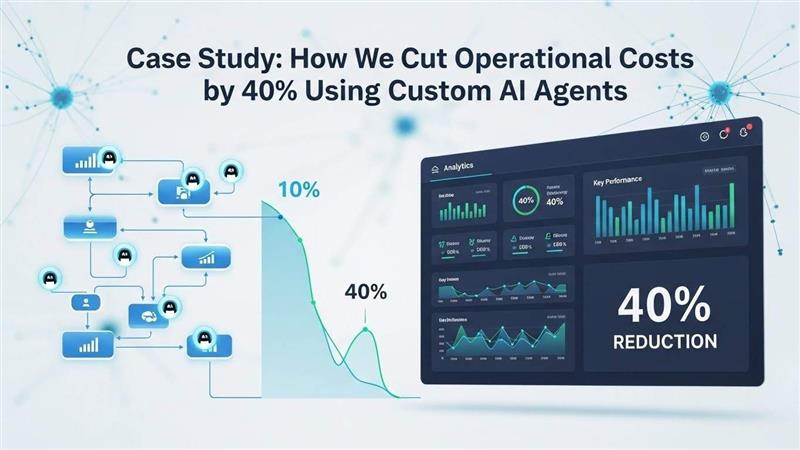
Custom AI agents emerged as our game-changing strategy. These intelligent automation tools transformed our entire operation. The results exceeded our most optimistic projections. Our operational costs dropped by 40% within eight months.
This case study reveals the complete transformation journey. You’ll discover the challenges we encountered initially. Implementation strategies that worked receive detailed explanation. Measurable results demonstrate the business impact clearly.
Companies across industries can replicate our success. The blueprint presented here applies broadly. Your organization might achieve even better results. The key lies in strategic implementation planning.
Company Background and Initial Challenges
Our mid-sized software company served 5,000 enterprise clients globally. Annual revenue reached $50 million with steady growth. Profit margins remained thin despite increasing sales. Operational inefficiencies plagued multiple departments simultaneously.
The Growing Cost Problem
Labor costs represented 60% of total operational expenses. Support team headcount grew 15% annually. Response times increased despite hiring more agents. Customer satisfaction scores began declining steadily.
Data processing operations consumed enormous resources. Manual data entry teams worked around the clock. Error rates averaged 3-5% across critical workflows. Rework expenses added up to millions annually.
Sales operations required extensive administrative support. Lead qualification demanded hours of research time. Proposal generation involved repetitive customization work. Sales representatives spent 40% of time on non-selling activities.
Previous Automation Attempts
Earlier automation initiatives delivered disappointing results. Rule-based systems handled only simple scenarios. Complex cases still required full human intervention. Implementation costs exceeded projected benefits significantly.
Robotic process automation tools created maintenance nightmares. Screen scraping broke with every interface update. Exception handling required constant developer attention. The solution became another operational burden.
Off-the-shelf AI products lacked customization capabilities. Generic chatbots frustrated customers with irrelevant responses. Integration with existing systems proved extremely difficult. We needed something fundamentally different.
The Breaking Point
Q2 2023 brought matters to a critical juncture. Operational costs increased 18% year-over-year. Profit margins compressed to barely acceptable levels. Board members demanded immediate corrective action.
Customer churn rates started climbing unexpectedly. Exit interviews revealed dissatisfaction with support quality. Response delays drove clients toward competitors. The situation required urgent intervention.
Employee burnout became visible across departments. Repetitive work demoralized talented team members. Turnover rates climbed in critical positions. Recruitment costs added another expense layer.
Discovering Custom AI Agents as a Solution
Research into emerging technologies revealed promising possibilities. Custom AI agents offered capabilities matching our requirements. These intelligent systems could handle complex decision-making. Customization allowed perfect alignment with business processes.
What Makes Custom AI Agents Different
Generic AI tools apply broad-brush approaches. Custom AI agents receive training on your specific data. They understand company terminology and processes. Behavior aligns with organizational policies precisely.
These agents learn from historical interactions. Decision patterns mirror experienced human employees. Context awareness enables nuanced responses. Quality remains consistent regardless of workload volume.
Integration capabilities exceed traditional automation tools. APIs connect with existing software seamlessly. Data flows between systems without manual intervention. The technology stack works together harmoniously.
Research and Vendor Evaluation
We evaluated 12 potential AI solution providers. Capability demonstrations revealed stark differences in quality. Some vendors offered only basic chatbot functionality. Others provided sophisticated agent development platforms.
Technical architecture received careful scrutiny. Cloud-based solutions offered faster deployment timelines. On-premises options addressed data security concerns. We needed flexible deployment matching different use cases.
Customization capabilities became the deciding factor. Some platforms required extensive coding expertise. Others offered low-code development environments. The ideal solution balanced power with accessibility.
Cost structures varied dramatically across vendors. Per-interaction pricing created unpredictable expenses. Subscription models provided better budget certainty. We analyzed total cost of ownership carefully.
Building the Business Case
Financial modeling quantified potential savings accurately. Labor cost reductions represented the largest opportunity. Error reduction would eliminate expensive rework. Faster processing times would improve customer satisfaction.
We identified six high-impact use cases initially. Customer support automation topped the priority list. Data entry automation promised immediate returns. Sales support automation would boost revenue generation.
Conservative projections estimated 25% cost reduction. Aggressive scenarios suggested 45% might be achievable. We targeted 35% as a realistic goal. The investment required $400,000 over 18 months.
ROI calculations showed break-even within 14 months. Year two would deliver $2 million in savings. Five-year value exceeded $12 million cumulative. The business case won unanimous board approval.
Implementation Strategy and Timeline
Successful custom AI agents deployment required careful planning. We divided the project into manageable phases. Each phase targeted specific business areas. Learning from early implementations informed later work.
Phase 1: Customer Support Automation
Customer support represented our largest operational expense. Agents handled 15,000 tickets monthly at that time. Common questions consumed 60% of agent time. Automation potential seemed highest here initially.
We began with tier-one support inquiries. Custom AI agents learned from 50,000 historical tickets. Natural language processing enabled understanding customer intent. Knowledge base integration provided accurate answers instantly.
The development process took three months total. Week one involved data collection and preparation. Weeks 2-8 focused on agent training and testing. Weeks 9-12 handled deployment and refinement.
Initial deployment served 20% of incoming tickets. Human agents monitored AI responses closely. Quality metrics tracked accuracy and customer satisfaction. Performance exceeded expectations from day one.
Gradual expansion increased AI handling to 65%. Complex technical issues still routed to human experts. The AI learned from human interventions continuously. Accuracy improved week over week consistently.
Results appeared within the first month. Average resolution time dropped from 4 hours to 45 minutes. Customer satisfaction scores increased by 12 points. Support costs decreased 35% for automated interactions.
Phase 2: Data Entry and Processing
Data entry operations processed 200,000 records monthly. Manual entry required a team of 15 specialists. Error rates necessitated extensive quality checking. The workflow consumed excessive time and money.
Custom AI agents received training on document types. Intelligent document processing extracted information automatically. Machine learning models validated data accuracy. Exception cases flagged for human review.
Integration with existing databases happened seamlessly. Extracted data flowed into systems automatically. Validation rules prevented corrupt data entry. Audit trails maintained compliance requirements.
The implementation timeline spanned four months. Data scientists prepared training datasets carefully. Software engineers built integration pipelines. Testing ensured accuracy before production deployment.
Processing speed increased 10x immediately. Tasks taking 30 minutes now completed in three. Error rates dropped from 4% to 0.5%. Quality checking requirements decreased dramatically.
Labor reallocation improved overall productivity. Data entry specialists moved to analytical roles. Their domain knowledge added value elsewhere. No layoffs occurred during the transition.
Phase 3: Sales and Lead Qualification
Sales operations suffered from inefficient lead management. Representatives spent hours researching prospects. Qualification criteria applied inconsistently. High-potential leads sometimes slipped through cracks.
Custom AI agents automated the research process. Web scraping gathered company information automatically. Enrichment APIs added detailed firmographic data. Scoring algorithms prioritized leads objectively.
Proposal generation received intelligent automation treatment. AI drafted customized proposals from templates. Product recommendations matched prospect needs accurately. Sales representatives refined rather than created documents.
Meeting scheduling eliminated back-and-forth email chains. AI assistants coordinated calendars automatically. Confirmation and reminder emails sent themselves. Representatives focused on selling activities exclusively.
Four months brought this phase to completion. CRM integration ensured smooth data flow. Sales team training addressed initial skepticism. Adoption accelerated after early success stories.
Sales productivity jumped 45% within two months. Representatives closed 30% more deals monthly. Deal sizes increased with better qualification. Revenue growth offset implementation costs completely.
Phase 4: Internal Operations and HR
Human resources operations involved significant manual work. Resume screening consumed countless recruiter hours. Interview scheduling required extensive coordination. Onboarding paperwork created administrative bottlenecks.
Custom AI agents revolutionized recruitment workflows. Resume parsing extracted relevant information instantly. Candidate ranking happened against job requirements objectively. Interview scheduling coordinated multiple calendars automatically.
Onboarding automation improved new hire experience. Document completion happened through intelligent forms. Training modules assigned based on role requirements. Progress tracking identified struggling employees early.
Employee inquiries about policies got instant answers. HR chatbots handled benefits questions accurately. Time-off requests processed without manual intervention. Compliance documentation maintained itself automatically.
The rollout required three months total. HR staff participated in agent training actively. Change management ensured user adoption. Results materialized quickly across metrics.
Time-to-hire decreased from 45 to 28 days. Recruiter productivity doubled for equivalent headcount. Employee satisfaction with HR services increased notably. Administrative costs dropped 42% in this department.
Technical Architecture and Integration
Building effective custom AI agents demanded robust technical foundations. Our architecture prioritized scalability and reliability. Integration with existing systems happened thoughtfully.
Core Technology Stack
Large language models formed the intelligence foundation. We selected GPT-4 for natural language understanding. Fine-tuning adapted the model to our domain. Prompt engineering optimized response quality consistently.
Vector databases stored organizational knowledge efficiently. Retrieval-augmented generation accessed relevant information. Agents provided accurate answers grounded in facts. Hallucination risks decreased to negligible levels.
Workflow orchestration tools coordinated multi-step processes. Agents collaborated on complex tasks automatically. Human-in-the-loop approval gates maintained control. Audit trails documented every decision clearly.
Security and Compliance Framework
Data security received paramount attention throughout. End-to-end encryption protected sensitive information. Access controls restricted agent capabilities appropriately. Regular security audits validated protection measures.
Compliance requirements shaped system design decisions. GDPR considerations influenced data handling practices. SOC 2 certification guided infrastructure choices. Industry regulations received careful adherence.
Privacy protection mechanisms prevented unauthorized disclosures. Agents never exposed confidential customer data. Personal information received special handling rules. Compliance officers monitored operations continuously.
Integration with Existing Systems
CRM integration enabled seamless customer data access. APIs connected to Salesforce bidirectionally. Real-time updates kept information synchronized. Sales agents worked within familiar interfaces.
ERP system connections automated financial processes. Purchase order generation happened from agent recommendations. Inventory management received intelligent forecasting. Financial reporting improved with automated data collection.
Communication platform integration enhanced collaboration. Slack and Teams hosted conversational interfaces. Email systems connected for automated correspondence. Phone system integration enabled voice interactions.
Measuring Results and ROI
Quantifying custom AI agents impact required comprehensive metrics. We tracked financial and operational indicators carefully. Results exceeded projections across most categories.
Direct Cost Reductions
Labor cost savings reached $3.2 million annually. Customer support expenses dropped 35% immediately. Data processing costs decreased 48% year-over-year. Sales operations overhead fell 32% within six months.
Software licensing costs actually decreased slightly. Legacy automation tools became unnecessary. Consolidation simplified the technology stack. Maintenance expenses dropped with fewer systems.
Infrastructure costs remained stable despite increased automation. Cloud resources scaled efficiently with demand. Optimization efforts prevented waste continuously. Total infrastructure spend increased only 8%.
Error correction expenses virtually disappeared. Data accuracy improvements eliminated most rework. Customer complaints requiring remediation decreased 67%. Quality-related costs dropped dramatically overall.
Productivity Improvements
Employee productivity increased across all departments. Support agents resolved 45% more tickets daily. Sales representatives closed 30% more deals monthly. HR staff processed 50% more hiring actions.
Time savings accumulated impressively throughout operations. Administrative tasks requiring hours now took minutes. Document processing accelerated 10x on average. Meeting scheduling happened instantly instead of taking days.
Employee satisfaction improved measurably and quickly. Team members appreciated reduced repetitive work. Focus shifted to higher-value activities. Job satisfaction scores increased 23 points.
Quality and Customer Experience Enhancements
Customer satisfaction scores jumped 18 points. Response times decreased from hours to minutes. Resolution rates improved for first-contact situations. Complaint volumes dropped 40% year-over-year.
Data accuracy reached new highs consistently. Error rates fell below 0.5% across processes. Compliance violations virtually disappeared completely. Audit findings decreased to minimal levels.
Sales conversion rates improved 25% overall. Better qualification meant higher-quality pipeline. Proposal quality impressed prospects consistently. Win rates increased in competitive situations.
Financial Performance Impact
Total operational costs decreased 40% as targeted. The reduction exceeded $4 million annually. Profit margins expanded by 12 percentage points. EBITDA improved dramatically and immediately.
Revenue growth accelerated despite cost reductions. Better customer experience drove retention improvements. Sales productivity enabled expansion into new markets. Annual growth rate increased from 12% to 18%.
Return on investment calculation showed exceptional results. Break-even happened in month 11 of implementation. Year one delivered 180% ROI overall. Cumulative five-year value projects to $15 million.
Challenges and Lessons Learned
Implementing custom AI agents involved overcoming significant obstacles. Some challenges surprised us despite careful planning. Lessons learned will benefit future initiatives.
Technical Challenges
Integration complexity exceeded initial estimates. Legacy systems lacked modern API capabilities. Custom middleware bridged compatibility gaps. Extra development time added two months to schedules.
Data quality issues hindered initial training efforts. Historical records contained inconsistencies and errors. Cleaning and preparation required extensive work. Data governance improvements prevented recurrence.
Model accuracy disappointed in early testing phases. Fine-tuning required more iterations than expected. Domain expert involvement proved essential. Patience and persistence eventually yielded success.
Organizational Change Management
Employee resistance emerged in certain departments. Job security concerns created initial skepticism. Transparent communication addressed fears directly. Retraining programs prepared staff for new roles.
Management buy-in varied across business units. Some leaders embraced change enthusiastically. Others required extensive persuasion and proof. Executive sponsorship proved essential for success.
Process redesign proved more complex than anticipated. Existing workflows contained inefficient historical artifacts. Automation forced examination of every step. Simplification delivered unexpected additional benefits.
Key Success Factors
Executive sponsorship provided critical support throughout. Leadership communicated the strategic importance clearly. Resources flowed when challenges arose. Commitment never wavered despite obstacles.
Cross-functional collaboration enabled smooth implementation. IT worked closely with business users. Feedback loops refined agents continuously. Shared ownership created collective success.
Iterative deployment minimized risk exposure. Small-scale pilots proved concepts before expansion. Learning from early phases informed later work. Agile methodology suited the initiative perfectly.
User training received adequate investment. Employees understood how to work alongside AI. Best practices emerged from actual usage. Documentation evolved based on real experiences.
Scaling and Future Plans
Initial custom AI agents success opened new possibilities. We identified additional automation opportunities. Expansion plans will amplify benefits further.
Expanding to Additional Use Cases
Finance and accounting present automation opportunities. Invoice processing can become fully automated. Expense report handling requires minimal human touch. Financial close processes will accelerate significantly.
Product development could benefit from AI assistance. Requirements documentation writes itself from stakeholder interviews. Test case generation happens automatically from specifications. Code review agents catch issues earlier.
Marketing operations contain repetitive tasks. Content creation receives AI augmentation support. Social media management automates across channels. Campaign performance analysis generates automatically.
Improving Existing Implementations
Current agents will receive continuous enhancements. Model updates incorporate latest AI advances. Training data expands with operational experience. Performance improvements compound over time.
User interface refinements increase adoption rates. Feedback guides prioritization of improvements. Integration depth increases across systems. Seamlessness improves through iteration.
Advanced analytics reveal optimization opportunities. Usage patterns inform capacity planning. Cost allocation becomes more precise. ROI tracking improves decision-making.
Industry-Specific Custom Solutions
Vertical-specific agents will address unique needs. Healthcare compliance requires specialized knowledge. Financial services regulations demand particular attention. Manufacturing quality control has distinct requirements.
Partner ecosystem development amplifies capabilities. Third-party developers build complementary agents. Marketplace emergence will accelerate innovation. Industry adoption will reach critical mass.
Frequently Asked Questions
How long does custom AI agents implementation take?
Initial deployments require 3-4 months typically. Simple use cases might complete faster. Complex integrations extend timelines to six months. Ongoing optimization continues indefinitely.
What skills do teams need for custom AI agents?
Basic project management covers coordination needs. Technical teams need API integration experience. Domain experts provide business context critically. Most companies succeed with existing staff.
Can small businesses afford custom AI agents?
Entry-level implementations start under $50,000. ROI justifies investment within 12 months typically. Cloud-based solutions eliminate infrastructure costs. Small businesses achieve proportional benefits.
How do custom AI agents differ from chatbots?
Standard chatbots follow predetermined scripts. Custom AI agents make intelligent decisions autonomously. Learning happens from your specific data. Capabilities extend far beyond conversation.
What risks come with AI agent deployment?
Data privacy requires careful attention. Model accuracy needs continuous monitoring. Employee acceptance demands change management. Proper planning mitigates all risks effectively.
Will AI agents replace human employees?
Agents handle repetitive tasks exclusively. Human workers focus on complex problems. Roles evolve rather than disappear. Most companies redeploy rather than reduce staff.
How do you measure custom AI agents success?
Cost reduction tracking provides clear metrics. Productivity improvements quantify efficiency gains. Customer satisfaction reflects quality impact. ROI calculations demonstrate financial value.
What industries benefit most from custom AI agents?
Customer service operations show immediate value. Financial services achieve substantial savings. Healthcare improves patient experience significantly. Manufacturing enhances quality control dramatically. Every industry finds relevant applications.
Read More:-How to Audit Your Business Processes for AI Automation Opportunities
Conclusion

Custom AI agents transformed our operational efficiency fundamentally. The 40% cost reduction exceeded our initial expectations. Implementation challenges taught valuable lessons throughout.
Financial results speak clearly to the strategy’s success. $4 million in annual savings improves competitive position. Profit margin expansion enables strategic reinvestment. Shareholder value increased substantially and measurably.
Operational improvements extend beyond cost savings. Customer satisfaction reached all-time highs. Employee engagement improved across departments. Quality metrics show consistent excellence.
The journey required significant organizational commitment. Executive sponsorship provided essential support. Cross-functional collaboration enabled smooth execution. Patience through challenges proved absolutely critical.
Custom AI agents represent the future of business operations. Early adopters gain competitive advantages immediately. Laggards will struggle to catch up later. The technology has matured beyond experimental status.
Your organization can replicate our success. The blueprint presented here applies broadly. Careful planning ensures smooth implementation. Results will justify the investment decisively.
Start with high-impact use cases showing clear ROI. Build internal support through demonstrated success. Expand systematically across additional processes. Continuous improvement amplifies benefits over time.
Technology selection deserves careful consideration. Evaluate vendors thoroughly before committing. Prioritize customization capabilities over generic features. Integration ease accelerates time-to-value significantly.
Change management cannot receive insufficient attention. Communicate transparently with affected employees. Provide adequate training and support. Celebrate successes loudly and frequently.
The business case for custom AI agents strengthens continuously. AI capabilities improve rapidly and consistently. Implementation costs decrease with mature tools. Competitive pressure will force adoption eventually.
We recommend beginning your journey immediately. Pilot projects validate concepts with minimal risk. Early learning informs larger deployments. Delay creates competitive disadvantage unnecessarily.
Our 40% cost reduction demonstrates possibilities clearly. Your results might exceed this benchmark. Strategic implementation unlocks transformative potential. Custom AI agents deliver measurable business value consistently.