Introduction
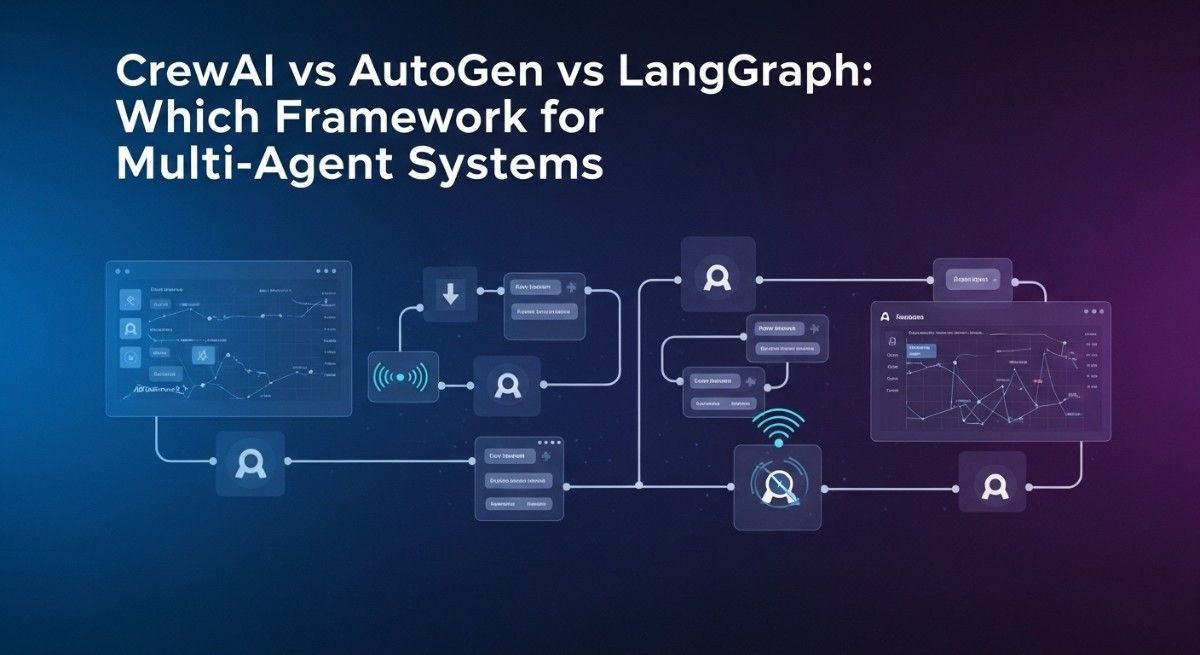
TL;DR Choosing the right framework matters. Developers building multi-agent AI systems face a real fork in the road. CrewAI vs AutoGen vs LangGraph for multi-agent systems is one of the most searched comparisons in the AI tooling space right now. Each framework solves the same core problem differently. This guide breaks down what each one does, where each shines, and which one fits your project.
What Are Multi-Agent Systems and Why Do They Matter?
A multi-agent system is a setup where several AI agents work together. Each agent handles a specific task. One agent might browse the web. Another might write code. A third might review and refine the output. Together, these agents complete complex workflows that a single model cannot.
The demand for these systems has grown fast. Businesses want AI that can plan, act, and deliver results end-to-end. Single-prompt models hit limits quickly. Multi-agent systems scale beyond those limits by splitting work across specialized agents.
Three frameworks dominate this space right now. CrewAI, AutoGen, and LangGraph each let you build and orchestrate these systems. The difference lies in their design philosophy, ease of use, and control level. Understanding CrewAI vs AutoGen vs LangGraph for multi-agent systems helps you pick the right tool from the start.
CrewAI: Role-Based Collaboration Made Simple
What Is CrewAI?
CrewAI is an open-source Python framework. It uses a crew metaphor to organize agents. You define agents with specific roles, goals, and backstories. Then you assign tasks and let the crew execute them in sequence or in parallel.
The framework is designed for simplicity. You do not need to understand complex graph theory or async patterns. You define your crew, set the tasks, and kick off the process. CrewAI handles orchestration in the background.
Core Concepts in CrewAI
CrewAI organizes work around four key building blocks. The first is the Agent. An agent has a role, a goal, and a backstory. This context shapes how the agent approaches its work. The second is the Task. Each task has a description and an expected output. You assign tasks to agents explicitly. The third is the Crew. A crew is a collection of agents and their tasks. The crew runs everything together. The fourth is the Process. CrewAI supports sequential and hierarchical processes. Sequential runs tasks one after another. Hierarchical uses a manager agent to delegate.
Who Should Use CrewAI?
CrewAI fits teams that want quick results. If your use case maps well to distinct roles, CrewAI is an excellent fit. Think of content teams, research pipelines, or customer service automation. The learning curve is low. Developers get a working multi-agent pipeline in hours, not days.
The framework is less suited for highly dynamic workflows. If your agents need to change roles mid-run or if the task structure is deeply unpredictable, you will hit walls with CrewAI. But for structured, repeatable pipelines, it is one of the fastest options available.
AutoGen: Conversational Agents with Microsoft Backing
What Is AutoGen?
AutoGen is a framework developed by Microsoft Research. It models multi-agent interaction as a conversation. Agents talk to each other. They pass messages back and forth until they reach a goal. This design makes AutoGen very flexible.
The core abstraction is the conversable agent. Every agent can send and receive messages. You can define custom reply functions to control exactly how each agent responds. AutoGen supports human-in-the-loop workflows natively. A human proxy agent can step in at any point.
Core Concepts in AutoGen
AutoGen revolves around two primary agent types. The AssistantAgent is powered by a language model. It generates responses, writes code, and reasons through problems. The UserProxyAgent acts as the human representative. It can execute code, pass input, and control flow.
Agents in AutoGen communicate through a chat interface. You define group chats for multi-agent scenarios. A GroupChatManager routes messages between agents based on logic you define. This setup gives you a lot of power. It also requires more configuration than CrewAI.
Who Should Use AutoGen?
AutoGen suits developers who want deep control over agent communication. It is excellent for code generation workflows. The code execution loop is a standout feature. An agent writes code, the proxy executes it, and the result feeds back into the conversation automatically.
AutoGen also works well for research and experimentation. Microsoft has invested heavily in documentation and examples. If you are exploring what multi-agent systems can do, AutoGen is a rich playground. The conversational model is also more intuitive for workflows that mimic human team dynamics.
The trade-off is complexity. Setting up multi-agent group chats with custom logic takes time. Debugging message flows can get tricky. For production pipelines that need fast iteration, this overhead adds up. Still, AutoGen is a strong contender in CrewAI vs AutoGen vs LangGraph for multi-agent systems when flexibility is the priority.
LangGraph: Graph-Based Control for Complex Workflows
What Is LangGraph?
LangGraph is built on top of LangChain. It models agent workflows as directed graphs. Nodes represent actions or agents. Edges define the flow between them. You get explicit, visual control over every step of your pipeline.
This graph-based design is LangGraph’s biggest differentiator. Other frameworks abstract the flow. LangGraph exposes it. You define states, transitions, and conditions. The system executes exactly what you design.
Core Concepts in LangGraph
LangGraph centers on three ideas. The first is State. A shared state object flows through the entire graph. Each node reads from and writes to this state. The second is Nodes. A node is a function or agent that processes the state. Nodes can call LLMs, run tools, or apply custom logic. The third is Edges. Edges connect nodes. Conditional edges let you branch the flow based on state values.
LangGraph supports cycles natively. This means an agent can revisit earlier steps based on new information. This cyclical design makes it ideal for agentic loops where an AI refines its own output iteratively.
Who Should Use LangGraph?
LangGraph is the right choice for complex, stateful workflows. If your system needs branching logic, retries, and fine-grained state management, LangGraph delivers. It is used heavily in production AI applications that need reliability and auditability.
The learning curve is steep. You need to understand graph theory at a basic level. You also need familiarity with LangChain’s ecosystem. But the payoff is real. LangGraph gives you a level of control that CrewAI and AutoGen simply do not offer. Engineering teams building mission-critical agents often choose LangGraph for this reason.
CrewAI vs AutoGen vs LangGraph for Multi-Agent Systems: Direct Comparison
Ease of Use
CrewAI wins on ease of use. The role-based model is intuitive. You think in terms of job titles, not graph nodes or message queues. A developer familiar with Python can build a working crew in under an hour. AutoGen sits in the middle. The conversational model is natural but requires more setup. LangGraph has the steepest learning curve. It rewards expertise with unmatched control.
Flexibility and Customization
LangGraph wins on flexibility. The graph model lets you design any workflow imaginable. You control every edge, every state transition, every condition. AutoGen is second. Custom reply functions and group chat managers give significant control. CrewAI is the most opinionated. It is flexible within its structure but resists workflows that break the crew metaphor.
Production Readiness
All three frameworks are production-ready. LangGraph has the strongest story here for complex systems. Its explicit state management makes debugging and monitoring straightforward. AutoGen works well in production but requires careful design to avoid runaway conversations. CrewAI is excellent for stable, repeatable pipelines with predictable agent roles.
Community and Ecosystem
LangGraph benefits from the broader LangChain ecosystem. That includes LangSmith for observability and a large community of contributors. AutoGen has strong Microsoft backing and active research output. CrewAI has grown rapidly and has a passionate community. All three have active GitHub repositories and regular updates.
Performance and Scalability
Performance depends on your implementation more than the framework. LangGraph’s state management adds minimal overhead. CrewAI’s sequential process is simple and predictable. AutoGen’s message-passing can become expensive in large group chats. For scalability, LangGraph edges ahead because you control exactly how state flows and where bottlenecks form.
Real-World Use Cases for Each Framework
CrewAI Use Cases
CrewAI excels in content production pipelines. Imagine a crew with a researcher, a writer, and an editor. The researcher gathers information. The writer drafts the article. The editor refines it. Each agent has a clear role. CrewAI orchestrates this naturally. Other strong use cases include SEO audits, market research reports, and customer support triage.
AutoGen Use Cases
AutoGen shines in software development assistance. A coder agent writes code. An executor agent runs it. A reviewer agent checks for bugs. This loop is AutoGen’s sweet spot. It also works well for data analysis tasks where a human needs to stay in the loop. Financial report generation and automated testing pipelines are other common applications.
LangGraph Use Cases
LangGraph handles the most demanding workflows. Multi-step reasoning systems, autonomous research agents, and complex decision trees all benefit from its graph model. E-commerce recommendation engines, legal document analysis systems, and AI-powered customer onboarding flows are real examples where LangGraph provides the control needed at scale.
Integration With LLMs and Tools
All three frameworks support major LLM providers. OpenAI, Anthropic, Google, and open-source models all work across the board. The integration depth varies.
LangGraph has the deepest LLM integration through LangChain. You get access to hundreds of pre-built tools, retrievers, and memory systems. AutoGen supports tool use natively and integrates well with Azure OpenAI. CrewAI wraps LangChain tools and also supports custom tool definitions. The developer experience for tool integration is smoothest in CrewAI for common tools and smoothest in LangGraph for custom, complex tool chains.
Cost Considerations
Framework choice affects cost indirectly. More agent calls mean more LLM tokens. CrewAI’s sequential process tends to use fewer tokens because the workflow is defined tightly. AutoGen’s conversational loops can balloon token usage if not carefully managed. LangGraph’s explicit edges let you optimize exactly when LLM calls happen.
You should also factor in development time. CrewAI saves time upfront. LangGraph demands more initial investment. For teams with tight deadlines, CrewAI’s speed-to-production advantage often outweighs LangGraph’s optimization potential. For teams building long-term systems, LangGraph’s investment pays back over time.
How to Choose Between CrewAI, AutoGen, and LangGraph
Start with your use case. Ask a simple question: how predictable is your workflow? If agents always follow a clear sequence with defined roles, pick CrewAI. If agents need to have a back-and-forth conversation and you want human oversight, pick AutoGen. If your workflow involves complex branching, stateful decisions, or cyclical refinement, pick LangGraph.
Ask about your team next. A team new to AI agents will move faster with CrewAI. A research-focused team will appreciate AutoGen’s experimental flexibility. A senior engineering team building production systems will invest in LangGraph’s control and observability.
Consider your timeline. CrewAI gets you to a prototype fast. AutoGen follows closely. LangGraph takes longer to set up but produces more maintainable code for complex systems. The right answer in CrewAI vs AutoGen vs LangGraph for multi-agent systems always depends on these specific factors.
Frequently Asked Questions
Can I use CrewAI and LangGraph together?
Yes, some developers use CrewAI for high-level orchestration and LangGraph for specific agents that require complex internal logic. The two frameworks are not mutually exclusive. However, mixing frameworks adds complexity. Keep it simple unless your use case genuinely demands both.
Is AutoGen better than CrewAI for code generation?
AutoGen has a clear edge for code generation. Its built-in code execution loop is purpose-built for this workflow. An agent writes code, the proxy runs it, and the result feeds back automatically. CrewAI can handle code generation tasks but requires more manual setup for this loop.
Does LangGraph require LangChain?
LangGraph is built on LangChain but you do not need to use LangChain’s full ecosystem. You can use LangGraph with any LLM provider by defining your own node functions. Using LangChain tools alongside LangGraph does unlock more features, though.
Which framework has better documentation?
All three have improved documentation significantly in the past year. LangChain’s documentation for LangGraph is extensive. AutoGen’s Microsoft-backed documentation is thorough, especially for code-centric workflows. CrewAI’s documentation is clear and beginner-friendly. For quick starts, CrewAI wins. For depth, LangGraph edges ahead.
Are these frameworks production-ready?
Yes. Companies are running all three in production. LangGraph is particularly popular in enterprise settings. AutoGen is used in research and development pipelines at major technology companies. CrewAI has a growing base of production deployments for content and automation workflows.
What is the best framework for beginners?
CrewAI is the best starting point for most beginners. The role-based model maps well to how people naturally think about teamwork. You can build your first multi-agent pipeline quickly without needing deep knowledge of graphs or message queues. From there, you can explore AutoGen and LangGraph as your needs grow.
The Future of Multi-Agent Frameworks
The space is evolving fast. All three frameworks release new features regularly. CrewAI has added flows for more dynamic control. AutoGen released AutoGen Studio, a visual interface for building agent workflows. LangGraph has improved its streaming and interrupt capabilities for better human-in-the-loop experiences.
Convergence is happening. Each framework is adopting features from the others. CrewAI is adding more stateful control. AutoGen is building better structured outputs. LangGraph is simplifying its API. The gap between them narrows with each release. But core design philosophies persist. Role-based simplicity, conversational flexibility, and graph-based control remain the defining characteristics.
Watch for better observability tools across all three. Debugging multi-agent systems is still hard. Frameworks that offer better tracing, logging, and visualization will win enterprise adoption. LangSmith already serves this role for LangGraph. AutoGen Studio addresses it visually. CrewAI is building similar capabilities.
Read More:-How AI is Lowering the Barrier to Entry for Technical Founders
Conclusion
CrewAI vs AutoGen vs LangGraph for multi-agent systems is not a competition with one winner. Each framework earns its place. CrewAI is the fastest path from idea to working prototype. AutoGen offers deep conversational flexibility with strong code execution support. LangGraph delivers unmatched control for complex, stateful production systems.
Pick CrewAI when speed and simplicity matter most. Pick AutoGen when conversational agent dynamics and human oversight are central. Pick LangGraph when your workflow demands explicit state management and complex branching logic.
The best framework is the one your team can use effectively to solve a real problem. Start simple. Build something working. Then optimize. The multi-agent space is moving fast, and all three frameworks will keep improving. Your job is to ship, learn, and iterate. The right tool for CrewAI vs AutoGen vs LangGraph for multi-agent systems is the one that gets you there.
Stay curious. Build something. The era of multi-agent AI is just getting started.