Introduction
TL;DR Artificial intelligence has become essential for modern businesses across every sector. Companies use AI for customer service, content generation, data analysis, and automation. The technology delivers remarkable value when implemented correctly. Yet the financial burden of AI can spiral out of control without careful planning.
Two primary approaches dominate how organizations deploy AI capabilities today. API-based services charge per token or API call. In-house model hosting requires infrastructure investment and ongoing operational costs. Each approach carries distinct advantages and hidden expenses.
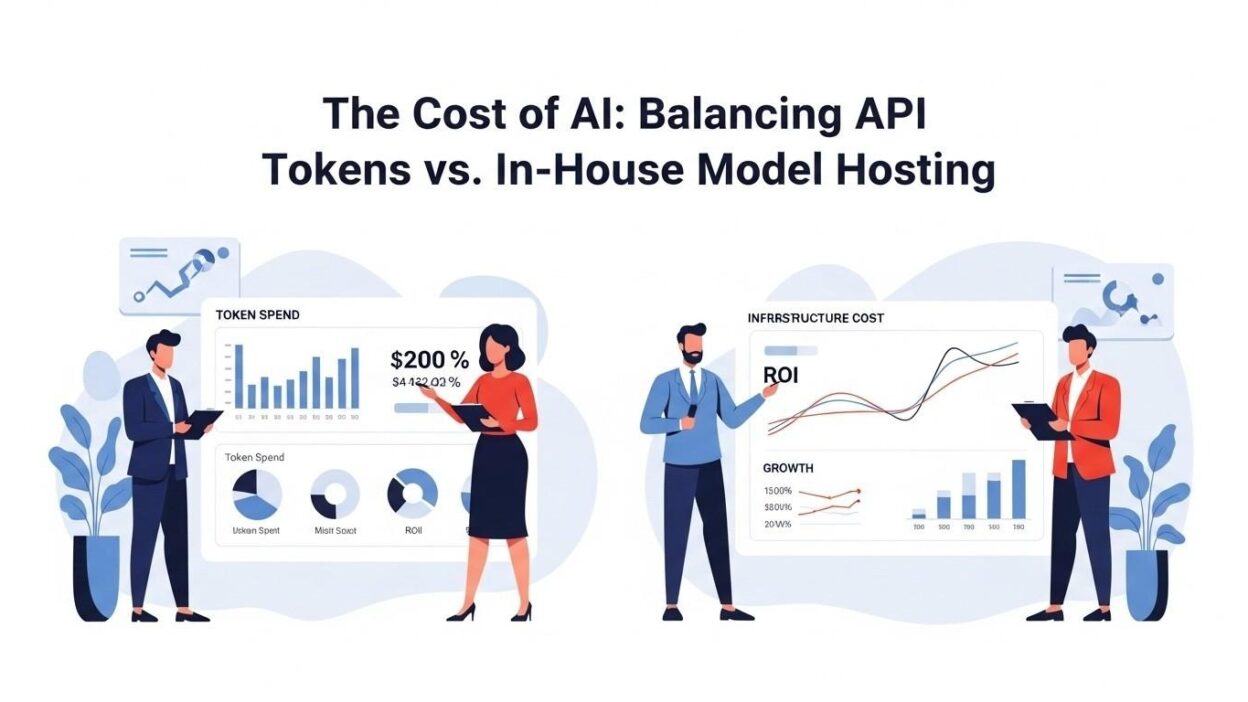
Understanding the Cost of AI API Tokens vs In-House Hosting determines your company’s profitability and scalability. The wrong choice can burn through budgets while delivering suboptimal performance. This comprehensive analysis examines every cost dimension to guide your strategic decision. You’ll discover exactly which approach suits your specific business requirements.
Table of Contents
Understanding API Token-Based Pricing
How Token Pricing Works
API providers charge based on the volume of text processed. Tokens represent chunks of text roughly equivalent to words. A typical token equals about four characters in English text. Different languages and special characters affect token counts variably.
Input tokens measure the text you send to the AI model. Your prompts, context, and data all count as input. Output tokens represent the AI-generated response text. Both input and output incur charges with most providers.
Pricing tiers vary significantly across AI service providers. OpenAI charges differently for GPT-3.5 versus GPT-4 models. Anthropic’s Claude models have their own pricing structure. Google’s PaLM and Gemini APIs use yet different rate cards. Understanding these differences affects your Cost of AI API Tokens vs In-House Hosting analysis.
Volume discounts become available at higher usage levels. Enterprise customers negotiate custom pricing agreements. Small startups pay published rates without negotiation leverage. Your usage scale dramatically impacts effective per-token costs.
Hidden Costs in API Services
Rate limiting restricts how many requests you can make. Exceeding limits forces you to slow operations or upgrade tiers. High-traffic applications hit these ceilings quickly. The business impact of rate limits often exceeds direct token costs.
Latency affects user experience and operational efficiency. Network calls to external APIs introduce delays. Round-trip times vary based on geographic distance and provider infrastructure. Real-time applications suffer from these unavoidable delays.
API versioning creates ongoing maintenance burden. Providers deprecate old API versions regularly. Your engineering team must update integration code periodically. These labor costs compound over years of API usage.
Service downtime risks disrupt critical business operations. Even reliable providers experience occasional outages. Your application’s availability depends entirely on third-party infrastructure. Backup plans and redundancy add complexity and cost when considering the Cost of AI API Tokens vs In-House Hosting.
Calculating Total API Costs
Monthly token consumption varies wildly across applications. Customer service chatbots process millions of tokens daily. Occasional content generation uses minimal volumes. Accurate usage forecasting requires running pilot programs first.
Engineering time for API integration represents significant upfront investment. Developers must learn provider-specific APIs and best practices. Integration complexity depends on your existing technical architecture. Budget several weeks of senior developer time for initial implementation.
Monitoring and optimization require ongoing attention. Token usage can explode unexpectedly with code bugs. Inefficient prompts waste tokens without delivering better results. Your team needs analytics to track spending and identify optimization opportunities.
Context window limitations force creative solutions. AI models have maximum token limits per request. Long documents require chunking strategies. Conversation history management becomes complex for chatbots. These technical constraints create engineering overhead.
Exploring In-House Model Hosting
Infrastructure Requirements
GPU servers form the foundation of in-house AI deployment. Modern language models demand specialized hardware. NVIDIA A100 and H100 GPUs represent industry standards. A single high-end GPU server costs tens of thousands of dollars.
Memory requirements scale with model size and batch processing needs. Large language models consume hundreds of gigabytes of RAM. Your infrastructure must accommodate peak usage scenarios. Underprovisioning leads to performance degradation or crashes.
Storage systems hold model weights and training data. Terabytes of fast storage enable efficient model loading. SSD or NVMe drives significantly outperform traditional hard drives. Storage costs accumulate as you experiment with multiple models.
Networking infrastructure supports model serving at scale. High-bandwidth connections prevent bottlenecks. Load balancers distribute requests across multiple servers. The Cost of AI API Tokens vs In-House Hosting includes these often-overlooked infrastructure components.
Operational Expenses
Electricity consumption for GPU servers is substantial. A single server can draw several kilowatts continuously. Annual power costs reach thousands of dollars per server. Data center efficiency affects total energy expenses significantly.
Cooling systems prevent expensive hardware from overheating. GPU servers generate enormous heat during operation. Adequate cooling infrastructure matches or exceeds server costs. Geographic location affects cooling efficiency and electricity rates.
Maintenance contracts protect hardware investments. Server failures happen despite quality components. Support agreements minimize downtime through rapid replacement. Budget fifteen to twenty percent of hardware costs annually for maintenance.
Software licensing may apply to certain frameworks or platforms. Enterprise ML platforms charge annual subscription fees. Monitoring tools and optimization software add recurring costs. Open-source alternatives reduce but don’t eliminate software expenses.
Staffing Requirements
Machine learning engineers command premium salaries. Experienced ML specialists earn well into six figures. Your team needs expertise in model deployment and optimization. Salaries often exceed infrastructure costs significantly.
DevOps engineers maintain infrastructure and deployment pipelines. Automation reduces manual intervention but requires upfront investment. Monitoring, logging, and alerting systems need expert configuration. Operational excellence demands skilled personnel.
Data scientists optimize model performance and accuracy. Fine-tuning models for specific use cases requires specialized knowledge. Experimentation with different approaches consumes significant time. The Cost of AI API Tokens vs In-House Hosting must account for these critical human resources.
Comparing Direct Financial Costs
Break-Even Analysis
Small-scale operations favor API services overwhelmingly. Monthly API costs might total hundreds or low thousands of dollars. In-house infrastructure requires six-figure initial investment. The break-even point lies far in the future for modest usage.
Medium-scale deployments reach break-even faster. Processing millions of tokens monthly generates substantial API bills. Infrastructure costs amortize across higher usage volumes. Many companies find the transition point around five to ten thousand dollars monthly in API fees.
Large-scale AI operations justify in-house hosting economically. API costs exceeding twenty thousand monthly make infrastructure attractive. Your Cost of AI API Tokens vs In-House Hosting calculation shifts dramatically at scale. Enterprise deployments almost always favor owned infrastructure.
Usage growth trajectories determine optimal timing. Rapid user growth means API costs escalate quickly. Stable usage patterns make cost prediction easier. Plan for scenarios ranging from slow growth to explosive adoption.
Total Cost of Ownership Models
Capital expenditure versus operational expenditure affects financial planning. In-house infrastructure requires significant upfront cash. API services convert fixed costs to variable expenses. Your company’s financial structure influences preference.
Depreciation schedules spread hardware costs over useful life. Servers typically depreciate over three to five years. This accounting treatment affects profitability metrics. Tax implications vary by jurisdiction and company structure.
Opportunity costs of capital investment deserve consideration. Money spent on servers cannot fund other initiatives. Alternative uses of capital might generate higher returns. CFOs weigh AI infrastructure against competing investment opportunities.
Risk-adjusted returns account for uncertainty in usage projections. Overbuilt infrastructure sits idle if growth disappoints. API services scale down painlessly during slow periods. The Cost of AI API Tokens vs In-House Hosting includes flexibility value.
Hidden Savings and Costs
Economies of scale benefit in-house deployments. Adding capacity costs less per unit as infrastructure grows. Bulk hardware purchases receive discounts. Operational efficiency improves with dedicated teams.
Learning curve costs affect both approaches differently. API integration requires less specialized knowledge initially. In-house hosting demands deep ML operations expertise. Training existing staff takes time and resources.
Vendor relationship management creates administrative overhead. Negotiating enterprise API agreements consumes executive time. Managing multiple API providers multiplies this burden. In-house approaches consolidate vendor relationships.
Performance and Control Considerations
Response Time and Latency
Local model hosting delivers single-digit millisecond response times. Eliminating network calls removes significant latency. Real-time applications requiring instant responses favor in-house deployment. User experience improves noticeably with local processing.
API services introduce unavoidable network delays. Round-trip times range from tens to hundreds of milliseconds. Geographic distance between users and API servers affects performance. Content delivery networks help but cannot eliminate physics.
Batch processing workloads care less about latency. Overnight report generation tolerates multi-second response times. Non-interactive AI applications work perfectly with API services. Your use case requirements determine whether latency matters when evaluating the Cost of AI API Tokens vs In-House Hosting.
Data Privacy and Security
In-house hosting keeps sensitive data on your infrastructure. Customer information never leaves your security perimeter. Regulated industries often require this level of control. Healthcare and finance face strict data residency rules.
API services process data on third-party infrastructure. Data travels across the internet to provider servers. Encryption protects data in transit but not at provider facilities. Your data governance policies might prohibit external processing.
Compliance certifications vary across AI providers. SOC 2, HIPAA, and ISO certifications indicate security maturity. Verify that API providers meet your compliance requirements. Non-compliant providers create legal and reputational risks.
Data retention policies differ between hosting approaches. API providers may store requests for training or debugging. In-house models give you complete control over data lifecycle. The Cost of AI API Tokens vs In-House Hosting includes these governance considerations.
Customization and Flexibility
Fine-tuned models deliver superior performance for specialized tasks. In-house hosting enables unlimited customization. Train models on your proprietary data. Optimize for your specific use cases without restrictions.
API services limit customization opportunities. Some providers offer fine-tuning capabilities at premium prices. Many lock you into their pre-trained models. Your application must adapt to provider limitations.
Model selection flexibility matters for diverse applications. In-house infrastructure runs any open-source model. Switch between models without changing vendors. Experimentation costs nothing beyond compute time.
Feature availability depends on provider roadmaps. New AI capabilities appear on provider timelines, not yours. In-house teams implement cutting-edge techniques immediately. Innovation speed differs dramatically between approaches.
Strategic Decision Framework
Assessing Your Organization’s Needs
Current usage volume provides the starting point. Calculate monthly token consumption across all applications. Project growth rates based on business plans. Multiply current costs by anticipated growth factors.
Technical team capabilities determine execution feasibility. Assess your team’s ML operations expertise honestly. Identify gaps between current skills and hosting requirements. Training programs or new hires address skill deficits.
Budget constraints influence which approach you can afford. Startups rarely have capital for expensive infrastructure. Established companies can invest in long-term cost savings. Your financial position shapes the Cost of AI API Tokens vs In-House Hosting decision.
Risk tolerance affects infrastructure commitments. Conservative organizations prefer predictable API costs. Risk-takers invest in infrastructure for future savings. Match your approach to corporate culture and philosophy.
Phased Adoption Strategies
Most companies start with API services. Rapid deployment gets AI features to market quickly. Learn usage patterns before infrastructure investment. Validate product-market fit with minimal upfront costs.
Hybrid approaches combine both hosting methods. Use APIs for variable workloads and experiments. Deploy in-house models for high-volume stable operations. This balanced strategy optimizes the Cost of AI API Tokens vs In-House Hosting.
Migration planning happens as usage grows. Document your API integration thoroughly. Abstract AI calls behind internal interfaces. This preparation simplifies eventual migration to in-house hosting.
Contingency plans protect against provider changes. API pricing can increase unexpectedly. Service quality might degrade over time. Maintain ability to switch approaches if circumstances change.
Long-Term Sustainability
Technology evolution affects both approaches continuously. API providers release better models regularly. In-house teams must update infrastructure for new capabilities. Ongoing investment requirements persist indefinitely.
Scaling economics favor different approaches at different sizes. API costs grow linearly with usage. Infrastructure costs grow in steps as you add capacity. The cost curves intersect at specific usage volumes.
Exit strategies preserve optionality. Design systems that can migrate between hosting approaches. Avoid deep coupling to specific providers or platforms. Flexibility protects against future regret.
Real-World Case Studies
Startup Success with APIs
Early-stage companies prioritize speed over cost optimization. APIs let small teams build sophisticated AI features. A five-person startup cannot staff ML operations. Token-based pricing aligns costs with revenue perfectly.
Monthly API bills grow alongside user adoption. Initial costs might be just hundreds of dollars. Successful products scale to thousands monthly. The Cost of AI API Tokens vs In-House Hosting favors APIs throughout early growth.
Series A funding might enable infrastructure investment. Ten thousand monthly in API costs justifies exploration. Calculate break-even points at anticipated Series B scale. Plan infrastructure projects during hypergrowth phases.
Enterprise In-House Success
Fortune 500 companies process billions of tokens monthly. API costs would reach millions annually. Six-figure infrastructure investments pay back within months. Dedicated teams optimize performance and costs continuously.
Proprietary models create competitive advantages. Custom training on company data improves accuracy. Competitors cannot access your AI capabilities. In-house hosting enables these strategic assets.
Regulatory requirements mandate data control. Financial services cannot send customer data externally. In-house hosting satisfies compliance while enabling AI. The Cost of AI API Tokens vs In-House Hosting becomes straightforward.
Hybrid Deployment Benefits
Mid-market companies often choose hybrid approaches. Core high-volume features run on owned infrastructure. Experimental features use flexible API services. This combination optimizes both cost and agility.
Geographic distribution combines local and cloud. In-house hosting serves primary markets. APIs fill in for distant regions with low usage. Global reach happens without worldwide infrastructure.
Disaster recovery leverages multiple approaches. In-house infrastructure handles normal operations. API services provide backup during outages. Redundancy ensures business continuity.
Frequently Asked Questions
At what usage volume should we switch from APIs to in-house hosting?
Break-even typically occurs between five and twenty thousand dollars monthly in API costs. Your specific break-even depends on infrastructure options and team capabilities. Calculate total ownership costs including salaries and operations. Most organizations evaluate in-house hosting when API bills consistently exceed ten thousand monthly. The Cost of AI API Tokens vs In-House Hosting equation becomes compelling at significant scale.
Can we use free or cheap cloud GPUs instead of dedicated servers?
Cloud GPU instances cost more than APIs at low usage. They become competitive at moderate scale before justifying owned hardware. AWS, Azure, and GCP all offer GPU virtual machines. Spot instances reduce costs but introduce availability risks. Cloud GPUs work well for testing in-house viability before hardware purchase.
How much do data scientists and ML engineers really cost?
Experienced ML engineers command salaries from one hundred fifty to three hundred thousand dollars annually. Benefits and overhead increase total compensation thirty to fifty percent. A small ML operations team costs half a million annually minimum. These costs often exceed infrastructure expenses significantly. Budget accordingly when evaluating the Cost of AI API Tokens vs In-House Hosting.
What about open-source models like Llama?
Open-source models eliminate licensing fees but require hosting infrastructure. Llama, Mistral, and other open models perform impressively. You still need servers, staff, and operations. The cost structure shifts from per-token to fixed infrastructure. Open-source excels for high-volume specialized applications.
How do we forecast AI usage accurately?
Start with pilot programs measuring actual consumption. Monitor token usage across representative user cohorts. Multiply by anticipated user growth rates. Add twenty to thirty percent buffer for unexpected growth. Revise forecasts quarterly based on actual usage trends.
Can we negotiate better API pricing?
Enterprise agreements offer volume discounts. Commit to minimum monthly spending for reduced rates. Negotiate when monthly bills consistently exceed several thousand dollars. Smaller companies have limited negotiation leverage. The Cost of AI API Tokens vs In-House Hosting improves with negotiated enterprise pricing.
What if our in-house infrastructure sits idle sometimes?
Idle capacity costs money but provides headroom for growth. Cloud GPU instances scale down during slow periods. Owned hardware depreciates regardless of utilization. Consider usage patterns and growth volatility. Consistent high utilization justifies owned infrastructure.
How long does in-house deployment take?
Initial deployment ranges from one to six months. Simple single-model hosting takes weeks. Complex multi-model production systems require months. Team expertise dramatically affects timeline. Rushed deployments often encounter costly problems.
Should we hire before or after deciding on in-house hosting?
Hire ML operations expertise before infrastructure investment. Consultants can assess readiness and create roadmaps. Your team must maintain deployed infrastructure. Staffing capabilities directly affect the Cost of AI API Tokens vs In-House Hosting decision success.
What happens if API providers raise prices significantly?
Design abstracttion layers isolating provider-specific code. Switching providers becomes possible though not trivial. In-house hosting provides insurance against price increases. Maintain architectural flexibility to adapt to market changes.
Read More:-Preparing Your Team for the AI Transition: A Leadership Checklist
Conclusion

The Cost of AI API Tokens vs In-House Hosting represents one of the most important technical decisions your organization will make. API services offer simplicity, flexibility, and predictable variable costs. In-house hosting provides control, customization, and economies of scale at high usage.
Small organizations and startups almost always choose API services initially. The low barrier to entry enables rapid innovation without capital investment. Learning happens quickly through experimentation. Scaling concerns can wait until product-market fit is proven.
Growing companies face the transition decision as usage increases. Monthly API bills reaching four or five figures trigger analysis. Calculate total ownership costs honestly including all hidden expenses. Many companies find hybrid approaches optimal during this phase.
Enterprise organizations with massive AI usage justify dedicated infrastructure. Millions in annual API costs make in-house hosting obviously superior. Custom models provide competitive advantages. Regulatory requirements often mandate data control through owned infrastructure.
Your specific Cost of AI API Tokens vs In-House Hosting calculation depends on unique factors. Usage volume, growth trajectory, team capabilities, and regulatory environment all matter. Financial structure and risk tolerance shape the optimal choice. No universal answer exists across all organizations.
Start with API services unless compelling reasons dictate otherwise. Validate your AI use cases with minimal investment. Monitor costs and performance carefully. Plan for eventual migration as usage scales.
Build optionality into your architecture from the beginning. Abstract AI calls behind internal interfaces. Document integration patterns thoroughly. This preparation enables smooth transitions between hosting approaches.
Revisit your hosting strategy annually as circumstances evolve. API pricing, model capabilities, and hardware costs all change. Your usage patterns and business scale shift. The optimal approach today might differ next year.
The AI landscape continues advancing rapidly. New providers, models, and deployment options emerge constantly. Stay informed about technological developments. Flexibility and adaptability matter more than optimizing for current conditions.
Your decision about the Cost of AI API Tokens vs In-House Hosting shapes competitive positioning. Organizations deploying AI cost-effectively gain advantages over wasteful competitors. Smart infrastructure choices free resources for innovation rather than overhead. Make this decision carefully with full understanding of long-term implications.
Take action now to assess your current AI costs comprehensively. Gather accurate usage data across all applications. Project realistic growth scenarios. Calculate total ownership costs for both approaches. Your informed analysis leads to the optimal infrastructure strategy for your organization’s success.