Customer conversations flow through digital channels at unprecedented volumes today. Your chatbot receives thousands of inquiries demanding instant responses across various topics. Routing these conversations to the right destination determines whether users get helpful answers or frustrating experiences. A well-designed conversational routing architecture ensures every message reaches the most appropriate handler efficiently. Modern businesses need systems that direct conversations based on intent, context, and complexity. Your customer satisfaction scores improve dramatically when routing logic matches inquiries with optimal resolution paths. Poor routing creates bottlenecks, escalations, and abandoned conversations that damage your brand reputation.
Table of Contents
Understanding Conversational Routing Fundamentals
What Conversational Routing Architecture Entails
Routing architecture defines the pathways conversations follow from initiation to resolution. The system analyzes incoming messages to determine appropriate destinations automatically. Machine learning algorithms classify user intent from natural language inputs. Business rules specify which agents, bots, or resources handle different conversation types. Priority queuing ensures urgent inquiries receive faster attention than routine questions. Fallback mechanisms redirect conversations when primary handlers prove unavailable or inadequate. A robust conversational routing architecture combines automated decision-making with human oversight capabilities.
Core Components of Routing Systems
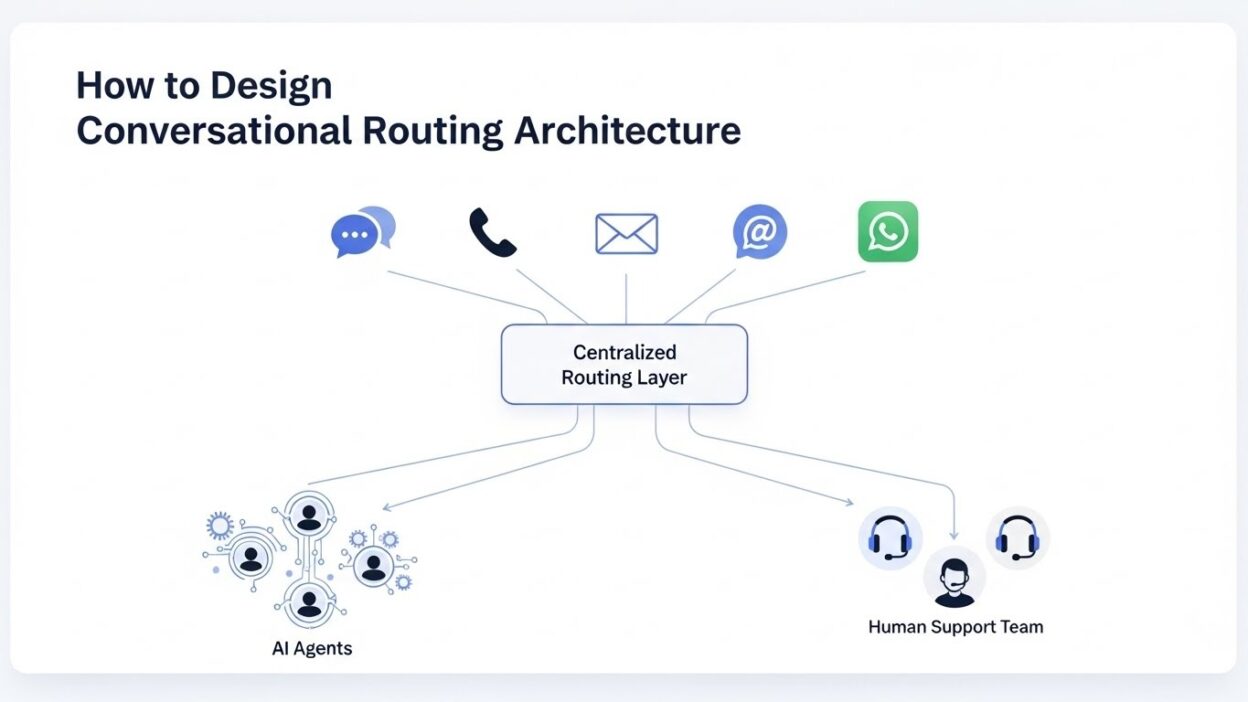
Effective architectures incorporate multiple interconnected elements working together seamlessly. Intent recognition engines parse user messages to identify underlying needs and goals. Context management systems maintain conversation history across multiple exchanges. Routing rules engines apply business logic to direct conversations appropriately. Queue management handles waiting periods and agent assignments. Integration layers connect routing systems to CRM, knowledge bases, and communication platforms. Monitoring dashboards provide real-time visibility into routing performance and bottlenecks. Each component plays a specific role in your conversational routing architecture.
Why Traditional IVR Falls Short
Interactive voice response systems dominated customer service routing for decades. Rigid menu trees forced customers through frustrating “press 1 for sales” sequences. Users often couldn’t describe their actual needs within predefined categories. Menu navigation consumed significant time before reaching any human assistance. Customers frequently selected wrong options, requiring transfers and repeated explanations. Modern expectations demand conversational interfaces that understand natural language immediately. Your conversational routing architecture must recognize intent from free-form user inputs.
Benefits of Intelligent Routing
Smart routing delivers measurable improvements across customer experience and operational efficiency metrics. First-contact resolution rates increase when inquiries reach qualified handlers immediately. Average handling time decreases because agents receive conversations matching their expertise. Customer satisfaction scores improve through faster, more accurate responses. Agent utilization optimizes when workload distribution aligns with team capabilities. Automation handles routine inquiries, freeing humans for complex problem-solving. Implementing sophisticated conversational routing architecture typically reduces support costs by 30-50%.
Analyzing Intent and Context
Natural Language Understanding Capabilities
Routing accuracy depends on correctly interpreting what users actually want from their messages. NLU engines break down sentences into meaningful components like entities and actions. The system recognizes synonyms and varied phrasings for the same underlying intent. Contextual understanding accounts for how previous messages influence current meaning. Sentiment analysis detects frustration, urgency, or satisfaction in user tone. Machine learning models improve classification accuracy through exposure to real conversations. Your conversational routing architecture requires robust NLU to make intelligent routing decisions.
Multi-Turn Context Management
Single-message classification misses critical information that emerges across conversation flows. Context tracking maintains relevant history as conversations develop over multiple exchanges. The system remembers user preferences, previous issues, and account details throughout sessions. Topic switching detection identifies when users change subjects mid-conversation. Anaphora resolution connects pronouns to previously mentioned entities correctly. Session management defines when conversations end and new routing decisions become necessary. Context-aware conversational routing architecture delivers more accurate destination selections.
Intent Confidence Scoring
Classification algorithms produce probability scores indicating certainty about detected intents. High-confidence classifications enable automatic routing without human verification. Medium-confidence scenarios might trigger clarifying questions before routing. Low-confidence situations require human review or fallback to general support queues. Threshold tuning balances automation rates against potential routing errors. Continuous monitoring identifies intents requiring model retraining or rule adjustments. Confidence-based decision trees form critical elements of conversational routing architecture design.
Entity Extraction for Routing
Identifying specific details within messages enables more precise routing decisions. Named entity recognition extracts customer names, product references, and account identifiers. Date and time extraction routes time-sensitive inquiries appropriately. Location detection directs conversations to geographically relevant teams. Numeric entities like order numbers enable automatic account lookups. Custom entity types capture domain-specific information unique to your business. Entity-rich conversational routing architecture creates highly targeted conversation pathways.
Designing Decision Trees and Logic
Mapping User Journey Scenarios
Effective routing begins with comprehensive documentation of all possible conversation paths. Interview customer service teams to catalog common inquiry types and resolutions. Analyze conversation logs to identify patterns and frequently co-occurring topics. Document edge cases and unusual scenarios that occur infrequently but require handling. Create visual flowcharts showing decision points and routing destinations. Prioritize scenarios by volume to optimize for most common user needs first. Thorough journey mapping ensures your conversational routing architecture covers real-world situations.
Creating Routing Rules Hierarchies
Complex businesses require layered rule structures that evaluate multiple criteria sequentially. Primary rules filter conversations by broad categories like sales, support, or billing. Secondary rules apply finer distinctions within each category. Conditional logic chains multiple criteria together for precise targeting. Exception rules handle special circumstances that override normal routing patterns. Default rules catch unclassified conversations preventing them from falling through cracks. Well-structured hierarchies make conversational routing architecture maintainable and debuggable.
Priority and Urgency Handling
Not all conversations deserve identical treatment regardless of content or customer value. VIP customer inquiries route to specialized teams with shorter wait times. Urgent keywords like “emergency” or “account compromised” trigger immediate escalation. Service level agreements define maximum wait times for different inquiry types. Queue position adjustments reward loyalty program members or premium account holders. Time-decay algorithms increase priority for conversations waiting beyond target thresholds. Priority mechanisms within conversational routing architecture balance fairness with business objectives.
Fallback and Escalation Paths
Systems must gracefully handle situations where primary routing fails or proves inadequate. Confidence threshold breaches trigger fallback to human routing specialists. Failed bot interactions escalate to live agents after defined retry limits. Unavailable specialists redirect to backup teams or generalist agents. After-hours inquiries route to global follow-the-sun support or queue for next-day handling. Customer-initiated escalation requests honor explicit demands to speak with supervisors. Comprehensive fallback logic prevents conversations from getting stuck in your conversational routing architecture.
Building Multi-Channel Routing
Unified Routing Across Platforms
Modern customers start conversations on one channel and continue them on another seamlessly. Your architecture must maintain context when users switch from chat to phone. Channel-agnostic routing evaluates all available channels before selecting optimal destinations. User preferences stored in profiles influence channel selection for outbound responses. Capability matching ensures channels support required features like file sharing or screen sharing. Cross-channel analytics reveal patterns in how customers combine platforms. Unified conversational routing architecture delivers consistent experiences regardless of touchpoint.
Channel-Specific Considerations
Each communication platform has unique characteristics affecting routing design. Chat conversations support asynchronous exchanges where response delays are acceptable. Voice calls demand immediate real-time engagement with minimal hold times. Social media inquiries often carry urgency from public visibility concerns. Email routing prioritizes comprehensive responses over speed. SMS conversations favor brevity and may have character limitations. Video calls require agents with specific technical setups and capabilities. Your conversational routing architecture must account for channel-specific requirements.
Omnichannel Context Preservation
Customers expect agents to see their complete history across all previous interactions. Integration layers aggregate conversation transcripts from every channel into unified records. Routing decisions consider whether customers have open issues from other channels. Agents receive complete context summaries when conversations arrive from routing queues. Proactive suggestions appear based on patterns across channel interactions. Journey analytics show how channel sequences correlate with resolution outcomes. Context preservation separates great conversational routing architecture from basic implementations.
Mobile-First Routing Strategies
Mobile devices dominate how customers initiate support conversations today. Mobile-optimized interfaces minimize typing through button-based responses and quick actions. Location services enable geographic routing to nearby stores or service centers. Push notifications alert customers when agents respond to asynchronous inquiries. App-based conversations link directly to account data within customer profiles. Mobile-specific intents like “find nearby location” require specialized routing paths. Mobile considerations shape modern conversational routing architecture fundamentally.
Implementing Agent Skills-Based Routing
Defining Agent Skill Profiles
Accurate skills taxonomies enable routing conversations to the most qualified available agents. Technical support teams segment by product knowledge, programming languages, or system expertise. Sales teams differentiate between inbound, outbound, and account management specializations. Language capabilities determine which agents handle multilingual customer inquiries. Certification levels indicate depth of training and problem-solving authority. Experience metrics track tenure and historical performance in specific conversation types. Detailed skill profiles improve matching accuracy in your conversational routing architecture.
Dynamic Skill Assignment
Agent capabilities evolve through training, experience, and changing business needs. Real-time skill updates reflect newly completed certifications or training modules. Performance analytics automatically adjust skill ratings based on conversation outcomes. Seasonal product launches temporarily broaden relevant agent skill sets. Cross-training programs systematically expand team capabilities across multiple domains. Self-assessment tools let agents report confidence levels for different inquiry types. Dynamic management keeps conversational routing architecture aligned with current team capabilities.
Balancing Specialization and Flexibility
Pure skills-based routing sometimes creates bottlenecks when specialists are fully occupied. Hybrid approaches combine skill matching with workload balancing algorithms. Timeout mechanisms route waiting conversations to less specialized agents after thresholds. Multi-skilled agents serve as overflow capacity during specialist queue backup. Training investments strategically reduce single points of failure in critical skills. Monitoring identifies where excessive specialization creates operational risks. Balanced conversational routing architecture maintains both quality and efficiency.
Skills Proficiency Levels
Binary skill tags oversimplify agent capabilities that actually exist on continuums. Proficiency ratings from novice to expert enable nuanced routing decisions. Complex inquiries route to expert-level agents while routine questions go to newer team members. Development programs systematically move agents up proficiency ladders through training. Conversation outcomes feed back into proficiency assessments automatically. Load balancing considers how many conversations at each proficiency level wait in queues. Proficiency-aware conversational routing architecture optimizes both service quality and agent development.
Automation and Bot Integration
When to Route to Bots Versus Humans
Effective architectures leverage automation for appropriate scenarios while preserving human touch. Bots handle high-volume, low-complexity inquiries like password resets or hours inquiries. FAQ-type questions with definitive answers suit automated responses. Transactional requests like checking order status or scheduling appointments work well with bots. Emotional situations, complaints, and complex problems require human empathy and judgment. VIP customers might bypass bot routing entirely based on relationship preferences. Clear delineation rules ensure your conversational routing architecture assigns conversations appropriately.
Seamless Bot-to-Human Handoffs
Conversations often begin with bots but require escalation to human agents. Handoff triggers include explicit customer requests, sentiment deterioration, or bot capability limits. Context transfer packages include full conversation transcripts and extracted information. Agents receive summaries highlighting why escalation occurred and what users need. Warm handoffs introduce agents before disconnecting bots from conversations. Handoff analytics identify patterns suggesting bot improvements or training needs. Smooth transitions preserve conversational routing architecture integrity across automation boundaries.
Hybrid Human-Bot Collaboration
Sophisticated systems enable agents and bots to work together within single conversations. Bots suggest responses or retrieve information while agents maintain conversation control. Real-time knowledge base searches provide agents with instant reference materials. Automated form filling reduces agent cognitive load during data collection. Quality assurance bots flag compliance issues or missed steps during conversations. Post-conversation automation handles follow-up tasks and documentation. Collaborative models represent the future of conversational routing architecture design.
Continuous Bot Performance Monitoring
Automated routing depends on bots actually solving problems effectively. Containment rates measure what percentage of bot conversations resolve without escalation. Satisfaction surveys capture user sentiment about automated interactions. Conversation analytics identify common failure patterns requiring bot improvements. A/B testing compares different bot conversation flows and routing strategies. Fallback frequency tracking reveals when bot capabilities fall short consistently. Monitoring ensures bots enhance rather than undermine your conversational routing architecture.
Scalability and Performance Optimization
Handling Peak Volume Loads
Routing systems must maintain performance when conversation volumes spike unexpectedly. Load testing simulates high-volume scenarios before production deployment. Auto-scaling infrastructure adds processing capacity during traffic surges automatically. Queue management prevents system overload through intelligent throttling mechanisms. Geographic distribution spreads load across multiple data centers. Caching frequent routing decisions reduces computational overhead. Robust scalability planning ensures conversational routing architecture handles growth gracefully.
Response Time Requirements
Routing delays frustrate users expecting instant engagement with conversational interfaces. Latency budgets allocate milliseconds to each routing architecture component. Intent classification must complete within 100-200 milliseconds for real-time conversations. Database lookups require optimization through indexing and query tuning. Network latency between distributed components needs careful architecture planning. Asynchronous processing handles non-critical tasks without blocking conversation flow. Performance optimization keeps conversational routing architecture responsive under all conditions.
Database and Storage Considerations
Conversation histories, routing rules, and agent profiles require efficient data management. NoSQL databases handle unstructured conversation content flexibly. Relational databases manage structured routing rules and agent schedules. Time-series databases store routing metrics and performance analytics. Data retention policies balance compliance requirements against storage costs. Archival strategies move inactive conversations to cheaper storage tiers. Database design directly impacts conversational routing architecture performance and cost.
Monitoring and Alerting Systems
Operations teams need visibility into routing health and performance continuously. Dashboard displays show queue depths, wait times, and agent utilization real-time. Anomaly detection algorithms alert teams when metrics deviate from normal patterns. Threshold-based alerts notify managers when SLAs approach violation. Trend analysis identifies gradual degradation before it causes incidents. Diagnostic logging enables troubleshooting when routing behaves unexpectedly. Comprehensive monitoring ensures your conversational routing architecture operates reliably.
Security and Compliance Integration
Authentication and Identity Verification
Routing decisions sometimes depend on confirming user identity securely. Multi-factor authentication confirms customer identity before sensitive conversations proceed. Knowledge-based authentication asks security questions before routing to account services. Biometric verification using voice or facial recognition adds security layers. Session tokens maintain authenticated state across conversation turns. Identity confidence scores influence routing to higher-security or lower-security channels. Security-aware conversational routing architecture protects sensitive information appropriately.
Data Privacy and PII Handling
Routing systems process personally identifiable information requiring careful protection. Encryption in transit protects conversation content crossing networks. Encryption at rest secures stored conversation histories and customer profiles. Tokenization replaces sensitive data with non-sensitive equivalents in routing logic. Access controls limit which systems and personnel can view PII. Data residency requirements affect where routing components can run geographically. Privacy-by-design principles embed protection throughout conversational routing architecture.
Compliance Requirements by Industry
Different sectors impose specific regulations on customer conversation handling. Healthcare routing must comply with HIPAA privacy and security requirements. Financial services face PCI DSS standards for payment card data. Government interactions may require FedRAMP-certified infrastructure. GDPR mandates specific consent and data handling practices in Europe. Recording laws vary by jurisdiction affecting conversation storage. Industry-specific conversational routing architecture must address relevant compliance frameworks.
Audit Trails and Logging
Regulatory compliance often requires comprehensive records of routing decisions. Audit logs capture who routed what conversation where and when. Decision explanations document which rules triggered specific routing outcomes. Change tracking records all modifications to routing rules and configurations. Access logs show which personnel viewed or modified routing systems. Retention periods align with regulatory requirements for your industry. Detailed logging enables your conversational routing architecture to satisfy compliance audits.
Testing and Quality Assurance
Simulation and Staging Environments
Routing changes require thorough testing before production deployment. Staging environments replicate production architecture with test data and conversations. Synthetic conversations exercise routing paths systematically. Edge case scenarios verify handling of unusual situations. Load testing validates performance under peak volume conditions. Integration testing confirms connections to external systems work correctly. Comprehensive staging prevents routing failures from impacting actual customers in conversational routing architecture.
A/B Testing Routing Strategies
Experimentation reveals which routing approaches deliver best outcomes. Split testing routes similar conversations through different logic paths. Randomized assignment eliminates bias in comparison groups. Metrics collection tracks resolution rates, satisfaction, and efficiency for each variant. Statistical analysis determines which routing strategy performs significantly better. Winning approaches roll out gradually while monitoring for unexpected issues. Data-driven optimization improves conversational routing architecture continuously.
Conversation Quality Metrics
Objective measurements reveal whether routing delivers intended results. First-contact resolution rates indicate routing accuracy to appropriate handlers. Transfer rates show how often initial routing proves incorrect. Average handle time reflects whether conversations reach qualified agents. Customer satisfaction scores measure user experience with routing outcomes. Agent satisfaction reveals whether workload distribution feels fair and appropriate. Quality metrics guide ongoing refinement of conversational routing architecture.
Error Rate Monitoring
Routing failures create negative experiences requiring systematic tracking and resolution. Misrouted conversations that require transfers indicate classification errors. Timed-out conversations suggest capacity or availability problems. Abandoned conversations reveal user frustration with routing delays. Bot escalations identify automation limitations requiring attention. Error pattern analysis reveals systematic issues versus random anomalies. Low error rates demonstrate healthy conversational routing architecture performance.
Advanced Routing Techniques
Predictive Routing Based on Patterns
Machine learning models forecast optimal routing destinations before conversations fully develop. Historical patterns show which agent types resolve specific intent combinations fastest. Customer history predicts likely needs based on previous conversation topics. Behavioral signals indicate emotional state affecting appropriate agent matching. Time-based patterns reveal when different inquiry types typically arrive. Predictive algorithms route conversations proactively rather than reactively. Anticipatory conversational routing architecture delivers superior user experiences.
Sentiment-Based Routing Adjustments
Emotional tone in customer messages should influence routing decisions dynamically. Frustration detection triggers priority routing to senior agents or retention specialists. Positive sentiment conversations might route to junior agents for development opportunities. Urgency keywords override normal queue positions for immediate handling. Satisfaction scores influence whether customers receive proactive outreach. Empathy matching pairs emotionally charged conversations with especially patient agents. Emotion-aware conversational routing architecture responds appropriately to customer feelings.
Geographic and Temporal Routing
Location and time zones affect optimal conversation destinations significantly. Local language routing connects customers with agents speaking their preferred languages. Regional expertise routing assigns conversations to agents familiar with local regulations. Time-zone matching prevents customers from reaching agents in overnight shifts. Business hours routing transitions between live agents and after-hours bots automatically. Geographic load balancing distributes conversations across global support centers. Location-aware conversational routing architecture serves diverse customer bases effectively.
Machine Learning Model Training
Routing accuracy improves through continuous learning from conversation outcomes. Supervised learning trains models using labeled historical conversations. Reinforcement learning optimizes routing through trial-and-error over time. Active learning identifies conversations where human labeling improves training most. Feature engineering extracts meaningful signals from raw conversation data. Model versioning enables rollback when new models perform worse than predecessors. ML-powered conversational routing architecture adapts automatically to changing patterns.
Maintaining and Evolving Systems
Regular Performance Reviews
Routing effectiveness requires ongoing assessment and optimization. Monthly metrics reviews identify trending issues and improvement opportunities. Quarterly rule audits remove obsolete logic and update business requirements. Annual architecture reviews assess whether fundamental design still meets needs. Stakeholder feedback sessions gather input from agents, customers, and managers. Competitive benchmarking compares your performance against industry standards. Regular reviews keep conversational routing architecture aligned with business goals.
Handling Business Changes
Organizations evolve requiring routing system adaptations. New product launches need routing paths to trained specialist teams. Service expansions into new regions require geographic routing logic. Organizational restructuring changes which teams handle which conversation types. Seasonal promotions create temporary routing rules for campaign-specific inquiries. Merger integrations combine routing systems from multiple companies. Change management processes ensure conversational routing architecture evolves with your business.
Documentation and Knowledge Management
Complex routing systems require comprehensive documentation for maintenance and troubleshooting. Architecture diagrams visualize conversation flow paths and decision points. Rule catalogs document every routing criterion and its business justification. Integration specifications detail connections to external systems. Runbooks guide operations teams through common troubleshooting scenarios. Training materials onboard new team members to routing concepts. Thorough documentation makes conversational routing architecture maintainable long-term.
Team Skills and Training
Effective routing management requires specialized expertise across multiple domains. Conversation designers understand user needs and optimal experience flows. Data scientists develop and tune machine learning models. Integration engineers connect routing systems to broader technology ecosystems. Operations analysts monitor performance and identify improvement opportunities. Business analysts translate stakeholder requirements into routing specifications. Investing in team capabilities ensures your conversational routing architecture succeeds.
Read More:-Self-Healing Code: Can AI Really Fix Its Own Bugs Yet?
Conclusion

Designing effective conversational routing architecture transforms how organizations handle customer interactions. Your system directs thousands of daily conversations to optimal destinations automatically. Intent recognition algorithms parse natural language to understand what customers actually need. Context management maintains coherent experiences across multiple message exchanges. Business rules balance automation efficiency with human expertise appropriately.
Multi-channel routing delivers consistent experiences whether customers use chat, voice, or social media. Skills-based assignment matches conversations with the most qualified available agents. Priority mechanisms ensure urgent inquiries and valuable customers receive appropriate attention. Bot integration handles routine inquiries while preserving human judgment for complex situations. Seamless handoffs maintain conversation quality when escalation becomes necessary.
Security and compliance integration protect sensitive information throughout routing processes. Authentication mechanisms verify identity before sensitive conversations proceed. Encryption and tokenization safeguard personal data in transit and storage. Audit trails document routing decisions for regulatory compliance. Privacy-by-design principles embed protection throughout your architecture.
Performance optimization ensures routing responds instantly even during peak volumes. Scalable infrastructure handles traffic surges without degradation. Load balancing distributes conversations across available capacity efficiently. Caching and database optimization minimize latency at every step. Monitoring systems alert teams immediately when issues arise.
Testing and quality assurance validate routing logic before production deployment. Staging environments safely evaluate changes with realistic conversation simulations. A/B testing compares routing strategies through controlled experiments. Error monitoring identifies problems requiring attention quickly. Regular performance reviews drive continuous improvement over time.
Advanced techniques like predictive routing and sentiment analysis elevate customer experiences. Machine learning models improve routing accuracy through continuous learning. Geographic and temporal factors optimize assignments across global operations. Emotion-aware routing matches customers with appropriately skilled agents. Sophisticated conversational routing architecture delivers competitive advantages.
Maintenance and evolution keep systems aligned with changing business needs. Regular reviews identify improvement opportunities and trending issues. Documentation enables teams to troubleshoot problems and onboard new members. Training programs build expertise required for ongoing success. Change management processes adapt routing as organizations evolve.
Start your design process by thoroughly mapping current conversation patterns. Document all inquiry types, resolution paths, and pain points systematically. Define clear routing objectives aligned with business goals. Choose technology platforms supporting your specific requirements. Build incrementally, testing thoroughly at each stage before expanding functionality.
Invest in robust intent recognition capabilities as your foundation. Context management across conversation turns dramatically improves routing accuracy. Create comprehensive fallback mechanisms preventing conversations from getting stuck. Balance automation with human judgment based on conversation complexity. Optimize continuously using data from actual routing outcomes.
Your conversational routing architecture directly impacts customer satisfaction and operational efficiency. Well-designed systems increase first-contact resolution while reducing handling times. Customers experience faster, more accurate responses to their specific needs. Agents handle workloads matching their expertise and capacity. Organizations reduce costs while simultaneously improving service quality.
The future of customer service depends on intelligent conversation distribution. Companies delivering superior routing experiences gain competitive advantages. Your investment in conversational routing architecture pays dividends through better outcomes. Start designing your system today to transform how conversations flow through your organization.