Introduction
TL;DR Customer expectations have changed dramatically in recent years. People want immediate answers to their questions at any hour. Service firms struggle to meet these demands with traditional support models.
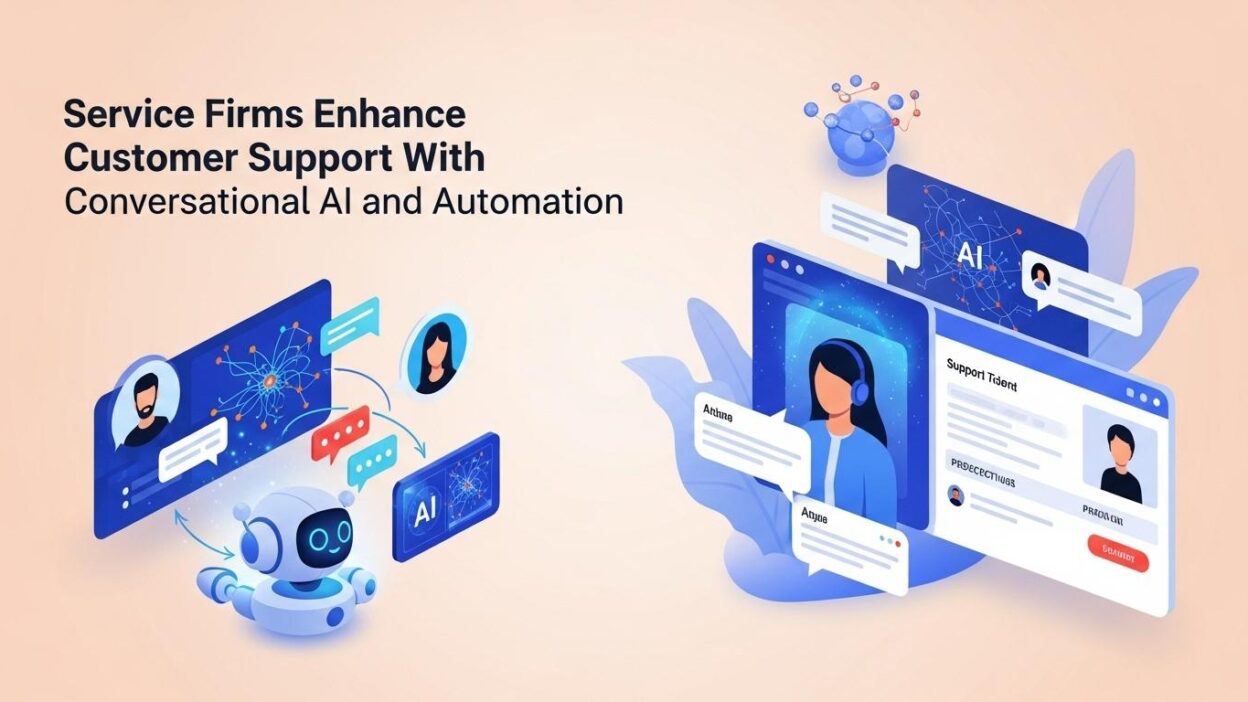
Conversational AI for customer support transforms how businesses interact with clients. Your team gets powerful assistance handling inquiries efficiently. Response times drop from hours to seconds across all channels.
The old support model relied entirely on human agents answering every question. Wait times frustrated customers during peak hours. Simple queries consumed the same resources as complex issues.
Smart service firms now blend human expertise with intelligent automation. Routine questions get handled instantly by AI systems. Your support team focuses energy on problems requiring human judgment and empathy.
This approach delivers better experiences while controlling operational costs. Customer satisfaction scores improve measurably. Your business scales support capabilities without proportional headcount increases.
Table of Contents
Understanding Conversational AI Technology
Conversational AI combines multiple technologies to simulate human dialogue. Natural language processing helps machines understand what people mean. Machine learning enables systems to improve through experience.
Traditional chatbots followed rigid decision trees with limited flexibility. Users had to phrase questions in specific ways. Conversations felt robotic and frustrating when queries deviated from expected patterns.
Modern conversational AI for customer support understands intent behind messages. Your customers type questions naturally without following scripts. The system interprets meaning despite variations in wording.
These platforms learn from every interaction continuously. Accuracy improves as the system processes more conversations. Your AI assistant becomes more helpful over time automatically.
Core Components of Conversational AI
Natural language understanding forms the foundation of conversational systems. This technology analyzes sentence structure and word relationships. Context and sentiment get extracted from customer messages.
Intent recognition determines what customers want to accomplish. The system identifies whether someone needs account information, troubleshooting help, or billing assistance. Appropriate responses trigger based on detected intent.
Entity extraction pulls specific details from messages. Names, dates, account numbers, and product references get identified automatically. Your system uses this information to provide personalized responses.
Dialogue management controls conversation flow and maintains context. Previous messages influence current responses appropriately. Multi-turn conversations feel natural rather than disconnected.
Response generation creates appropriate replies based on identified intent. Pre-written templates provide consistency for common scenarios. Dynamic generation handles unique situations requiring custom responses.
How AI Differs From Traditional Chatbots
Rule-based chatbots required extensive programming for each possible conversation path. Developers anticipated every question customers might ask. Updating these systems demanded significant technical effort.
Conversational AI for customer support learns patterns from training data. Your system improves without manual programming for each scenario. New capabilities emerge through machine learning rather than explicit coding.
Traditional bots failed when customers phrased questions unexpectedly. Conversations hit dead ends frequently. Users became frustrated and abandoned self-service attempts.
AI systems handle variations in language gracefully. Regional dialects, typos, and casual phrasing all get interpreted correctly. Success rates increase dramatically compared to older technology.
Context awareness allows modern systems to reference previous conversation points. Customers don’t repeat information already provided. Conversations flow naturally like interactions with human agents.
Key Technologies Enabling Conversational AI
Large language models power the most sophisticated conversational systems. These neural networks train on massive text datasets. Understanding and generation capabilities reach impressive levels.
Sentiment analysis detects customer emotions from message tone. Your system identifies frustration, satisfaction, or confusion. Routing and response strategies adapt based on emotional state.
Speech recognition converts voice input to text for analysis. Phone support benefits from conversational AI capabilities. Voice and text channels receive consistent treatment.
Knowledge graphs organize information about your products and services. The AI system accesses this structured data when answering questions. Accuracy improves through curated knowledge bases.
Integration APIs connect conversational AI to your business systems. Customer data, order information, and account details flow into conversations. Personalized responses become possible through system integration.
Benefits of Conversational AI for Service Firms
Strategic implementation of conversational AI delivers measurable advantages. Your business operates more efficiently while serving customers better. Multiple stakeholders benefit from this technology adoption.
24/7 Availability Without Staffing Costs
Customers contact support outside traditional business hours frequently. Evening and weekend inquiries pile up until Monday morning. Service level agreements suffer from delayed responses.
Conversational AI for customer support operates continuously without breaks. Your customers receive assistance at 3 AM as reliably as 3 PM. Global clients in different time zones get immediate help.
Hiring staff for round-the-clock coverage costs significantly. Night shift premiums and weekend rates add up quickly. Small service firms cannot justify these expenses typically.
AI systems handle unlimited concurrent conversations simultaneously. Capacity scales instantly during unexpected volume spikes. Your support infrastructure adapts to demand automatically.
Holiday coverage becomes simple without scheduling complications. The system works through weekends and holidays without complaint. Your human team enjoys better work-life balance.
Instant Response to Common Questions
Customers hate waiting on hold or for email responses. Each minute of delay increases frustration levels. Modern consumers expect Amazon-level service speed everywhere.
AI systems answer routine questions in under three seconds typically. Password resets, account balance inquiries, and FAQ responses happen instantly. Customer satisfaction improves through immediate assistance.
Your human agents spend less time on repetitive inquiries. They focus attention on complex situations requiring expertise. Job satisfaction increases when mundane tasks disappear.
First contact resolution rates improve with instant AI responses. Customers get accurate information without escalation delays. Support ticket volume decreases as self-service succeeds.
Average handle time drops across your entire support operation. More customers receive help during each business hour. Efficiency gains multiply throughout the organization.
Consistent Service Quality
Human agents have varying knowledge levels and communication styles. Training new team members takes months. Quality fluctuates based on who answers each inquiry.
Conversational AI for customer support delivers identical quality every interaction. Approved messaging reaches all customers consistently. Your brand voice remains steady across thousands of conversations.
Information accuracy stays high because AI pulls from verified knowledge bases. Outdated advice doesn’t slip through like with undertrained staff. Compliance requirements get satisfied systematically.
Emotional consistency prevents bad interactions during agent stress. Customers never encounter rude or impatient responses. Professional tone maintains regardless of conversation difficulty.
Updates to policies or procedures propagate instantly across the AI system. Your entire support operation reflects current information immediately. Manual training sessions become unnecessary for simple updates.
Multilingual Support Capabilities
Global service expansion requires multilingual support capabilities. Hiring fluent agents for every language proves expensive. Coverage gaps leave some customers underserved.
Modern conversational AI handles dozens of languages automatically. Spanish, French, Mandarin, and Arabic support happens without separate development. Your business serves international clients effortlessly.
Translation accuracy exceeds basic machine translation quality. Context-aware systems understand idioms and cultural nuances. Conversations feel natural to native speakers.
Language detection identifies customer preference automatically. Users don’t select languages from dropdown menus. The system adapts to incoming message language seamlessly.
Your human agents focus on languages they speak fluently. AI handles the rest without quality compromise. Support capacity expands geographically without location constraints.
Valuable Customer Insights
Every conversation generates data about customer needs and pain points. Conversational AI for customer support captures this information systematically. Analytics dashboards surface actionable insights.
Common questions reveal gaps in your documentation or product design. Frequent confusion indicates areas needing improvement. Product teams receive direct customer feedback continuously.
Sentiment trends highlight changing customer perceptions over time. Early warning signs of problems appear in conversation data. Proactive intervention prevents small issues from becoming crises.
Feature request patterns emerge from conversational analysis. Your product roadmap aligns with actual customer needs. Development priorities reflect market demand accurately.
Conversation transcripts provide training material for human agents. New team members learn from thousands of real interactions. Best practices emerge from successful conversation patterns.
Essential Use Cases for Service Firms
Conversational AI applications vary by industry and business model. Strategic deployment focuses on scenarios delivering maximum value. These common use cases prove effective across service sectors.
Initial Customer Inquiry Handling
Potential clients research services before contacting sales teams. Questions about pricing, capabilities, and availability need quick answers. Delayed responses lose opportunities to faster competitors.
AI assistants qualify leads through conversational exchanges. Budget ranges, project timelines, and specific needs get collected automatically. Sales receives comprehensive information before human contact.
Service descriptions and case studies surface based on inquiry topic. Customers learn about relevant offerings through interactive dialogue. Education happens before sales conversations begin.
Appointment scheduling integrates directly into conversational flows. Calendar availability appears within the chat interface. Meetings get booked without phone tag or email exchanges.
Contact forms feel outdated compared to conversational experiences. Completion rates increase when information collection feels natural. Lead quality improves through conversational qualification.
Account Management and Self-Service
Customers need account access outside business hours regularly. Password resets and account unlocking cannot wait until morning. Conversational AI for customer support handles these requests instantly.
Balance inquiries and transaction history get provided through secure chat. Authentication happens through knowledge-based questions or integration with login systems. Customers access information without agent assistance.
Service plan details and billing information appear on demand. Upgrade and downgrade options present themselves conversationally. Account modifications happen through guided workflows.
Document retrieval automates through conversational requests. Invoices, contracts, and reports get delivered via chat. Manual fulfillment processes become unnecessary.
Subscription management allows customers to pause or cancel services. AI guides them through confirmation steps and retention offers. Self-service reduces cancellation processing costs.
Technical Troubleshooting Support
Technical issues frustrate customers more than any other support scenario. Quick resolution becomes critical for satisfaction. AI systems diagnose and solve common problems effectively.
Guided troubleshooting walks customers through diagnostic steps. The system asks relevant questions based on problem symptoms. Solutions appear automatically for identified issues.
Common error messages trigger specific resolution workflows. Customers copy error text into chat for instant help. Knowledge base articles surface contextually during conversations.
Escalation to human technicians happens seamlessly when AI reaches limits. Context from the AI conversation transfers to the agent. Customers don’t repeat information already provided.
Video tutorials and screenshots enhance troubleshooting conversations. Visual guidance helps customers complete complex steps. Success rates improve through multimedia support.
Appointment Scheduling and Reminders
Service businesses live and die by appointment efficiency. No-shows waste time and reduce revenue. Conversational AI optimizes scheduling workflows end-to-end.
Calendar integration shows real-time availability during booking conversations. Customers select convenient times from presented options. Double-booking becomes impossible through system coordination.
Confirmation messages send automatically after scheduling. Customers receive details via their preferred communication channel. Clear expectations prevent confusion and missed appointments.
Reminder sequences begin days before scheduled appointments. Multiple touchpoints reduce no-show rates significantly. Last-minute confirmations allow rescheduling if needed.
Rescheduling requests get handled conversationally without agent involvement. Available alternative times appear based on cancellation reason. Calendar gaps fill automatically through smart rebooking.
Billing and Payment Inquiries
Payment-related questions spike during billing cycles predictably. Your team gets overwhelmed at month-end consistently. Conversational AI for customer support absorbs this predictable volume.
Invoice explanations happen through conversational breakdowns. Line items get clarified without agent time. Customers understand charges before disputes arise.
Payment processing integrates directly into chat interfaces. Secure payment collection happens without redirecting to separate pages. Convenience increases payment conversion rates.
Past due balance conversations happen sensitively through AI. Payment plans get offered based on customer circumstances. Collections become less adversarial and more successful.
Refund requests follow structured workflows that capture necessary information. Approvals happen based on predefined business rules. Processing times decrease through automation.
Implementing Conversational AI Successfully
Technology deployment requires careful planning and execution. Random implementation often disappoints. Strategic approaches maximize return on investment.
Assess Your Support Needs
Analyze your current support ticket volume by category. Identify the most frequent inquiry types. Calculate time spent resolving each category currently.
Review customer satisfaction scores across different support scenarios. Note areas with consistently low ratings. Improvement opportunities surface through honest assessment.
Map your customer journey from initial contact through problem resolution. Identify friction points causing frustration. Conversational AI targets these specific pain points.
Evaluate your team’s capacity constraints realistically. Determine whether volume, hours, or languages create bottlenecks. Technology selection depends on specific limitations.
Calculate costs of your current support model including all expenses. Labor, training, tools, and overhead all count. Baseline measurements enable ROI calculation later.
Choose the Right Platform
Major technology vendors offer conversational AI for customer support platforms. Capabilities vary significantly between solutions. Your specific needs should guide selection.
Zendesk provides AI-powered bots integrated with their ticketing system. Implementation proves straightforward for existing Zendesk customers. Native integration eliminates data synchronization issues.
Intercom combines conversational AI with customer engagement tools. The platform suits businesses prioritizing proactive outreach. Chatbots and targeted messaging work together seamlessly.
Freshdesk includes Freddy AI across their customer service suite. Multi-channel support covers email, chat, and social media. Small service firms appreciate affordable pricing tiers.
Custom solutions built on platforms like Dialogflow offer maximum flexibility. Development resources create tailored experiences. Technical complexity increases compared to packaged solutions.
Evaluate free trials extensively before committing financially. Test with realistic scenarios from your actual support cases. Vendor demos often showcase best-case situations only.
Build Your Knowledge Base
Conversational AI quality depends entirely on underlying knowledge. Your system needs comprehensive information to provide accurate answers. Knowledge base development proves critical for success.
Document answers to your most common customer questions. Write clear explanations without jargon or ambiguity. Simple language increases AI interpretation accuracy.
Organize information in logical categories and hierarchies. Related topics should connect through clear relationships. Structure helps the AI system navigate your knowledge effectively.
Include variations in how customers phrase the same questions. Multiple expressions of identical intent help training. The system learns to recognize patterns across phrasings.
Update your knowledge base regularly as offerings evolve. Outdated information damages credibility and satisfaction. Maintenance processes ensure continued accuracy over time.
Test your knowledge base content with real customer questions. Verify that answers actually address what people ask. Gaps in coverage surface through systematic testing.
Train Your AI System
Initial configuration establishes your conversational AI personality and capabilities. Brand voice guidelines ensure responses match your company style. Tone settings align with customer expectations.
Feed historical support conversations into the training process. Your system learns from past successful resolutions. Patterns emerge from real customer interaction data.
Define intent categories that cover your support scenarios. Map customer questions to specific intents explicitly. Classification accuracy improves through clear intent definitions.
Create conversational flows for common support paths. Design logical progressions from problem to resolution. User experience improves through thoughtful conversation design.
Test extensively with team members before customer exposure. Role-play various scenarios including difficult situations. Refinement happens safely before production deployment.
Integrate With Existing Systems
CRM integration provides conversational AI access to customer data. Personalized responses become possible through system connectivity. Account history influences conversation handling appropriately.
Ticketing system connections enable seamless escalation workflows. Context transfers automatically when human help becomes necessary. Customers don’t repeat information to multiple systems.
Calendar platforms allow appointment scheduling within conversations. Real-time availability prevents double-booking issues. Automated confirmations flow from integrated systems.
Payment processors enable secure transaction handling through chat. Customers complete purchases without leaving conversations. Friction decreases in revenue-generating workflows.
Analytics tools capture conversation data for reporting. Dashboard visibility helps optimize conversational AI for customer support performance. Data-driven improvements happen through measurement.
Monitor and Optimize Continuously
Conversation logs reveal where your AI succeeds and struggles. Review unresolved conversations regularly. Patterns indicate areas needing improvement.
Customer feedback collected after AI interactions provides direct insights. Ask whether the conversation helped solve problems. Satisfaction scores guide optimization priorities.
Escalation rates to human agents show AI capability limits. High escalation for specific topics indicates training gaps. Additional knowledge base content addresses these weaknesses.
Response accuracy metrics track how often AI provides correct information. Sample conversations manually for quality assessment. Scores should improve over time through learning.
Adjust confidence thresholds that determine when AI requests human help. Balance between attempting resolution and early escalation. Optimal settings depend on your specific circumstances.
Advanced Strategies for Maximum Impact
Basic implementation delivers immediate benefits. Sophisticated approaches multiply value over time. Mature conversational AI practices separate leaders from followers.
Proactive Customer Outreach
Conversational AI initiates conversations based on customer behavior. Website visitors receive helpful offers at strategic moments. Engagement increases through timely assistance.
Cart abandonment triggers rescue conversations automatically. Customers receive reminders with incentives to complete purchases. Revenue recovery improves through systematic outreach.
Service renewal dates prompt proactive retention conversations. Customers receive upgrade offers before contracts expire. Churn prevention happens through strategic timing.
Product usage patterns trigger educational conversations. Customers learn about underutilized features they already pay for. Value perception increases through guided discovery.
Problem detection from system monitoring initiates support conversations. Customers learn about issues before they cause frustration. Proactive service builds loyalty and satisfaction.
Sentiment-Based Routing
Emotion detection identifies frustrated or angry customers automatically. Conversational AI for customer support escalates these conversations immediately. Human empathy addresses emotional situations appropriately.
Happy customers receive upsell and referral requests strategically. Positive moments become revenue opportunities. Timing matters critically for these conversations.
Confused customers get simplified explanations automatically. The system adapts communication style based on detected comprehension. Accessibility improves through adaptive responses.
Response tone adjusts based on detected customer sentiment. Formal language suits business contexts while casual works elsewhere. Communication style matching builds rapport.
Voice Channel Integration
Phone support benefits from conversational AI capabilities significantly. Voice recognition converts speech to text for processing. Natural language understanding works identically across channels.
IVR systems become conversational rather than menu-driven. Customers state problems naturally instead of navigating options. Call routing improves through better intent detection.
Voice synthesis reads AI responses aloud naturally. Text-to-speech quality has improved dramatically recently. Customers hardly notice they’re speaking with AI initially.
Call transcription captures every phone interaction automatically. Searchable records benefit quality assurance and training. Compliance documentation happens without manual effort.
Omnichannel Consistency
Customers contact support through various channels based on preference and context. Email, chat, phone, and social media all require responses. Conversational AI for customer support delivers consistent experiences everywhere.
Conversation history persists across channels automatically. Customers switch from chat to phone without repeating information. Context follows them throughout their journey.
Brand voice remains identical whether customers use Facebook or your website. Response quality stays high across all touchpoints. Customers receive reliable service regardless of channel choice.
Social media mentions trigger appropriate conversational responses. Public comments receive timely acknowledgment. Brand reputation benefits from visible responsiveness.
Measuring Success and ROI
Quantifying conversational AI impact justifies investment and guides optimization. Specific metrics demonstrate value to stakeholders. Data-driven decisions improve outcomes continuously.
Key Performance Indicators
Resolution rate measures how often AI solves problems without escalation. Industry benchmarks suggest 60-80% resolution as realistic targets. Your goal depends on inquiry complexity.
Customer satisfaction scores after AI interactions indicate experience quality. CSAT above 4.0 out of 5.0 shows solid performance. Track trends over time rather than absolute numbers only.
Average response time drops dramatically with conversational AI deployment. Sub-three-second responses become standard. Compare to previous wait times for impact calculation.
Cost per conversation decreases significantly versus human-only support. Calculate fully loaded agent costs including benefits and overhead. AI conversations typically cost 70-90% less.
Containment rate shows percentage of inquiries handled entirely by AI. Higher containment means less human agent workload. Your target depends on inquiry mix and AI sophistication.
Financial Impact Analysis
Labor cost savings emerge as your primary financial benefit. Calculate agent hours freed by AI automation. Multiply by hourly rates for direct savings.
Opportunity cost of faster problem resolution has real value. Customers who receive quick help remain satisfied and loyal. Retention improvements translate to preserved revenue.
Revenue increase from extended service hours shows 24/7 availability value. International customers and night owls contribute incremental sales. Calculate revenue during previously uncovered hours.
Efficiency improvements allow your team to handle more customers. Revenue per employee improves through conversational AI for customer support. Growth happens without proportional headcount increases.
Customer Experience Metrics
Net Promoter Score tracks customer loyalty and satisfaction holistically. Conversational AI implementations typically improve NPS by 10-20 points. Customers appreciate faster, more convenient service.
Customer effort score measures how hard people work to get help. Lower scores indicate better experiences. AI self-service reduces effort dramatically compared to phone queues.
First contact resolution improves when AI answers questions correctly immediately. Customers avoid frustrating callback requirements. This metric directly correlates with satisfaction.
Overcoming Implementation Challenges
Predictable obstacles emerge during conversational AI deployment. Awareness enables proactive solutions. Success requires addressing both technical and human factors.
Ensuring Answer Accuracy
AI systems occasionally provide incorrect information. Confidence thresholds determine when uncertainty triggers escalation. Conservative settings prioritize accuracy over automation.
Human-in-the-loop review processes catch errors before they reach customers. Subject matter experts validate responses for critical topics. Quality assurance happens before full automation.
Knowledge base maintenance keeps information current and accurate. Regular audits identify outdated content. Conversational AI for customer support quality depends on underlying data.
Managing Customer Expectations
Transparency about AI assistance sets appropriate expectations. Customers appreciate knowing they’re interacting with automation. Deception damages trust when discovered.
Clear escalation paths to human agents must exist always. Customers need escape routes when AI cannot help. Forced automation creates frustration and negative sentiment.
Handling Complex Scenarios
Sophisticated problems still require human expertise and judgment. Conversational AI should recognize its limitations gracefully. Seamless handoffs preserve positive customer experiences.
Edge cases will always exist beyond AI training data. System monitoring identifies these situations for knowledge base expansion. Continuous learning addresses gaps systematically.
Maintaining Privacy and Security
Customer data security remains critical in AI implementations. Encryption protects information in transit and at rest. Compliance with regulations like GDPR is mandatory.
Access controls limit who can view conversation transcripts. Audit trails track data access for accountability. Security practices prevent breaches and misuse.
Read More:-Pharmaceutical Automation: Ensuring Compliance While Scaling Operations
Conclusion

Conversational AI for customer support fundamentally transforms service delivery. Your customers receive faster, better assistance at any hour. Operational efficiency improves dramatically while costs decrease.
Service firms that embrace this technology gain significant competitive advantages. Customer satisfaction scores rise measurably. Revenue grows through improved retention and expanded capacity.
Traditional support models cannot meet modern customer expectations. Wait times and limited availability frustrate people increasingly. Conversational AI solves these problems elegantly.
Implementation requires strategic planning and execution. Knowledge base development proves critical for success. Integration with existing systems multiplies value significantly.
Your competitors are deploying these capabilities right now. Delaying adoption allows them to capture market share. Customer loyalty shifts toward firms providing superior experiences.
The technology has matured beyond experimental stages. Proven platforms deliver reliable results across industries. Risk has decreased while potential benefits have become clear.
Start with high-volume, routine inquiries that consume agent time. Prove value through quick wins before expanding scope. Success builds momentum for broader automation.
Your team will adapt to working alongside AI assistance. Job satisfaction often improves when tedious work disappears. Human agents focus on complex problems requiring expertise and empathy.
Investment in conversational AI for customer support pays returns quickly. Most implementations achieve positive ROI within six months. Long-term benefits compound as systems learn and improve.
The future of customer support combines human and artificial intelligence. Service firms that master this balance will dominate their markets. That competitive advantage begins with your first AI conversation.
Your customers deserve better support experiences. Your team deserves better tools and working conditions. Conversational AI delivers both outcomes simultaneously.
The technology exists today to transform your service delivery. Implementation pathways have become clear through early adopter experiences. Only your decision to begin remains.