Introduction
TL;DR AI agents are getting smarter every year. Developers want their agents to do more than spit out answers. They want agents that think, plan, and reason. That is exactly where Chain of Thought reasoning in custom AI agents becomes a game-changer.
This approach pushes an AI model to break down its thinking step by step. It does not jump to an answer. It works through each part of a problem first. The result is more accurate, more trustworthy, and far more useful output.
This blog covers everything you need to implement this approach inside your own AI systems. You will learn the core concepts, technical steps, real-world use cases, and expert-level best practices. Whether you are building a customer support bot or a complex reasoning engine, this guide has you covered.
What Is Chain of Thought Reasoning?
Chain of Thought (CoT) reasoning is a prompting strategy. It forces a language model to show its work before giving a final answer. Think of it like a math student who writes out every step instead of guessing.
The model does not just produce an output. It generates a chain of logical steps that lead to the output. Each step builds on the last. This makes the reasoning transparent and checkable.
Chain of Thought reasoning in custom AI agents is the deliberate use of this technique inside purpose-built AI systems. You are not just using a general model. You are designing an agent that reasons in structured, explainable steps by default.
This is different from basic prompt engineering. It is a design philosophy. You engineer the agent from the ground up to think aloud, document its logic, and arrive at answers through verified reasoning paths.
Why Chain of Thought Reasoning Matters for Custom AI Agents
Accuracy Goes Up When Agents Think Step by Step
A model that reasons through a problem makes fewer errors. Each intermediate step catches potential mistakes before they reach the final answer. This is especially true for math, logic, and multi-step tasks.
Chain of Thought reasoning in custom AI agents directly improves output quality. The agent does not skip steps. It validates each part of its reasoning before moving forward. That small discipline creates a massive jump in accuracy.
Users Trust Agents That Show Their Reasoning
Explainability is a massive issue in AI adoption. Users do not trust black-box answers. They want to see why the agent said something.
When your custom agent shows its reasoning chain, users can follow along. They can spot errors. They can ask follow-up questions with more context. That builds trust fast.
Complex Tasks Need Structured Thinking
Some problems are not simple. They involve many variables, dependencies, and constraints. A one-shot answer attempt will fail on these tasks almost every time.
Chain of Thought reasoning in custom AI agents handles complexity better. The agent maps out the problem before solving it. That structure makes even deeply complex tasks manageable.
Core Concepts Behind Chain of Thought Reasoning
Intermediate Steps as First-Class Outputs
In standard AI output, intermediate steps are hidden. The model processes them internally but does not show them. With CoT, those steps become part of the output itself.
You treat intermediate steps as real, valuable content. They are not scaffolding you throw away. They are the reasoning record of your agent.
Prompting as Architecture
The way you write prompts shapes how the agent thinks. With Chain of Thought reasoning in custom AI agents, your prompt design is structural. You are not just asking a question. You are setting up a thinking framework.
A well-designed prompt instructs the agent to reason before answering. It might say: “Think through this step by step before giving your final answer.” That one instruction can transform output quality dramatically.
Self-Consistency as a Quality Filter
Self-consistency is a CoT technique where the agent generates multiple reasoning paths. It then picks the answer that appears most often across those paths. This is like running a vote on which answer is most logically sound.
This technique is powerful inside custom agents. You can build self-consistency checks directly into your agent pipeline. It filters out flukes and reinforces reliable answers.
How to Implement Chain of Thought Reasoning in Custom AI Agents
Define the Reasoning Framework
Before writing a single line of code, decide how your agent should reason. Map out the types of problems it will face. Identify what a good step-by-step answer looks like for each problem type.
Chain of Thought reasoning in custom AI agents works best when the reasoning framework matches the domain. A legal agent reasons differently from a coding agent. A financial agent has different logical steps than a medical diagnosis agent.
Write out example reasoning chains for your domain. Use those examples as the foundation of your prompt design. This groundwork makes every later step faster and more effective.
Design Your CoT Prompts
A CoT prompt has two key parts. The first part sets the task. The second part explicitly instructs the agent to reason step by step.
Here is a simple example structure:
Task: “Calculate the total cost of an order with three items, a 10% discount, and 8% tax.”
CoT Instruction: “Before you answer, work through each part of the calculation step by step. Show your reasoning for each step. Then give the final answer.”
This prompt structure is the foundation of Chain of Thought reasoning in custom AI agents. It is not magic. It is deliberate instruction design.
For advanced agents, you can include few-shot examples inside the prompt. These are sample reasoning chains that show the model exactly how to think. Few-shot examples dramatically improve the consistency of CoT output.
Choose Your Implementation Method
There are three common methods to implement Chain of Thought reasoning in custom AI agents.
Method A: Zero-Shot CoT
You add a simple instruction to reason step by step. You do not provide example chains. This is the easiest method. It works well for capable base models like GPT-4, Claude 3, and Gemini Pro.
Method B: Few-Shot CoT
You provide two to five example problems with full reasoning chains. The model learns the expected format from these examples. This method produces more consistent output. It is worth the extra effort for production agents.
Method C: Programmatic Chain Execution
You break the reasoning into explicit program steps. Each step is a separate API call or function. The output of one step becomes the input of the next. This method gives you full control over the reasoning process. It is best for highly structured domains.
Build Reasoning Validation Into Your Pipeline
Raw CoT output needs checking. Your agent might reason well most of the time but produce flawed chains occasionally. A validation layer catches those errors before they reach users.
Validation can take several forms. You can use a second model call to review the reasoning chain. You can use rule-based checks for domain-specific logic. You can run self-consistency checks across multiple chains.
Chain of Thought reasoning in custom AI agents becomes truly reliable when validation is built into the architecture. Do not treat it as an afterthought. Plan for it from day one.
Structure the Agent’s Memory Around Reasoning
Custom agents often handle multi-turn conversations. Each turn should preserve the reasoning context from earlier turns. Without this, the agent loses the logical thread and starts reasoning from scratch each time.
Use a structured memory format that stores not just previous answers but the reasoning behind them. This gives the agent a reasoning history it can reference. It creates continuity across long conversations and complex tasks.
Advanced Techniques for Chain of Thought Reasoning in Custom AI Agents
Tree of Thought (ToT) as an Extension of CoT
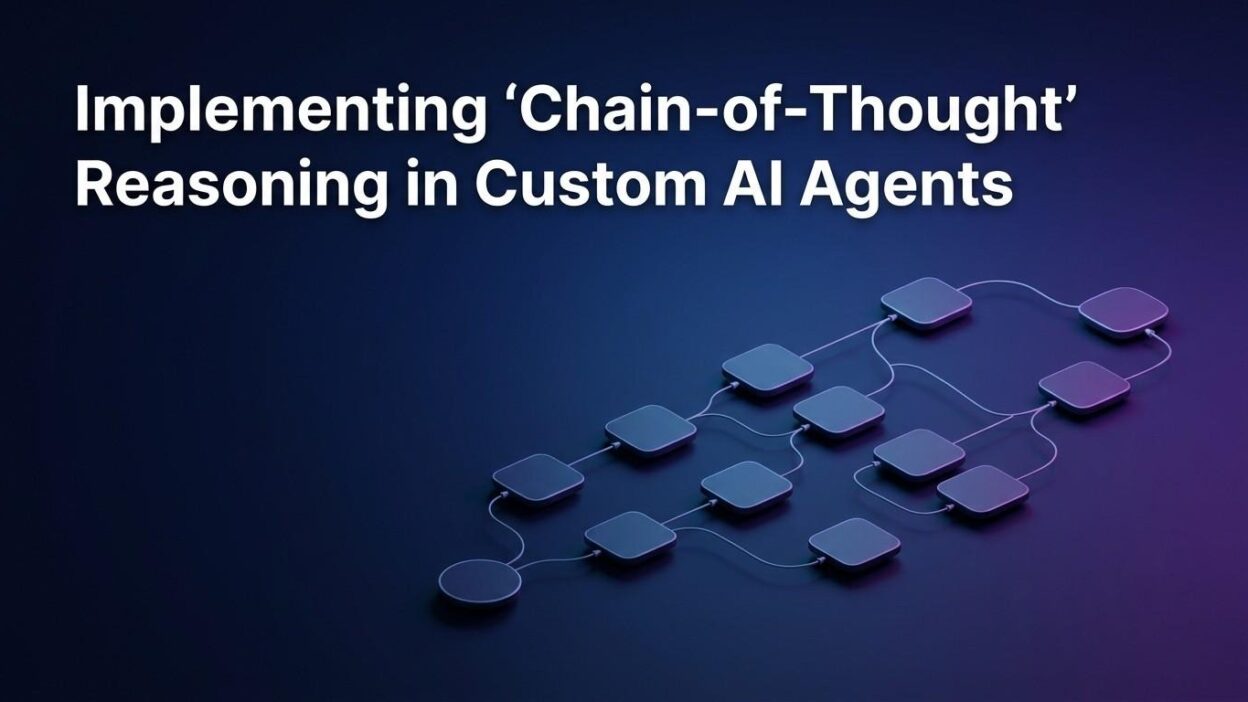
Tree of Thought takes Chain of Thought further. Instead of one linear reasoning chain, the agent explores multiple branches of reasoning simultaneously. It evaluates each branch and selects the most promising path.
This approach is powerful for open-ended problems with many possible solutions. Chain of Thought reasoning in custom AI agents can be upgraded to Tree of Thought when the domain requires it. The implementation is more complex, but the results on hard problems are significantly better.
Retrieval-Augmented CoT
Your agent’s reasoning can draw from external knowledge sources. Retrieval-Augmented Generation (RAG) combined with CoT creates agents that reason with facts, not just training data.
The agent retrieves relevant documents first. Then it reasons step by step using those documents as grounding. Chain of Thought reasoning in custom AI agents powered by RAG is far more accurate on knowledge-intensive tasks. It also reduces hallucination significantly.
Tool-Use Integration With Reasoning Chains
Modern AI agents can use external tools: calculators, code interpreters, search engines, APIs. When you integrate tool use into CoT reasoning, the agent knows when to compute rather than guess.
The reasoning chain includes tool invocation steps. The agent might reason: “I need to calculate 15% of $2,450. I will use the calculator tool for precision.” This kind of reasoning is exactly what Chain of Thought reasoning in custom AI agents enables at scale.
Metacognitive Prompting
Metacognitive prompting asks the agent to evaluate its own reasoning. After generating a chain, it asks itself: “Is this reasoning correct? Did I miss any steps? Is there a better approach?”
This self-evaluation layer adds another quality check. The agent critiques its own work before producing a final answer. Chain of Thought reasoning in custom AI agents with metacognitive prompting delivers noticeably higher accuracy on complex multi-step tasks.
Real-World Applications
Customer Support Agents
A customer support agent using Chain of Thought reasoning in custom AI agents can diagnose issues methodically. It checks account status, reviews recent activity, identifies the root cause, and proposes a fix — all in clear, visible steps.
Customers see transparent reasoning. Support teams can audit the agent’s logic. This builds confidence in automated support at scale.
Legal and Compliance Agents
Legal reasoning demands rigorous logic. A custom agent analyzing contracts must check clauses, identify risks, cross-reference regulations, and flag inconsistencies. Chain of Thought reasoning in custom AI agents makes this possible in a structured, auditable way.
Law firms and compliance teams need to verify AI output. A visible reasoning chain makes verification practical. It also makes the agent’s analysis more defensible in professional settings.
Financial Analysis Agents
Financial agents face complex, multi-variable problems every day. An agent helping with portfolio analysis must reason through market conditions, risk tolerance, asset correlations, and regulatory constraints.
Chain of Thought reasoning in custom AI agents ensures the financial agent does not skip critical analytical steps. Each decision point in the reasoning chain can be reviewed by human analysts. That review process maintains accuracy and accountability.
Medical Information Agents
Medical agents assist healthcare professionals with information retrieval and clinical reasoning support. These agents must reason carefully. Errors have real consequences.
Chain of Thought reasoning in custom AI agents used in healthcare contexts makes the agent’s logic visible to clinicians. Doctors can review the reasoning path and catch any gaps. This human-in-the-loop approach is essential for high-stakes domains.
Code Review and Debugging Agents
A code review agent powered by Chain of Thought reasoning in custom AI agents can analyze code in structured steps. It reviews syntax first, then logic, then security vulnerabilities, then performance. Each step builds on the last.
Developers get more than just a verdict. They get a structured reasoning report that explains every finding. That depth makes the agent a genuine productivity tool rather than a simple linter.
Common Mistakes to Avoid
Skipping Few-Shot Examples in Complex Domains
Zero-shot CoT works well for general models on general tasks. For specialized domains, the model needs examples of domain-specific reasoning. Skipping few-shot examples in complex agents leads to inconsistent and often shallow reasoning chains.
Not Extracting the Final Answer Separately
CoT output contains both the reasoning chain and the final answer. Your pipeline must extract them separately. If you pass the entire chain to the user as the final answer, you create a confusing experience. Parse your output carefully.
Using CoT on Tasks That Do Not Need It
Not every task needs Chain of Thought reasoning. Simple factual lookups, short classifications, and basic data retrieval do not benefit from step-by-step reasoning. Adding CoT to these tasks wastes tokens and adds latency. Use CoT where it creates genuine value.
Ignoring Reasoning Chain Length
Long reasoning chains cost more tokens. They also increase latency. You must balance reasoning depth with efficiency. Chain of Thought reasoning in custom AI agents should be calibrated to task complexity. Not every step needs ten sub-steps.
Measuring the Impact of Chain of Thought Reasoning
Key Metrics to Track
You need to measure whether CoT is actually helping your agent. The right metrics tell you if the approach is working or if something needs adjustment.
Accuracy Rate: Compare the agent’s answers with and without CoT. For most complex tasks, CoT improves accuracy by a meaningful margin.
Reasoning Chain Quality Score: Have human reviewers score a sample of reasoning chains. Rate them on logical coherence, completeness, and relevance.
User Trust Score: Survey users about their confidence in the agent’s answers. Ask if the visible reasoning chain helps them understand and trust the output.
Error Rate by Task Type: Break errors down by task category. This tells you where CoT helps most and where it adds no value.
Iterative Improvement of Reasoning Chains
Chain of Thought reasoning in custom AI agents improves over time. Analyze failed reasoning chains. Identify where logic broke down. Update your prompts and few-shot examples based on what you learn.
Treat your CoT implementation as a living system. Regular audits, prompt updates, and example improvements keep your agent’s reasoning sharp. This iterative discipline separates great AI agents from mediocre ones.
Frequently Asked Questions (FAQs)
What is the difference between Chain of Thought and standard prompting?
Standard prompting asks the model for a direct answer. Chain of Thought prompting instructs the model to reason step by step before answering. Chain of Thought reasoning in custom AI agents uses this technique as a core part of the agent’s design, not just as an occasional prompt trick.
Does Chain of Thought reasoning work with all AI models?
It works best with capable large language models. Models with fewer than a few billion parameters often struggle to produce coherent reasoning chains. GPT-4, Claude 3, and similar frontier models handle Chain of Thought reasoning in custom AI agents very well. Smaller models may need more structured prompts and few-shot examples.
How many steps should a reasoning chain have?
It depends on the task. Simple problems might need three to five steps. Complex problems might need ten or more. Chain of Thought reasoning in custom AI agents should calibrate step count to task complexity. Avoid padding reasoning chains with unnecessary steps just to look thorough.
Can Chain of Thought reasoning reduce AI hallucinations?
Yes, it can. When the agent reasons step by step, each step constrains the next. This reduces the chance of logical leaps that produce hallucinated facts. Combining Chain of Thought reasoning in custom AI agents with retrieval-augmented generation reduces hallucinations even further.
Is Chain of Thought reasoning expensive to implement?
The primary cost is token usage. Reasoning chains use more tokens than direct answers. This increases API costs slightly. However, the accuracy gains often justify the extra cost, especially in high-stakes or complex-task domains. You can also optimize chains to minimize unnecessary verbosity.
What industries benefit most from Chain of Thought reasoning in custom AI agents?
Legal, finance, healthcare, software development, and customer service all benefit significantly. Any domain that requires multi-step reasoning, auditability, or explainable output is a strong candidate for Chain of Thought reasoning in custom AI agents.
How do I test if my CoT implementation is working?
Run your agent on a benchmark dataset with known correct answers. Compare accuracy with and without CoT prompting. Review a sample of reasoning chains manually for logical coherence. Track error patterns over time and adjust your prompt design accordingly.
Read More:-The Best Tech Stack for Building a SaaS With AI Features in 2025
Conclusion

Chain of Thought reasoning in custom AI agents is not a trend. It is a fundamental shift in how we build AI systems that people can actually trust.
The days of black-box AI that spits out answers with no explanation are numbered. Developers, businesses, and end users all want more. They want to see the thinking. They want to audit the logic. They want agents that earn their trust through transparency.
Implementing Chain of Thought reasoning in custom AI agents requires deliberate design. You need a clear reasoning framework, well-crafted prompts, robust validation, and a commitment to iterative improvement. None of that is easy. All of it is worth it.
Start small. Pick one use case in your system where complex reasoning matters most. Apply the techniques in this guide. Measure the results. Refine your approach. Expand from there.
The AI agents of tomorrow will reason like experts. Chain of Thought reasoning in custom AI agents is your path to building them today.