Introduction
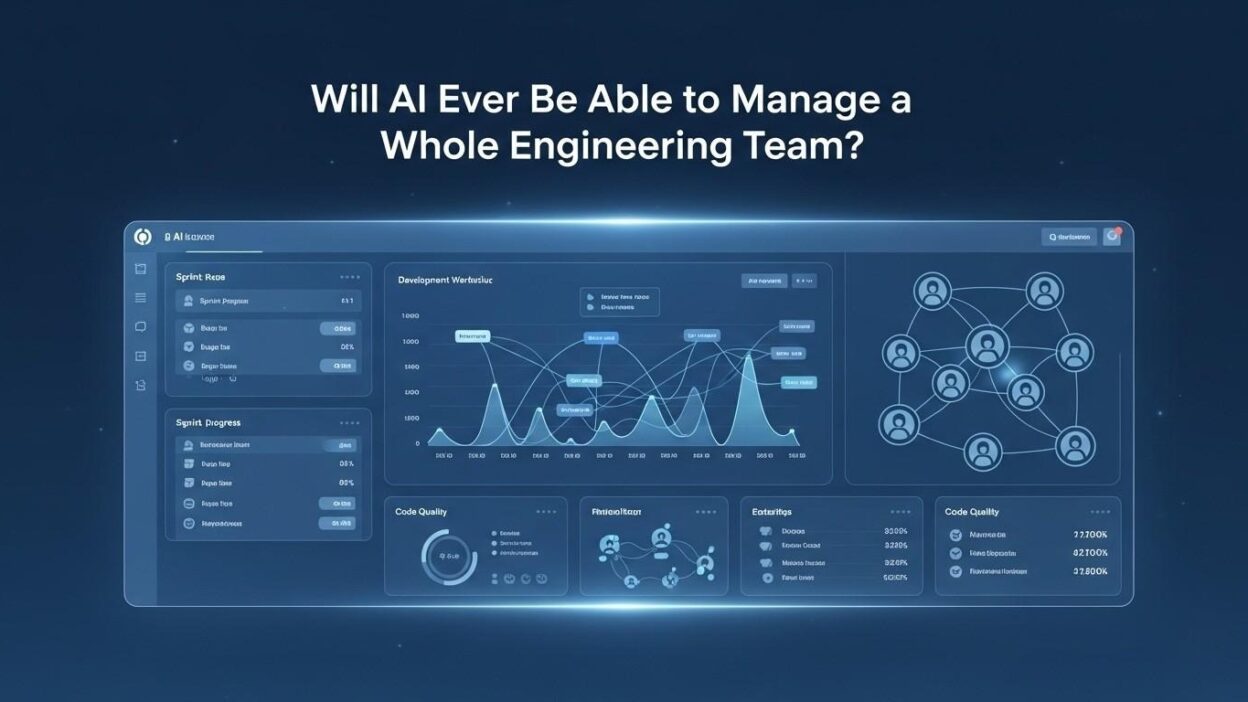
TL;DR Silicon Valley has a habit of declaring the death of every profession it disrupts. Accountants. Lawyers. Radiologists. Writers. Now the spotlight has landed on engineering managers. The question circulating in boardrooms, startup forums, and tech communities is direct: can AI manage a whole engineering team?
The conversation is no longer hypothetical. AI systems already write production code, review pull requests, flag performance regressions, and generate project status reports. Companies are experimenting with AI-driven sprint planning. Some startups run engineering operations with leaner management layers than ever before.
But writing code and managing the people who write code are two fundamentally different activities. The gap between those two things is where the real answer lives.
This blog examines the question seriously. It explores what engineering managers actually do that creates value, what AI currently handles in engineering workflows, where the hard limits on AI management capability sit, and what the realistic near-term future looks like for engineering organizations navigating this transition.
Can AI manage a whole engineering team? The full answer requires understanding what management genuinely is, not just what it looks like from the outside.
Table of Contents
Defining What Engineering Management Actually Creates
To properly answer can AI manage a whole engineering team, start with a precise definition of what engineering management creates. Not what it does administratively, but what value it generates for the organization and the people inside it.
Engineering management creates alignment. A team of ten engineers with different assumptions about priorities, quality standards, and success definitions will build ten different things simultaneously. The engineering manager aligns those ten individuals toward a single coherent direction. That alignment does not happen through memos. It happens through repeated human conversation that builds shared understanding over time.
Engineering management creates safety. Psychological safety specifically. Engineers take creative risks, admit confusion, and surface bad news when they trust their manager will respond constructively. That trust forms through dozens of small interactions that demonstrate the manager’s genuine investment in each person’s success. Without psychological safety, engineering teams hide problems until they become crises.
Engineering management creates growth. Senior engineers did not arrive senior. Someone identified their potential, gave them increasingly challenging opportunities, delivered honest feedback when they fell short, and advocated for their advancement when the time was right. This developmental investment compounds over years into the engineering capability the organization depends on.
Engineering management creates resilience. Teams face setbacks, missed deadlines, scope changes, and technical failures regularly. The engineering manager keeps the team functional through those difficulties. They absorb organizational pressure before it reaches engineers. They reframe failures as learning. They maintain forward momentum when confidence is low.
Can AI manage a whole engineering team by creating these things? Each one warrants careful examination.
The Invisible Work That Makes Engineering Teams Function
Most of what engineering managers do never appears in any tool, dashboard, or meeting agenda. It is the invisible connective tissue of functional teams.
A manager notices that a usually vocal engineer has gone quiet in team meetings for two weeks. They schedule a one-on-one, ask a genuine question, and discover the engineer received a competing job offer and is considering leaving. The conversation that follows either retains or loses a critical team member. Nothing triggered an alert. No system flagged the situation. Human observation caught it.
A manager learns during a product planning meeting that a feature request will require rearchitecting a core system. They know this will frustrate three engineers who just finished a related refactor. Before the announcement reaches the team, the manager has individual conversations with each of those engineers that acknowledge the frustration and explain the business reasoning. The team receives the news with context rather than surprise. Morale stays intact.
A manager realizes that two engineers are consistently assigned to the same project type and have never worked on architectural decisions. They deliberately restructure team assignments to give both engineers exposure to different challenges. Neither engineer asked for this. The manager recognized the developmental gap and acted proactively.
Can AI manage a whole engineering team by performing this invisible, proactive, relationship-driven work? Current AI systems observe what they are shown. They do not notice what has changed or what is conspicuously absent in human behavior patterns across time.
What AI Genuinely Handles Well in Engineering Workflows Today
Can AI manage a whole engineering team requires honest examination of AI’s genuine current capabilities. Dismissing AI as merely a code autocomplete tool misunderstands the technology’s real and growing impact on engineering operations.
Automated code review is one of AI’s strongest contributions to engineering workflows. Tools like CodeRabbit, Sourcegraph Cody, and GitHub Copilot review pull requests for security vulnerabilities, logic errors, style inconsistencies, and performance concerns. They catch issues that tired human reviewers miss. They provide consistent feedback without the personal dynamics that sometimes make code review feel adversarial.
Technical documentation generation removes one of the most consistently neglected engineering responsibilities. Engineers write code and skip documentation. AI tools generate README files, inline comments, API documentation, and architecture decision records from existing code. Code that previously lived undocumented in someone’s head now has written context that survives team changes.
Sprint velocity analysis and planning support improves with AI systems that analyze historical data. How long did similar tasks take this team historically? Which engineers have relevant experience with the technology stack a new feature requires? Which tasks have dependencies that will create blocking situations if sequenced incorrectly? AI surfaces this analysis in seconds rather than requiring managers to manually review weeks of historical data.
Anomaly detection in engineering metrics catches performance regressions, deployment frequency drops, and build failure rate increases that might otherwise go unnoticed until they create larger problems. AI monitoring systems alert relevant people when metrics deviate from established patterns. Early detection prevents small problems from compounding.
Meeting summarization and action item extraction saves significant time across weekly team meetings, cross-functional syncs, and incident reviews. AI tools transcribe recordings, extract commitments, identify owners, and draft follow-up communications. Time spent on post-meeting administrative work drops from 30 to 45 minutes per meeting to five to ten minutes of review and adjustment.
Can AI manage a whole engineering team using these capabilities? These are valuable contributions to engineering operations. They are not management.
AI Agents Taking on Engineering Coordination Tasks
A newer category of AI capability is particularly relevant to the question of can AI manage a whole engineering team. AI agents designed for software engineering coordination are advancing rapidly and deserve specific attention.
Cognition’s Devin demonstrated that AI agents could autonomously complete multi-step software engineering tasks. Given a problem description with sufficient context, Devin researches solutions, writes code, runs tests, debugs failures, and iterates toward working solutions without step-by-step human guidance. Its release in 2024 genuinely shifted what engineers and engineering leaders thought AI agents could accomplish.
Multi-agent frameworks like AutoGen, CrewAI, and similar platforms allow multiple specialized AI agents to collaborate on complex engineering tasks. One agent handles backend implementation. Another reviews code quality. A third generates tests. A coordinator agent manages the workflow between them. These frameworks handle structured, well-defined engineering tasks with increasing reliability.
Project management platforms now embed AI features that triage incoming bug reports automatically, suggest task assignments based on code ownership data, estimate complexity from historical task patterns, and flag risks in proposed sprint compositions. These features reduce the coordination overhead that engineering managers previously handled through manual analysis.
The trajectory of AI agent capability in engineering coordination is clearly upward. The question of can AI manage a whole engineering team increasingly becomes a question about which management functions require human judgment versus which require only reliable coordination.
The Hard Limits: Where AI Cannot Manage Engineering Teams
Can AI manage a whole engineering team requires an honest examination of where current and near-future AI capability hits genuine walls. These walls are not temporary gaps that will close in the next model release. They reflect fundamental challenges in what AI systems currently understand.
Interpersonal conflict resolution requires navigating histories, personalities, and emotions that exist outside any data system. Two engineers who disagree on architectural direction bring their professional identities, their past experiences with each other, and their deeper anxieties about competence and recognition into the disagreement. A skilled engineering manager reads those dynamics accurately and creates conditions where both engineers feel genuinely heard before guiding the team toward resolution. AI systems produce generic conflict resolution suggestions that ignore the specific human context.
Performance management for underperforming engineers demands a level of individualized human judgment that no current AI system can replicate. Is the underperformance caused by unclear expectations, personal circumstances outside work, skill gaps the engineer cannot identify themselves, a mismatch between their strengths and current project requirements, or a fundamental motivation problem? Each diagnosis leads to a different management response. The wrong response causes unnecessary harm to the engineer and fails to solve the performance problem. Getting it right requires deep individual knowledge built through sustained human relationship.
Organizational advocacy for engineering teams requires political intelligence that operates in social systems AI cannot fully perceive. Engineering managers secure budget for infrastructure improvements that have no direct revenue attribution. They protect team working conditions during aggressive product delivery cycles. They build relationships with product, design, and executive stakeholders that create goodwill the engineering team draws on during difficult negotiations. These activities require understanding unwritten organizational power dynamics and investing in human relationships over time.
Hiring decisions at the senior level require judgment about culture fit, team dynamic impact, and long-term potential that resists algorithmic evaluation. A senior engineer with an impressive technical interview performance but subtly dismissive behavior toward junior engineers will damage team culture in ways that compound over years. A candidate with a less polished technical presentation but genuine intellectual curiosity and collaborative orientation will strengthen the team over time. Experienced engineering managers read these signals in extended human interaction. AI systems evaluate what they can measure.
Can AI manage a whole engineering team through these high-stakes judgment situations? The honest answer is no, not with current technology or likely near-future technology.
Why Trust Cannot Be Automated in Engineering Leadership
Trust is the operating system that engineering teams run on. Without it, everything slows down. Engineers hedge their commitments. They filter the problems they surface. They avoid the honest conversations that surface real risks. Teams that lack trust between engineers and their managers consistently underperform teams with high trust even when technical skill levels are equivalent.
Trust between engineers and their managers builds through specific, repeated human experiences. A manager delivers a difficult performance message honestly and with genuine care. An engineer shares a concern about project feasibility and the manager takes it seriously. A manager advocates for an engineer’s promotion when the engineer doubts their own readiness. Each of these experiences deposits into a trust account that the relationship draws on when difficult moments arise.
AI systems do not build trust in the same way. Engineers know they are interacting with a system. They adjust their behavior accordingly. They present the information the system expects rather than the full, honest picture of their situation. The psychological safety that produces honest communication in human management relationships does not transfer to AI-managed workflows.
Can AI manage a whole engineering team in a trust-dependent way? The fundamental challenge is not AI’s analytical capability. It is that the trust relationship requires genuine human presence and authentic investment in other people’s wellbeing. Those qualities do not currently emerge from AI systems regardless of how sophisticated their conversational outputs become.
The Hybrid Reality: AI-Augmented Engineering Management
Can AI manage a whole engineering team independently? No. Will AI fundamentally reshape what engineering management looks like in practice? Absolutely. The realistic near-term future is a hybrid model with specific characteristics that are worth examining carefully.
Administrative burden reduction is the most immediate and widespread change already underway. Engineering managers at organizations deploying AI management tools report spending 35 to 50 percent less time on status updates, documentation requests, meeting logistics, data compilation, and routine communication. That recovered time represents genuine capacity that human managers can reinvest in the human work that creates disproportionate team value.
Insight quality improvement changes the basis of management decisions. Engineering managers who previously made decisions based on subjective impressions and incomplete data now work with richer quantitative signals about team health, individual contributor patterns, and process efficiency. Better information supports better decisions. The manager still makes the decision. They make it with more complete context.
Coaching capacity extension becomes possible when AI tools handle routine check-ins and status collection. A manager who previously had capacity for six meaningful coaching conversations per week might have capacity for nine when AI handles the administrative layer of team communication. More coaching conversations compound into significantly better engineering team development over time.
Cross-functional communication improves when AI tools handle summary generation, status reporting, and stakeholder updates. Engineering managers spend less time translating technical progress into business language for executive audiences. More time becomes available for the relationship-building activities that create organizational trust in the engineering function.
Can AI manage a whole engineering team in this augmented model? The answer remains no. But the engineering manager in this model becomes significantly more effective. The human leadership work that creates the most value gets more attention and more capacity.
What Engineering Organizations Must Do to Prepare for AI-Augmented Management
Organizations asking can AI manage a whole engineering team should invest simultaneously in deploying AI tools effectively and in developing human management capability more deliberately. These investments reinforce each other.
Role clarity becomes more important when AI handles increasing shares of administrative management work. Organizations need clarity about which management functions AI tools support and which require undiluted human judgment. That clarity prevents the confusion where important human decisions default to AI recommendations because the distinction between AI-appropriate and human-required decisions is not explicit.
Manager selection criteria should evolve alongside AI tool adoption. Organizations that previously valued engineering managers primarily for coordination ability and technical knowledge should increasingly prioritize coaching depth, interpersonal intelligence, and organizational influence capability. These distinctly human skills become more valuable as AI handles coordination and analysis.
Data governance frameworks protect against risks in AI-augmented management. What performance data do AI management tools access? How are AI-generated performance insights used in compensation and promotion decisions? What human review is required before AI recommendations become organizational actions? These questions need answers before broad AI tool deployment rather than after problems emerge.
Engineer transparency about AI tools in management workflows builds trust rather than eroding it. Engineers who know which management insights come from AI analysis and which come from direct manager observation can engage authentically with both. Organizations that deploy AI management tools without transparency create the perception of surveillance rather than support.
Specific Scenarios: Testing Can AI Manage a Whole Engineering Team
Abstract analysis only goes so far. Testing can AI manage a whole engineering team against specific, realistic engineering management scenarios reveals the gaps most clearly.
Scenario one: A senior engineer receives an offer from a competitor. They mention it to no one. Their recent performance data shows no change. Their communication patterns appear normal. An experienced human manager with a strong relationship notices a subtle withdrawal during team social interactions and creates space for an honest conversation. An AI system with no access to informal social signals detects nothing. The company loses the engineer without warning.
Scenario two: A team misses a critical deadline. Post-mortem reveals that two engineers had identified the risk three weeks earlier but did not escalate because they felt the manager would respond negatively to bad news. An AI system analyzing project data might flag the timeline risk late. A human manager who created genuine psychological safety would have received that escalation three weeks earlier when intervention was still possible.
Scenario three: An engineer who was a top performer last year is producing mediocre work this quarter. AI performance analytics flag the decline accurately. What the system cannot determine is whether this reflects a personal health crisis, increasing skill mismatch with current project requirements, disengagement from a specific team dynamic, or the early stages of a mental health challenge. Each situation requires a completely different management response. Getting it wrong causes harm. Human judgment from someone who knows this engineer makes the difference.
Scenario four: The engineering team is asked to deliver a major feature in half the estimated time due to competitive pressure. An AI system can model the capacity math and identify the tradeoffs. It cannot navigate the conversation with the engineering team that explains the business reality, acknowledges the unreasonableness of the ask, maintains engineering morale through resentment, and ultimately gets the team aligned behind a committed delivery plan. That conversation requires authentic human leadership.
Can AI manage a whole engineering team through these scenarios? In each case, AI contributes analytical value. In each case, the outcome-determining action requires human judgment, relationship capital, and authentic presence.
Industries and Team Types Where AI Management Goes Further
Can AI manage a whole engineering team varies by context. Certain engineering environments are more amenable to higher degrees of AI management than others.
Highly structured engineering work with clear task definitions, established quality criteria, and low ambiguity in success measurement is more amenable to AI management support. Teams maintaining legacy systems with well-documented requirements, teams executing established feature development patterns, and teams working in highly regulated environments with explicit compliance criteria all fit this profile.
Smaller, more senior teams with high individual autonomy require less active management coordination. When every engineer is experienced enough to manage their own priorities, maintain quality standards independently, and navigate cross-functional relationships without support, the coordination and development demands on the manager reduce significantly. AI tools cover a higher fraction of residual management needs in these contexts.
Remote-first engineering teams already operate with more asynchronous and tool-mediated communication than colocated teams. They have developed higher tolerance for AI-mediated workflows because tool-mediated interaction is already their default. AI management support integrates more naturally into these team cultures.
Conversely, teams working on novel technical problems, teams with significant junior engineer populations requiring active development, and teams navigating significant organizational change all require higher degrees of human management presence. Can AI manage a whole engineering team in these contexts? Less capably than in the more structured environments described above.
The Future Timeline: When and How Much Will AI Management Capability Grow?
Can AI manage a whole engineering team at some future point requires examining the trajectory of relevant AI capabilities and the specific advances needed for full management parity.
Persistent individual modeling is the capability most directly needed for human-level people management. Current AI systems lack sustained, nuanced memory of specific individuals built across months of interaction. Managing a person’s career development requires remembering the context of thirty previous conversations, recognizing how their stated concerns have evolved over time, and connecting current performance patterns to past developmental discussions. AI systems with genuinely persistent individual models do not yet exist at the depth people management requires.
Genuine emotional comprehension beyond pattern recognition in language is a deeper challenge. Current AI systems recognize emotional language and generate emotionally appropriate responses. They do not genuinely understand what a person feels, why they feel it, and what specific response will be genuinely helpful for this specific person in this specific situation. The difference between recognizing emotional patterns and genuinely understanding emotional experience is significant and not clearly on a near-term development roadmap.
Autonomous organizational navigation requires AI systems that understand informal power structures, unwritten organizational norms, and political dynamics that never appear in any document or data system. Organizations are social systems. Their most important dynamics are deliberately informal and intentionally undocumented. AI systems that cannot perceive and navigate these dynamics cannot perform the organizational advocacy and stakeholder management that engineering managers provide.
Accountability structures for AI management decisions represent a regulatory and organizational design challenge alongside a technical one. When AI management systems make consequential decisions about individual engineers’ careers, compensation, or working conditions, clear accountability frameworks must exist. Who is responsible when an AI management decision causes harm? Until these frameworks exist, full AI management autonomy creates unacceptable organizational and legal risk.
Realistic timeline perspectives from researchers and practitioners who work with these systems daily suggest that AI will handle 50 to 65 percent of current engineering management work within five to eight years. The judgment-intensive, relationship-intensive, and politically complex dimensions will remain primarily human work for significantly longer. Can AI manage a whole engineering team fully? Not in any near-term timeline with confidence.
Skills Engineering Managers Must Develop for the AI Management Era
Engineering managers who understand can AI manage a whole engineering team are better positioned to develop the skills that will make them most valuable as AI handles increasing shares of management work.
Coaching depth becomes the primary differentiator for human managers in AI-augmented organizations. The ability to accelerate individual engineer growth through skillful developmental conversation is exactly the capability AI cannot replicate. Engineering managers who invest seriously in coaching skills, including formal coach training, create value that compounds over entire engineering careers.
Systems thinking about organizational dynamics enables managers to see and shape the informal structures that AI cannot perceive. Understanding how team incentives create unexpected behaviors, how communication patterns amplify or suppress important information, and how cultural norms develop and sustain themselves gives human managers leverage points that AI-driven analysis cannot identify.
AI tool literacy enables managers to extract maximum value from AI management tools while applying human judgment where it matters most. Understanding what AI analysis is reliable, where it produces misleading outputs, and how to combine AI insights with direct human observation makes managers significantly more effective than peers who either reject or uncritically accept AI management recommendations.
Cross-functional influence building through authentic relationship investment creates organizational capital that AI-managed teams cannot accumulate. Engineering managers who are trusted peers to product, design, finance, and executive stakeholders secure resources, protect their teams, and shape strategy in ways that depend entirely on human relationship quality.
Frequently Asked Questions: Can AI Manage a Whole Engineering Team?
Can AI manage a whole engineering team right now in 2025?
No. AI tools currently handle specific engineering management functions effectively, including code review, documentation generation, performance analytics, sprint planning support, and meeting summarization. They cannot replicate the full scope of engineering management, which requires interpersonal relationship building, career development coaching, conflict resolution, organizational advocacy, and high-stakes judgment in ambiguous situations. Can AI manage a whole engineering team in a complete sense remains a clear no for any foreseeable near-term timeframe.
Which specific management tasks is AI best at replacing today?
AI handles administrative and analytical management functions most effectively. Automated status reporting, performance metric aggregation, documentation generation, code review feedback, meeting summarization, sprint velocity analysis, and task triage all fall within current AI capability. These functions represent 30 to 45 percent of total engineering manager time in most organizations. Freeing this time through AI tools enables human managers to concentrate on the relationship-intensive and judgment-intensive work that creates disproportionate value.
Could a startup run engineering with no human manager using AI tools?
Very small engineering teams at early stages with highly experienced, self-directed engineers can operate effectively with minimal formal management. AI tools can supplement coordination in these contexts. As team size grows beyond five to seven engineers, the coordination complexity, development needs, and relationship dynamics that require human management judgment increase faster than AI tools can compensate. Startups that eliminate engineering management entirely typically experience compounding team health and retention problems as they scale.
What are the biggest risks of over-relying on AI for engineering management?
Over-reliance on AI management tools creates several compounding risks. Engineers who receive primarily AI-mediated feedback and development guidance develop weaker relationships with their organizations and lower commitment to their teams. Performance management decisions based primarily on AI analytics miss contextual factors that quantitative data cannot capture. Teams managed primarily by AI systems lose the psychological safety that comes from authentic human relationships. These risks accumulate quietly until they surface as retention failures, performance declines, and team fragmentation.
How should engineering managers respond to AI management tools?
Engineering managers should adopt AI tools that reduce administrative burden and improve decision data quality. They should simultaneously invest in the human skills that AI cannot replicate. Can AI manage a whole engineering team is a threat question for managers whose primary value is administrative coordination. It is an opportunity question for managers whose primary value is coaching, advocacy, and authentic leadership. The managers who embrace AI tools while deepening distinctly human capabilities become more valuable as AI handles more coordination work.
Will AI eventually be able to fully replace engineering management?
Full replacement would require AI systems that build genuine individual trust over sustained time, navigate complex organizational politics, exercise ethical judgment in situations without clear correct answers, and provide authentic developmental relationships that meaningfully affect people’s careers. Each of these requirements exceeds current AI capability by a significant margin. Full replacement remains unlikely within any horizon where current AI development trajectories remain relevant. Significant augmentation is certain. Full replacement is not.
What secondary keywords support this topic for SEO?
Related secondary keywords with meaningful search volume include AI replacing engineering managers, future of engineering management with AI, AI tools for tech leads, autonomous software development teams, AI project management for engineering, engineering manager skills for AI era, and software team management automation. These subtopics attract readers researching AI’s impact on engineering leadership from multiple angles and build topical authority around the primary question of can AI manage a whole engineering team.
Adjacent Topics That Complete the AI Engineering Leadership Picture
A comprehensive SEO content strategy around can AI manage a whole engineering team benefits from coverage of adjacent topics that capture related search intent from different audience segments.
The engineering manager career path in the AI era attracts engineers considering whether to pursue management careers when AI may automate management functions. This highly searched topic connects directly to the primary question because individuals making career decisions need honest analysis of which management functions will remain human and which will automate.
AI-assisted technical leadership for individual contributors addresses the growing population of senior engineers who take on coordination and quality responsibilities without formal management titles. AI tools that support tech lead and staff engineer functions attract a large, motivated audience who face management-adjacent challenges without the support structures available to formal managers.
Engineering team productivity measurement with AI covers the specific tools and methodologies that engineering organizations use to track team health and individual contributor performance. This topic connects to the management question because measurement is a core management function that AI is already transforming.
Agentic AI for software development represents a related topic that addresses AI’s role as an autonomous contributor rather than a management tool. As AI agents take on increasing shares of software development work, the engineering management challenge shifts from managing human engineers to orchestrating human-AI collaborative teams. This emerging topic attracts engineering leaders thinking ahead about how team composition will evolve.
Remote engineering team management and AI addresses a growing intersection between distributed team management challenges and AI tool adoption. Distributed teams already operate with more tool-mediated communication. AI management augmentation integrates more naturally into remote work cultures. This combined topic serves a specific and growing audience of engineering leaders managing distributed teams.
Read More:-5 Signs Your Business is Ready for Full AI Automation
Conclusion
Can AI manage a whole engineering team? Not today. Not in the near future. And not in the way that would fully replace what skilled human engineering managers create for their organizations and the people inside them.
AI currently handles significant engineering management work. Code review automation, performance analytics, documentation generation, sprint planning support, and meeting summarization all contribute genuine operational value. Engineering managers who deploy these tools well free substantial capacity for the human leadership work that creates disproportionate team impact.
The hard limit on AI management capability is not computational power or data access. It is the fundamentally relational nature of people management. Trust builds through authentic human investment over time. Careers develop through relationships that see and advocate for individual potential. Teams remain cohesive through difficult periods because a human leader absorbs organizational pressure and maintains forward momentum. None of this currently transfers to AI systems.
Can AI manage a whole engineering team in a hybrid model where it handles coordination and analytics while humans handle coaching and judgment? This is the model already emerging in organizations that deploy AI management tools thoughtfully. It makes human managers more effective, not less necessary.
The engineering managers who thrive in this environment invest in AI tool fluency alongside deepening the human capabilities AI cannot replicate. They coach more. They advocate more effectively. They build organizational relationships that create lasting team advantage. They use AI-generated insights to make better decisions while applying human judgment to the situations that determine whether teams are genuinely well-led.
The question is not whether AI will replace engineering management. The question is whether the engineering managers of today are building the human leadership skills that will make them irreplaceable as AI handles the parts of their role that were never the most important parts to begin with.