Introduction
TL;DR Your sales team dials hundreds of numbers daily. Some calls convert beautifully. Others crash and burn within seconds. Most land somewhere in between.
What if you knew which calls would succeed before dialing? What if you could prioritize high-probability prospects automatically? What if your agents focused energy where it actually matters?
Call outcome prediction models make this possible. Machine learning algorithms analyze historical call data to forecast results. They predict whether a call will result in a sale, a callback, a rejection, or no answer.
Sales managers gain unprecedented visibility into future performance. Call center leaders optimize resource allocation dramatically. Agents work smarter instead of just harder.
The technology transforms guesswork into data-driven strategy. Your organization stops wasting time on dead-end conversations. You maximize revenue per dial hour.
Table of Contents
What Are Call Outcome Prediction Models?
Predictive models use machine learning to forecast call results before conversations happen. The algorithms examine historical patterns in successful and unsuccessful calls. They identify which factors correlate with different outcomes.
These models analyze dozens or hundreds of variables simultaneously. Customer demographics, past purchase behavior, engagement history, time of day, day of week, and countless other signals feed into predictions. The system calculates probability scores for various outcomes.
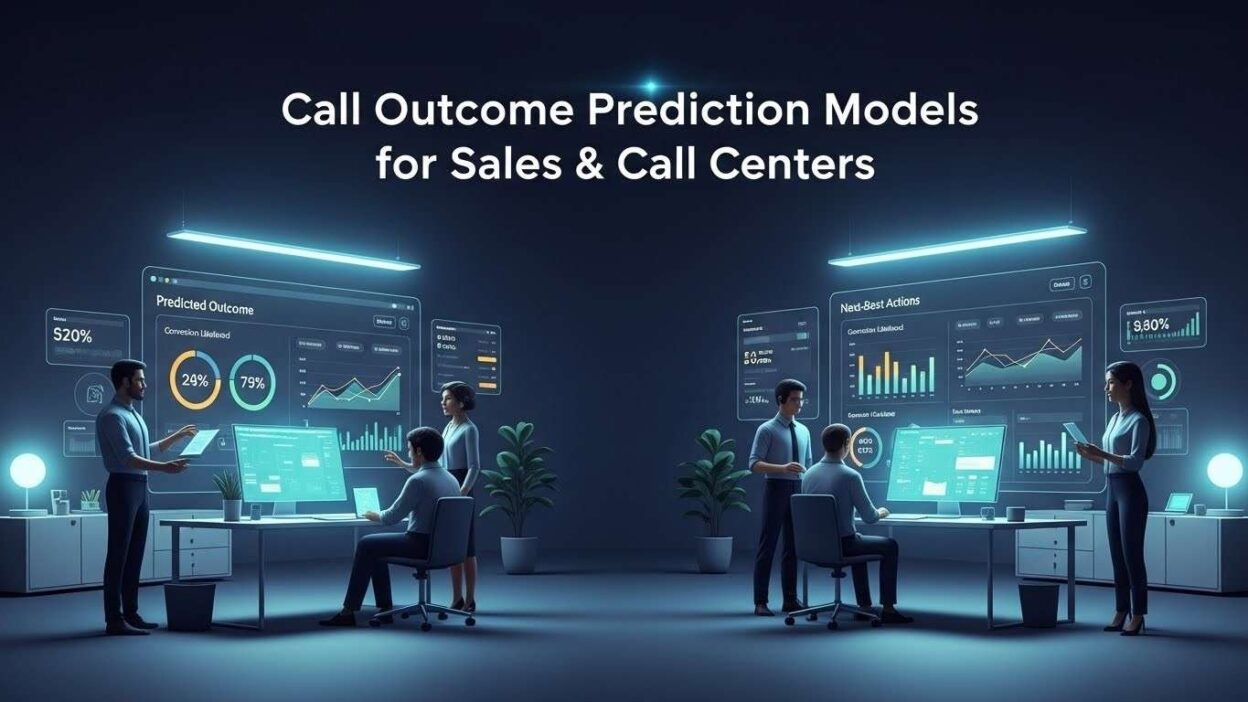
A typical call outcome prediction model might generate scores like these: 65% probability of sale, 20% probability of callback request, 10% probability of immediate rejection, 5% probability of no answer. Sales reps see these predictions before dialing.
The technology operates on supervised learning principles. You train models using thousands of past calls with known outcomes. The algorithm learns which patterns preceded sales versus rejections. It applies these learned patterns to predict future call results.
Different prediction models target different outcome categories. Binary models predict simple yes/no results like “will convert” or “won’t convert.” Multi-class models forecast specific outcomes like “sale,” “callback,” “not interested,” “wrong number,” and “voicemail.” Regression models predict continuous values like deal size or revenue potential.
Real-time prediction capabilities distinguish modern systems. The model updates probability scores as new information becomes available. A prospect who just visited your pricing page sees their conversion probability jump immediately. The prediction reflects current intent signals.
Call outcome prediction models improve continuously through feedback loops. Actual call results train the algorithm further. Each conversation makes the model smarter. Prediction accuracy increases over time automatically.
How Prediction Models Work in Sales Environments
Data collection forms the foundation of accurate predictions. Your CRM system tracks every customer interaction. Marketing automation platforms record email engagement. Website analytics capture browsing behavior. Phone systems log call attempts and outcomes.
Feature engineering transforms raw data into predictive signals. A data scientist doesn’t just feed “customer visited website” into the model. They create specific features like “pages_viewed_last_week,” “time_on_pricing_page,” and “days_since_last_visit.” These engineered features carry predictive power.
Model training consumes historical call outcome data. The algorithm examines thousands of past calls. It identifies which combinations of features preceded successful sales. It discovers patterns that predict rejections or callbacks. The learning happens through statistical pattern recognition.
Algorithm selection depends on your specific needs and data characteristics. Logistic regression works well for simple binary predictions. Random forests handle complex nonlinear relationships. Gradient boosting machines deliver high accuracy across various scenarios. Neural networks excel with massive datasets.
Validation ensures your model actually works. Data scientists split historical data into training and testing sets. They train the model on one portion. They test prediction accuracy on the holdout portion. Poor performance triggers model refinement.
Deployment puts predictions into production systems. The model integrates with your dialer or CRM platform. Sales reps see probability scores alongside contact information. The system might automatically prioritize the call list by predicted success probability.
Score interpretation guides agent behavior. A prospect with 80% conversion probability deserves immediate attention from your best closer. Someone with 15% probability might receive an automated email instead. Call outcome prediction models enable intelligent resource allocation.
Monitoring tracks model performance over time. Prediction accuracy can drift as market conditions change. Regular retraining keeps models current. Performance dashboards alert you to degradation.
Key Benefits for Sales Teams
Revenue per hour worked increases dramatically. Sales reps focus on high-probability prospects first. They spend less time on dead-end calls. More conversations end in closed deals. Individual productivity often jumps 20-40%.
Lead prioritization becomes scientific rather than guesswork. Your team stops relying on gut feelings about which prospects to call. Data-driven scores rank opportunities objectively. The best leads get attention first.
Call list optimization happens automatically. Call outcome prediction models reorder your dial queue continuously. New high-intent prospects jump to the top. Stale leads with low scores drop down. Your team always works the hottest opportunities.
Conversion rates improve across the board. Better targeting means more relevant conversations. Prospects receive outreach when they’re actually ready to buy. Timing optimization alone can boost conversion rates significantly.
Sales forecasting accuracy reaches new levels. You predict next month’s revenue based on current pipeline probabilities. Finance teams can plan with greater confidence. Resource allocation decisions improve.
Agent motivation increases with higher success rates. Sales reps experience more wins daily. They waste less time on fruitless calls. Job satisfaction improves when effort yields results. Turnover typically decreases.
Training effectiveness accelerates for new hires. Call outcome prediction models identify which prospect characteristics indicate easier sales. New agents start with these high-probability leads. They build confidence through early successes.
Competitive advantage compounds over time. Organizations using predictive models acquire customers more efficiently. They convert more prospects with the same effort. Market share grows while acquisition costs shrink.
Advantages for Call Center Operations
Contact center efficiency improves through intelligent call routing. Inbound calls get routed based on predicted outcomes. High-value customers with complex needs reach senior agents. Simple inquiries go to junior staff. Resources match requirements perfectly.
Staffing optimization uses outcome predictions for workforce planning. You forecast call volume by outcome type. You schedule appropriate skill mixes for predicted demand. Labor costs decrease while service levels improve.
Quality scores benefit from better call matching. Agents handle calls they’re most likely to succeed with. Performance metrics improve naturally. Quality assurance programs show better results.
Customer satisfaction increases when interactions succeed. Call outcome prediction models help ensure customers reach agents who can actually help them. First-call resolution rates climb. CSAT scores improve.
Callback scheduling becomes smarter and more strategic. The system predicts optimal times to reach specific customers. It schedules callbacks when conversion probability peaks. Connection rates increase substantially.
Campaign effectiveness measurement happens with greater precision. You compare predicted outcomes against actual results by campaign. You identify which messaging and offers drive success. You optimize campaigns based on performance data.
Compliance risk decreases through better call targeting. Predictive models help avoid calling customers likely to complain or report violations. You reduce regulatory exposure while maintaining productivity.
Cost per acquisition drops as efficiency increases. You spend less effort acquiring each customer. Marketing and sales expenses generate higher returns. Profitability per customer improves.
Essential Data Sources for Accurate Predictions
CRM data provides the richest source of predictive signals. Contact information, company details, past purchases, interaction history, and opportunity stages all matter. Demographics like industry, company size, and role influence outcomes.
Behavioral data reveals customer intent and readiness. Website visits, content downloads, email opens, and link clicks all carry meaning. Recent high-intent behaviors predict near-term conversion probability.
Communication history shows engagement patterns. Call frequency, email response rates, and preferred contact channels matter. Customers who engage regularly show different outcome patterns than those who ignore outreach.
Transactional data from past purchases informs predictions. Order frequency, average deal size, product categories, and payment history all correlate with future buying behavior. Past behavior predicts future actions.
Timing variables prove surprisingly predictive. Day of week, time of day, days since last contact, and time in sales cycle all influence outcomes. Call outcome prediction models learn optimal contact timing automatically.
External data enriches predictions beyond internal sources. Firmographic data, technographic information, and intent signals from third-party providers add valuable context. Market trends and economic indicators might factor into predictions.
Agent characteristics influence call outcomes significantly. Experience level, skill ratings, personality traits, and past performance with similar prospects all matter. Some agents excel with certain customer types.
Campaign and offer details contribute to outcome predictions. Different messaging approaches yield different results. Promotional offers influence conversion probability. The model learns which campaigns work best for which segments.
Building Your First Prediction Model
Define your prediction goal with crystal clarity. Do you want to predict sales versus no-sales? Do you need to forecast specific outcomes like “demo scheduled” or “not qualified”? Different goals require different modeling approaches.
Inventory available data sources comprehensively. Map all systems that capture customer and call information. Identify gaps in your current data collection. Plan integrations to consolidate data.
Clean and prepare your historical data carefully. Remove duplicates, fix errors, and standardize formats. Handle missing values appropriately. Data quality directly determines model accuracy.
Create a labeled training dataset with known outcomes. You need thousands of past calls with documented results. More training data generally produces better predictions. Aim for balanced representation of different outcomes.
Engineer meaningful features from raw data. Transform timestamps into “days since last contact.” Convert page views into “engagement score.” Create composite variables that capture complex patterns. Feature quality matters more than quantity.
Select an initial algorithm to test. Start simple with logistic regression or decision trees. Establish a baseline performance level. Experiment with more sophisticated algorithms later.
Train your model on historical data systematically. Split data into training and validation sets. Use cross-validation to prevent overfitting. Tune hyperparameters to optimize performance.
Evaluate prediction accuracy rigorously. Calculate metrics like precision, recall, and AUC-ROC. Test across different customer segments. Ensure the model performs well across all important groups.
Deploy predictions into production workflows. Integrate model scores with your dialer, CRM, or call routing system. Make predictions easily accessible to people who need them.
Types of Prediction Models and Algorithms
Logistic regression serves as the foundational approach for binary outcomes. The algorithm predicts probability of success versus failure. It handles linear relationships well. Interpretation remains straightforward. Business users can understand which factors drive predictions.
Decision trees create rules-based predictions through branching logic. The model splits data based on feature values. It handles nonlinear relationships naturally. Results are highly interpretable. Single trees tend to overfit on complex data.
Random forests combine multiple decision trees for robust predictions. Each tree trains on a different data sample. The ensemble averages predictions across all trees. Accuracy improves dramatically over single trees. Call outcome prediction models often use random forests successfully.
Gradient boosting machines deliver state-of-the-art accuracy for structured data. XGBoost, LightGBM, and CatBoost dominate machine learning competitions. They build trees sequentially to correct previous errors. They handle missing data elegantly. Interpretation becomes more challenging.
Neural networks excel with very large datasets and complex patterns. Deep learning architectures can process text, audio, and numerical data simultaneously. They require substantial training data. Computational costs run higher. Black-box nature complicates explanation.
Support vector machines work well for classification problems with clear boundaries. SVMs find optimal separation between outcome classes. They handle high-dimensional feature spaces effectively. Training time increases substantially with large datasets.
Naive Bayes algorithms provide fast baseline predictions. They assume feature independence despite the name. They work surprisingly well for text classification. Probability calibration often needs adjustment.
Ensemble methods combine multiple algorithms for maximum accuracy. Stacking different model types often outperforms any single approach. Call outcome prediction models benefit from diversity in the ensemble.
Implementing Predictions in Dialer Systems
API integration connects prediction models with dialer platforms. The dialer sends contact information to the prediction service. The model returns probability scores in milliseconds. Scores appear alongside contact details in the agent interface.
Call list sorting reorders contacts by predicted success probability. Agents work through the list from highest to lowest scores. They maximize revenue per hour automatically. Manual prioritization becomes unnecessary.
Dynamic prioritization adjusts as new information arrives. A prospect who just opened an email sees their score increase. They jump higher in the queue. The call list stays perpetually optimized.
Skip logic uses predictions to bypass low-probability contacts. Prospects below a threshold score don’t get called at all. They receive alternative touches like email or SMS instead. Agent time focuses on winnable opportunities.
Agent assignment matches reps with optimal prospects. Junior agents get easier high-probability leads. Senior closers handle complex high-value opportunities. Skills align with requirements automatically.
Campaign segmentation splits audiences by predicted outcome. High-probability prospects receive premium treatment. Low-probability contacts get minimal touches. Marketing spend flows to the best opportunities.
Real-time coaching uses predictions to prepare agents. Before each call, agents see why the model predicts success or challenge. They enter conversations informed and prepared. Opening approaches adapt to predicted outcome.
Performance tracking compares predictions against actual results. You measure model accuracy continuously. You identify prediction errors and retrain accordingly. Call outcome prediction models improve through ongoing refinement.
Measuring Model Performance and ROI
Prediction accuracy metrics establish baseline performance. Accuracy, precision, recall, and F1 score all matter. Different metrics matter for different business contexts. Track all key measures consistently.
AUC-ROC curves visualize classification performance across thresholds. A perfect model scores 1.0. Random guessing scores 0.5. Aim for 0.75 or higher for practical business value. Higher scores justify greater confidence in predictions.
Confusion matrices reveal specific error patterns. False positives and false negatives carry different costs. Understanding error types guides threshold optimization. You might prefer missing some sales to wasting time on dead ends.
Revenue lift calculation quantifies business impact. Compare revenue per hour before and after implementing predictions. Measure conversion rate improvements. Calculate the value of saved agent time.
Cost savings from efficiency gains add up quickly. Each hour saved by avoiding low-probability calls creates value. Multiply hourly agent cost by hours saved monthly. ROI often becomes obvious within months.
Customer acquisition cost decreases with better targeting. You acquire the same customers with less effort. Marketing and sales expenses per new customer drops. Profitability per customer increases.
Forecast accuracy improvements deliver planning benefits. Better pipeline predictions enable smarter resource allocation. Inventory management optimizes for expected demand. Cash flow forecasting improves.
Competitive win rate changes show relative performance. You close more deals than competitors using traditional methods. Market share grows. Call outcome prediction models create sustainable advantages.
Common Challenges and Solutions
Data quality issues undermine prediction accuracy. Incomplete records, duplicate entries, and outdated information create problems. Implement robust data governance processes. Invest in regular data cleaning. Quality predictions require quality data.
Insufficient historical data limits model training. Startups and new initiatives lack thousands of past calls. Start with simpler models requiring less data. Augment internal data with external sources. Consider transfer learning from similar domains.
Model interpretability concerns slow executive adoption. Black-box predictions make stakeholders nervous. Use interpretable algorithms initially. Implement SHAP or LIME for explanation. Show which factors drive each prediction.
Integration complexity delays time-to-value. Connecting prediction systems with dialers and CRMs requires development work. Choose vendors with pre-built integrations. Budget time and resources for technical implementation.
Changing market conditions degrade model accuracy. Economic shifts, competitive moves, and product changes alter outcome patterns. Monitor performance continuously. Retrain models quarterly or more frequently. Build adaptability into your approach.
Agent resistance emerges when people distrust predictions. Sales reps might ignore scores they don’t believe. Involve agents in model development. Share accuracy results transparently. Demonstrate value through pilot programs.
Overfitting causes models to memorize training data rather than learn patterns. Predictions work well on historical data but fail on new prospects. Use proper validation techniques. Regularize complex models. Test thoroughly before deployment.
Privacy and compliance concerns arise with customer data usage. Regulations like GDPR restrict data collection and processing. Implement proper consent mechanisms. Anonymize data where possible. Work with legal teams on compliance.
Advanced Techniques and Optimization
Feature importance analysis reveals which variables matter most. Understanding key drivers enables better data collection priorities. You focus on gathering the most predictive information. Resources flow to high-impact data sources.
Automated feature engineering creates predictive variables systematically. Tools like Featuretools generate hundreds of features automatically. This reduces manual data science effort. It often discovers non-obvious predictive patterns.
Hyperparameter tuning optimizes model configuration. Grid search and random search explore parameter spaces. Bayesian optimization finds optimal settings efficiently. Properly tuned models significantly outperform default configurations.
Cross-validation prevents overfitting and ensures generalization. K-fold validation tests model performance across multiple data splits. Time-series cross-validation respects temporal ordering. Robust validation produces reliable production performance.
Ensemble stacking combines multiple model types. A meta-model learns to weight predictions from base models optimally. Diversity in the ensemble improves overall accuracy. Call outcome prediction models often benefit from stacking.
Online learning enables continuous model improvement. The system updates predictions as new call outcomes arrive. It adapts to changing patterns automatically. Prediction accuracy stays current without manual retraining.
A/B testing validates model value scientifically. One group of agents uses predictions while control group doesn’t. Measure performance differences objectively. Statistical significance proves ROI convincingly.
Threshold optimization balances different error types. Adjust the probability cutoff for taking action. Higher thresholds reduce false positives but increase false negatives. Optimize for your specific cost structure.
Integration with CRM and Sales Tools
Salesforce integration brings predictions directly into daily workflows. Custom fields display probability scores on contact and opportunity records. Lightning components show predictions in context. Agents never leave their familiar environment.
HubSpot connections enable prediction-driven workflows. Scores trigger automation rules automatically. High-probability prospects enter nurture campaigns. Low scores receive different treatment. Marketing and sales alignment improves.
Microsoft Dynamics integration embeds predictions in sales processes. Workflow automation uses scores for routing and prioritization. Power BI dashboards visualize prediction performance. The Microsoft ecosystem works together seamlessly.
Outreach and SalesLoft benefit from prediction-powered sequencing. Call outcome prediction models determine which prospects stay in sequences. They adjust outreach intensity based on probability. They optimize timing for maximum impact.
Gong and Chorus analyze conversation patterns that correlate with outcomes. This conversation intelligence feeds back into prediction models. The combination creates a powerful improvement loop. Both systems become smarter together.
Marketing automation platforms use predictions for lead scoring. Pardot, Marketo, and Eloqua calculate composite scores. Predictions augment traditional engagement scoring. Sales receives better qualified leads.
Dialer platforms like Five9 and Talkdesk embed predictions natively. Agents see scores during calls. Call lists sort by probability automatically. Analytics track prediction versus actual performance.
Custom integrations enable unique workflows. APIs make predictions available to any system. You build exactly the integrations your business needs. Flexibility maximizes value realization.
Industry-Specific Applications
B2B sales organizations use predictions for account-based selling. Models identify which accounts are most likely to convert. They predict optimal contact timing within target accounts. They forecast deal size and sales cycle length.
Insurance companies predict policy renewal likelihood. Call outcome prediction models identify customers at risk of cancellation. Retention teams reach out proactively. Save rates improve through early intervention.
Financial services firms forecast loan application approval probability. They predict which applicants will complete the process. They allocate underwriting resources efficiently. Customer experience improves through faster processing.
Healthcare providers predict appointment show rates. They identify which patients will likely miss appointments. They send targeted reminders to at-risk patients. No-show rates decrease significantly.
Telecommunications companies predict churn during retention calls. Models identify which offers will succeed with specific customers. Agents present the right retention offer at the right time. Customer lifetime value increases.
Real estate agencies predict listing conversion probability. They identify which property inquiries will result in showings and sales. Agents prioritize the most promising leads. Revenue per agent hour increases.
E-commerce businesses predict which abandoned cart owners will convert via phone outreach. They calculate expected order value for each prospect. They optimize contact strategy by predicted value. Recovery revenue increases.
Collection agencies predict payment probability during collection calls. They identify optimal settlement amounts for different debtors. They allocate collector time to highest-probability recoveries. Collection rates improve while costs decrease.
Future Trends in Call Outcome Prediction
Real-time sentiment analysis will enhance predictions during live calls. AI will detect customer emotion and engagement in the moment. Predictions will update dynamically as conversations progress. Agents will receive live guidance based on conversation trajectory.
Voice biometrics will add identity verification signals. The system will confirm speaker identity through voice patterns. Fraud risk scores will feed into outcome predictions. Security improves while user experience remains seamless.
Multimodal AI will combine text, audio, and visual signals. Video call analysis will add facial expressions and body language. Screen sharing activity will provide additional context. Predictions become more accurate with richer data.
Conversational AI will predict dialogue paths. Models will forecast how conversations will unfold. They’ll suggest optimal responses to customer objections. They’ll predict which talking points will resonate.
Automated coaching will personalize agent development. Call outcome prediction models will identify specific skill gaps for each agent. AI will generate custom training content. Performance improvement will accelerate.
Predictive dialers will become fully autonomous. Systems will determine optimal contact strategies without human intervention. They’ll test different approaches automatically. They’ll learn and adapt continuously.
Emotion AI will detect subtle psychological states. Technology will recognize stress, confusion, excitement, and trust. Predictions will incorporate emotional trajectory. Agents will receive empathy coaching in real-time.
Quantum computing might enable prediction of extremely complex patterns. Processing power will unlock new model architectures. Accuracy will reach unprecedented levels. The technology remains years away but promises transformation.
Read More:-Call Handling Automation Tips Using Predictive Analytics
Conclusion

Call outcome prediction models transform sales and call center performance fundamentally. Random dialing gives way to intelligent targeting. Guesswork becomes data-driven strategy. Resources flow to opportunities that actually matter.
The technology delivers measurable business impact quickly. Revenue per hour increases. Conversion rates improve. Customer acquisition costs decrease. ROI typically appears within months of implementation.
Building effective prediction models requires investment in data infrastructure and analytics capabilities. Quality data forms the foundation. Technical expertise guides model development. Organizational commitment sustains long-term success.
Start small with focused use cases. Prove value before expanding scope. Build capabilities incrementally. Let success create momentum for broader adoption.
Modern sales and service operations cannot compete effectively without predictive intelligence. Customer expectations continue rising. Competition intensifies constantly. Efficiency becomes mandatory for survival.
Call outcome prediction models level the playing field for smaller organizations. You don’t need massive budgets to implement basic predictions. Cloud platforms democratize access to sophisticated analytics. Smart small companies beat larger competitors through better targeting.
The future belongs to organizations that master predictive technologies. Market leaders already use these capabilities extensively. The gap between adopters and laggards widens daily. Your competitive position depends on embracing these tools.
Privacy and ethical considerations require careful attention. Customers deserve transparent treatment. Regulations mandate responsible data usage. Build prediction systems that respect people while driving results.
Your team deserves tools that help them succeed. Sales reps want to win more deals. Call center agents want productive conversations. Call outcome prediction models enable both outcomes.
Start evaluating vendors and approaches today. Research available platforms. Calculate potential ROI for your situation. Talk with peers about their implementations. The technology exists and works. The question is when you’ll start using it.
Customer expectations won’t decrease. Competition won’t get easier. Efficiency demands will only intensify. Predictive intelligence isn’t optional anymore. It’s essential for sustainable success.
Your data contains valuable patterns waiting for discovery. Historical calls hold lessons about future success. Machine learning can extract these insights automatically. You simply need to harness the technology effectively.
The investment pays dividends for years. Models improve continuously through feedback. Accuracy increases as data accumulates. Competitive advantages compound over time.
Choose call outcome prediction models that align with your specific needs. Match complexity to your capabilities. Start where you are and grow from there. Progress matters more than perfection.
Your customers, your agents, and your bottom line will all benefit. Better targeting creates better experiences. More successful calls generate more revenue. Everyone wins when predictions guide strategy.
The time to act is now. Technology matures constantly. Implementation gets easier. Competitive pressure builds. Organizations that move quickly capture the greatest advantages.
Transform your sales and service operations through predictive intelligence. Stop guessing which calls will succeed. Start knowing with data-driven confidence. Let call outcome prediction models guide your path to superior performance.