Introduction
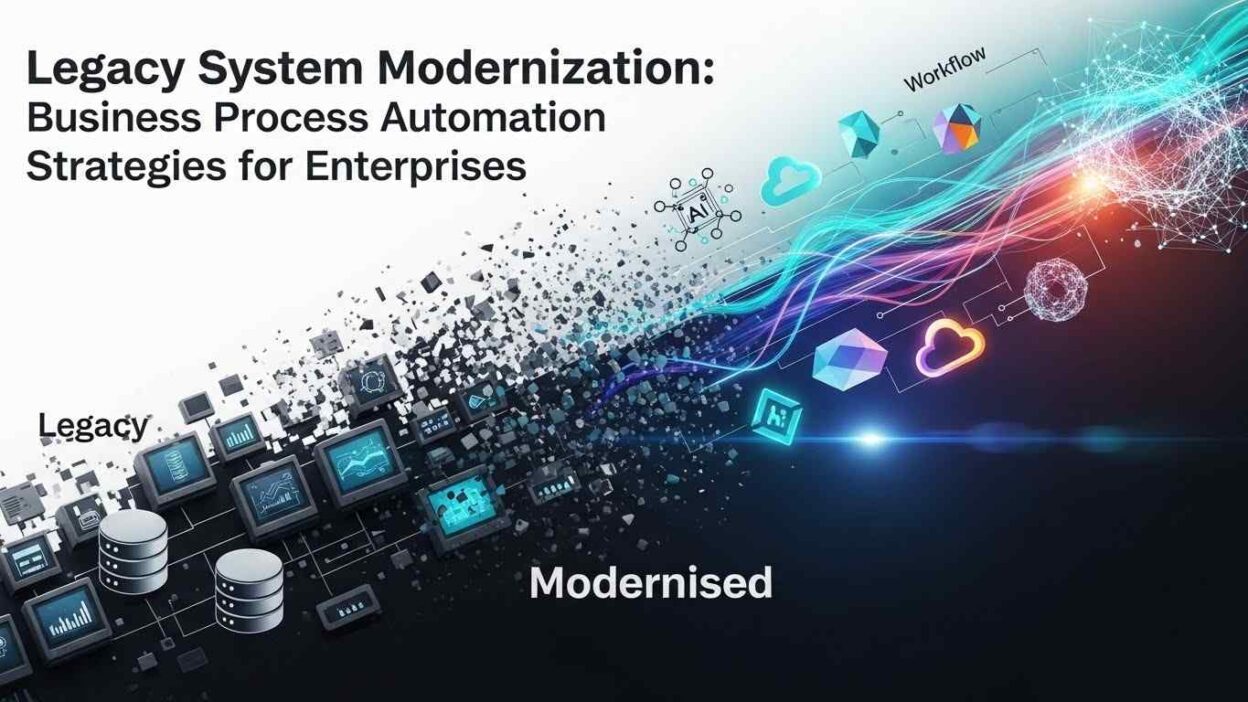
TL;DR Your enterprise runs on systems built decades ago. These legacy platforms keep the lights on. They process millions of transactions daily. They hold years of critical business data.
Everything works until it doesn’t. Maintenance costs climb every year. Finding developers who understand outdated code becomes impossible. Security vulnerabilities multiply. Competitors move faster with modern technology.
Business process automation strategies for enterprises start with confronting this reality. You can’t rip out legacy systems overnight. You can’t afford to keep running them unchanged either. You need a practical path forward.
Modern automation transforms how enterprises operate. Manual workflows disappear. Data flows seamlessly between systems. Employees focus on strategic work instead of repetitive tasks. Customer experiences improve dramatically.
The challenge lies in connecting old and new. Your legacy systems contain decades of business logic. Your data lives in proprietary formats. Your teams depend on familiar interfaces. Any modernization must preserve what works while fixing what doesn’t.
Smart enterprises take a measured approach. They identify high-value automation opportunities. They build bridges between legacy and modern platforms. They deliver results quickly while planning for long-term transformation.
The cost of inaction keeps growing. Legacy technical debt compounds annually. Your competitors gain ground with every passing quarter. Your best talent gets frustrated with outdated tools and leaves.
This guide explores proven business process automation strategies for enterprises facing legacy modernization. You’ll learn how to assess your current state honestly. You’ll discover practical approaches that minimize risk. You’ll see how to deliver value during the transformation journey.
Table of Contents
Understanding the Legacy System Challenge
Most enterprise systems entered production 15 to 30 years ago. Developers wrote code in COBOL or legacy versions of Java. Databases run on mainframes or outdated server infrastructure. Documentation exists only in the heads of retiring employees.
These systems weren’t designed for today’s business needs. They assumed paper-based workflows. They expected batch processing overnight. They never anticipated mobile access or real-time analytics. They served a different era completely.
Your business has evolved around these constraints. You’ve hired armies of people to bridge gaps manually. Teams copy data from one system to another. Employees work weekends processing batch jobs. Everyone accepts limitations that shouldn’t exist.
The human cost runs deeper than most executives realize. Your IT team spends 70-80% of its budget maintaining legacy systems. They have little time or resources for innovation. Talented engineers leave for companies with modern technology stacks. Knowledge walks out the door daily.
Security risks multiply constantly. Legacy systems receive few updates. Vendors stop supporting old platforms. Vulnerabilities remain unpatched for years. Every breach could expose customer data or critical business operations.
Integration becomes progressively harder. Modern SaaS applications expect RESTful APIs. Legacy systems use proprietary protocols or file transfers. Connecting new tools requires expensive custom development. Your technology stack becomes more fragmented over time.
Business process automation strategies for enterprises must address these realities head-on. You can’t ignore legacy systems. You can’t replace them instantly. You need intelligent approaches that work with what you have while building toward what you need.
The Business Case for Modernization and Automation
Finance departments see only the cost of modernization projects. They miss the enormous hidden costs of maintaining legacy systems. The total picture tells a different story.
Legacy maintenance consumes shocking amounts of money. Companies spend $300 billion annually maintaining outdated systems. Your organization likely dedicates 60-75% of IT budget to keeping existing systems running. That percentage grows every year as systems age.
Opportunity cost dwarfs direct maintenance expenses. Every hour spent on legacy system support is an hour not spent on innovation. Your competitors build new capabilities while you patch old code. Market share erodes slowly but steadily.
Employee productivity suffers dramatically. Workers spend hours on manual data entry. They wait for overnight batch processes to complete. They work around system limitations daily. These inefficiencies compound across thousands of employees.
Customer experience degrades relative to modern standards. Your clients expect instant account updates. They want mobile access to everything. They demand personalized interactions. Legacy systems can’t deliver these experiences easily.
Risk exposure increases constantly. Data breaches cost enterprises an average of $4.5 million per incident. Legacy systems with known vulnerabilities represent massive liability. Compliance violations bring regulatory fines and reputation damage.
Revenue growth gets constrained by technical limitations. You can’t launch new products quickly. You can’t expand into new markets easily. You can’t respond rapidly to competitive threats. Technology becomes a business bottleneck instead of an enabler.
Business process automation strategies for enterprises deliver measurable returns. Companies implementing comprehensive automation see 30-50% reduction in process cycle times. They achieve 25-40% cost savings in operations. They reduce errors by 70-90% in automated workflows.
The investment pays for itself remarkably quickly. Most automation projects achieve positive ROI within 18-24 months. The benefits compound for years afterward. Every dollar spent on smart modernization returns multiples over time.
Core Components of Enterprise Automation Strategy
Process Discovery and Assessment
You can’t automate what you don’t understand. Most enterprises have limited visibility into their actual operational processes. Systems documentation is outdated or missing. Tribal knowledge lives with long-tenured employees.
Start by mapping current state workflows completely. Document every step in critical business processes. Identify handoffs between systems and people. Note where delays typically occur and why.
Process mining tools provide unprecedented visibility. They analyze transaction logs from existing systems. They create visual maps of how work actually flows. They reveal bottlenecks and inefficiencies you never knew existed.
Talk to people doing the work daily. They understand friction points intimately. They know which workarounds everyone uses. They can explain why certain steps exist. Their insights prove invaluable for automation planning.
Measure baseline performance metrics carefully. Current processing times. Error rates. Cost per transaction. Customer satisfaction scores. These numbers let you prove improvement later.
Prioritize processes based on multiple factors. Volume matters significantly. High-frequency processes yield bigger savings. Pain level drives user adoption. Breaking obvious problems builds momentum. Technical complexity affects implementation timeline. Balance quick wins with strategic impact.
Integration Architecture Design
Legacy systems weren’t built to talk with other applications. Modern automation requires seamless data flow. You need architectural patterns that bridge old and new technologies.
API wrappers provide the most elegant solution. They expose legacy functionality through modern interfaces. New applications consume these APIs without touching old code directly. This approach protects investments while enabling innovation.
Enterprise service buses coordinate communication between disparate systems. They handle data transformation and routing. They provide monitoring and error handling. They create flexibility for future changes.
Middleware platforms specialize in connecting legacy and modern systems. They support dozens of protocols and data formats. They include pre-built connectors for common applications. They reduce custom development dramatically.
Database replication keeps critical data synchronized. Changes in legacy systems propagate to modern platforms. Analytics run against replicated data without impacting production. Real-time integration becomes possible without rearchitecting core systems.
Business process automation strategies for enterprises succeed or fail based on integration quality. Fragile connections create ongoing maintenance nightmares. Robust integration architecture enables sustainable automation at scale.
Automation Technology Selection
The automation technology landscape offers overwhelming choices. Robotic Process Automation. Business Process Management platforms. Low-code development tools. Artificial intelligence solutions. Each serves different purposes.
RPA tools automate repetitive tasks at the user interface level. They interact with applications the same way humans do. They work well for processes that span multiple systems. They require no changes to underlying applications.
BPM platforms orchestrate complex workflows across systems and people. They provide visual process design tools. They include rules engines for decision logic. They offer analytics and optimization capabilities.
Low-code platforms accelerate application development dramatically. Business analysts build functional applications without traditional programming. Citizen developers solve departmental problems independently. IT teams deliver projects in weeks instead of months.
AI and machine learning add intelligence to automation. Natural language processing handles unstructured data. Computer vision extracts information from documents. Predictive models make smart recommendations automatically.
Choose technologies based on your specific needs. Simple repetitive tasks need RPA. Complex workflows require BPM. Custom applications benefit from low-code. Intelligent automation demands AI capabilities.
Most enterprises need multiple technologies working together. RPA bots might extract data. BPM platforms orchestrate overall workflows. AI models make decisions. Low-code applications provide user interfaces. The key is making these pieces work together seamlessly.
Change Management and Training
Technology implementation represents only half the modernization challenge. Getting people to embrace new ways of working determines ultimate success or failure.
Resistance emerges from legitimate concerns. Employees worry automation threatens their jobs. They’ve invested years mastering current systems. Change feels risky and uncomfortable. Their skepticism deserves respect and thoughtful response.
Involve affected employees early in the process. Let them help design automated workflows. Incorporate their feedback meaningfully. Turn potential critics into automation champions. Their endorsement influences colleagues powerfully.
Communicate transparently about automation goals. Explain how it helps people do better work. Show what employees gain from automation. Address job security concerns directly and honestly. Share the vision for how roles will evolve.
Provide comprehensive hands-on training. People resist systems they don’t understand. Lab environments let employees practice safely. Documentation supports learning at individual pace. Ongoing support builds confidence over time.
Celebrate early wins publicly and enthusiastically. Share specific examples of how automation helped. Recognize employees who embraced new approaches. Build momentum through visible success stories. Cultural change happens through accumulated small victories.
Proven Modernization Approaches
Strangler Fig Pattern
The strangler fig pattern takes its name from a natural phenomenon. Fig plants grow around host trees gradually. They eventually replace the original tree completely. The same principle applies to legacy system replacement.
Start by identifying discrete functions within legacy systems. Customer lookup. Order processing. Inventory management. Payment handling. Each represents a potential modernization target.
Build new microservices that replicate specific legacy functions. Deploy them alongside existing systems. Route some traffic to new services while legacy handles the rest. Gradually increase the percentage of requests going to modern components.
This incremental approach minimizes risk dramatically. You can roll back immediately if problems arise. Business operations continue normally throughout the transition. Teams learn and adapt gradually rather than facing big-bang disruption.
Business process automation strategies for enterprises often favor this pattern. It delivers value continuously throughout multi-year transformations. You’re never stuck in a lengthy implementation with no benefits. Modern capabilities expand steadily over time.
API-First Modernization
Legacy systems contain valuable business logic accumulated over decades. Rewriting that logic from scratch wastes time and introduces bugs. API-first approaches preserve existing functionality while enabling modern integration.
Wrap legacy systems with RESTful API layers. These interfaces expose core capabilities through standard protocols. Modern applications consume legacy functions without touching old code. The API layer becomes your innovation platform.
Start with high-value business capabilities. Customer account management. Product catalog access. Order placement. Payment processing. Expose these through well-designed APIs first.
Document APIs thoroughly for internal developers. Include authentication requirements. Provide example requests and responses. Explain error handling and rate limits. Good documentation accelerates adoption dramatically.
Build an API management layer for governance and security. Control who can access each API. Monitor usage patterns and performance. Implement rate limiting and throttling. Protect legacy systems from overload.
New automation initiatives consume these APIs rather than integrating directly with legacy systems. You can eventually replace legacy implementations without impacting consuming applications. The API contract remains stable even as underlying systems change.
Data-First Strategy
Many legacy modernization failures stem from data problems. Enterprises underestimate the complexity of decades of accumulated information. Data quality issues surface late in projects and derail timelines.
Tackle data challenges proactively before automation implementation. Inventory what data exists across legacy systems. Identify authoritative sources for critical entities. Document relationships and dependencies between data elements.
Clean historical data systematically. Deduplicate customer records. Standardize address formats. Validate against known good sources. This unglamorous work pays enormous dividends later.
Create a unified data model that represents your business clearly. Define standard entities and attributes. Establish naming conventions. Document business rules and constraints. This model guides all integration and automation efforts.
Implement master data management for critical business entities. Customers. Products. Vendors. Employees. Locations. Maintain golden records that serve as single source of truth. Synchronize this master data to all consuming systems.
Build data pipelines that move information efficiently. Extract data from legacy systems regularly. Transform it to match your unified model. Load it into modern data platforms. Enable analytics and automation on clean, reliable data.
Business process automation strategies for enterprises depend fundamentally on data quality. Automating processes that work with bad data just spreads errors faster. Invest in data foundations before scaling automation broadly.
Hybrid Cloud Architecture
Most enterprises can’t move everything to the cloud immediately. Regulatory requirements keep certain data on-premises. Performance needs demand local processing. Risk management suggests gradual migration.
Design hybrid architectures that span on-premises and cloud environments. Legacy systems remain in your data center initially. New applications and services deploy to the cloud. Secure connections link the two environments seamlessly.
Use cloud-based integration platforms as the connective tissue. They run in the cloud but connect to on-premises systems securely. They provide scalability without infrastructure investment. They enable modern automation capabilities immediately.
Move appropriate workloads to the cloud progressively. Development and testing environments go first. Non-critical applications follow. Mission-critical systems migrate last after proven success. This staged approach builds confidence and capability.
Cloud platforms offer services legacy systems could never provide. Infinite scalability. Global distribution. Advanced AI capabilities. Serverless computing. Event-driven architectures. These tools enable automation impossible with on-premises infrastructure alone.
Automating Key Enterprise Processes
Financial Operations and Accounting
Finance departments drown in manual work. Month-end closes consume entire teams. Expense reports require extensive human review. Accounts payable processing takes days. Budget variance analysis happens manually in spreadsheets.
Automate invoice processing from receipt through payment. Optical character recognition extracts data from scanned invoices. AI matches invoices to purchase orders automatically. Rules engines route exceptions for human review. Payment batches get created and executed without manual intervention.
Streamline expense report handling completely. Mobile apps capture receipts instantly. AI categorizes expenses automatically. Rules check for policy violations. Approvals route based on amounts and organizational hierarchy. Reimbursements process within days instead of weeks.
Accelerate financial close processes dramatically. Data collection happens continuously instead of monthly. Reconciliations run automatically when discrepancies meet thresholds. Journal entries get created based on templates and rules. Management reports generate automatically as data becomes available.
Enable real-time financial visibility throughout the organization. Dashboard surfaces key metrics continuously. Budget versus actual comparisons update hourly. Variance analysis highlights issues immediately. Forecasts refresh based on latest actuals and pipeline data.
Human Resources and Talent Management
HR teams spend countless hours on administrative tasks. Resume screening for open positions. Interview scheduling across multiple calendars. Onboarding paperwork for new hires. Benefits enrollment during open periods. Performance review coordination.
Automate candidate screening and initial assessments. AI analyzes resumes against job requirements. Chatbots conduct preliminary interviews with applicants. Automated scoring ranks candidates objectively. Only qualified candidates reach human recruiters.
Streamline interview scheduling completely. Candidates select available times from integrated calendars. Confirmation emails go to all participants automatically. Reminders reduce no-show rates. Feedback collection happens immediately after each interview.
Transform employee onboarding experiences. Welcome emails trigger on offer acceptance. Equipment orders process automatically. Account provisioning happens across all systems. Training assignments appear based on role and location. New hires feel supported from day one.
Simplify benefits administration dramatically. Chatbots answer common questions instantly. Decision support tools help employees optimize selections. Enrollment integrations eliminate manual data entry. Changes sync to payroll and insurance carriers automatically.
Supply Chain and Logistics
Supply chain operations involve massive complexity. Purchase orders flow between multiple systems. Inventory tracking happens across warehouses. Shipment coordination spans carriers and time zones. Demand forecasting requires analyzing huge datasets.
Automate procurement workflows end-to-end. Requisitions trigger based on inventory levels. AI suggests suppliers based on price and performance history. Purchase orders generate and send automatically. Receipt confirmations update inventory immediately.
Enable real-time inventory visibility across the enterprise. RFID and barcode scanning feed central systems. Stock levels update continuously. Alerts trigger when inventory falls below thresholds. Analytics predict stockouts before they occur.
Optimize logistics operations intelligently. AI determines optimal shipping methods based on cost and urgency. Carrier integration provides live tracking updates. Delivery confirmations update customer systems automatically. Exception handling routes problems to appropriate teams.
Improve demand forecasting accuracy significantly. Machine learning analyzes historical patterns. External data feeds incorporate market conditions. Collaborative planning includes supplier input. Forecasts update dynamically as conditions change.
Business process automation strategies for enterprises transform supply chains from cost centers into competitive advantages. Automation reduces operating costs while improving service levels simultaneously.
Customer Service and Support
Customer service represents a crucial brand touchpoint. Support teams handle thousands of inquiries daily. Response time impacts customer satisfaction directly. Resolution quality affects retention and loyalty. Manual processes can’t keep pace with volume.
Deploy intelligent chatbots for tier-one support. Natural language processing understands customer intent. Knowledge bases provide accurate answers instantly. Escalation logic routes complex issues to humans. Customers get help 24/7 without long wait times.
Automate ticket routing and prioritization. AI analyzes incoming requests automatically. Tickets get assigned to agents with relevant expertise. Urgent issues escalate immediately. Workload balances across the team automatically.
Enable self-service capabilities broadly. Customer portals provide account access anytime. Knowledge bases let people find answers independently. Video tutorials demonstrate common tasks. Most customers prefer solving problems themselves when possible.
Streamline case management workflows. CRM updates happen automatically based on agent actions. Follow-up tasks generate based on case type. Satisfaction surveys send at resolution. Analytics identify improvement opportunities continuously.
Measuring Success and ROI
Executives demand proof that automation investments deliver value. Vague promises about efficiency don’t justify multi-million dollar projects. You need concrete metrics that demonstrate return.
Define success criteria before starting any automation initiative. Decide what you’re trying to improve specifically. Process cycle time. Cost per transaction. Error rates. Customer satisfaction. Employee productivity. Set baseline measurements.
Track hard cost reductions precisely. Calculate hours eliminated by automation. Multiply by loaded labor rates. Include reduced error correction costs. Add avoided hiring due to increased capacity. These direct savings prove financial value.
Measure process improvements quantitatively. Compare before and after cycle times. Calculate throughput increases. Document error rate reductions. Track customer satisfaction changes. These metrics show operational impact.
Calculate opportunity cost recovery. Estimate how freed employee time gets redeployed. Value of innovation projects now possible. Revenue from faster time-to-market. Strategic initiatives previously unaffordable. These benefits often exceed direct savings.
Monitor automation adoption rates carefully. Low adoption indicates user experience problems. High usage validates your design decisions. Usage patterns reveal optimization opportunities. Track metrics continuously rather than just at launch.
Business process automation strategies for enterprises must deliver measurable results. Projects without clear metrics struggle to maintain funding and support. Build measurement into every automation initiative from the start.
Common Pitfalls and How to Avoid Them
Underestimating Complexity
Most enterprises dramatically underestimate modernization difficulty. Surface-level process maps miss hidden complexity. Legacy system dependencies surprise teams mid-project. Data quality issues emerge late and derail timelines.
Invest heavily in discovery before committing to approaches. Map processes in excruciating detail. Interview long-tenured employees who know the exceptions. Test data quality assumptions thoroughly. Build extra time into your project plans.
Start with smaller scoped pilots rather than enterprise-wide programs. Learn on contained projects with limited blast radius. Apply lessons to subsequent phases. Scale gradually as capability matures. Patience delivers better results than aggressive timelines.
Ignoring Cultural Resistance
Technology teams often dismiss cultural challenges. They assume good solutions sell themselves. They underinvest in change management. Projects deliver technically but fail to achieve adoption.
Treat change management as equally important to technical implementation. Dedicate resources specifically to user adoption. Communicate constantly throughout the project. Involve users in design decisions. Celebrate wins publicly and frequently.
Address job security concerns directly and honestly. Explain how automation changes roles rather than eliminating them. Show career paths for employees willing to adapt. Provide retraining for new responsibilities. Treat people with dignity throughout transitions.
Over-Reliance on Single Vendor
Vendor lock-in creates long-term strategic risk. Single-vendor approaches limit flexibility. Pricing power shifts to the vendor over time. You become hostage to their roadmap and priorities.
Design architectures that maintain vendor independence. Use standard protocols and open APIs. Avoid proprietary languages and formats. Build abstraction layers that hide vendor specifics. Plan exit strategies before selecting vendors.
Diversify technology stack across multiple providers. Different vendors excel at different capabilities. Best-of-breed approach maximizes functionality. Multiple relationships provide negotiating leverage. Portfolio approach manages risk better than single bets.
Skipping Data Governance
Many automation projects ignore data management fundamentals. They assume data quality improves automatically. They don’t establish ownership and accountability. Chaos results as systems multiply.
Establish data governance before scaling automation broadly. Define data owners for critical entities. Set quality standards and measurement. Implement master data management. Create processes for ongoing data stewardship.
Build data quality checks into automated workflows. Validate inputs against business rules. Flag anomalies for human review. Prevent garbage data from propagating. Monitor data quality metrics continuously.
The Path Forward
Legacy system modernization represents a multi-year journey for most enterprises. You can’t complete it overnight. You can’t afford to delay starting either. The competitive landscape demands action now.
Begin with clear-eyed assessment of your current state. Document what systems you have. Understand their limitations honestly. Identify the most painful problems. Prioritize based on business impact and technical feasibility.
Develop a phased roadmap that delivers value continuously. Quick wins in the first 90 days build momentum. Meaningful capabilities emerge within six months. Strategic transformation unfolds over several years. Each phase funds the next through realized benefits.
Business process automation strategies for enterprises succeed through pragmatic execution. Perfect plans matter less than consistent progress. Learning and adapting beats rigid adherence to original designs. Results speak louder than intentions.
Build organizational capability deliberately. Train existing employees on new technologies. Hire expertise where gaps exist. Partner with vendors and integrators strategically. Develop internal automation practices and standards.
Celebrate progress publicly throughout the journey. Share metrics showing improvement. Recognize teams delivering results. Tell stories about problems solved. Cultural momentum builds through accumulated wins.
Stay focused on business outcomes rather than technology for its own sake. Every automation initiative should solve real business problems. Every system modernization should enable better customer experiences or lower costs. Technology serves business strategy.
Frequently Asked Questions
What are business process automation strategies for enterprises?
Business process automation strategies for enterprises involve systematic approaches to modernizing operations through technology. These strategies combine process redesign, technology implementation, data management, and change management to automate manual workflows and modernize legacy systems at scale.
How long does enterprise legacy system modernization typically take?
Complete legacy modernization usually requires three to five years for large enterprises. Small projects delivering initial value can complete in three to six months. The key is phased approaches that deliver continuous benefits while working toward comprehensive transformation.
What is the average cost of automating enterprise business processes?
Costs vary dramatically based on scope and approach. Simple RPA implementations might cost $50,000 to $200,000. Comprehensive automation programs spanning multiple departments can require $5 million to $50 million over several years. Most enterprises see positive ROI within 18-24 months of initial investment.
Should we replace legacy systems completely or wrap them with APIs?
API wrapping usually provides faster value with lower risk than complete replacement. It preserves existing business logic while enabling modern integration. Complete replacement makes sense when systems are truly obsolete or when licensing costs make maintenance economically unfeasible.
How do we prioritize which processes to automate first?
Prioritize based on business impact, technical feasibility, and organizational readiness. High-volume repetitive processes yield biggest savings. Painful manual workflows drive user enthusiasm. Processes with clear inputs and outputs automate most easily. Balance quick wins with strategic importance.
What skills do we need internally to manage enterprise automation?
Key skills include business process analysis, integration architecture, automation platform expertise, data management, and change management. Many enterprises partner with consultants initially while building internal capabilities. Cross-functional teams work better than pure IT initiatives.
How do we handle data migration from legacy systems?
Plan data migration carefully with extensive discovery. Clean data before moving it. Build validation checkpoints throughout. Migrate in phases rather than big-bang approaches. Run legacy and new systems parallel during transition periods to verify accuracy.
Can we automate processes that span multiple legacy systems?
Absolutely. RPA excels at automating cross-system workflows. Integration platforms connect disparate applications. BPM tools orchestrate complex processes across boundaries. The key is good architecture that handles data transformation and error scenarios.
How do we measure ROI from automation investments?
Track hard cost savings from reduced labor and errors. Measure process improvements in cycle time and throughput. Calculate opportunity value from freed employee capacity. Monitor customer satisfaction changes. Build comprehensive business cases that capture all benefit categories.
What happens to employees whose jobs get automated?
Most enterprises redeploy employees to higher-value work rather than eliminating positions. Automation removes tedious tasks that frustrate workers. People move into roles requiring human judgment and creativity. Provide retraining and support throughout transitions to ease fears.
Read More:-How AI Automation for Small Businesses Drives Productivity and Cost Savings
Conclusion

Legacy systems represent both your greatest asset and biggest liability. They contain decades of business logic and critical data. They also constrain growth and innovation severely. The path forward requires balancing preservation with transformation.
Business process automation strategies for enterprises provide the framework for successful modernization. They enable you to automate manual workflows while gradually replacing outdated systems. They deliver continuous value throughout multi-year journeys. They manage risk through incremental approaches.
The business case for action grows stronger daily. Legacy maintenance costs increase every year. Security risks multiply continuously. Competitive pressure intensifies as others modernize. The cost of inaction exceeds the cost of transformation significantly.
Success requires more than technology implementation. You need clear strategy and phased roadmaps. You need organizational commitment and adequate resources. You need change management as much as technical expertise. You need patience and persistence over years.
Start with honest assessment of your current situation. Map processes thoroughly. Understand system dependencies. Evaluate data quality. Prioritize opportunities based on impact and feasibility. Build realistic plans that account for complexity.
Choose automation approaches that fit your specific context. API wrappers preserve legacy investments. RPA automates cross-system workflows. BPM orchestrates complex processes. Low-code accelerates development. AI adds intelligence. Most enterprises need multiple technologies working together.
Invest in integration architecture that enables flexibility. Build on standard protocols and open APIs. Create abstraction layers that hide vendor specifics. Design for evolution rather than static end states. Your needs will change as you learn.
Treat people as importantly as technology throughout. Involve employees in design decisions. Communicate transparently about changes and concerns. Provide comprehensive training and support. Celebrate wins publicly and frequently. Cultural transformation determines ultimate success.
Measure progress rigorously with concrete metrics. Track cost reductions precisely. Monitor process improvements quantitatively. Calculate opportunity value from freed capacity. Prove value continuously to maintain funding and support.
Your competitors are already on this journey. Some are further along than you realize. The gap widens with every passing quarter. Catching up becomes harder over time. The moment to start is now.
Business process automation strategies for enterprises transform legacy burdens into competitive advantages. They free your people to do their best work. They enable customer experiences that delight and retain. They create sustainable economic models for growth.
The journey will challenge you. You’ll encounter unexpected complexity. You’ll face resistance and setbacks. You’ll question decisions and adjust approaches. This is normal and expected. Persistence through difficulty separates winners from those who give up.
Your enterprise has survived and thrived for decades. You’ve adapted to countless changes before. This transformation represents your next evolution. Embrace it with confidence grounded in realistic planning. Execute with discipline and flexibility. The future belongs to enterprises that modernize successfully.