Introduction
TL;DR Modern businesses face a challenging dilemma. Their legacy systems run critical operations daily. These platforms store decades of valuable business data. Employees understand these systems deeply.
Yet these older systems create serious bottlenecks. They can’t scale to meet growing demands. Integration with modern tools seems nearly impossible. Manual workarounds consume countless employee hours.
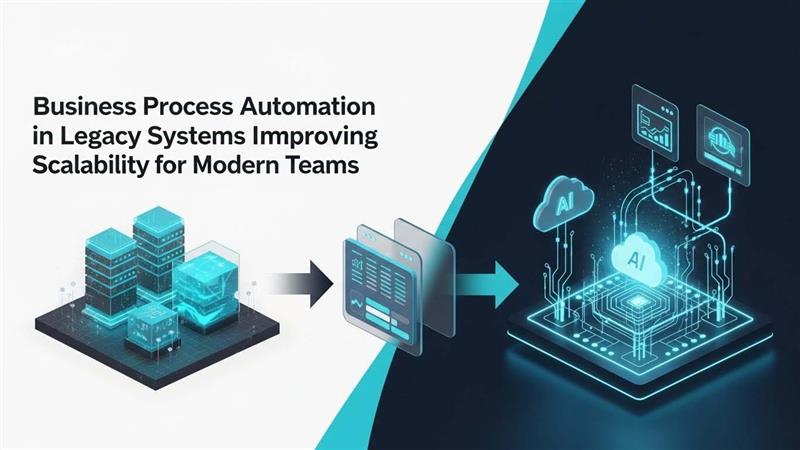
Business process automation in legacy systems provides a breakthrough solution. You modernize operations without replacing entire platforms. Automation bridges old infrastructure with new capabilities. Your teams gain efficiency while keeping institutional knowledge intact.
The transformation happens strategically and gradually. You preserve systems that work reliably. Smart automation extends platform lifespans significantly. Scalability becomes achievable where it seemed impossible before.
Table of Contents
Why Legacy Systems Still Dominate Business Operations
Legacy systems power the majority of large enterprises today. Banks run on mainframes from the 1970s and 1980s. Manufacturing facilities use control systems installed decades ago. Insurance companies process claims through platforms built before smartphones existed.
These systems aren’t failing exactly. They handle transactions reliably every single day. They’ve proven stability through years of continuous operation. They contain business logic refined through countless iterations and improvements.
Complete system replacement sounds appealing in theory. The reality proves far more complex and risky. Replacement projects routinely fail or exceed budgets dramatically. Business disruption during transitions can devastate operations completely.
Organizations find themselves trapped between two bad options. They can continue struggling with outdated limitations. They can risk everything on uncertain replacement projects. Neither choice offers guaranteed success or reasonable risk.
Business process automation in legacy systems creates a third path forward. Modern automation tools work alongside existing infrastructure. They enhance capabilities without requiring dangerous full replacements. Organizations gain modern functionality while preserving stable cores.
The True Cost of Maintaining Legacy Infrastructure
Maintenance expenses escalate steadily as systems age. Finding developers who understand ancient programming languages becomes increasingly difficult. COBOL programmers command premium rates despite the language being decades old. Training new staff requires months or even years of investment.
Technical debt accumulates silently over time. Quick fixes layer upon previous shortcuts. Documentation disappears or becomes hopelessly outdated. Knowledge exists only in the minds of employees nearing retirement. Organizations face knowledge loss crises regularly.
Manual processes fill gaps where legacy systems fall short consistently. Employees export data into spreadsheets for basic analysis. They rekey information between systems that refuse to communicate. They perform calculations the old platforms simply cannot handle. These workarounds waste dozens of hours weekly across teams.
Security vulnerabilities multiply as systems age without modern protections. Older platforms lack encryption and authentication features considered standard today. Patching becomes risky when any change might break critical functionality. Compliance requirements designed for current technology don’t map to legacy architectures.
Customer experience degrades relative to rising modern expectations. Response times feel glacially slow compared to mobile apps. User interfaces confuse customers accustomed to intuitive design. Limited self-service options force phone calls for simple tasks. Poor experiences drive business toward more technologically advanced competitors.
Understanding Why Complete Replacement Usually Fails
System replacement projects promise dramatic improvements and modern capabilities. Vendor demonstrations look impressive and compelling. Executive teams approve large budgets enthusiastically. Everyone expects transformation within reasonable timeframes.
Reality crushes these optimistic expectations regularly. Industry studies show replacement projects fail at alarming rates. Sixty to seventy percent exceed budgets significantly or fail completely. The reasons repeat across industries and organizations predictably.
Business complexity always exceeds initial estimates by substantial margins. Legacy systems contain decades of accumulated business rules and exceptions. Many rules exist nowhere except buried in old code. Requirements documentation disappeared years ago or never existed. Understanding everything the current system actually does takes far longer than anyone anticipates.
Data migration creates challenges that derail entire projects. Years of information must transfer with perfect accuracy. Data quality problems surface that nobody knew existed previously. Format conversions introduce subtle errors that compound over time. Validating migration completeness proves nearly impossible in practice.
User resistance intensifies as reality diverges from promises. New systems work differently from familiar processes. Learning curves frustrate experienced employees who were productive before. Productivity drops during transitions instead of improving. Employee satisfaction plummets rather than rising.
Business disruption during cutover carries catastrophic potential. The moment you switch from old to new system represents maximum risk. Problems cannot simply reverse by switching back to old systems. Transactions processed during failures may vanish completely. Customers experience service failures at the absolute worst possible moments.
How Business Process Automation Transforms Legacy Operations
Automation provides a practical middle path between acceptance and replacement. Business process automation in legacy systems extends capabilities without requiring full rebuilds. Modern tools work alongside existing infrastructure harmoniously.
The strategy focuses on automating processes rather than replacing underlying systems. You preserve the stable and reliable core platforms. You add automation layers that dramatically enhance functionality. Results combine legacy reliability with modern capabilities seamlessly.
Integration technology has advanced tremendously in recent years. APIs enable connections between previously incompatible systems. Robotic process automation mimics human interactions with legacy interfaces. Data pipelines move information between old and new platforms continuously. Technologies make integration achievable where it once seemed completely impossible.
Key Automation Technologies Enabling Legacy Modernization
Robotic process automation revolutionizes interaction with older systems completely. Software robots navigate legacy interfaces exactly as human users do. They log into systems and enter data precisely. They click buttons and extract information systematically. Legacy systems experience no difference between robot and human interactions.
RPA eliminates tedious data entry that consumed employee hours daily. Robots work around the clock without breaks or vacations. They process information faster than humans could ever achieve. They maintain perfect consistency across thousands of daily transactions. Employees redeploy to higher-value work requiring human judgment and creativity.
API integration connects legacy platforms to modern cloud services. Middleware platforms translate between incompatible protocols and formats. Data flows bidirectionally keeping multiple systems perfectly synchronized. Real-time integration replaces slow batch processing and manual file transfers.
Low-code automation platforms democratize process improvement across organizations. Business analysts create powerful automations without writing traditional code. Visual workflow designers make complex logic accessible to non-programmers. Templates provide solid starting points for common business processes. Organizations build automation capabilities without massive IT department investments.
Event-driven architecture enables truly responsive automated operations. Actions in legacy systems trigger immediate automated workflows elsewhere. Completed transactions automatically kick off downstream fulfillment processes. Account changes trigger instant notifications to relevant team members. Systems become proactive instead of purely reactive.
Cloud integration platforms connect legacy systems to modern services seamlessly. They handle protocol translation and complex data format conversion. They manage security and authentication across system boundaries. They provide comprehensive monitoring and sophisticated error handling. Legacy platforms gain access to cloud AI and analytics without direct integration work.
Immediate Benefits Your Teams Will Experience
Response times decrease dramatically when automation handles routine tasks. Customer inquiries receive instant answers from automated systems. Order processing completes in minutes instead of hours or days. Reports generate on demand rather than requiring days of manual preparation. Speed becomes a genuine competitive advantage instead of a persistent limitation.
Error rates plummet as automation eliminates manual data handling completely. Robots never transpose numbers or misread handwritten information. Validation rules enforce data quality automatically at entry points. Errors get caught immediately instead of surfacing weeks later. Quality improves substantially while expensive rework decreases proportionally.
Business process automation in legacy systems improves employee satisfaction measurably. Nobody enjoys tedious data entry or navigating confusing legacy interfaces. Automation handles these universally frustrating tasks completely. Employees focus on interesting problems requiring genuine human creativity. Job satisfaction increases noticeably when automation eliminates pure drudgery.
Operational costs decrease as automation replaces repetitive manual labor. Single automation handles work previously requiring multiple full-time employees. Labor costs drop significantly while output volume increases steadily. Savings typically exceed automation implementation costs within just months. Ongoing cost reductions continue accumulating year after year.
Compliance becomes dramatically easier to maintain and demonstrate convincingly. Automation enforces required procedures with perfect consistency. Audit trails capture every single action automatically. Required documentation generates without tedious manual compilation. Regulatory reporting happens accurately and on schedule reliably. Compliance costs and organizational risks both decrease substantially.
Customer experience improves dramatically with faster service and fewer errors. Customers access information through intuitive modern self-service portals. They receive instant confirmations and proactive status updates. Problems get identified and resolved much faster than before. Satisfaction scores increase measurably as overall experience improves.
Strategic Implementation for Maximum Impact
Success requires careful strategy rather than random automation of easy tasks. Understanding your current operational state enables smart prioritization. Clear goals guide every implementation decision effectively. Proper planning prevents common pitfalls that derail automation initiatives.
Mapping Your Legacy System Landscape
Begin by documenting all legacy systems and their specific roles. Which platforms handle which critical business functions? How do these systems connect and communicate currently? What manual processes bridge gaps between disconnected systems? Where do bottlenecks occur most regularly? Comprehensive understanding informs truly effective automation strategy.
Identify the most painful processes consuming disproportionate time and resources. Survey employees extensively about their daily frustrations and challenges. Review help desk tickets for patterns and recurring issues. Analyze where errors occur most frequently across operations. These documented pain points become your top automation priorities.
Evaluate technical accessibility for each specific legacy system. Can you interact programmatically through APIs or database access? Does the system require screen-scraping through RPA tools? What documentation exists about actual system functionality and behavior? Technical constraints significantly influence which automation approaches work best.
Assess data quality in legacy systems with brutal honesty. Automation amplifies existing data problems rather than fixing them. Poor quality data inevitably leads to poor automation results. Plan thorough data cleansing before or during automation implementation. Clean data enables reliable and trustworthy automated processes.
Map complete information flows between systems and departments carefully. Where does critical data originate in your operations? How does it move through your entire organization? What transformations occur during these movements? Understanding current flows reveals automation opportunities and integration requirements.
Document business rules embedded in manual processes that employees perform. Workers often execute steps they understand intuitively but never documented formally. These unwritten rules must surface before successfully automating processes. Missing rules cause automated processes to fail in unexpected edge cases.
Prioritizing Automation Opportunities Strategically
Not every process deserves immediate automation investment and effort. Some deliver enormous value very quickly. Others require extensive effort for disappointingly modest gains. Smart prioritization maximizes your return on automation investment.
Calculate potential time savings for each candidate process accurately. How many hours weekly does this process currently consume? How much could automation realistically reduce this burden? Multiply savings across all employees affected by the process. Processes saving significant collective time deserve highest priority ranking.
Consider error rates and their actual business impact carefully. Some errors merely annoy people temporarily. Others cause customer churn or serious compliance violations. Automating error-prone processes delivers substantial value beyond pure time savings. Risk reduction alone often justifies automation investment completely.
Evaluate implementation complexity with complete honesty about capabilities. Simple automations deploy quickly and build organizational momentum. Complex projects bog down teams and consume excessive resources. Mix quick wins with strategic long-term initiatives thoughtfully. Early successes demonstrate clear value and secure support for larger efforts.
Business process automation in legacy systems should target high-frequency processes first. Tasks performed daily or hourly deliver far more cumulative benefit. Monthly activities provide less total value despite individual importance. Frequency multiplies the value of any efficiency improvement exponentially.
Look for processes frustrating employees or customers most intensely. Addressing these improves satisfaction beyond pure productivity metrics alone. Employee retention and customer loyalty carry tremendous value. Happy teams and satisfied customers justify automation investment clearly.
Building Your Phased Implementation Roadmap
Successful automation always happens incrementally rather than all at once. Phased approaches dramatically reduce risk and enable organizational learning. Each implementation phase delivers measurable value while informing subsequent phases.
Phase one should aggressively target quick wins demonstrating automation value. Choose processes with crystal clear pain points and measurable outcomes. Aim for complete deployment within sixty to ninety days maximum. Early success builds crucial support for continued investment and expansion.
Design automation architecture with future scalability in mind from day one. Architecture should easily accommodate adding new processes over time. Reusable components dramatically accelerate future automation development efforts. Flexible design prevents costly rebuilding as organizational needs inevitably evolve.
Plan integration points between separate automated processes very carefully. Early automations may initially operate completely independently. Eventually they’ll need sophisticated coordination and data sharing. Designing for future integration prevents expensive and disruptive rework later. Coordination enables powerful end-to-end process automation over time.
Budget adequate time for thorough testing and continuous refinement. Automation rarely works absolutely perfectly on first deployment. Edge cases surface only during actual real-world usage. Plan explicit iterative improvement cycles into your timeline. Perfect execution matters far less than steady measurable progress.
Include comprehensive training and change management from day one. Employees must thoroughly understand how automation changes their work. They need active support during potentially disruptive transitions. Clear communication about tangible benefits reduces natural human resistance. Training ensures people use automated systems effectively and confidently.
Measure results rigorously and share successes broadly across the organization. Track specific metrics established before implementation begins. Document time savings, error reductions, and cost decreases carefully. Share impressive results with all key stakeholders regularly. Proven outcomes justify expanding automation initiatives significantly.
Real-World Success Transforming Operations
Theory sounds compelling but actual results prove the concept definitively. Organizations across diverse industries achieve remarkable outcomes through business process automation in legacy systems. These concrete examples demonstrate practical applications and measurable benefits.
Regional Bank Achieves Digital Transformation
A regional bank operated on core banking systems from the early 1980s. The mainframe handled millions of transactions reliably every single day. Customers and employees hated the experience intensely despite reliability.
Account opening required three to five business days minimum. Loan approvals stretched across two to three weeks typically. Customer service representatives navigated cryptic green-screen interfaces constantly. Frustration levels reached critical points across the organization.
Complete system replacement would cost fifty million dollars conservatively. The timeline stretched to five years minimum for full deployment. Failure risk seemed unacceptably high given industry statistics. They chose business process automation in legacy systems as the alternative.
RPA automated all data entry between mainframe and modern CRM. Customer information synchronized automatically without manual intervention. Representatives viewed complete account histories through intuitive web interfaces. They never touched the confusing mainframe interface directly anymore.
Loan application processing automated completely from end to end. Applicants completed applications online through attractive modern portals. Automation extracted data and fed mainframe systems perfectly. Credit checks and fraud screening happened automatically in seconds. Approvals that required weeks now completed in mere hours.
Document management modernized completely across the entire organization. Automation extracted customer documents from the legacy mainframe. It organized everything in modern content management systems. Employees found specific documents instantly instead of searching arcane commands. Compliance documentation became straightforward rather than nightmarish.
Customer satisfaction scores increased by thirty-five points within months. Account opening time dropped from days to literal minutes. Employee turnover decreased as workplace frustration diminished substantially. The bank spent three million over eighteen months total. They achieved modernization benefits without replacement risks or massive costs.
Manufacturing Plant Optimizes Production Operations
A multinational manufacturer ran production on legacy systems from the 1990s. These platforms controlled machinery across dozens of global facilities. Systems worked reliably but lacked any modern features whatsoever.
Real-time operational visibility was completely impossible. Reporting required extensive manual data compilation weekly. Integration with supply chain partners was entirely nonexistent. Managers made decisions with outdated and incomplete information.
They implemented business process automation in legacy systems strategically. Core control systems remained completely unchanged and stable. Automation added powerful modern functionality around reliable legacy platforms.
Data extraction automated from legacy production systems continuously. Information flowed to cloud analytics platforms in actual real-time. Managers viewed production metrics through live interactive dashboards. Problems surfaced immediately instead of appearing in weekly reports. Response times improved by orders of magnitude.
Quality data from legacy inspection systems fed predictive maintenance models. Machine learning algorithms identified subtle patterns predicting equipment failures. Maintenance scheduled proactively before costly breakdowns occurred. Unplanned downtime decreased by sixty percent organization-wide. Maintenance costs dropped substantially while reliability improved.
Supply chain integration connected legacy systems to partner platforms seamlessly. Purchase orders flowed automatically to supplier systems instantly. Shipment notifications updated production schedules in real-time automatically. Inventory levels optimized automatically based on actual demand. Working capital requirements decreased significantly across operations.
Production scheduling optimized across all facilities globally simultaneously. Automation considered capacity constraints, material availability, and demand forecasts. It generated optimal schedules automatically every single day. Planners refined schedules rather than creating them from scratch. Overall equipment effectiveness improved by twenty-five percent.
The manufacturer increased total output by eighteen percent sustainably. They avoided two hundred million in planned system replacement costs. Operations gained modern capabilities while preserving reliable legacy systems. Automation investment paid back in under twelve months completely.
Healthcare Network Integrates Patient Information
A hospital network operated patient record systems from different decades. Some departments used platforms from the 1990s exclusively. Others ran on systems from the mid-2000s primarily. Nothing communicated effectively across the fragmented landscape.
Patient information existed in isolated silos throughout the network. Clinicians spent hours hunting for complete medical histories daily. Critical information often went missing during patient transfers. Safety risks increased alongside clinician frustration levels.
Complete system consolidation would cost tens of millions minimum. Implementation would dangerously disrupt patient care for extended periods. They chose automation to achieve integration without risky replacement.
Business process automation in legacy systems created unified patient views. Automation aggregated information from all legacy platforms continuously. Clinicians accessed complete records through single modern interfaces. Underlying systems remained separate but appeared fully integrated.
Lab results from legacy systems flowed automatically to physician dashboards. Doctors received instant alerts for any critical values. Results from external labs integrated seamlessly into records. Response times to critical findings improved dramatically. Patient outcomes improved measurably across quality indicators.
Appointment scheduling automated across specialties and locations completely. Patients booked appointments online through modern self-service portals. Automation checked availability across all legacy scheduling systems. Confirmations and reminders sent automatically via preferred channels. No-show rates decreased substantially saving tremendous time.
Billing integration connected clinical systems to revenue cycle platforms. Procedures documented in legacy systems triggered appropriate charges automatically. Billing accuracy improved significantly reducing revenue leakage. Days in accounts receivable decreased by double-digit percentages. Revenue capture increased significantly quarter over quarter.
Patient satisfaction scores rose by forty points within one year. Clinicians spent more time with patients and less hunting information. Administrative costs decreased while clinical quality improved measurably. The hospital network achieved integration benefits without replacement risks. Clinical quality and financial performance both improved substantially and sustainably.
Overcoming Common Implementation Obstacles
Automation initiatives face predictable challenges across organizations and industries. Understanding obstacles enables effective proactive solutions. Most problems have proven approaches from organizations succeeding before you.
Managing Technical Complexity Successfully
Legacy systems present uniquely challenging technical obstacles regularly. Documentation often disappeared many years ago completely. Original developers retired or moved to other opportunities. Modern developers lack experience with genuinely old technologies. Understanding actual system behavior requires extensive detective work.
Start with extremely thorough discovery before automating anything whatsoever. Observe carefully how employees interact with systems currently. Document every single step in existing manual processes. Identify all data sources and ultimate destinations. Map complete information flows throughout operations. Understanding current state prevents automation surprises later.
Engage employees who know legacy systems intimately and deeply. They understand undocumented quirks and unexpected system behaviors. Their institutional knowledge accelerates automation development dramatically. Their involvement significantly increases adoption chances across teams. Treat them as valuable partners rather than obstacles.
Plan explicitly for unexpected system behaviors during extensive testing. Legacy systems often have undocumented features that became accepted behavior. Automation may trigger edge cases nobody encountered in years. Extensive testing in safe non-production environments catches problems early. Issues surface before they impact actual customer operations.
Build comprehensive error handling into every single automation. Things will inevitably go wrong occasionally despite best efforts. Good error handling prevents cascading failures across systems. Detailed logging enables quick and accurate problem diagnosis. Recovery procedures minimize business disruption when problems occur.
Document everything thoroughly as you learn system behaviors. Business process automation in legacy systems creates valuable organizational knowledge. Capture system behaviors, integration patterns, and business rules carefully. Documentation helps enormously with future automation efforts. It protects against catastrophic knowledge loss when team members change.
Addressing Security and Compliance Requirements
Legacy systems frequently lack modern security features entirely. Automation adds new access points potentially creating security vulnerabilities. Security teams rightfully scrutinize automation initiatives very carefully. Addressing concerns early prevents costly delays and expensive rework.
Implement strict least-privilege access for all automated processes. Automation should access only what it genuinely needs. Avoid using powerful administrative credentials for routine automations. Segregation of duties applies equally to automated processes.
Encrypt all data moving between legacy and modern systems. Data in transit crosses network boundaries and multiple systems. Encryption protects against interception and unauthorized access. Modern integration platforms include encryption by default typically. Ensure configuration is correct and actually active.
Maintain comprehensive audit trails of all automated actions. Who authorized the specific automation originally? What changes did it make to data? When did actions occur precisely? Detailed logs satisfy compliance requirements effectively. They enable thorough investigation when problems inevitably occur.
Test security thoroughly before any production deployment whatsoever. Attempt to bypass controls or access unauthorized data actively. Engage security teams directly in testing processes. Identify vulnerabilities in safe test environments first. Fix problems before they expose real sensitive data.
Address compliance requirements explicitly in automation design from inception. Regulations like HIPAA, SOX, or GDPR impose specific requirements. Automation must enforce these requirements with perfect consistency. Automated processes often dramatically improve compliance by eliminating human errors.
Future Trends Reshaping Legacy Automation
Technology evolution continues at an accelerating pace constantly. New capabilities expand what’s possible with business process automation in legacy systems. Understanding emerging trends helps you plan future investments strategically.
Artificial Intelligence Enhancing Automation Capabilities
Artificial intelligence transforms automation capabilities in fundamental ways. Machine learning enables automations that adapt and improve continuously. AI handles unstructured data that traditional automation couldn’t process.
Natural language processing extracts information from documents and emails. Legacy systems store critical information in unstructured notes fields. AI reads these notes and extracts perfectly structured data. Information previously trapped in free text becomes analyzable and actionable.
Computer vision reads legacy system screens more reliably than traditional RPA. It understands screen content conceptually rather than relying on fragile pixel positions. Automation continues working when interfaces change slightly over time. Maintenance requirements decrease substantially reducing long-term costs.
Predictive models anticipate operational problems before they actually occur. AI analyzes complex patterns in legacy system data continuously. It identifies early warning signs humans consistently miss. Maintenance schedules proactively before expensive failures happen. Customer churn predictions enable effective retention interventions.
Intelligent document processing handles highly varied document formats automatically. Legacy systems require specific rigid document structures traditionally. AI extracts information accurately from any format variation. Invoices, purchase orders, and forms process automatically regardless of layout. Manual document handling becomes completely unnecessary.
Conversational interfaces enable natural interaction with legacy systems finally. Employees ask questions in plain everyday language. AI translates requests into cryptic legacy system commands. Information retrieves and presents in modern attractive formats. Nobody needs to learn confusing mainframe syntax anymore.
End-to-End Process Orchestration
Current automation typically handles individual isolated tasks or processes. Future automation will orchestrate complete business workflows spanning multiple systems. End-to-end automation delivers exponentially more value than point solutions.
Process mining discovers automation opportunities automatically without manual analysis. Tools analyze logs from legacy systems continuously. They map actual process flows as they really occur. They identify bottlenecks and process variations automatically. Automation opportunities surface that humans would never spot manually.
Business process automation in legacy systems will coordinate actions across platforms. Customer orders trigger orchestrated workflows spanning multiple departments. Order management, inventory, fulfillment, billing, and communication happen automatically. Each system receives required information without any human intervention. Entire processes execute flawlessly without manual touches.
Digital twins model complete business processes in software. Organizations test process changes in simulation before implementing them. They optimize workflows using actual operational data continuously. Continuous improvement happens systematically rather than intuitively. Performance increases compound over time automatically.
Automation becomes genuinely self-optimizing without human guidance. Systems monitor their own performance against targets continuously. They identify inefficiencies and adjust automatically. They A/B test variations to find optimal approaches. Improvement happens continuously without any human intervention required.
Frequently Asked Questions
What exactly is business process automation in legacy systems?
Business process automation in legacy systems uses modern automation tools to enhance older platforms. Rather than replacing legacy systems completely, automation creates connections and workflows improving functionality. RPA, integration platforms, and orchestration tools work with existing systems. They automate manual processes, integrate with modern tools, and provide modern interfaces. Organizations gain modern capabilities while preserving reliable legacy infrastructure investments.
Why should we automate instead of replacing legacy systems?
Complete replacement carries enormous cost and catastrophic risk. Replacement projects frequently fail or exceed budgets by multiples. Legacy systems contain decades of business logic and valuable data. Recreating this knowledge accurately is nearly impossible practically. Automation delivers modernization benefits at fractions of replacement cost. Organizations gain needed capabilities while preserving what works reliably.
How much does legacy system automation typically cost?
Costs vary significantly based on scope and complexity. Simple RPA automations start around ten thousand to twenty-five thousand dollars per process. Comprehensive automation programs cost one hundred thousand to five hundred thousand dollars typically. Most organizations see positive ROI within six to eighteen months. Savings from reduced manual labor exceed automation costs quickly.
How long does typical implementation take?
Timelines depend heavily on automation complexity and organizational readiness. Simple process automations deploy in four to eight weeks. Comprehensive programs require six to twelve months for full implementation. Phased approaches deliver value incrementally as you progress. Organizations see benefits from early automations while continuing expansion.
Will we eventually need to replace legacy systems?
Not necessarily in many cases. Well-maintained legacy systems with proper automation operate effectively indefinitely. Automation extends system lifecycles by many years. Some organizations operate decades-old systems successfully through smart automation. Eventually replacement may make strategic sense. Automation bridges the gap until the right time arrives.
What processes should we automate first?
Prioritize high-frequency and time-consuming processes with clear business impact. Data entry between systems offers quick wins. Report generation automation delivers immediate measurable value. Customer-facing processes improve satisfaction directly. Error-prone processes reduce costly mistakes. Choose processes where success is easily measurable.
Can automation work with any legacy system?
Most legacy systems can integrate with automation tools somehow. Systems with APIs or database access integrate easily. Systems without these capabilities require RPA or screen-scraping approaches. Some extremely old or proprietary systems present challenges. Technical assessment determines the best automation approach for your systems.
How do we maintain automated processes long-term?
Establish clear ownership and governance for each automation. Document thoroughly how automations work and what they accomplish. Monitor performance continuously against established targets. Plan regular reviews and updates proactively. Budget fifteen to twenty percent of initial costs annually. Build automation expertise internally or maintain strong vendor relationships.
What happens when legacy systems change or update?
Design automation with change tolerance from the beginning. API-based integration handles system updates better than screen-scraping. Build error handling that detects unexpected changes immediately. Maintain test environments mirroring production exactly. Test automations after system updates before production deployment. Flexible architecture minimizes rework when systems inevitably change.
How do we accurately measure automation ROI?
Track time saved on automated processes carefully. Calculate labor cost reductions from efficiency gains. Measure error rate improvements and associated cost savings. Monitor customer satisfaction changes over time. Document compliance risk reductions. Compare these benefits to total costs including development and maintenance. Most organizations achieve two hundred to four hundred percent ROI.
Read More:-Complete Guide to CRM Automation Powered by AI for Real Estate Businesses to Scale Conversions
Conclusion

Legacy systems will remain operational reality for most organizations indefinitely. Complete replacement carries excessive cost and unacceptable risk. Living with severe limitations constrains business growth and competitiveness. Business process automation in legacy systems provides the essential third path.
Modern automation technology bridges the gap between old infrastructure and new capabilities. RPA interacts with systems lacking modern APIs. Integration platforms connect incompatible technologies seamlessly. Orchestration coordinates processes across multiple isolated systems. Modern interfaces hide legacy complexity from frustrated users.
The benefits transform operations substantially and measurably. Manual processes automate completely. Information flows seamlessly between previously disconnected systems. Employees work through intuitive interfaces instead of cryptic legacy screens. Customers experience modern service despite aging backend systems. Scalability improves dramatically without replacing core infrastructure.
Implementation requires careful strategy rather than random automation efforts. Assess your current environment thoroughly and honestly. Prioritize processes delivering maximum measurable value. Build expertise gradually through phased careful deployment. Measure results rigorously and refine continuously. Success comes through systematic approaches.
Organizations across diverse industries prove the value proposition repeatedly. Banks modernize customer experience without replacing core banking systems. Manufacturers optimize production while preserving reliable control systems. Healthcare organizations integrate patient data without consolidating disparate platforms. Business process automation in legacy systems delivers results across all sectors.
Technology continues advancing at an accelerating pace. AI enhances automation capabilities exponentially. Cloud platforms simplify integration dramatically. Low-code tools democratize development across organizations. Future automation will accomplish what seems impossible today. Organizations starting now position themselves for continued evolution.
Your legacy systems contain tremendous accumulated value. Decades of business logic and data represent irreplaceable institutional knowledge. Replacing everything entirely wastes assets while creating risks. Smart automation preserves what works while adding modern capabilities. You gain the best of both worlds practically.
The competitive landscape demands continuous modernization. Customer expectations rise relentlessly. Competitors leverage modern technology advantages aggressively. Manual processes cannot keep pace anymore. Standing still means falling behind competitors. Automation provides the sustainable path forward.
Start planning your automation journey immediately. Identify your most problematic legacy system limitations. Research automation approaches appropriate for your specific environment. Define what success looks like specifically for your organization. Take the first step toward transforming operations while preserving technology investments.