Introduction
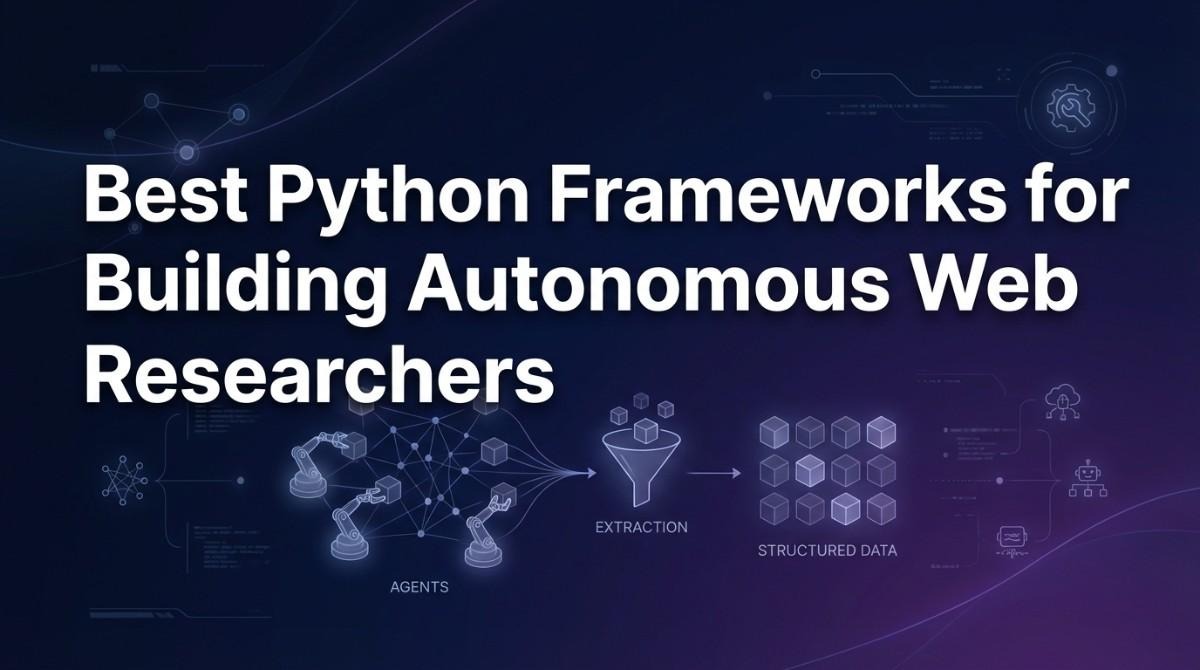
TL;DR Web research used to mean hours of manual browsing, copying, and summarizing. That model is obsolete. Developers now build autonomous agents that search the web, extract information, synthesize findings, and deliver structured reports without human involvement at every step. Choosing the best Python frameworks for autonomous web researchers determines how fast you ship, how reliable your agents perform, and how far you can scale. This guide breaks down every major option, compares them honestly, and helps you pick the right stack for your specific project.
Table of Contents
What Makes a Web Research Agent Autonomous?
An autonomous web researcher does more than scrape a webpage. It understands a research goal. It decides which sources to visit. It evaluates source quality. It extracts relevant information. It synthesizes across multiple sources. It formats the output for downstream use. Each of these steps requires reasoning, not just execution.
Python is the dominant language for building these systems. The AI and web tooling ecosystems in Python are unmatched. LLM integrations, web scraping libraries, browser automation tools, and vector databases all have mature Python support. The best Python frameworks for autonomous web researchers build on this ecosystem to provide the orchestration layer that turns individual capabilities into a coherent research agent.
The difference between a good and a great research agent comes down to three things. Reliability means the agent handles errors, rate limits, and unexpected page structures without crashing. Accuracy means the agent extracts the right information and attributes it correctly. Speed means the agent completes research tasks in minutes, not hours. The framework you choose shapes all three.
LangChain: The Versatile Research Foundation
What LangChain Offers Web Researchers
LangChain is the most widely adopted Python framework for LLM-powered applications. It provides chains, agents, tools, and memory abstractions that map directly to web research workflows. A LangChain agent can use a search tool to find relevant URLs, a scraper tool to extract page content, and a summarization chain to distill findings into structured output.
The framework ships with built-in integrations for major search APIs. Tavily Search, SerpAPI, DuckDuckGo, and Bing Search all have LangChain tool wrappers. Connecting your agent to web search takes minutes. The tool abstraction also makes it straightforward to add custom scrapers, specialized databases, or domain-specific APIs alongside generic web search.
LangChain Agent Types for Research
LangChain supports several agent types relevant to web research. The ReAct agent is the most commonly used for research tasks. It reasons about what to do, takes an action, observes the result, and repeats until the research goal is satisfied. This loop structure maps naturally to how a human researcher works through a complex topic.
The OpenAI Functions agent and the OpenAI Tools agent leverage structured tool calling from OpenAI’s API. These agents are more reliable than ReAct for structured research tasks because they use the model’s native tool-calling capabilities rather than parsing free-text responses. For production research agents, tools-based agents consistently outperform text-parsing approaches.
LangChain’s Place Among the Best Python Frameworks for Autonomous Web Researchers
LangChain earns its position among the best Python frameworks for autonomous web researchers through sheer breadth. The integrations library covers nearly every tool a research agent needs. The documentation is extensive. The community is enormous. Finding examples, debugging help, and pre-built components is straightforward.
The trade-off is complexity. LangChain’s abstraction layers add overhead. Debugging a multi-step research chain can feel like navigating a maze of abstractions. Teams building simple research pipelines sometimes find LangChain over-engineered for their needs. But for complex, multi-source research agents that need to scale, LangChain’s depth is an asset.
LangGraph: Graph-Based Research Workflows
Why Graph Architecture Suits Research Agents
Research workflows rarely follow a straight line. An agent might search for a topic, find that the initial results are insufficient, decide to refine the query, search again, encounter a paywalled source, pivot to an alternative source, extract data, find a contradiction, and decide to search for clarification. This branching, iterative logic is exactly what graph architecture handles best.
LangGraph models workflows as directed graphs. Nodes represent actions. Edges define transitions. Conditional edges let the agent branch based on what it finds. Cycles let the agent loop back to earlier steps. This design gives developers explicit control over every research decision point.
Building a Research Agent With LangGraph
A LangGraph research agent typically includes several nodes. A planning node takes the research goal and generates a search strategy. A search node executes web searches and retrieves URLs. A scraping node fetches and extracts content from relevant pages. An evaluation node assesses whether the retrieved information satisfies the research goal. A synthesis node combines findings into a structured report. An output node formats and delivers the final result.
State management is LangGraph’s strongest feature for research agents. A shared state object tracks every aspect of the research session. The current query, visited URLs, extracted facts, identified gaps, and synthesis progress all live in the state. Each node reads and updates the state. The agent always knows exactly where it is in the research process and what it has already found.
LangGraph’s Strengths as a Research Framework
LangGraph belongs among the best Python frameworks for autonomous web researchers when research workflows involve complex branching logic. If your agent needs to pursue multiple research threads simultaneously, reconcile conflicting sources, or make iterative refinement decisions based on intermediate findings, LangGraph’s explicit graph model is the right architectural choice.
The observability advantage of LangGraph is also significant. LangSmith integrates natively with LangGraph to provide full execution traces. You can see exactly which nodes fired, what state looked like at each transition, and where the agent spent its time. This visibility accelerates debugging and makes production monitoring practical.
CrewAI: Role-Based Research Teams
The Crew Metaphor Applied to Web Research
CrewAI organizes agents around roles. Each agent has a defined job, a goal, and a set of tools. For web research, this role-based model maps intuitively to how human research teams operate. A research crew might include a search specialist who finds relevant sources, a content extractor who pulls key information from pages, a fact-checker who verifies claims across multiple sources, and a writer who synthesizes findings into a report.
This separation of responsibilities improves research quality. Agents that focus on a single well-defined task perform better than generalist agents trying to do everything. The search specialist gets better at finding high-quality sources. The extractor gets more accurate at pulling structured data. The writer produces more coherent synthesis. Specialization compounds into better overall research output.
CrewAI Features That Support Research Workflows
CrewAI supports sequential and hierarchical execution processes. Sequential processes run agents one after another in a defined order. This suits research pipelines where each step depends on the previous one. Hierarchical processes use a manager agent that delegates tasks to worker agents and reviews their output. This suits complex research projects where a coordinator needs to assess whether the research goal is satisfied and direct additional investigation when it is not.
Tool assignment in CrewAI is clean and explicit. You assign specific tools to specific agents. The search specialist gets access to Tavily Search and DuckDuckGo. The extractor gets access to Playwright or BeautifulSoup. The fact-checker gets access to both search and a vector store of previously extracted claims. Each agent only calls the tools relevant to its role.
When CrewAI Is the Right Choice
CrewAI earns recognition among the best Python frameworks for autonomous web researchers when your research workflows map naturally to distinct team roles. If you can describe your research process as a sequence of specialized jobs, CrewAI will feel natural and produce fast results. The learning curve is lower than LangGraph. Teams new to agent development ship working research crews quickly.
CrewAI fits best for structured research tasks with predictable workflows. Market research reports, competitor analysis pipelines, and content aggregation systems all suit the crew model. For highly dynamic research where the agent must make unpredictable decisions about what to investigate next, LangGraph’s explicit branching control may serve better.
AutoGen: Conversational Research Collaboration
How AutoGen Models Research as Conversation
AutoGen from Microsoft Research models multi-agent interaction as a conversation. Agents exchange messages. Each message carries information, requests, or results. For web research, this conversational model lets a research agent and a critic agent debate the quality and completeness of findings before delivering a final report.
The AssistantAgent in AutoGen handles reasoning and planning. The UserProxyAgent handles execution and tool calls. For a research workflow, the AssistantAgent decides what to search for and how to interpret results. The UserProxyAgent executes the actual web requests and returns results. This clean separation between reasoning and execution improves reliability in production research systems.
AutoGen’s Code Execution Loop for Research
AutoGen’s built-in code execution loop is a distinctive feature. The AssistantAgent writes Python code to accomplish a research subtask. The UserProxyAgent executes that code and returns the output. The AssistantAgent reviews the output and writes the next piece of code. This loop lets a research agent write and execute custom scrapers, data extraction logic, and processing functions on the fly.
This dynamic code generation capability makes AutoGen exceptionally flexible for research tasks that involve unusual data structures or specialized extraction requirements. If your research agent encounters a website with a complex JavaScript-rendered data table, the AutoGen agent can write a custom extraction script for that specific page structure rather than relying on a generic scraper.
AutoGen’s Position Among Research Frameworks
AutoGen stands out among the best Python frameworks for autonomous web researchers when research tasks require dynamic adaptation. The ability to write and execute code as part of the research loop makes it uniquely capable for challenging extraction scenarios. Microsoft’s continued investment in the framework means regular capability improvements and strong documentation.
The setup complexity is higher than CrewAI for simple research tasks. Configuring group chats, managing conversation flow, and debugging multi-agent message exchanges takes more effort. The payoff is flexibility and power that simpler frameworks cannot match for complex research scenarios.
Scrapy: The High-Performance Extraction Engine
Scrapy’s Role in Autonomous Research Systems
Scrapy is not an LLM orchestration framework. It is a web scraping framework. But no guide to the best Python frameworks for autonomous web researchers is complete without it. Scrapy handles the data extraction layer that research agents depend on. It manages crawling, request queuing, rate limiting, proxy rotation, and structured data extraction at scale.
Scrapy excels when research requires systematic crawling of large websites or document collections. If your research agent needs to extract data from hundreds of pages on a specific domain, Scrapy handles this far more efficiently than a single-threaded requests-based scraper. Its asynchronous architecture processes multiple pages concurrently without the complexity of manual async management.
Integrating Scrapy With LLM Research Agents
The most effective research architectures combine Scrapy’s extraction power with an LLM orchestration layer. The LLM agent decides what to research and which sources to target. Scrapy handles the actual data retrieval and extraction. The LLM agent processes the structured data Scrapy returns and synthesizes findings.
Scrapy integrates with LangChain through custom tool wrappers. You define a Scrapy spider as a LangChain tool. The LLM agent calls that tool with a URL or a crawl specification. Scrapy executes the crawl and returns structured data. The LLM agent receives clean, structured content rather than raw HTML, which dramatically improves extraction accuracy and reduces token costs.
Playwright and Selenium: Browser Automation for Dynamic Research
Why Browser Automation Matters for Web Research
Many modern websites render content with JavaScript. A simple HTTP request returns an empty shell. The actual content loads after JavaScript execution. Static scrapers miss this content entirely. Browser automation tools like Playwright and Selenium render pages fully before extracting content. This capability is essential for research agents targeting modern web applications, social platforms, and JavaScript-heavy news sites.
Playwright has largely superseded Selenium for new research agent development. Playwright supports all major browsers, handles modern web patterns reliably, and offers both synchronous and asynchronous Python APIs. Its auto-wait functionality handles dynamic content loading without manual sleep calls. Playwright’s screenshot and PDF capture capabilities add useful documentation options for research reports.
Playwright as a Research Agent Tool
Playwright integrates naturally as a tool in LangChain, LangGraph, CrewAI, and AutoGen research agents. You define a Playwright-based page fetcher as a tool. The research agent calls this tool when it needs to extract content from a JavaScript-rendered page. The tool launches a headless browser, navigates to the URL, waits for content to load, extracts the relevant text, closes the browser, and returns the content.
Stealth mode libraries extend Playwright’s capabilities for research agents that need to access rate-limited sources. playwright-stealth and undetected-playwright modify browser fingerprints to reduce detection by anti-bot systems. This capability must be applied ethically and within the terms of service of the sites your agent accesses. Responsible research agent development respects robots.txt and site usage policies.
Tavily: Purpose-Built Search for AI Research Agents
What Makes Tavily Different
Tavily is a search API designed specifically for AI agents. Unlike SerpAPI or Google Search API, which return raw search results designed for human interfaces, Tavily returns structured, AI-optimized content. It performs the search, fetches the relevant pages, extracts the key content, and returns clean, summarized information ready for LLM processing.
This design eliminates a major pain point in research agent development. Normally, a research agent must search for URLs, fetch each URL separately, parse the HTML, extract relevant text, and handle all the edge cases that come with diverse web content. Tavily compresses this entire pipeline into a single API call. The result is faster development, lower token costs, and more reliable extraction.
Tavily Integration Across Frameworks
Tavily has official integrations with LangChain, LangGraph, CrewAI, and AutoGen. Adding web search capability to a research agent in any of these frameworks requires minimal code. Tavily handles the search and extraction. The framework handles the orchestration. The LLM handles the reasoning. Each component does what it does best.
Tavily’s advanced search mode performs deeper research on each query. It retrieves more sources, goes deeper into relevant pages, and returns richer context. This mode suits research tasks that require comprehensive coverage rather than quick fact retrieval. The cost is higher per query but the result quality improvement justifies it for serious research applications.
Comparing the Best Python Frameworks for Autonomous Web Researchers
Framework Selection by Use Case
Selecting from the best Python frameworks for autonomous web researchers starts with understanding your specific research scenario. Simple research tasks with predictable flows suit CrewAI. The role-based model gets you to a working agent fast. Complex research with branching decision logic suits LangGraph. The explicit graph model gives you control over every decision point. Dynamic research that requires adaptive code generation suits AutoGen.
High-volume research that needs to crawl large websites efficiently benefits from Scrapy at the extraction layer paired with any of the LLM frameworks at the orchestration layer. Research targeting JavaScript-heavy sites requires Playwright or Selenium in the tool stack regardless of which orchestration framework you choose. Tavily belongs in almost every research agent stack because it dramatically simplifies the search-to-content pipeline.
Performance Comparison
LangGraph delivers the best performance for complex research workflows because explicit state management and conditional edges eliminate unnecessary LLM calls. The agent only reasons about what it needs to reason about. CrewAI performs well for structured research where each agent has clear responsibilities and the workflow rarely deviates. AutoGen’s code execution loop adds latency per cycle but enables capabilities that save time overall on complex extraction tasks.
Scrapy dramatically outperforms requests-based scrapers at scale. For research agents that need to process hundreds of pages, Scrapy’s concurrent architecture reduces total extraction time by an order of magnitude. Playwright adds latency compared to static scrapers but is the only reliable option for JavaScript-rendered content. Use static scraping where possible and Playwright where necessary.
Community and Long-Term Support
LangChain and LangGraph have the largest communities among AI research frameworks. The combined LangChain ecosystem includes thousands of contributors, extensive documentation, and regular releases. CrewAI has grown fast and has strong community momentum. AutoGen benefits from Microsoft Research backing with consistent academic and engineering investment. Scrapy is one of the most mature Python web scraping frameworks with over a decade of production use.
Frequently Asked Questions
What is the best Python framework for building a simple autonomous web researcher?
CrewAI is the best starting point for simple autonomous web researchers. The role-based model maps naturally to research workflows. You define a search agent, an extraction agent, and a synthesis agent, assign each the right tools, and CrewAI orchestrates the research flow. Most developers ship a working simple research agent in one to two days with CrewAI. For anything requiring complex branching logic or stateful multi-session research, LangGraph becomes the better choice.
Can I use multiple frameworks together in one research agent?
Yes, and experienced developers often do. A common architecture pairs LangGraph for orchestration with Scrapy for high-volume extraction and Playwright for JavaScript-rendered pages. Tavily handles standard web searches. The orchestration framework manages the research logic while specialized tools handle extraction at each layer. Mixing frameworks adds architectural complexity but unlocks capabilities that no single framework provides alone.
How do autonomous web research agents handle paywalled content?
Autonomous research agents cannot legally bypass paywalls. Responsible agent design respects access controls and terms of service. Agents handle paywalled content by detecting paywall indicators in page responses, skipping the paywalled source, and finding alternative sources for the same information. Some research agent architectures integrate with services that provide licensed access to premium content through legitimate API agreements.
What LLM works best with Python research agent frameworks?
GPT-4o from OpenAI delivers the most consistent results for complex research reasoning tasks. Its strong instruction-following capability and reliable tool-calling performance make it the default choice for production research agents. Claude 3.5 Sonnet from Anthropic performs exceptionally well for research tasks requiring careful reading and nuanced synthesis of long documents. For cost-sensitive high-volume research, smaller models like GPT-4o-mini or Claude Haiku provide good results at significantly lower per-query costs.
How do I prevent my research agent from getting blocked by websites?
Rate limiting is the most important protection. Build delays between requests. Respect robots.txt directives. Rotate user agents across requests. Use residential proxy services for high-volume research that targets rate-limiting sites. Playwright-stealth reduces browser fingerprint detectability for JavaScript-rendered page access. Most importantly, design agents that research efficiently rather than aggressively. An agent that fetches twenty highly relevant pages produces better research than one that fetches two hundred pages indiscriminately.
What is the typical cost of running an autonomous web research agent?
Costs depend on research complexity, query volume, and model choice. A single research task using GPT-4o that involves ten web searches, twenty page extractions, and a final synthesis report typically costs between five and twenty cents in LLM API fees. Tavily adds approximately one to three cents per search query. At scale, these costs compound significantly. Teams running hundreds of research tasks daily should evaluate smaller models for extraction-heavy steps and reserve larger models for complex reasoning and synthesis steps only.
Read More:-Will AI Ever Be Able to Manage a Whole Engineering Team?
Conclusion
The best Python frameworks for autonomous web researchers give developers the tools to build agents that genuinely automate complex research workflows. The ecosystem has matured to a point where production-grade research agents are achievable without specialized AI research expertise.
LangChain provides the broadest integration coverage. LangGraph delivers explicit control for complex workflows. CrewAI offers fast development for role-based research pipelines. AutoGen enables dynamic code-based research adaptation. Scrapy powers high-performance extraction at scale. Playwright handles JavaScript-rendered content. Tavily simplifies the search-to-content pipeline across all frameworks.
The right stack combines the orchestration framework that matches your workflow complexity with the extraction tools your target content requires. Start with the simplest combination that satisfies your requirements. CrewAI plus Tavily handles most standard research tasks well. Add LangGraph when your workflows need branching control. Add Playwright when your targets render content with JavaScript. Add Scrapy when volume demands concurrent extraction.
The best Python frameworks for autonomous web researchers keep improving every quarter. New model capabilities expand what research agents can reason about. New tool integrations reduce the code you need to write. New serving infrastructure makes production deployment more reliable. Stay engaged with the community. Frameworks that ship the best research agents today will be significantly more capable six months from now.
Start building. Pick one use case. Deploy a focused research agent that solves a real problem for your team. Measure the quality and speed against manual research. The results will make the case for everything you build next.