Introduction
TL;DR SEO never sleeps. Rankings shift overnight. Competitors publish new content daily. Google rolls out algorithm updates without warning. Search intent evolves as audiences change.
Most SEO teams cannot keep pace. They run weekly rank checks manually. They audit content quarterly. They spot a ranking drop weeks after it happens. By then, the damage compounds and recovery takes months.This is exactly the problem an autonomous SEO agent solves.
An autonomous SEO agent is an AI-powered system that monitors your rankings continuously, identifies content gaps automatically, updates underperforming pages based on current data, and reports changes without waiting for a human to trigger any of those actions. It works while your team sleeps.
The idea of fully autonomous SEO feels ambitious. A year ago it was mostly theoretical. Today the tools exist to build one. Large language models handle content analysis and generation. Web scraping handles rank tracking. Workflow orchestration tools connect these capabilities into a single system that runs on a schedule or in response to triggers.
This blog explains how to build an autonomous SEO agent from scratch. You will learn the architecture, the tools, the workflows, and the implementation steps. You will also learn the limitations — because no autonomous system works perfectly without human oversight.
Let us build something that actually works.
Why Manual SEO Processes Break at Scale
Manual SEO processes work for small websites. A five-page site with three target keywords is manageable with spreadsheets and monthly check-ins.
Scale changes everything. A site with five hundred pages, two thousand target keywords, and dozens of competitors requires a fundamentally different approach. No human team can monitor every ranking signal, every content freshness indicator, and every competitor movement at once.
The cost of slow response is real. A page that drops from position three to position twelve loses roughly 60 percent of its organic traffic. If nobody catches that drop for three weeks, you lose three weeks of traffic you cannot recover. The content that caused the drop — an outdated statistic, a missing section, a competitor that published better content — often takes another few weeks to fix even after discovery.
Building an autonomous SEO agent compresses this cycle dramatically. Detection happens daily or hourly. Analysis runs automatically. Content updates generate within hours of a ranking signal. The recovery cycle shrinks from weeks to days.
The teams winning in competitive search niches today are not necessarily the ones with the best writers. They are the ones with the best feedback loops. An autonomous SEO agent creates the tightest possible feedback loop between ranking data and content action.
Understanding this feedback loop is the key to understanding why building one matters now.
What Is an Autonomous SEO Agent
The Definition in Plain Terms
An autonomous SEO agent is a software system that performs SEO tasks without requiring a human to initiate each action. It observes ranking data, analyzes the causes of changes, decides what content actions to take, executes those actions, and monitors results — all within a defined set of parameters you establish upfront.
The word “autonomous” is important. A tool that generates a weekly report you still have to read and act on manually is not autonomous. A system that reads that report, prioritizes actions by impact, updates relevant content, and notifies you of what it changed — that is autonomous.
Autonomy exists on a spectrum. A fully autonomous SEO agent makes content decisions and publishes updates without human review. A semi-autonomous agent drafts updates and waits for human approval before publishing. Most production systems start semi-autonomous and gradually expand autonomy as the team builds trust in the system’s judgment.
How an Autonomous SEO Agent Differs From Traditional SEO Tools
Traditional SEO tools collect and display data. They track rankings, crawl sites, analyze backlinks, and surface recommendations. A human interprets the data and decides what to do.
An autonomous SEO agent acts on data. It does not wait for interpretation. It applies logic you define to make decisions and execute tasks. The distinction is the difference between a dashboard and an operator.
Most teams use both. Traditional tools provide data depth and visualization. The autonomous SEO agent processes that data and takes action. The tools inform the system. The system does the work.
The Architecture of an Autonomous SEO Agent
The Four Core Components
Every autonomous SEO agent needs four functional components to operate reliably. Each component has a specific job. Each one feeds the next in a continuous cycle.
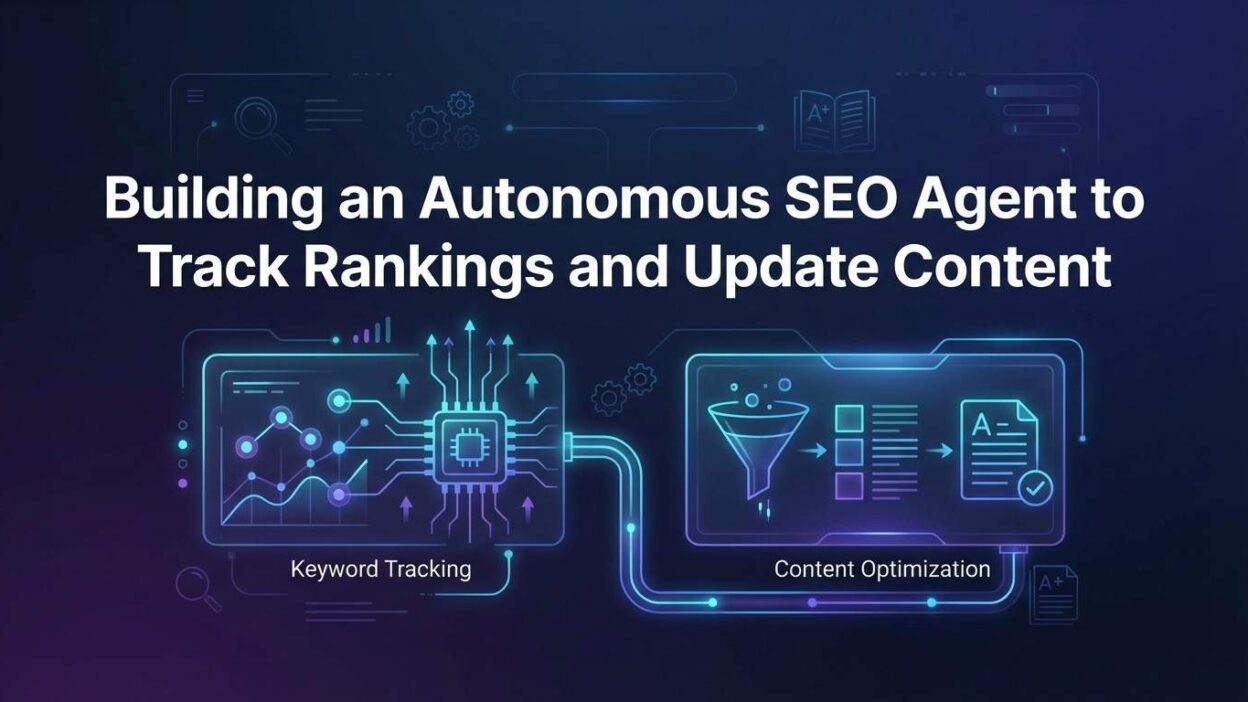
The observation layer monitors ranking positions, traffic metrics, and content signals continuously. It collects raw data from multiple sources and stores it in a structured format the rest of the system can process. This layer answers the question: what changed?
The analysis layer interprets ranking changes and identifies root causes. It compares current rankings against historical baselines. It cross-references ranking drops with competitor movements, algorithm update timelines, and content freshness signals. This layer answers the question: why did it change?
The action layer generates content updates based on analysis output. It identifies exactly which page sections need updating, what information needs adding, what outdated content needs replacing, and what structural changes improve relevance. This layer answers the question: what should change?
The monitoring layer tracks the impact of content changes on rankings over time. It measures whether updates improved, maintained, or further dropped rankings. It feeds results back to the observation layer to create a closed learning loop. This layer answers the question: did the change work?
How the Components Connect
The four components connect through a workflow orchestration layer. Tools like n8n, Zapier, or custom Python scripts manage the sequencing, scheduling, and data passing between components. Each component runs on a trigger — either a time-based schedule or a data threshold breach.
A ranking drop below a defined threshold triggers the analysis layer automatically. The analysis layer outputs a structured brief. The action layer consumes that brief and generates content updates. The monitoring layer begins tracking the updated page from the moment the change goes live.
This architecture describes every effective autonomous SEO agent regardless of which specific tools you use to implement it. The tools change. The four-component structure stays consistent.
Building Your Autonomous SEO Agent
Define Your Monitoring Scope and Triggers
Every autonomous system needs boundaries. Define exactly what your agent monitors before writing a line of code.
Start with your highest-value pages. These are your top twenty to fifty pages by organic traffic, conversion value, or competitive importance. These pages justify the highest monitoring frequency and the fastest response to ranking changes.
Define your trigger thresholds. A drop of one position on a high-volume keyword is noise. A drop of five positions on your top commercial keyword is a trigger. Set different thresholds for different page and keyword tiers. High-value targets get tight thresholds. Long-tail content gets wider tolerances before triggering analysis.
Define your monitoring frequency. Daily rank checks suit most commercial sites. Hourly monitoring suits high-stakes content in fast-moving niches. Weekly monitoring suits evergreen content with stable rankings and low competition.
Set Up the Rank Tracking Data Layer
The autonomous SEO agent needs reliable ranking data as its primary input signal. Several APIs provide programmatic rank tracking. DataForSEO, SEMrush API, Ahrefs API, and SerpApi all offer rank tracking endpoints your agent can query on a schedule.
Choose an API that covers your target search engines, locations, and device types. Store rank tracking results in a structured database — PostgreSQL works well, as does a simple Google Sheets setup for smaller implementations. Each data record needs a timestamp, keyword, URL, current position, and previous position stored consistently.
Build a comparison layer that calculates position changes automatically. A page moving from position four to position nine represents a five-position drop. Your trigger logic fires when that drop crosses your defined threshold.
Build the Analysis Layer
The analysis layer interprets ranking changes. This is where AI adds the most value in an autonomous SEO agent.
A language model analyzes the content of your ranking page alongside the top three current search results for the same keyword. It identifies what the ranking pages have that your page lacks — additional subtopics, updated statistics, better structural organization, richer examples, or clearer answers to search intent.
Build your analysis prompt carefully. Instruct the model to compare your page against the current top results. Ask it to identify specific content gaps, not general observations. Ask it to prioritize gaps by likely ranking impact. Ask it to output a structured JSON object containing its findings so the action layer can consume them programmatically.
Supplement AI analysis with keyword data. Pull current search volume, keyword difficulty, and related keyword variations for each triggered keyword. A ranking drop on a keyword with rising search volume is more urgent than a drop on a declining keyword. This data helps the system prioritize which triggers get immediate attention.
Build the Content Update Layer
The content update layer generates specific page improvements based on analysis output. This is the most powerful capability of a fully built autonomous SEO agent.
Feed the analysis output as structured context into a content generation prompt. The prompt should include the current page content, the identified content gaps, the target keyword and related variations, and the tone and style guidelines for your site. Ask the model to produce specific section revisions rather than full page rewrites. Targeted updates perform better than wholesale content replacement.
Implement a human review step before any updates publish. Even the most capable autonomous SEO agent makes errors. A human review queue that shows the original content, the proposed update, and the reasoning behind it takes minutes to process and prevents costly mistakes from going live.
Track every update with a change log. Record the date, the page URL, the keyword that triggered the update, the specific changes made, and the pre-update ranking. This log becomes your evidence base for measuring agent performance over time.
Automate the Monitoring and Feedback Loop
The monitoring layer closes the loop. After a content update publishes, the system begins watching that page’s rankings more closely. Daily rank checks for updated pages catch early signals of improvement or continued decline.
Set a review window for each update. Fourteen days gives search engines time to crawl, reindex, and adjust rankings based on updated content. After fourteen days, the system compares current rankings against pre-update rankings. Pages that recovered go into a success log. Pages still declining trigger a second analysis cycle.
This closed feedback loop is what separates an autonomous SEO agent from a one-time automation script. The loop runs continuously. The system learns from outcomes. The monitoring layer feeds the observation layer. The cycle repeats.
Tools and Technologies for Building an Autonomous SEO Agent
Rank Tracking APIs
DataForSEO offers one of the most cost-effective programmatic rank tracking APIs available. It supports bulk keyword tracking, multiple locations, and device-specific results. SerpApi provides a simpler interface for smaller-scale implementations. Ahrefs API and SEMrush API suit teams already paying for these platforms and wanting to integrate their existing data.
Choose based on your keyword volume, budget, and the geographic and device coverage you need. All of these APIs return JSON data your agent can process programmatically.
Workflow Orchestration Tools
n8n is an open-source workflow automation tool that runs locally or on a cloud server. It connects APIs, databases, and AI models through a visual node-based interface. Building an autonomous SEO agent in n8n requires no dedicated engineering team. The visual interface makes workflows readable and maintainable.
Make (formerly Integromat) offers a similar visual workflow builder as a managed cloud service. It suits teams that prefer not to manage infrastructure. Zapier handles simpler workflows but lacks the data transformation capabilities that complex SEO automation requires.
Python scripts handle the most complex logic. Teams comfortable with Python often build the core analysis and content generation logic in Python and use n8n or Make for scheduling and notifications.
AI Models for Content Analysis and Generation
GPT-4o handles content analysis and generation reliably. Its long context window accommodates full page content alongside top-ranking competitor pages in a single prompt. Claude 3.5 Sonnet performs particularly well for structured output generation — its JSON output is consistent, which simplifies the data flow between agent components.
Open-source models like Llama 3 suit teams with data privacy requirements that prevent sending content to external APIs. These models run locally but require adequate GPU infrastructure.
Content Management Integrations
The autonomous SEO agent must connect to your CMS to publish updates. WordPress offers the REST API for programmatic content publishing. Contentful, Sanity, and other headless CMS platforms provide similar APIs. Build your CMS integration early. Blocked publishing kills the value of every other component you build.
Common Challenges When Building an Autonomous SEO Agent
Ranking Data Noise and False Triggers
Ranking positions fluctuate naturally. A page might drop two positions on a Tuesday and recover by Thursday without any action taken. An autonomous SEO agent that triggers on every fluctuation generates unnecessary analysis and clutters your content update queue with low-value changes.
Solve this with smoothed ranking signals. Instead of triggering on a single day’s data, calculate a rolling seven-day average for each keyword. Trigger analysis only when the seven-day average drops below your threshold. This eliminates noise-triggered false positives while catching real ranking declines promptly.
Content Quality Control
AI-generated content updates vary in quality. A well-prompted model produces excellent updates most of the time. Occasionally it generates content that misses the point, introduces factual errors, or conflicts with your brand voice.
A human review queue is the right control mechanism for most teams. Not every update needs full editorial review. A quick scan for tone, accuracy, and relevance catches problems before they go live. Set a standard that every update a reviewer approves in under five minutes is worth the efficiency gain even in a semi-autonomous system.
CMS Integration Complexity
Different content management systems require different integration approaches. Custom-built CMSs may lack API access entirely. Complex page builders like Elementor or Divi store content in non-standard database formats that are difficult to update programmatically.
Map your CMS integration requirements before building the rest of the system. A beautiful autonomous SEO agent that cannot publish updates is just an expensive analysis tool. Integration complexity is the most common reason autonomous SEO projects stall before reaching production.
Attribution and Measurement
Measuring the impact of your autonomous SEO agent requires clean attribution. When rankings improve after a content update, did the update cause the improvement or did an algorithm update lift all boats? Clean attribution requires controlled experiments — updating some pages and holding others stable as controls.
What Is AI-Powered SEO Automation
AI-powered SEO automation applies machine learning and large language models to tasks traditionally done manually by SEO specialists. It covers keyword research automation, content gap analysis, internal linking recommendations, meta tag generation, and content quality scoring.
An autonomous SEO agent represents the most advanced form of AI-powered SEO automation. It does not just analyze and recommend. It acts. This distinction matters for teams evaluating whether to invest in automation tools versus building an agentic system.
Simpler AI-powered SEO tools suit teams with smaller sites, limited technical resources, or lower urgency. An autonomous SEO agent suits teams with large content libraries, competitive niches, and the technical capability to build and maintain a more complex system.
How RAG Improves Content Analysis in SEO Agents
Retrieval-Augmented Generation improves the analysis layer of an autonomous SEO agent. Instead of relying solely on what a language model knows from training, RAG retrieves current, specific content from your pages and competitor pages before generating analysis.
This matters for SEO because content quality judgments require specific, current information. A language model that recommends adding a statistic from 2021 to rank for a keyword where top results cite 2024 research creates a content update that does not help.
RAG grounds content analysis in current retrieval data. The model analyzes actual current top-ranking content before generating recommendations. This produces more accurate gap identification and more relevant content suggestions than analysis based on training knowledge alone.
Real-World Applications of Autonomous SEO Agents
E-commerce Product Page Optimization
E-commerce sites with thousands of product pages face an impossible manual SEO challenge. Product rankings fluctuate constantly. Seasonal trends shift keyword intent. Competitor pricing changes affect search behavior.
An autonomous SEO agent for e-commerce monitors product page rankings by category. It identifies products dropping in visibility, analyzes top-ranking competitor product pages, and generates updated product descriptions, specification tables, and FAQ sections. Price-sensitive queries get different content treatments than research-phase queries.
SaaS Content Marketing
SaaS companies publish extensive blog content targeting bottom-of-funnel keywords. These posts age quickly as products evolve, competitors launch, and market terminology shifts.
An autonomous SEO agent monitors content freshness signals alongside ranking data. It flags posts where key statistics are more than eighteen months old, generates updated statistics sections, and refreshes the publication date metadata when updates go live. This keeps content competitive without requiring a full content team to manually audit every post quarterly.
Local Business Directory Management
Businesses with multiple locations need location-specific content that ranks in local search. An autonomous SEO agent tracks local pack rankings for each location, identifies locations losing visibility, and generates location-specific content updates targeting the relevant local search signals for that market.
FAQ Section for SEO
What is an autonomous SEO agent?
An autonomous SEO agent is an AI-powered system that monitors search rankings, analyzes ranking changes, generates content updates, and executes SEO actions without requiring manual intervention for each task. It automates the observe-analyze-act-measure cycle that manual SEO teams run slowly.
How long does it take to build an autonomous SEO agent?
A minimal viable autonomous SEO agent with rank tracking, basic analysis, and human-reviewed content updates takes four to six weeks to build for a team with Python and API experience. A fully automated system with CMS integration and closed-loop monitoring takes two to three months.
Does an autonomous SEO agent replace SEO teams?
No. An autonomous SEO agent amplifies what SEO teams accomplish. It handles monitoring, routine analysis, and content drafting at scale. Human SEO strategists focus on high-judgment tasks — strategy, technical SEO, link building, and quality control — that require expertise the system cannot replicate.
Which AI model works best for SEO content analysis?
GPT-4o and Claude 3.5 Sonnet both perform well for SEO content analysis and generation. Claude tends to produce more consistent structured JSON output. GPT-4o handles very long context windows well. Test both on your specific content before committing to either.
Can small teams benefit from an autonomous SEO agent?
Yes. Small teams benefit most from automation because they have the least capacity for manual monitoring. A lean two-person content team with a well-built autonomous SEO agent outperforms a five-person team running manual processes on competitive keywords.
Read More:-Pinecone vs Milvus vs Weaviate: Choosing the Right Vector Database for RAG
Conclusion

Search rankings reward speed and relevance. The teams that detect changes fast, analyze root causes accurately, and update content quickly win the long game in competitive niches.
Manual SEO processes cannot deliver this speed at scale. Weekly rank checks miss problems. Quarterly content audits miss opportunities. Spreadsheet-based tracking does not trigger action automatically. The gap between data and action costs traffic every single day.
An autonomous SEO agent closes that gap. It monitors continuously. It analyzes immediately. It acts within hours. It tracks results and feeds them back into the next monitoring cycle. The feedback loop runs without requiring your team to drive it manually.
Building one is not trivial. The architecture requires clear thinking about data flow, trigger logic, content quality control, and CMS integration. The implementation requires comfortable work with APIs, language models, and workflow automation tools. These are real engineering challenges that take real time to solve.
The investment pays off quickly for any site with significant organic traffic and a content library large enough that manual monitoring creates real bottlenecks. The first ranking recovery the system catches and fixes faster than your manual process would have handled justifies the build time. Every subsequent recovery compounds that return.
Start with the monitoring layer. Get reliable rank tracking data flowing into a database. Build your trigger logic before your analysis logic. Ship a semi-autonomous system that drafts updates and waits for approval before trying to publish autonomously.
Trust builds with evidence. Evidence comes from watching the autonomous SEO agent perform. Let it prove itself before giving it full autonomy over your content.
Build the system. Measure the results. Expand the autonomy. The compounding returns are worth it.