Introduction
TL;DR Legal document review is one of the most time-consuming, expensive, and error-prone tasks in the legal profession. A single contract dispute can generate thousands of documents. A compliance audit can require reading through years of filings. An M&A deal can produce document volumes that overwhelm even large legal teams. Automating legal document review with AI agents changes this reality. Law firms and corporate legal departments that act on this shift gain a durable competitive edge. This guide explains what the technology looks like, how to build it, and what results it delivers.
Table of Contents
The Cost of Manual Legal Document Review
Manual legal document review consumes attorney time at a rate that no business can sustain indefinitely. Senior associates bill at three hundred to seven hundred dollars per hour. Document-heavy matters can require hundreds or thousands of review hours. Clients push back on these costs. Firms absorb write-downs. Everyone loses.
The accuracy problem compounds the cost problem. Humans reviewing documents under time pressure and volume stress make errors. A missed indemnification clause in a commercial contract creates liability exposure. An overlooked termination condition in a vendor agreement creates operational risk. A regulatory filing with an undetected inconsistency creates compliance exposure. The consequences of review errors in legal work range from costly to catastrophic.
Automating legal document review with AI agents addresses both dimensions simultaneously. AI agents review documents faster than any human team. They apply consistent attention to every clause, every page, and every document in a set without fatigue or distraction. The quality of review does not degrade at document number five thousand the way human quality degrades at document number fifty.
Legal departments that still rely entirely on manual review are falling behind. Competitor firms and corporate legal teams that embrace automating legal document review with AI agents complete matters faster, charge less, and make fewer errors. The productivity gap between AI-assisted and manual review widens every year as the technology improves.
What AI Agents Actually Do in Legal Document Review
Classification and Triage
The first job an AI agent performs in legal document review is classification. A large document set contains many document types. Contracts, amendments, correspondence, court filings, regulatory submissions, and supporting exhibits all sit in the same review queue. An AI agent classifies each document accurately and routes it to the appropriate review workflow.
This triage step alone saves significant time. Human reviewers spend a surprising portion of review time simply determining what type of document they are looking at and whether it is relevant to the matter at hand. An AI agent handles this classification at a rate of hundreds of documents per minute. By the time human attorneys engage with a document set, the irrelevant documents are set aside and the relevant ones carry labels that tell reviewers exactly what they are dealing with.
Clause Extraction and Tagging
Automating legal document review with AI agents delivers its clearest value in clause extraction. AI agents identify specific clause types across a document set. Governing law clauses. Limitation of liability clauses. Indemnification provisions. Termination rights. Change of control clauses. Dispute resolution mechanisms. Confidentiality obligations. Each of these gets extracted, labeled, and surfaced for attorney review.
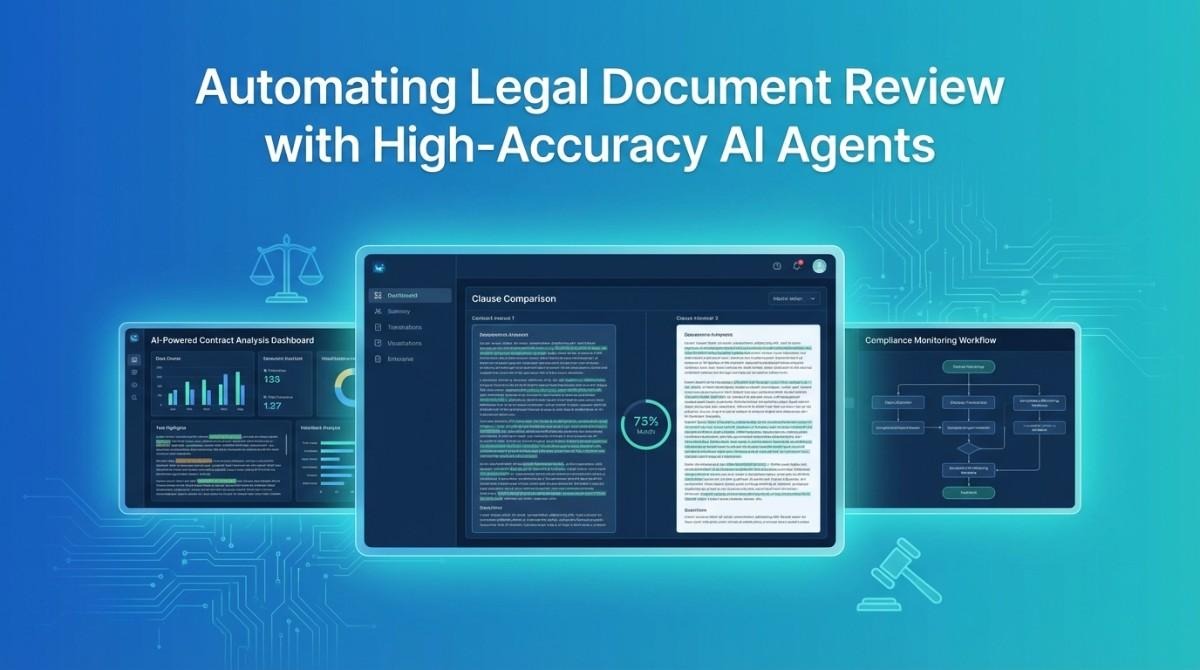
The agent does not just find clauses. It extracts the specific terms within each clause. For a limitation of liability clause, the agent extracts the cap amount, the exclusions, the applicable party, and the governing conditions. This structured extraction turns a raw document into a structured data record that attorneys can query, filter, and compare across an entire document set.
Risk Identification and Flagging
Trained AI agents identify clause language that deviates from standard positions and flag it for attorney attention. A vendor contract with a unilateral termination right gets flagged. An NDA with an unusually broad definition of confidential information gets flagged. A service agreement with no limitation of liability gets flagged. The agent applies a consistent risk framework to every document in the set.
Risk flagging transforms how attorneys spend their review time. Without AI, attorneys read every clause in every document looking for problems. With AI agents handling the initial review, attorneys focus their attention on documents and clauses the agent has already identified as potentially problematic. Review time concentrates where it matters most.
Cross-Document Consistency Analysis
Legal matters often involve multiple documents that should align. A master services agreement and its statements of work should use consistent definitions. A series of loan documents should have internally consistent financial covenants. An acquisition agreement and its disclosure schedules should not contradict each other. AI agents perform cross-document consistency analysis that human reviewers rarely have time to do thoroughly.
This capability catches a class of errors that manual review misses systematically. When reviewing document number eighty-three in a set, a human reviewer does not reliably remember the exact definition used in document number twelve. An AI agent maintains perfect recall across the entire document set and flags every inconsistency it detects.
Technical Architecture of a Legal Document Review Agent
Document Ingestion and Preprocessing
A legal document review agent starts with document ingestion. Legal documents arrive in multiple formats. PDFs, Word documents, scanned images, and email attachments all enter the review pipeline. The preprocessing layer handles format conversion, OCR for scanned documents, text extraction, and normalization.
OCR quality matters enormously for scanned legal documents. Low-quality OCR produces text with errors that confuse downstream analysis. Production legal AI systems use high-quality OCR engines like Tesseract with preprocessing steps that improve scan quality before OCR runs. The preprocessing investment pays back in consistently better extraction accuracy throughout the review pipeline.
The LLM at the Core
The large language model at the center of a legal review agent performs the actual reading, reasoning, and extraction. Legal document review requires models with strong instruction-following capabilities, long context handling, and careful attention to precise language. GPT-4o from OpenAI handles complex legal reasoning reliably. Claude from Anthropic excels at following detailed extraction instructions and maintaining consistency across long documents. Both support context windows large enough to process typical contract lengths in a single pass.
Fine-tuning on legal document datasets improves performance on domain-specific extraction tasks. A model fine-tuned on thousands of commercial contracts extracts governing law clauses more accurately than a general-purpose model. Fine-tuning is a significant investment but delivers measurable accuracy improvements for high-volume, specialized review workflows.
RAG for Legal Knowledge Bases
Retrieval Augmented Generation gives the AI agent access to organizational legal knowledge beyond what fits in its context window. Your firm’s standard contract positions, playbook guidance, risk thresholds, and approved clause language all live in a vector database. When the agent reviews a clause, it retrieves the relevant standard positions from the knowledge base and compares the clause against those standards.
This RAG architecture makes the agent’s risk assessments specific to your organization rather than generic. A deviation from your firm’s specific limitation of liability standard gets flagged differently than a deviation from market standard. The agent knows the difference because it retrieves your firm’s position from the knowledge base. Automating legal document review with AI agents reaches its highest value when the agent reflects your organization’s specific legal standards.
Orchestration Layer
A production legal document review agent needs orchestration logic that manages multi-step workflows. LangGraph is the strongest framework for this purpose. Its graph-based model lets you define distinct processing stages with explicit state management. A document enters the graph at ingestion, moves through classification, clause extraction, risk flagging, cross-document analysis, and report generation, with the agent state tracked precisely at each step.
The orchestration layer also manages human review integration. Not every document needs full attorney review after AI processing. The orchestration layer routes low-risk documents to a quick confirmation queue and high-risk documents to a detailed attorney review queue. This intelligent routing concentrates attorney time where it adds the most value.
Building Accuracy Into Legal Document Review AI
Why Accuracy Is Non-Negotiable in Legal AI
Legal document review does not tolerate the accuracy thresholds acceptable in consumer AI applications. A search engine that returns slightly irrelevant results is annoying. An AI agent that misses a material adverse change clause in an acquisition agreement is a professional liability event. Accuracy engineering for legal AI requires a different level of rigor than most AI development.
Accuracy in legal AI has two dimensions. Recall measures how many of the relevant clauses and issues the agent finds. Missing something is a false negative. Precision measures how many of the things the agent flags are actually relevant. Flagging the wrong things is a false positive. Production legal review agents need high recall above everything else. Missing a real issue is far more damaging than over-flagging and creating extra review work.
Building a Legal Evaluation Dataset
Measuring accuracy requires a ground truth dataset. Build a labeled dataset of legal documents with clause locations, risk flags, and consistency issues identified by experienced attorneys. This dataset becomes your evaluation benchmark. Every change to your agent’s system prompt, model version, retrieval configuration, or extraction logic gets measured against this benchmark before it reaches production.
Evaluation datasets for legal AI require attorney involvement to build correctly. The labels must reflect correct legal judgment, not just surface pattern matching. Invest in building a high-quality evaluation dataset early in your development process. It pays dividends throughout the life of your legal document review system by giving you a reliable way to measure whether changes improve or degrade performance.
Prompt Engineering for Legal Precision
System prompts for legal document review agents require careful engineering. Vague instructions produce inconsistent extraction. Precise, detailed instructions produce reliable results. A good extraction prompt for governing law clauses does not say find the governing law. It says identify the clause that specifies which jurisdiction’s law governs the interpretation and enforcement of this agreement, extract the full clause text, identify the specified jurisdiction, note any carve-outs, and flag any ambiguous or unusual formulations.
Chain-of-thought prompting improves accuracy for complex legal analysis tasks. Instruct the agent to reason through its analysis step by step before producing its final output. For risk assessment tasks, ask the agent to identify the relevant clause, describe its terms, compare those terms to standard market positions, identify the specific deviations, and then assess the risk level of each deviation. This structured reasoning process catches errors that direct-answer prompts miss.
Human-in-the-Loop Quality Control
No AI system eliminates the need for human judgment in legal review. Well-designed systems define exactly where human review adds irreplaceable value. Attorneys confirm AI extractions on a sample basis to measure ongoing accuracy. They review all high-risk flags before matters close. They update the knowledge base when the AI’s assessments prove incorrect. This feedback loop improves the agent continuously.
Automating legal document review with AI agents works best when attorneys treat AI output as a highly capable first-pass reviewer rather than a replacement for legal judgment. The agent handles volume and consistency. The attorney handles judgment, context, and final accountability. This division of labor maximizes the value both contribute.
Use Cases Across Legal Practice Areas
Contract Review and Negotiation Support
Commercial contract review is the highest-volume use case for legal AI agents. Sales contracts, vendor agreements, partnership agreements, and service level agreements all flow through legal teams at high volume. An AI agent that extracts key terms, flags deviations from playbook positions, and suggests redline language based on the firm’s standard positions transforms the contract review workflow.
Negotiation support extends the value further. When counterparty redlines arrive, the agent compares the new version against the previous version, identifies every change, and assesses each change against the firm’s acceptable positions. Attorneys receive a structured change summary with risk assessments rather than a raw redlined document. Review time for counterparty redlines drops by sixty to eighty percent in well-implemented systems.
Due Diligence in M&A Transactions
M&A due diligence is among the most document-intensive legal workflows in existence. A mid-market acquisition can require review of ten thousand to fifty thousand documents across multiple subject areas. Legal, financial, regulatory, intellectual property, employment, and environmental diligence all generate massive document volumes. Automating legal document review with AI agents makes comprehensive due diligence feasible within transaction timelines that would otherwise force selective review.
AI agents in M&A due diligence extract key terms from every material contract in the target company’s portfolio. Change of control provisions, assignment restrictions, exclusivity clauses, and termination rights all get identified and flagged. The resulting diligence database lets acquiring company counsel search across the entire contract portfolio to assess specific risk categories quickly. Risks that manual review would miss due to volume constraints surface systematically.
Regulatory Compliance Review
Corporate legal teams monitor regulatory filings, internal policies, and operational documents for compliance with evolving regulatory requirements. This monitoring task requires reading large volumes of documents against a changing set of compliance standards. AI agents handle this continuous monitoring efficiently. They apply the current compliance framework to each document and flag gaps or deviations for legal team attention.
Financial services companies use automating legal document review with AI agents to monitor loan agreements, derivatives contracts, and customer-facing disclosures for compliance with regulations like MiFID II, Dodd-Frank, and consumer lending rules. Healthcare organizations use AI review agents to monitor contracts and policies for HIPAA compliance. The regulatory complexity that makes manual compliance monitoring unsustainable is exactly the complexity that AI agents handle well.
Litigation Document Review
Litigation matters generate discovery document sets that regularly reach millions of pages. Traditional document review at this scale requires armies of contract reviewers working for months at significant cost. AI-assisted review applies relevance and privilege screening to the entire document set in a fraction of the time, concentrating human review effort on the most critical documents.
Privilege review is a particularly sensitive litigation review task. Producing privileged documents in discovery is a serious legal error. AI agents trained on privilege identification criteria flag potentially privileged documents for attorney review before production. The agent’s recall on privilege identification must be extremely high. Under-flagging privileged documents is not an acceptable outcome. Production systems set recall thresholds above ninety-eight percent for privilege screening.
Implementation Roadmap for Legal Teams
Phase One: Pilot on a Single Document Type
Start small and focused. Choose one high-volume document type that your team reviews regularly. Commercial NDAs work well as pilots because they are relatively short, structurally consistent, and reviewed in high volume. Define three to five extraction tasks your pilot agent should handle. Governing law, term and termination, confidentiality scope, permitted disclosure exceptions, and return of materials obligations cover the most commonly negotiated NDA provisions.
Build your evaluation dataset for this document type before writing any agent code. Label fifty to one hundred NDAs with ground truth extractions for your target tasks. This dataset measures your agent’s performance honestly from day one. It also reveals the variability in your document population that your agent needs to handle. You will discover edge cases in the labeling process that shape better agent design.
Phase Two: Expand to a Full Document Type Workflow
After a successful NDA pilot, expand to a complete workflow for your highest-volume document type. For many firms, this is the full commercial contract review workflow. Add clause extraction for all standard commercial contract provisions. Add risk flagging based on your firm’s or department’s playbook positions. Add the knowledge base that stores your standard positions and acceptable deviation thresholds.
Integrate the agent output into your existing matter management system during this phase. Attorneys should not need to visit a separate AI tool to see review results. The extraction summary, risk flags, and cross-document analysis should appear within the workflow tools attorneys already use. Integration friction is one of the most common reasons legal AI pilots fail to achieve adoption.
Phase Three: Scale Across Practice Areas and Document Types
With a proven workflow for one document type, extend the system to additional practice areas and document types. Each new document type requires a new evaluation dataset and potentially new fine-tuning or prompt engineering work. Reuse the core infrastructure from your initial deployment. The document ingestion pipeline, LLM configuration, orchestration framework, and matter management integration all carry over.
Build a feedback mechanism that captures attorney corrections and confirmations across all document types. Route this feedback into periodic prompt updates and evaluation dataset expansions. Legal AI systems that improve with use create a compounding advantage. The more documents your agents review, the better calibrated their risk assessments become for your specific practice and client portfolio.
Frequently Asked Questions
Is automating legal document review with AI agents accurate enough for production use?
Production-grade legal AI review systems achieve accuracy levels that exceed average human reviewer accuracy for well-defined extraction tasks. Studies by legal AI vendors consistently show that AI clause extraction accuracy exceeds ninety-two to ninety-six percent on standard commercial contract provisions when systems are properly configured and evaluated. Human reviewer accuracy on the same tasks under production conditions typically falls between eighty-five and ninety-two percent due to fatigue and attention variation. High-stakes review always warrants attorney confirmation of AI-extracted results, but AI accuracy now justifies relying on AI as the primary reviewer for routine document types.
How long does it take to implement a legal document review AI agent?
A focused pilot covering one document type with three to five extraction tasks takes four to eight weeks to build and deploy. A complete contract review workflow covering all standard provisions with risk flagging and knowledge base integration takes three to six months. Enterprise deployments covering multiple practice areas and document types take six to eighteen months depending on the breadth of scope and the complexity of existing system integrations. Timeline accelerates significantly when using pre-built legal AI platforms rather than building custom agents from scratch.
What are the data privacy considerations for legal document review AI?
Legal documents contain highly sensitive client information subject to attorney-client privilege and confidentiality obligations. Sending client documents to public AI APIs raises serious privilege and confidentiality concerns. Most serious law firms and corporate legal departments deploy private LLMs or use AI vendors with strict data isolation guarantees backed by contractual and technical controls. Model providers that offer zero data retention agreements, private deployment options, and SOC 2 compliance documentation satisfy the baseline requirements most legal organizations need. Review your bar association’s ethics opinions on AI tool use before deploying any AI system that processes client matter documents.
Can AI agents replace junior associates in document review?
AI agents replace the mechanical first-pass review work that junior associates have historically performed on high-volume document matters. They do not replace the judgment, client relationship, and strategic analysis work that constitutes the career development path through associate ranks. Law firms and legal departments that use AI agents for first-pass review typically redeploy junior associate time to higher-value work: client communication, legal strategy, and more complex analytical tasks. The question is not replacement but redeployment. Organizations that frame the shift this way achieve better AI adoption and better attorney development outcomes simultaneously.
What contract management systems integrate with AI review agents?
Major contract lifecycle management platforms like Ironclad, Icertis, ContractPodAi, and Conga all offer AI review integrations or support API connections to custom AI agents. Document management systems like iManage, NetDocuments, and SharePoint integrate with AI review agents through API layers. Most modern legal AI implementation architectures connect the AI agent to existing systems via API rather than requiring migration to a new platform. Your team keeps working in familiar tools. The AI review layer sits underneath, processing documents and surfacing results within existing workflows.
How do law firms price AI-assisted document review for clients?
Pricing models for AI-assisted legal document review vary across firms. Some firms pass AI efficiency gains to clients through lower blended rates on document-intensive matters. Others maintain traditional hourly billing but use AI to handle more work per hour, improving profitability. Fixed-fee arrangements for defined document review scopes become more attractive for firms when AI reduces the variability in review time. The most forward-thinking firms price AI-assisted review as a premium service that delivers faster turnaround and higher accuracy, justifying rates that reflect value delivered rather than hours billed.
Read More:-Manual Data Entry vs. AI OCR: Saving Weeks of Work
Conclusion

Legal document review stands at an inflection point. The tools to automate it accurately and at scale exist right now. Automating legal document review with AI agents is no longer a future possibility. It is a present competitive reality that separates firms and legal departments that act from those that wait.
The technology works. AI agents classify documents accurately, extract clause terms reliably, flag risks consistently, and identify cross-document inconsistencies that human reviewers miss. The accuracy achieved by production legal AI systems meets or exceeds human reviewer accuracy for routine extraction tasks. The speed advantage is not marginal. AI agents review documents in minutes that human teams take days to process.
The implementation path is clear. Start with a focused pilot on one high-volume document type. Build an evaluation dataset before writing code. Integrate results into existing workflows. Expand based on measured performance. Build attorney feedback loops that improve the system over time. Each phase delivers measurable value that justifies the next investment.
Law firms that master automating legal document review with AI agents serve clients faster, make fewer errors, and free their attorneys for higher-value work. Corporate legal departments that adopt this technology reduce outside counsel spend, accelerate transaction timelines, and build internal capabilities that compound over time. The investment is real. The return is larger.
Automating legal document review with AI agents is not a threat to the legal profession. It is the technology that lets legal professionals do their best work. It removes the volume burden that consumes attorney time without requiring attorney judgment. It surfaces the problems that need legal expertise to resolve. It makes legal teams more capable, not less necessary. The firms and departments that understand this distinction will define what modern legal practice looks like for the next decade.