Introduction
TL;DR The modern sales landscape demands speed and precision. Your sales team spends countless hours sifting through leads manually. Many of these prospects never convert into paying customers. This inefficiency drains resources and kills momentum.
Automating lead qualification changes everything. AI-powered systems work around the clock to evaluate every prospect in your pipeline. Your team focuses only on high-value opportunities. The result? More closed deals and higher revenue.
This comprehensive guide explores how AI transforms lead qualification. You’ll discover practical strategies to implement automation in your CRM today. Let’s dive into the future of intelligent sales processes.
Table of Contents
Understanding Lead Qualification in Today’s Sales Environment
Lead qualification separates tire-kickers from serious buyers. Traditional methods rely heavily on human judgment and manual data entry. Sales representatives ask qualifying questions during discovery calls. They score prospects based on gut feeling and limited information.
This approach creates several problems. Human bias affects decision-making. Representatives miss subtle buying signals. Manual processes slow down response times. High-quality leads slip through the cracks while your team chases dead ends.
The average sales rep spends only 36% of their time actually selling. The rest disappears into administrative tasks and lead research. Your best closers become data entry clerks. This misallocation of talent costs companies millions in lost opportunities.
The Cost of Manual Lead Qualification
Consider the real financial impact. A sales representative earning $75,000 annually spends roughly $48,000 worth of time on non-selling activities. Multiply this across your entire team. The numbers become staggering quickly.
Manual qualification also introduces inconsistency. Different team members apply different criteria. One rep might pursue a lead another would discard. Your pipeline becomes a guessing game rather than a predictable revenue engine.
Response time matters more than ever. Studies show that contacting a lead within five minutes increases conversion rates by 900%. Manual processes can’t maintain this speed consistently. Leads grow cold while waiting for human attention.
What Is Automating Lead Qualification?
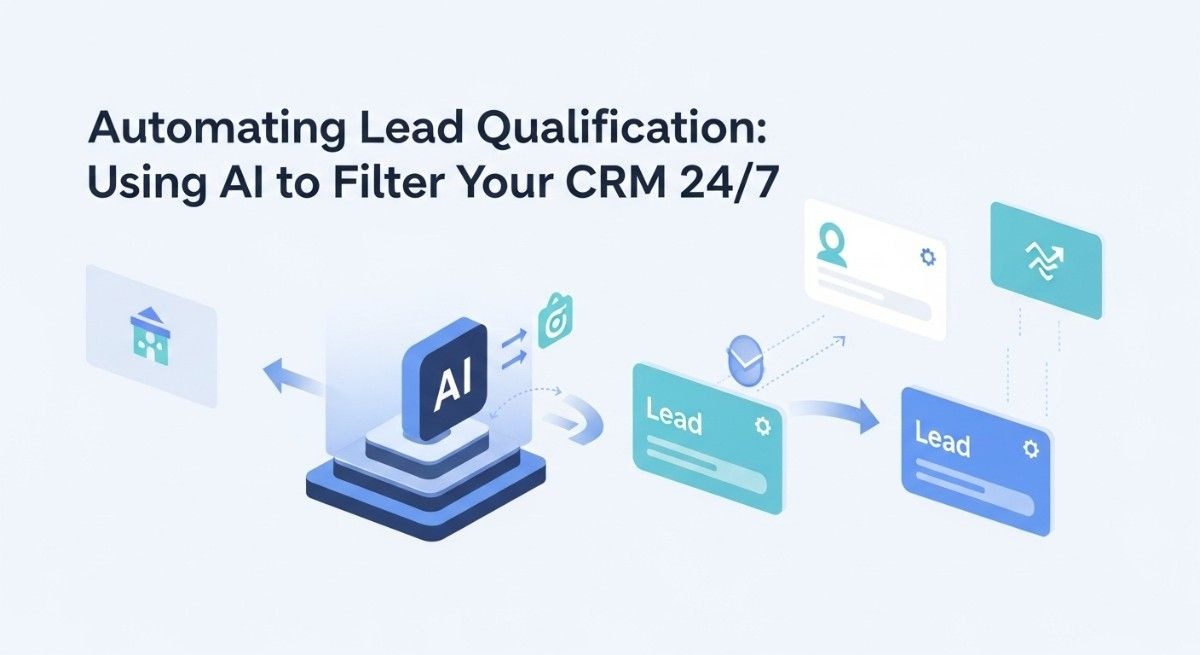
Automating lead qualification uses artificial intelligence to evaluate prospects without human intervention. The system analyzes multiple data points simultaneously. It assigns scores based on predefined criteria and behavioral patterns. Qualified leads move forward automatically while poor fits get filtered out.
AI examines demographic information like company size and industry. It tracks behavioral data including website visits and email engagement. The technology identifies patterns that indicate buying intent. Each prospect receives an objective score based on their likelihood to convert.
This happens continuously in the background. Your CRM becomes an intelligent assistant that never sleeps. Every new lead gets evaluated the moment they enter your system. Hot prospects get routed to sales immediately while nurture sequences engage others.
How AI Differs from Traditional Scoring Models
Traditional lead scoring uses simple point systems. A prospect gets points for job title, company size, or specific actions. The system adds up points to determine qualification. This approach lacks nuance and misses complex buying signals.
AI takes a fundamentally different approach. Machine learning algorithms identify correlations humans miss. The system recognizes that certain combinations of factors predict success. It adapts based on actual outcomes in your specific business.
Your AI learns which leads close and which don’t. It adjusts its criteria automatically over time. The qualification process becomes more accurate with every interaction. Human-created rules remain static while AI continuously improves.
The Technology Behind Automating Lead Qualification
Modern AI systems combine several powerful technologies. Natural language processing analyzes communication content. Machine learning identifies patterns in historical data. Predictive analytics forecasts future behavior based on past actions.
These systems integrate directly with your existing CRM platform. They pull data from multiple sources automatically. Website analytics, email platforms, social media, and third-party databases all feed the AI engine. The technology creates a comprehensive view of each prospect.
Cloud computing enables 24/7 processing without your IT infrastructure. The AI works constantly in the background. It evaluates new information the moment it becomes available. Your qualification process never stops regardless of time zones or holidays.
Machine Learning Models for Lead Scoring
Supervised learning trains AI on your historical data. The system studies thousands of past leads and their outcomes. It identifies which characteristics correlate with closed deals. The model then applies these insights to new prospects.
The AI looks beyond obvious factors. It might discover that prospects who visit your pricing page three times convert at higher rates. Or that leads from certain referral sources close faster. These insights emerge from data rather than assumptions.
The model continuously refines itself. Each new outcome provides additional training data. Your qualification accuracy improves month over month. The system adapts to market changes and evolving buyer behaviors automatically.
Natural Language Processing in Lead Analysis
NLP technology reads and understands written communication. It analyzes emails, chat messages, and form submissions. The AI extracts intent and sentiment from prospect interactions. A lead asking about implementation timelines signals higher interest than one requesting general information.
This technology identifies buying signals in natural conversation. It recognizes urgency indicators and budget discussions. The system flags prospects using language that historically precedes purchases. Your team receives alerts when leads demonstrate strong buying intent.
NLP also standardizes data entry. The AI extracts key information from unstructured text. Contact details, company information, and pain points get captured automatically. Your CRM stays updated without manual data entry.
Key Benefits of Automating Lead Qualification
Automating lead qualification delivers immediate operational improvements. Your sales team stops wasting time on unqualified prospects. Representatives focus their energy on leads most likely to close. This focused approach increases conversion rates dramatically.
Speed becomes your competitive advantage. The AI evaluates new leads in seconds rather than hours or days. Hot prospects receive immediate attention. Your response time drops from hours to minutes. Fast follow-up converts more leads before competitors make contact.
Consistency eliminates subjective judgment calls. Every lead gets evaluated using the same criteria. Personal biases and bad days don’t affect qualification decisions. Your pipeline becomes predictable and reliable.
Increased Productivity and Revenue
Sales teams using AI qualification tools close 30% more deals on average. Representatives spend more time in actual sales conversations. They work fewer leads but convert them at higher rates. The math strongly favors automation.
Your cost per acquisition decreases significantly. Less time wasted on poor fits means lower operational costs. Marketing spend becomes more efficient when only qualified leads consume sales resources. ROI improves across your entire revenue organization.
The technology scales effortlessly. Your AI handles ten leads or ten thousand with the same accuracy. Growing your pipeline doesn’t require proportional increases in sales headcount. You scale revenue without scaling costs linearly.
Better Lead Quality and Higher Conversion Rates
AI identifies quality leads that human reviewers might miss. The technology spots subtle combinations of factors that indicate readiness. Your team pursues prospects with genuine buying intent. Conversion rates climb because you’re targeting the right people.
The system also prevents good leads from falling through gaps. Every prospect gets evaluated regardless of when they arrive. Night and weekend leads receive the same attention as business hours submissions. No opportunity gets overlooked due to timing or workload.
Historical data shows that automating lead qualification typically increases conversion rates by 20-50%. The exact improvement depends on your current process efficiency. Companies with inconsistent manual qualification see the biggest gains.
24/7 Operation Without Human Intervention
Your qualification system never takes a break. Leads get evaluated immediately upon entering your CRM. Geographic boundaries disappear when AI handles initial qualification. International prospects receive instant assessment regardless of time differences.
This constant operation captures perishable opportunities. A prospect researching solutions at midnight gets qualified before morning. Your team finds hot leads waiting in their queue every day. The early bird advantage becomes standard operating procedure.
Weekend and holiday leads receive proper attention. Traditional sales teams lose momentum during off hours. AI-powered qualification maintains consistency throughout the year. Your business never goes dark from a lead qualification perspective.
Implementing AI Lead Qualification in Your CRM
Implementation begins with data preparation. Your CRM needs clean, organized historical information. The AI trains on past lead outcomes to build its model. Garbage data produces garbage results regardless of technology sophistication.
Start by standardizing your existing lead fields. Ensure consistent data entry across all records. Remove duplicates and correct obvious errors. Define what “qualified” means for your specific business. The AI needs clear examples of success and failure.
Most modern CRMs offer native AI features or easy integrations. Salesforce Einstein, HubSpot’s predictive scoring, and Microsoft Dynamics AI are popular options. Third-party tools like Conversica and Exceed.ai provide specialized capabilities. Choose solutions that match your technical capabilities and budget.
Choosing the Right AI Solution
Evaluate platforms based on your specific needs. Some tools excel at behavioral tracking while others focus on demographic analysis. Consider your sales cycle length and typical customer profile. B2B enterprise sales require different capabilities than B2C transactions.
Integration capabilities matter significantly. The AI must connect seamlessly with your existing tech stack. Marketing automation, email platforms, and analytics tools all provide valuable data. Siloed systems limit the AI’s effectiveness.
Vendor support and training resources deserve careful consideration. Your team needs to understand how the system works. Look for providers offering implementation assistance and ongoing optimization help. Technology alone won’t deliver results without proper deployment.
Data Requirements and Preparation
AI needs sufficient historical data to learn effectively. Most systems require at least 1,000 past leads with known outcomes. More data produces better results. Companies with limited history might start with rules-based systems before graduating to full AI.
Data quality trumps quantity every time. The AI learns from patterns in your records. Inconsistent or inaccurate information creates flawed models. Invest time in data cleanup before implementing automation. This foundation determines your success.
Define clear outcome labels for your historical leads. Mark which prospects became customers and which didn’t. Include additional context like deal size and sales cycle length. Rich labeling helps the AI understand different types of qualification success.
Integration with Existing Systems
Automating lead qualification requires connections across your technology stack. Your AI pulls data from marketing automation platforms to track campaign engagement. Website analytics provide behavioral information. Email systems show communication patterns.
API connections enable real-time data flow. Lead information updates continuously as prospects interact with your brand. The AI evaluates these interactions immediately. Your qualification scores stay current rather than becoming stale snapshots.
Create feedback loops between sales and the AI system. When representatives override qualification decisions, capture their reasoning. This information helps refine the model over time. Human expertise and machine learning work together rather than in opposition.
Best Practices for Automating Lead Qualification
Start with clear qualification criteria based on your ideal customer profile. Document the characteristics of your best customers. Translate these attributes into measurable data points. The AI needs specific parameters to evaluate effectively.
Implement progressive qualification stages rather than binary pass/fail decisions. Grade leads on a spectrum from cold to hot. This nuanced approach preserves leads that need nurturing. Not every prospect is ready to buy immediately but many will be eventually.
Maintain human oversight during the initial implementation phase. Review the AI’s decisions regularly to ensure accuracy. Look for patterns in misclassified leads. Adjust your criteria and model training as needed. Full automation comes after validating the system’s judgment.
Setting Appropriate Thresholds
Qualification thresholds determine which leads advance to sales. Set these cutoffs based on your team’s capacity and lead volume. Too lenient and your reps get overwhelmed with marginal prospects. Too strict and you miss genuine opportunities.
Test different threshold levels to find your sweet spot. Monitor conversion rates at various score ranges. The goal is maximizing revenue rather than maximizing lead volume. Quality always beats quantity in B2B sales.
Consider dynamic thresholds that adjust based on pipeline health. When your team has capacity, lower the bar slightly. During busy periods, raise standards to protect representative productivity. Flexibility optimizes resource allocation.
Continuous Monitoring and Optimization
AI models require ongoing attention despite their automated nature. Review qualification accuracy monthly. Compare AI scores against actual outcomes. Identify areas where the system consistently errs.
Market conditions change over time. Economic shifts affect buying behaviors and budgets. Your AI needs retraining to stay current with these changes. Most platforms offer automated retraining that incorporates new data continuously.
Gather feedback from your sales team regularly. Representatives develop intuition about lead quality through daily interactions. Their insights can highlight blind spots in your AI model. Combine human expertise with machine intelligence for optimal results.
Balancing Automation with Human Touch
Automating lead qualification doesn’t eliminate the need for human judgment. Sales representatives should retain override authority on questionable leads. Gut instinct and relationship context matter in complex B2B sales.
Use automation to handle routine decisions at scale. Free your team to focus on nuanced situations requiring human empathy. The AI excels at processing vast amounts of data quickly. Humans excel at reading between the lines and building rapport.
Create escalation paths for edge cases. When the AI encounters unusual situations, flag them for human review. This hybrid approach combines efficiency with wisdom. Your process gains speed without sacrificing judgment quality.
Common Challenges and Solutions
Implementation resistance often comes from sales teams worried about technology replacing them. Address these concerns directly and honestly. Explain that AI handles tedious qualification work so representatives can focus on selling. Frame automation as a tool that makes their jobs easier and more successful.
Data quality issues plague many organizations attempting AI implementation. Incomplete records and inconsistent field usage undermine model accuracy. Dedicate resources to data hygiene before and during implementation. Assign data quality ownership to specific team members.
Integration complexity can delay or derail projects. Legacy systems may lack modern APIs or proper documentation. Work with experienced integration partners if your IT team lacks expertise. Budget time and money for integration work upfront.
Overcoming Data Silos
Different departments often use separate systems that don’t communicate. Marketing data lives in one platform while sales uses another. Customer service maintains yet another database. These silos prevent AI from seeing the complete picture.
Break down these barriers through centralized data architecture. Implement a customer data platform that aggregates information from all sources. Give your AI access to the unified view. Comprehensive data produces more accurate qualification.
Establish data governance policies that mandate cross-platform updates. When information changes in one system, it should update everywhere automatically. Synchronization ensures consistency across your technology stack. The AI makes better decisions with reliable, current information.
Maintaining Model Accuracy Over Time
AI models decay as market conditions evolve. A model trained on 2023 data may perform poorly in 2026. Buyer behaviors shift. New competitors emerge. Economic conditions fluctuate. Your qualification criteria must adapt accordingly.
Schedule regular model retraining sessions. Most platforms can retrain quarterly or even monthly. Feed new outcome data continuously. The AI learns from recent successes and failures. This ongoing education maintains relevance and accuracy.
Monitor key performance indicators that signal model drift. Declining conversion rates on qualified leads suggest the criteria need adjustment. Increased override rates from sales reps indicate human judgment differs from AI assessment. These metrics flag when intervention is necessary.
Real-World Applications and Case Studies
A B2B SaaS company implemented automating lead qualification and reduced their sales cycle by 40%. The AI immediately identified prospects showing strong buying signals. Sales representatives contacted these hot leads within minutes rather than hours. Faster response times led to earlier engagement and quicker closes.
An insurance brokerage used AI to segment leads into seven distinct categories. Each category received customized nurture sequences and routing rules. Conversion rates increased by 35% within six months. The system identified patterns that human reviewers consistently missed.
A manufacturing company with long sales cycles trained AI on three years of historical data. The model predicted which early-stage prospects would eventually close large deals. Sales leadership allocated resources accordingly. Deal sizes increased while sales costs decreased. Strategic focus replaced scattered effort.
Small Business Success Story
A ten-person marketing agency struggled with lead volume from paid advertising. The team spent entire mornings qualifying new inquiries. Client work suffered due to constant interruptions. Implementing basic AI qualification changed their operation completely.
The system evaluated incoming leads against their ideal customer profile automatically. Poor fits received automated email responses. Strong matches got routed to the appropriate team member immediately. The agency closed 60% more deals without hiring additional salespeople.
Return on investment came within three months. The AI subscription cost $200 monthly but generated thousands in additional revenue. The team’s work-life balance improved dramatically. No more evening calls qualifying leads from different time zones.
Enterprise Implementation Example
A global technology company with 500 sales representatives faced consistency challenges. Different regional teams used varying qualification standards. Pipeline quality fluctuated wildly between territories. Leadership mandated standardization through AI automation.
The implementation took six months and required significant change management. Historical data from all regions trained a unified model. Every lead worldwide now gets evaluated using identical criteria. Regional variations appear as custom scoring adjustments rather than different processes entirely.
First-year results exceeded expectations. Pipeline quality standardized across all territories. Conversion rates increased by 22% company-wide. Sales leadership gained unprecedented visibility into global lead quality. Data-driven forecasting replaced educated guessing.
The Future of Automating Lead Qualification
Artificial intelligence capabilities continue advancing rapidly. Future systems will predict buyer behavior months in advance. Prospects will receive personalized engagement before they even realize they have a problem to solve. Proactive outreach will replace reactive qualification.
Conversational AI will handle initial prospect interactions. Chatbots and voice assistants will conduct preliminary qualification conversations. These systems will ask clarifying questions and schedule meetings automatically. Human representatives will only engage after AI completes groundwork.
Predictive analytics will identify which existing customers are ready for upsells. The line between new lead qualification and customer expansion will blur. One unified AI system will manage the entire revenue lifecycle. Every customer interaction informs future qualification decisions.
Emerging Technologies and Capabilities
Computer vision will analyze prospect behavior during video calls. The AI will detect engagement levels and buying signals from facial expressions. This adds another data layer to qualification models. Emotional intelligence joins traditional metrics.
Blockchain technology may enable trusted data sharing between companies. Industry consortiums could train AI models on aggregated data while protecting individual privacy. Better training data produces more accurate qualification across participating companies. Rising tide lifts all boats.
Quantum computing will eventually enable real-time processing of massive datasets. Current AI systems sample and simplify data for practical processing. Future systems will analyze everything with perfect accuracy. Lead qualification will achieve near-perfect precision.
Measuring Success and ROI
Track conversion rate improvements as your primary success metric. Compare qualified lead close rates before and after AI implementation. Calculate the percentage increase in deals closed per lead processed. This directly measures qualification accuracy.
Monitor time savings across your sales organization. Measure hours spent on qualification activities before automation. Compare against post-implementation time allocation. Multiply saved hours by average hourly cost to calculate hard dollar savings.
Revenue per representative typically increases with better qualification. Track this metric monthly to see productivity gains. Your team closes more deals because they pursue better opportunities. Individual performance improves while effort decreases.
Key Performance Indicators to Track
Lead response time measures how quickly qualified prospects receive human attention. Target under five minutes for hot leads. Track average and median response times. Faster response correlates directly with higher conversion rates.
Pipeline velocity shows how quickly leads move through your sales funnel. Automating lead qualification accelerates this movement by reducing bottlenecks. Measure days between qualification and close. Shorter cycles indicate healthier processes.
Sales rep satisfaction deserves measurement despite being qualitative. Survey your team quarterly about lead quality and process efficiency. Happier representatives stay longer and perform better. Quality of life improvements create tangible business value.
Calculating Return on Investment
Total cost includes software subscriptions, implementation expenses, and ongoing maintenance. Add training time and any headcount dedicated to managing the system. This represents your complete investment in automation.
Benefits include direct revenue increases from higher conversion rates. Add cost savings from reduced manual qualification labor. Include productivity gains from faster pipeline velocity. Factor in customer lifetime value improvements from better initial qualification.
Most companies achieve positive ROI within six to twelve months. Enterprise implementations may take longer due to complexity. The ongoing benefits compound year over year as the AI continues learning and improving. This investment pays dividends indefinitely.
Read More:-The Smart Agency: Using AI to Double Your Output Without Increasing Headcount
Conclusion

Automating lead qualification transforms how modern sales teams operate. AI technology handles repetitive evaluation tasks that drain representative productivity. Your team focuses exclusively on high-value selling activities. This shift delivers measurable improvements in conversion rates and revenue.
The technology works continuously without breaks or inconsistency. Every lead receives immediate evaluation based on objective criteria. Speed and accuracy combine to create competitive advantages that manual processes cannot match. Your business operates more efficiently while closing more deals.
Implementation requires careful planning and quality data. Choose platforms that integrate with your existing systems. Set clear qualification criteria based on your ideal customer profile. Monitor performance regularly and adjust as needed.
The future of sales lies in intelligent automation that augments human capabilities. AI handles what it does best while people focus on relationship building and complex problem solving. Companies embracing this hybrid approach will dominate their markets. Those clinging to manual processes will fall behind competitors leveraging technology effectively.
Start your automation journey today. Begin with clear documentation of your current qualification process. Identify bottlenecks and inefficiencies that technology could address. Research platforms suited to your business size and industry. The sooner you implement automating lead qualification, the sooner you’ll see results that impact your bottom line directly.