Introduction
TL;DR Customers today expect fast, accurate answers at any hour. Businesses struggle to deliver that at scale. Automated customer support AI agents are changing the game — not by replacing humans, but by handling complexity that old chatbots simply cannot touch. This blog breaks down what that shift looks like, why it matters, and how your business can move forward.
Table of Contents
What Is Automated Customer Support — and Why the Old Model Failed?
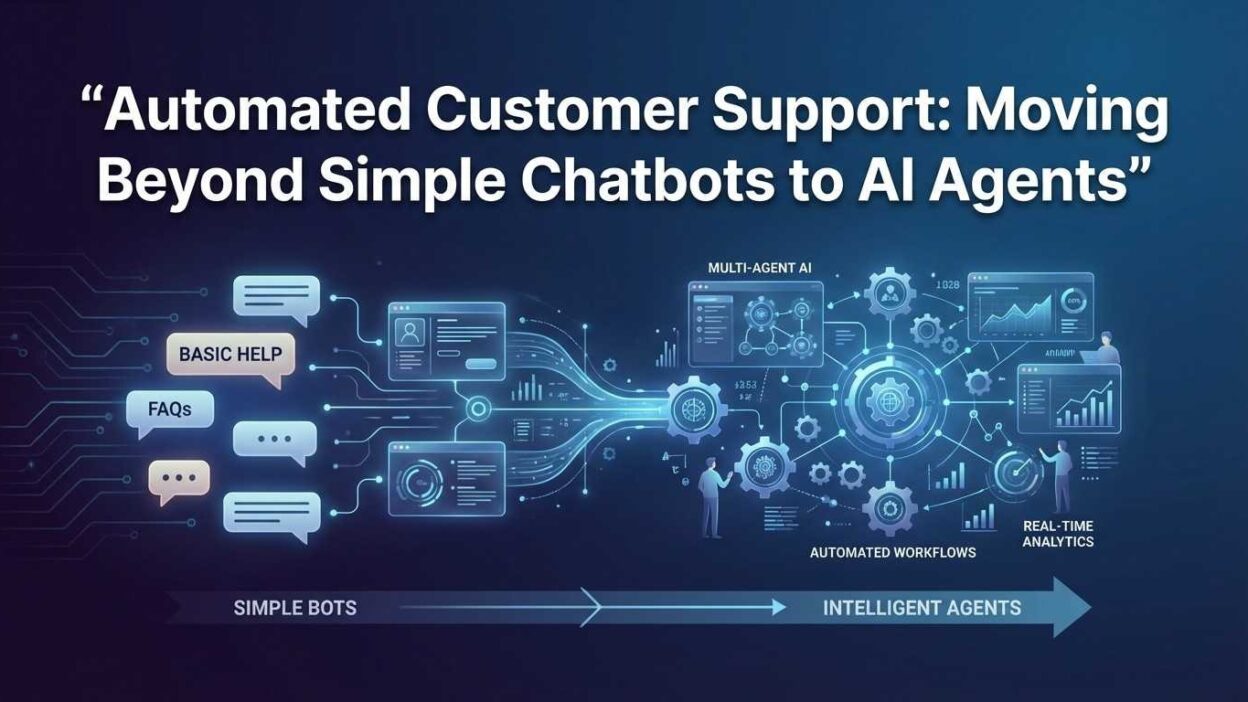
Most companies started their digital support journey with rule-based chatbots. These bots followed fixed scripts. They matched keywords to pre-written answers. When a customer’s question was slightly different from the expected phrase, the bot broke down completely.
Customers grew frustrated. Support teams got buried in escalations. The promise of 24/7 help became a 24/7 loop of “I didn’t understand that.”
Automated customer support in its early form was reactive. It responded only to what it already knew. It held no memory of past interactions. It could not learn from mistakes or adapt mid-conversation.
Businesses lost trust in the technology. Many reverted to purely human support, accepting the high cost as a necessary trade-off. That trade-off no longer makes sense.
The Hidden Cost of Staying with Chatbots
A basic chatbot handles perhaps 20% to 30% of incoming queries without human help. The rest still land on a human agent’s desk. That means the business pays for technology and a full human team simultaneously.
Churn also increases. Customers who receive poor automated answers do not give companies a second chance easily. One bad interaction drives them to a competitor. The cost of that lost customer far exceeds the cost of building smarter support infrastructure.
68%of customers abandon a brand after one poor support experience
5×more expensive to acquire a new customer than to retain one
40%of support queries can be fully resolved by AI agents today
The numbers make the case clearly. Staying with outdated tools is not a cost-saving strategy. It is a cost-compounding one.
Chatbots vs. AI Agents: Understanding the Core Difference
People use “chatbot” and “AI agent” interchangeably. That confusion costs businesses real money. The two technologies operate on completely different principles.
What a Chatbot Actually Does
A chatbot follows a decision tree. The system designer maps out possible customer questions in advance. The bot matches input to a branch and delivers a stored response. It cannot reason. It cannot access live data unless a developer manually connects it. It cannot handle questions outside its predefined map.
Chatbots work for very narrow use cases. Order status checks with a direct database connection. Basic FAQs with fixed answers. Appointment scheduling within a rigid calendar system. Outside those boundaries, they fail.
What an AI Agent Does Differently
Automated customer support AI agents work with language models at their core. They understand intent, not just keywords. They hold context across an entire conversation. They can reason through multi-step problems. They connect to live systems, pull real-time data, and act on it.
An AI agent helping with a billing dispute does not just acknowledge the issue. It pulls the customer’s account history. It checks the payment records. It identifies the discrepancy. It proposes a resolution. All of this happens inside one conversation without a human agent entering the picture.
“An AI agent reasons through problems. A chatbot retrieves stored answers. That single distinction changes everything about what support can accomplish.”
Memory, Context, and Continuity
A chatbot forgets everything the moment a session ends. An AI agent can maintain context across sessions when the system is built to support it. A customer who called about a defective product three days ago does not need to explain the story again. The agent already knows.
That continuity feels profoundly different from the customer’s perspective. It signals that the company values their time. It reduces frustration before a single word of the new conversation appears on screen.
How Automated Customer Support AI Agents Actually Work
Understanding the mechanics helps business leaders make smarter decisions. You do not need to be a data scientist. You need to know what capabilities you are buying and what they require to function.
The Language Model at the Core
Every modern AI agent relies on a large language model (LLM). The LLM reads customer messages and generates responses that sound natural, contextually accurate, and on-brand. It does not retrieve stored answers. It generates responses based on training and the specific context it receives.
The quality of the underlying model matters enormously. A poorly trained or under-configured model produces confident-sounding wrong answers. That is worse than a bot saying “I don’t know.” Businesses must evaluate model quality rigorously before deployment.
Tool Use and System Integration
An LLM alone cannot access your CRM, check inventory, or process a refund. It needs tools — API connections that let it interact with live systems. When built correctly, an automated customer support agent can query a database, update a record, trigger a workflow, and confirm the action to the customer in real time.
This is where AI agents separate completely from legacy chatbots. The agent does not just talk. It does. A customer asking to reschedule a delivery gets it rescheduled inside the same conversation. No forms. No hold music. No callbacks.
Guardrails and Human Escalation
No AI system handles everything perfectly. Smart deployments include clear escalation paths. When a query exceeds the agent’s confidence threshold or touches a high-stakes domain, the system routes to a human agent with full context already loaded.
The human picks up exactly where the AI left off. They do not ask the customer to repeat themselves. That seamless handoff is what separates a well-designed automated customer support AI agents system from one that merely adds a layer of frustration before the human call.
Continuous Learning and Improvement
AI agents improve over time when feedback loops exist. Every resolved query, every escalation, every customer satisfaction score feeds back into the system. The model learns which responses work and which do not. Over weeks and months, resolution rates climb without adding headcount.
That compounding improvement is one of the strongest financial arguments for moving to agent-based automated customer support. The system grows smarter with usage, unlike a human team whose capacity scales linearly with hiring.
Real Business Use Cases for Automated Customer Support AI Agents
Theory matters less than results. Here is what automated customer support AI agents look like in practice across different industries.
E-Commerce and Retail
Retail businesses deal with massive query volumes around orders, returns, and product questions. An AI agent handles all three without a human agent touching the ticket. It checks order status in real time. It initiates return labels. It answers product questions using catalog data and previous customer reviews. Seasonal spikes no longer require emergency hiring.
One mid-sized online retailer reduced support ticket volume by 55% after deploying an agent-based system. Human agents focused entirely on complex disputes and high-value customer relationships. Overall satisfaction scores rose by 18 points within two quarters.
Financial Services and Banking
Banking customers ask sensitive questions. Balance inquiries, fraud alerts, loan application statuses, fee disputes. An AI agent handles routine account questions securely. It escalates anything that touches fraud or compliance to a specialist immediately.
Automated customer support AI agents in banking also reduce call center costs dramatically. A bank handling 500,000 calls per month can deflect 60% of those to digital agent interactions at a fraction of the cost per interaction.
Healthcare and Insurance
Patients and policyholders need fast answers about appointments, coverage, claims, and billing. AI agents handle appointment reminders, basic coverage questions, and claim status updates. They do so with the sensitivity and accuracy those industries demand.
HIPAA-compliant deployments require careful architecture. But modern automated customer support platforms built for healthcare handle that compliance layer without requiring custom builds from scratch.
SaaS and Technology Companies
Software companies face high support volumes from onboarding, troubleshooting, and feature questions. An AI agent trained on product documentation and past support tickets resolves most tier-one issues instantly. Developers and power users get answers at 2 AM without waiting for business hours.
That responsiveness directly reduces churn. In SaaS, a customer who cannot get help during a critical moment cancels. An AI agent that solves the problem immediately turns a potential cancellation into a renewed contract.
Key Features to Look for in an Automated Customer Support Platform
Not every platform marketed as an AI agent actually delivers agent-level capability. Businesses evaluating tools need to ask specific questions and demand clear demonstrations.
Natural Language Understanding Quality
The agent must understand customer intent accurately, even when the phrasing is unusual, abbreviated, or emotionally charged. Test the system with real queries from your support ticket archive. If it stumbles on common edge cases during evaluation, it will stumble in production.
Strong automated customer support AI agents handle typos, colloquialisms, and non-native English without breaking. They identify the underlying need even when the surface language is messy.
Integration Depth
An agent that cannot connect to your existing systems adds no real value. It becomes another FAQ page. Evaluate how deeply the platform integrates with your CRM, your order management system, your ticketing platform, and your internal knowledge base. Shallow integrations produce shallow results.
Analytics and Reporting
You cannot improve what you cannot measure. A strong automated customer support platform provides granular data on resolution rates, escalation rates, customer satisfaction scores, and topic distribution. That data guides both AI improvement and broader business decisions about product and process.
Escalation Design and Human Handoff
Evaluate how the platform handles the edge of its competence. Does it escalate gracefully? Does it pass full conversation context to the human agent? Does it know when to escalate proactively rather than waiting for the customer to demand it? These design choices define the customer experience at its most critical moments.
Security and Compliance Architecture
Customer support interactions contain sensitive personal data. The platform must meet your industry’s compliance requirements. Demand clear documentation on data handling, storage, encryption, and audit trails. Do not accept vague assurances. Require specifics and verify them independently if the stakes are high.
Implementing Automated Customer Support AI Agents: A Practical Roadmap
Moving from chatbot to agent is not a single-step deployment. It is a deliberate process that builds capability over time. Businesses that rush deployment without proper groundwork create more problems than they solve.
Audit Your Current Support Operations
Collect data on your top 50 query types by volume. Identify which ones have clear, consistent answers. Identify which require judgment, access to live data, or sensitive handling. That analysis shapes your deployment priorities.
Start with high-volume, low-complexity queries. Prove the system works there before expanding scope. Early wins build internal confidence and customer trust simultaneously.
Build and Connect the Knowledge Base
An AI agent is only as good as the information it has access to. Invest time in organizing your product documentation, policy documents, and historical support data before deployment. Gaps in the knowledge base produce gaps in agent performance.
This step often reveals outdated or contradictory information in existing documentation. Fixing those issues improves both AI performance and human agent effectiveness at the same time.
Pilot, Measure, and Iterate
Deploy the automated customer support AI agents system in a controlled environment first. Run it alongside your human team. Compare resolution rates, accuracy, and satisfaction scores. Identify failure patterns quickly. Refine the system based on real data before full rollout.
Pilots typically run four to eight weeks. That timeline gives enough query volume to identify meaningful patterns without leaving gaps in customer service for extended periods.
The Human Role in an AI-Powered Support Model
Automated customer support AI agents do not eliminate the need for human support professionals. They change what those professionals do every day.
Human agents stop spending their hours answering the same ten questions repeatedly. They focus on complex disputes, emotionally sensitive situations, and high-value account relationships. That shift is better for the business and significantly better for agent job satisfaction.
AI as the First Line, Humans as the Expert Layer
Think of the structure as a two-tier model. The AI agent handles tier one — volume, speed, and routine resolution. Human agents own tier two — judgment, empathy, and strategic relationship management.
Companies that frame this correctly to their support teams see adoption go smoothly. The message is clear: AI removes the repetitive work. Humans handle the work that requires human judgment. Neither replaces the other. Both become more effective together.
Training Human Agents to Work with AI
Human agents need training on how to review AI-handled conversations, how to interpret escalation context, and how to provide feedback that improves agent performance. That training investment pays back in faster improvement cycles for the AI system itself.
The best support teams treat AI improvement as part of their professional responsibility. They flag errors. They suggest better responses. They contribute to a system that gets smarter because of their involvement.
Measuring the ROI of Automated Customer Support AI Agents
Business leaders need numbers. The case for automated customer support AI agents is strong when measured across the right metrics.
Cost Per Resolution
Human-handled support interactions typically cost between $6 and $12 per contact depending on channel and complexity. AI agent resolutions cost a fraction of that — often below $1 per interaction at scale. For a business handling 100,000 contacts per month, that difference is transformative.
First Contact Resolution Rate
FCR measures whether a customer’s issue gets fully resolved in the first interaction. AI agents trained well on relevant data improve FCR significantly. Higher FCR means fewer follow-up contacts, lower cost, and higher customer satisfaction simultaneously.
Customer Satisfaction Score Improvement
Counterintuitively, AI agents often improve satisfaction scores rather than harming them. Customers who receive an instant, accurate, helpful response do not care whether it came from a human or a machine. They care about speed and accuracy. AI agents deliver both reliably.
Agent Productivity and Retention
Human agents who handle more complex, interesting work report higher job satisfaction. Lower turnover reduces recruitment and training costs. The ROI of a well-deployed automated customer support system extends well beyond the direct cost per interaction.
Frequently Asked Questions
What is the difference between automated customer support and traditional chatbots?
Traditional chatbots follow fixed decision trees and respond only to pre-programmed inputs. Automated customer support AI agents use language models to understand intent, access live data, and resolve complex issues without human involvement. The difference in capability is substantial.
How long does it take to deploy an automated customer support AI agent?
A focused initial deployment covering high-volume, lower-complexity queries typically takes six to twelve weeks. That includes knowledge base preparation, system integration, testing, and a controlled pilot. Full-scale deployment covering most query types takes three to six months.
Will automated customer support AI agents replace human support agents?
Not entirely. AI agents handle high-volume routine interactions efficiently. Human agents remain essential for complex disputes, emotionally sensitive situations, and strategic account relationships. The two work together as a more effective combined system.
How do automated customer support AI agents handle data security?
Enterprise-grade platforms include encryption, access controls, audit trails, and industry-specific compliance frameworks such as GDPR, HIPAA, or PCI-DSS. Businesses must evaluate each platform’s compliance documentation against their specific regulatory requirements before deployment.
What industries benefit most from automated customer support AI agents?
E-commerce, financial services, healthcare, insurance, and SaaS technology companies see the strongest returns because of their high query volumes and the structured nature of most customer interactions. However, almost any industry with significant customer contact volume benefits from the technology.
How do I measure the success of my automated customer support AI agents deployment?
Track cost per resolution, first contact resolution rate, customer satisfaction score, escalation rate, and human agent productivity. Compare all metrics against your pre-deployment baseline over a 90-day rolling window for a meaningful performance picture.
Read More:-Automating Complex Excel Workflows Using
Conclusion
Customer expectations are not slowing down. Support budgets are not unlimited. The gap between what customers want and what legacy chatbots deliver is widening every quarter.
Automated customer support AI agents close that gap in a way rule-based systems never could. They understand context. They act on live data. They resolve real problems inside a single conversation. They improve with every interaction they handle.
Businesses that move now build a genuine competitive advantage. Every month spent waiting is a month of costly escalations, frustrated customers, and unnecessary agent burnout.
The shift from chatbot to agent is not a technology upgrade. It is a fundamental change in how your business delivers value at every customer touchpoint. Start with a focused audit of your highest-volume query types. Choose a platform with real integration depth and strong analytics. Pilot deliberately. Measure rigorously. Scale what works.
The companies winning on customer experience in 2025 and beyond are not the ones with the biggest support teams. They are the ones with the smartest, most capable automated customer support AI agents working alongside their best people.