Introduction
TL;DR Running a SaaS company demands constant attention across multiple fronts. Customer acquisition, product development, support, and operations compete for limited resources. Founders wear countless hats while trying to scale efficiently. Manual processes consume time that should go toward strategic decisions.
Artificial intelligence has transformed how modern SaaS businesses operate. The right tools automate repetitive tasks and accelerate growth trajectories. Smart founders leverage AI to compete with larger, better-funded competitors. Technology levels the playing field in ways previously impossible.
The challenge lies in selecting which AI tools for SaaS founders actually deliver measurable results. Thousands of options flood the market with similar promises. Most tools over-promise and under-deliver on their capabilities. Choosing poorly wastes money and creates implementation headaches.
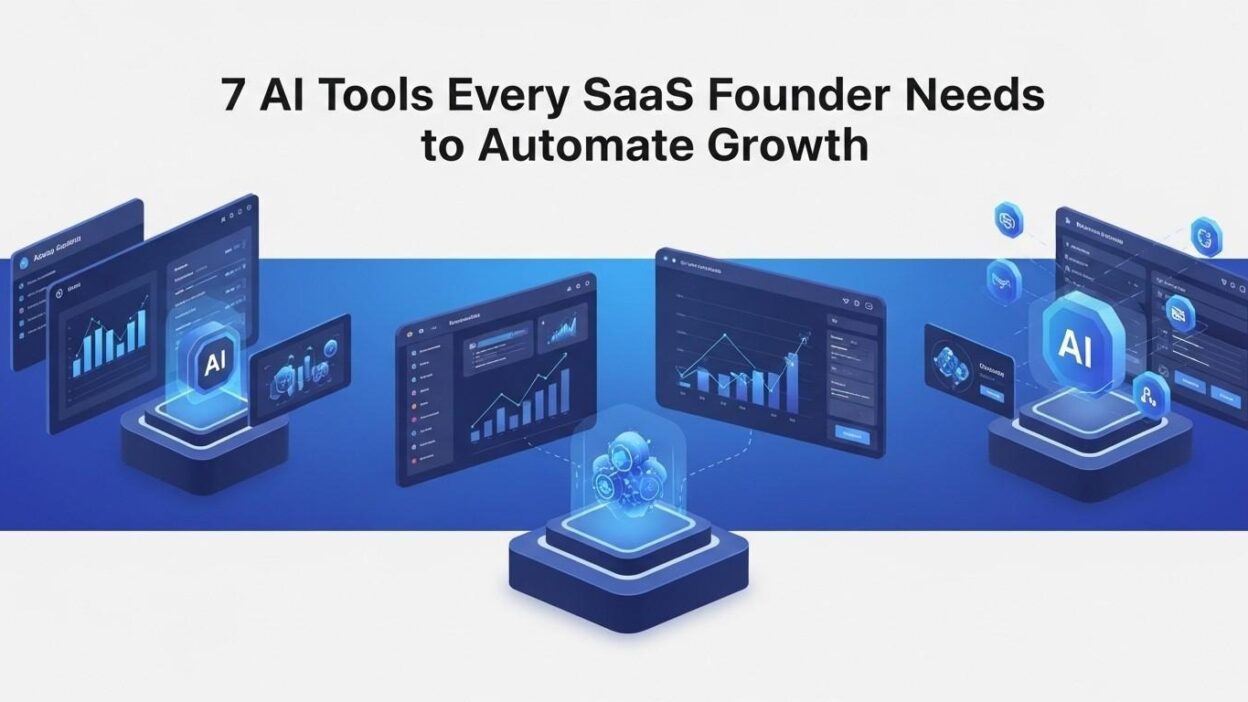
This comprehensive guide identifies seven essential AI tools that transform SaaS operations. Each tool addresses critical growth challenges that founders face daily. We’ll explore specific use cases, implementation strategies, and expected outcomes. You’ll discover how AI automation frees your time for high-impact activities.
Real-world examples demonstrate how successful SaaS companies use these tools. Practical implementation advice helps you deploy quickly and effectively. By the end, you’ll have a clear roadmap for automating growth. Your SaaS business can scale faster with fewer resources than traditional approaches require.
Table of Contents
Why SaaS Founders Need AI-Powered Automation
SaaS businesses operate with unique constraints that demand efficiency. Recurring revenue models require consistent customer acquisition and retention. Churn directly impacts long-term viability and valuation multiples. Every operational inefficiency drains resources from critical growth activities.
Traditional hiring doesn’t scale economically for early-stage companies. Adding headcount increases burn rate and extends runway risk. Bootstrapped founders need maximum output from minimal teams. AI tools for SaaS founders provide leverage that human hiring cannot match.
Customer expectations continue rising across all service dimensions. Response times, personalization, and feature velocity all face constant pressure. Competitors using AI raise the bar for everyone else. Manual processes create competitive disadvantages that compound over time.
Data volumes grow exponentially as SaaS businesses scale. Customer interactions, usage metrics, and market signals multiply constantly. Human analysis cannot keep pace with information flows. AI tools extract insights that would otherwise remain hidden.
Speed to market determines success in crowded SaaS categories. First movers capture market share and mindshare advantages. Development cycles must compress without sacrificing quality. Automation accelerates iteration while maintaining consistency.
Resource allocation becomes increasingly complex as companies grow. Determining where to invest time and money requires sophisticated analysis. AI tools for SaaS founders provide data-driven recommendations. Gut feelings get replaced with algorithmic precision.
The compounding effects of automation create exponential advantages. Small efficiency gains multiply across thousands of interactions. Automated systems improve continuously through machine learning. Your competitive moat deepens with every optimization cycle.
AI Tool #1: Intelligent Customer Support Automation
Customer support represents one of the highest-leverage automation opportunities. Support requests grow linearly with customer base expansion. Traditional support models require proportional staffing increases. AI-powered systems handle volume without corresponding cost growth.
Intercom leads the market for AI-powered customer messaging platforms. The system combines chatbots, help articles, and human handoff seamlessly. Natural language processing understands customer intent accurately. Common questions get resolved instantly without human intervention.
The AI learns from every customer interaction continuously. Response accuracy improves as the knowledge base expands. Custom training on your specific product documentation enhances relevance. The system understands context from previous conversations automatically.
Implementation starts with importing existing help documentation. The AI analyzes content and creates conversational flows. You customize the bot’s personality to match your brand voice. Integration with your product takes hours rather than weeks.
Resolution rates for common queries exceed 70% without human involvement. Customers receive instant answers regardless of time zones. Your support team focuses exclusively on complex issues. First response times drop from hours to seconds.
Zendesk offers similar AI capabilities with robust ticket management. Their Answer Bot suggests solutions before customers even ask. Machine learning predicts which articles solve specific problems. The system gets smarter with every resolved ticket.
Cost savings become substantial as support volume scales. One support agent can manage 10x more customers with AI assistance. The technology pays for itself within the first month typically. Customer satisfaction scores improve despite reduced human touchpoints.
Advanced features include sentiment analysis and escalation triggers. The AI detects frustrated customers and prioritizes their tickets. Proactive outreach happens when usage patterns indicate problems. Churn prevention starts before customers even complain.
AI Tool #2: Predictive Analytics for Churn Prevention
Customer retention directly determines SaaS business sustainability. Losing customers costs far more than acquiring them initially. Early churn signals often go unnoticed until too late. AI tools for SaaS founders identify at-risk accounts proactively.
ChurnZero specializes in customer success automation for SaaS companies. The platform analyzes product usage patterns continuously. Machine learning algorithms identify behavioral changes that predict churn. Alerts trigger before customers decide to cancel.
The system tracks engagement across dozens of dimensions. Login frequency, feature adoption, and support ticket patterns all matter. Declining usage signals disengagement weeks before cancellation. Your customer success team receives prioritized intervention lists.
Automated playbooks execute based on risk scores. At-risk customers receive targeted email campaigns automatically. Feature tutorials appear when adoption lags. Personal outreach from account managers gets triggered strategically.
Gainsight provides enterprise-grade customer success capabilities. Their AI predicts renewal likelihood with remarkable accuracy. The platform integrates data from multiple sources comprehensively. CRM, product analytics, and support tickets combine for complete visibility.
Health scores update in real-time as behaviors change. Green accounts require minimal attention and resources. Yellow accounts enter automated nurture sequences. Red accounts get immediate human intervention.
Expansion opportunities surface alongside retention risks. The AI identifies customers ready for upsells or cross-sells. Usage patterns reveal when additional seats make sense. Revenue optimization happens automatically across your customer base.
Implementation requires connecting your product analytics and CRM. The AI needs historical data to establish baseline patterns. Initial setup takes a few days but delivers immediate insights. Your customer success strategy transforms from reactive to proactive.
Results typically show 20-30% churn reduction within six months. Lifetime value increases as retention improves. Customer success teams become dramatically more efficient. Revenue predictability improves with better retention forecasting.
AI Tool #3: Content Creation and Marketing Automation
Content marketing drives awareness and inbound leads for SaaS companies. Consistent publishing requires substantial time and creative resources. Quality cannot suffer despite volume demands. AI tools for SaaS founders accelerate content production significantly.
Jasper AI generates marketing copy across multiple formats. Blog posts, social media updates, and email campaigns all get automated. The system understands SaaS positioning and value propositions. Brand voice customization ensures consistency across all content.
You provide topic ideas and key points to cover. The AI researches and drafts complete articles within minutes. Editing refines the output rather than creating from scratch. Content volume increases 5-10x with the same team size.
SEO optimization happens automatically during content creation. Keyword research, meta descriptions, and heading structure get handled. Search rankings improve as content velocity accelerates. Organic traffic grows without proportional content team expansion.
Copy.ai focuses specifically on short-form marketing copy. Ad headlines, email subject lines, and CTAs get generated rapidly. A/B testing multiple variations becomes trivial. Performance data feeds back to improve future generations.
The platform integrates with major advertising platforms directly. Campaign creation accelerates from days to hours. Testing velocity increases, improving conversion rates. Marketing teams focus on strategy rather than execution.
Social media management benefits enormously from AI assistance. Buffer and Hootsuite now incorporate AI writing features. Posting schedules optimize based on engagement patterns. Content repurposing happens automatically across platforms.
Video content creation leverages AI tools like Synthesia. Talking head videos get generated from text scripts. No cameras, studios, or actors required. Product tutorials and explainer videos scale economically.
The combined effect transforms marketing productivity. Small teams produce enterprise-level content volumes. Lead generation accelerates as content footprint expands. AI tools for SaaS founders level the marketing playing field.
AI Tool #4: Sales Automation and Lead Scoring
Sales processes contain numerous repetitive, time-consuming tasks. Lead qualification, outreach sequencing, and follow-ups drain sales capacity. Manual prioritization leads to missed opportunities regularly. AI automation optimizes every stage of the sales funnel.
Gong.io revolutionizes sales team performance through conversation intelligence. The platform records and analyzes all customer calls. Natural language processing extracts insights from every conversation. Win rates improve as teams learn from top performers.
The AI identifies which talking points correlate with closed deals. Objection handling techniques get scored and shared. New sales reps ramp faster by studying successful patterns. Coaching becomes data-driven rather than subjective.
Deal risk assessment happens automatically based on conversation analysis. The system detects buyer hesitation and competitive concerns. Sales managers receive alerts when deals need intervention. Forecast accuracy improves dramatically with AI insights.
Drift combines chatbots with intelligent lead routing. Website visitors get qualified through conversational interfaces. High-intent prospects connect with sales reps immediately. Low-quality leads enter nurture campaigns automatically.
The AI learns which visitor behaviors indicate purchase intent. Pricing page visits, competitor comparison research, and demo requests all matter. Lead scoring happens in real-time rather than batch processing. Your sales team talks exclusively to qualified opportunities.
Calendaring automation eliminates scheduling friction completely. The bot handles meeting booking without human involvement. Time zone conversions and availability matching happen instantly. Conversion rates improve when friction disappears.
Outreach.io automates sales sequences across multiple channels. Email, phone, and LinkedIn touchpoints get orchestrated systematically. The AI optimizes send times based on recipient behavior. Response rates increase while manual effort decreases.
A/B testing runs continuously on messaging and timing. The system identifies winning variations automatically. Personalization scales through AI-powered variable insertion. Each prospect receives customized outreach at massive scale.
Sales productivity metrics improve across all dimensions. Reps spend more time in actual conversations. Administrative tasks consume minimal attention. Pipeline velocity accelerates as friction points disappear.
AI Tool #5: Product Development and User Feedback Analysis
Understanding customer needs drives successful product development. User feedback arrives through numerous channels constantly. Manual analysis misses patterns and buries insights. AI tools for SaaS founders surface actionable product intelligence.
Productboard aggregates feedback from all customer touchpoints. Support tickets, sales calls, surveys, and social media all feed in. Natural language processing categorizes requests automatically. Feature demand becomes quantifiable rather than anecdotal.
The AI identifies themes across thousands of customer comments. Common pain points surface without manual review. Your product roadmap aligns with actual user needs. Development resources get allocated based on data rather than opinions.
Prioritization frameworks incorporate multiple scoring dimensions. Customer value, strategic alignment, and effort estimates all contribute. The system recommends which features deliver maximum impact. Roadmap decisions become objective and defensible.
Pendo provides product analytics with AI-powered insights. User behavior tracking reveals how customers actually use your software. Feature adoption metrics identify what delivers value. Unused features get flagged for potential removal.
The platform detects unusual usage patterns automatically. Power users get identified for case study opportunities. Struggling users trigger intervention workflows. Your product team understands real-world usage completely.
In-app guidance systems deploy based on behavior triggers. New users receive contextual tutorials automatically. Advanced features get promoted to qualified users. Adoption rates improve without increasing support burden.
Amplitude offers sophisticated behavioral cohort analysis. The AI identifies user segments with different needs. Personalization becomes possible at scale. Product experiences adapt to user types automatically.
Funnel analysis reveals where users encounter friction. Drop-off points get prioritized for optimization. A/B testing validates improvements before full deployment. Conversion rates improve systematically through data-driven iteration.
Session replay functionality shows exactly what users experience. Bugs and confusion points become immediately obvious. Your development team fixes issues they didn’t know existed. Product quality improves continuously through AI-assisted observation.
AI Tool #6: Financial Forecasting and Business Intelligence
Financial planning requires accurate data and predictive modeling. Revenue forecasts determine hiring, spending, and strategic decisions. Manual spreadsheet modeling introduces errors and delays. AI tools for SaaS founders deliver real-time financial intelligence.
Baremetrics specializes in SaaS metrics and financial analytics. The platform connects directly to payment processors. MRR, churn, LTV, and CAC calculations happen automatically. Beautiful dashboards make complex metrics accessible.
Forecasting models predict revenue based on historical patterns. The AI accounts for seasonality and growth trends. Multiple scenarios show best-case, worst-case, and expected outcomes. Board presentations become data-rich and compelling.
Cohort analysis reveals retention patterns across customer groups. You understand which acquisition channels deliver best lifetime value. Marketing spend optimization becomes possible with clear attribution. Every dollar gets allocated more effectively.
Profitwell offers free subscription analytics with AI-powered insights. The system benchmarks your metrics against similar companies. You discover whether performance is exceptional or concerning. Competitive context informs strategic adjustments.
Pricing optimization recommendations come from analyzing customer behavior. The AI identifies willingness to pay across segments. Revenue recovery happens through better pricing strategies. Packaging changes get tested systematically.
Causal provides financial modeling specifically for startups. The platform handles complex SaaS economics elegantly. Hiring plans, burn rate projections, and runway calculations update dynamically. Scenario planning becomes interactive rather than static.
Sensitivity analysis shows which variables impact outcomes most. You understand leverage points in your business model. Strategic focus areas become clear from quantitative analysis. AI tools for SaaS founders remove guesswork from planning.
Investor reporting automation saves countless hours monthly. Metrics packages generate automatically for board meetings. Consistent formatting and calculations prevent embarrassing errors. Your time goes toward insight rather than data compilation.
Alert systems notify you when metrics deviate from expectations. Churn spikes, conversion drops, and expansion slowdowns trigger immediately. Proactive management replaces reactive firefighting. Your business intelligence becomes genuinely intelligent.
AI Tool #7: Recruitment and Team Building Automation
Hiring the right team members determines SaaS success fundamentally. Recruitment consumes enormous founder time and attention. Candidate sourcing, screening, and assessment all require human effort. AI automation accelerates hiring without sacrificing quality.
Hired uses AI to match companies with pre-vetted candidates. The platform understands technical requirements and cultural fit. Candidate profiles arrive with compatibility scores. Your pipeline fills with qualified prospects automatically.
Initial screening happens through AI-powered assessments. Technical skills get validated before human interviews. Culture fit indicators reduce bad hire risk. Time-to-hire compresses dramatically with qualified candidates.
SeekOut specializes in diverse candidate sourcing. The AI searches beyond traditional job boards. Passive candidates get identified through advanced algorithms. Your talent pool expands exponentially with better targeting.
Interviewing assistance comes from tools like BrightHire. The platform records and transcribes all candidate conversations. AI analysis identifies red flags and strengths. Hiring decisions become data-informed rather than gut-based.
Structured interview frameworks ensure consistency across candidates. The system prompts interviewers with relevant questions. Scoring rubrics eliminate subjective bias. Your hiring process becomes defensible and fair.
Reference checking automation removes tedious follow-up work. AI tools gather feedback from previous employers systematically. Verification happens faster and more thoroughly. Background insights inform final decisions.
Onboarding workflows trigger automatically when candidates accept. Documentation, equipment, and access provisioning happen seamlessly. New hires become productive faster with structured programs. AI tools for SaaS founders extend beyond hiring into retention.
Employee engagement monitoring detects satisfaction issues early. Pulse surveys and sentiment analysis identify problems. Retention improves when concerns get addressed proactively. Your team stays intact longer with predictive management.
Talent analytics reveal hiring patterns and outcomes. You understand which sources deliver best performers. Recruitment strategies improve based on historical data. Every hire gets smarter than the last.
Implementation Strategy for AI Tools
Starting with a single high-impact tool prevents overwhelm. Identify your biggest operational bottleneck currently. Choose the AI solution that addresses it specifically. Master one tool before adding others.
Integration planning ensures smooth deployment across your stack. Map data flows between existing systems and new tools. API connections enable seamless information sharing. Your technology ecosystem works together coherently.
Team training determines adoption success or failure. Invest time teaching proper tool usage. Share best practices and use cases regularly. Champions within your team accelerate organization-wide acceptance.
Measurement frameworks prove ROI and guide optimization. Define success metrics before implementation. Track performance changes rigorously. Data validates whether tools deliver promised benefits.
Iteration improves results as you learn system capabilities. Start with basic features and expand gradually. Advanced functionality becomes accessible through experience. Your sophistication grows alongside tool mastery.
Budget allocation should prioritize tools with clearest ROI. Calculate expected time savings and revenue impact. Some AI tools for SaaS founders pay for themselves immediately. Others deliver strategic value that justifies investment.
Vendor relationships matter for long-term success. Choose companies with strong customer support. Active product development ensures continuous improvement. Your tools evolve as your needs change.
Measuring ROI from AI Tool Investments
Time savings translate directly to founder productivity. Calculate hours recovered from automated tasks. Multiply by your effective hourly value. Most AI tools for SaaS founders justify costs within weeks.
Revenue impact comes from improved conversion and retention. Track metric changes before and after implementation. Attribution may be imperfect but directional clarity emerges. Growth acceleration validates investment decisions.
Cost reduction happens through operational efficiency. Support automation, content creation, and recruitment all cut expenses. Compare pre-automation costs to current spending. Savings compound as scale increases.
Team productivity improvements boost output without headcount. Measure deliverables per person before and after automation. Small teams punch above their weight class. Your competitive position strengthens relative to larger competitors.
Customer satisfaction scores often improve with AI implementation. Faster responses, better insights, and proactive service all matter. NPS and CSAT metrics reflect automation quality. Happy customers stay longer and refer more.
Quality consistency represents a subtle but important benefit. AI tools never have bad days or lapses. Performance stays uniformly high across all interactions. Reliability builds trust with customers and team members.
Strategic time liberation enables founder focus on growth. Less operational firefighting means more strategic thinking. Your highest-value activities get appropriate attention. Business trajectory improves when founders think rather than execute.
Read More:-How to Use AI to Summarize 100+ Meetings Weekly
Conclusion

AI tools for SaaS founders have evolved from experimental to essential. The seven categories covered address critical growth challenges. Customer support, retention, marketing, sales, product, finance, and hiring all benefit enormously. Automation creates leverage that manual processes cannot match.
Smart implementation starts with identifying your biggest constraint. Choose tools that directly address that bottleneck. Master individual solutions before expanding your AI stack. Integration across tools amplifies benefits exponentially.
The competitive landscape demands AI adoption increasingly. Companies using automation outpace those relying on manual processes. Early adopters establish advantages that compound over time. Waiting increases the difficulty of catching up later.
ROI calculations justify investment in quality AI tools. Time savings, revenue growth, and cost reduction all contribute. Most tools pay for themselves within the first quarter. Long-term value creation extends far beyond initial returns.
Your SaaS business deserves technology that accelerates growth. AI tools for SaaS founders remove operational friction systematically. Small teams accomplish what previously required large organizations. The playing field levels when automation provides leverage.
Customer expectations will continue rising across all dimensions. Speed, personalization, and quality all face constant pressure. AI enables meeting these expectations profitably. Manual approaches increasingly struggle to compete.
The seven tools outlined provide comprehensive growth automation. Support, retention, marketing, sales, product, finance, and hiring all improve. Each category contains proven solutions with track records. Your implementation roadmap can start immediately.
Future success requires embracing AI strategically. Founders who automate intelligently will lead their markets. Those who resist will find themselves at disadvantages. The choice between growth and stagnation becomes clear.
Start your AI automation journey today. Select the tool addressing your most pressing challenge. Implement thoroughly and measure results rigorously. Build from success to success systematically.
Your SaaS business has unlimited potential with proper leverage. AI tools for SaaS founders provide that crucial multiplication factor. Growth acceleration happens when technology amplifies human effort. The future belongs to founders who embrace these powerful capabilities.