Introduction
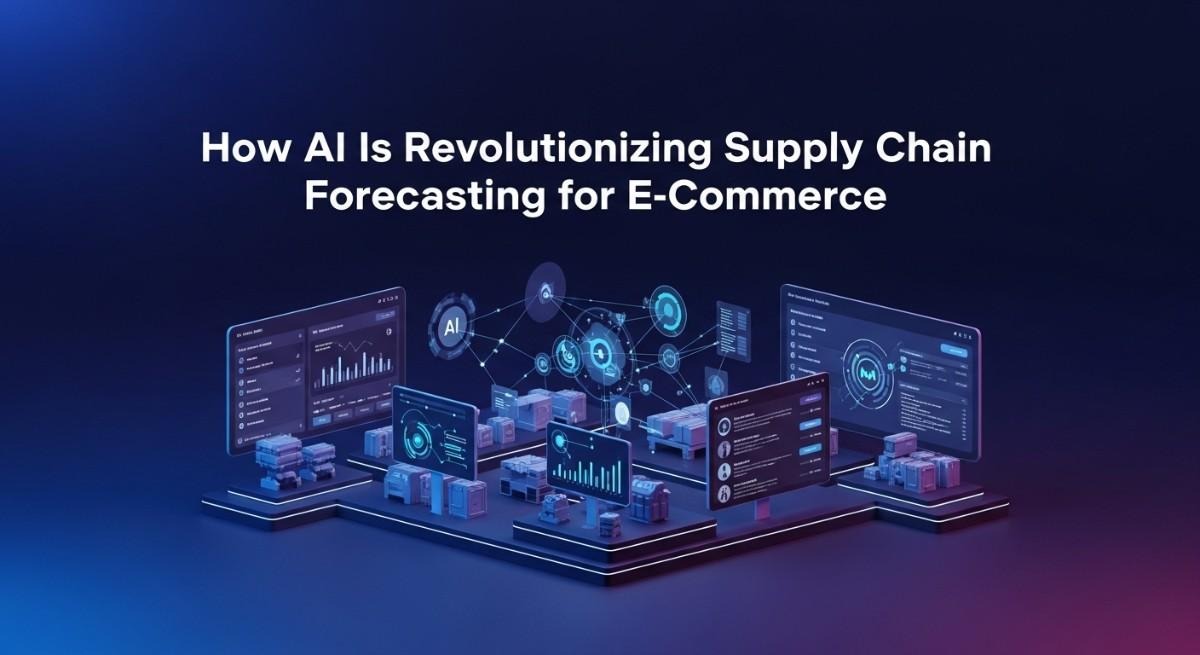
TL;DR E-commerce moves fast. Customer expectations shift overnight. Seasonal spikes arrive without mercy. Traditional supply chain planning tools were never built for this kind of velocity. They rely on historical averages. They assume stable patterns. Real e-commerce demand does not work that way. AI supply chain forecasting for e-commerce solves the problem that spreadsheets and legacy ERP systems cannot. It reads signals that humans miss. It adapts in real time. It turns supply chain management from a reactive cost center into a competitive advantage.
Table of Contents
The Real Problem With Traditional Supply Chain Forecasting
Legacy forecasting methods share a fundamental flaw. They look backward to predict forward. A demand planner reviews last year’s sales data. She identifies seasonal trends. She applies a growth factor. She creates a forecast. That forecast sits in a spreadsheet until the next planning cycle. By the time reality diverges from the plan, the organization is already overcommitted on inventory it cannot move or scrambling to fulfill demand it did not anticipate.
The e-commerce environment makes this worse. A viral TikTok video can triple demand for a product in 48 hours. A competitor going out of stock can shift thousands of orders to your catalog overnight. A supply disruption on the other side of the world can empty your warehouse before your reorder point triggers. Traditional forecasting has no mechanism to detect or respond to any of these signals.
The consequences are measurable and painful. Overstocking drives up carrying costs and forces margin-eroding promotions. Stockouts destroy customer trust and hand revenue to competitors permanently. Research consistently shows that poor inventory management costs retail and e-commerce businesses between 3 and 8 percent of annual revenue. AI supply chain forecasting for e-commerce directly attacks this waste.
How AI Fundamentally Changes Demand Forecasting
AI-powered forecasting does not replace human judgment. It gives human planners vastly superior information to act on. The core difference is signal breadth and processing speed. AI systems ingest hundreds of data streams simultaneously. They identify patterns across dimensions that no human team could track manually.
Machine Learning Models That Adapt Continuously
Traditional forecasting models are static. You build them, deploy them, and revisit them quarterly or annually. Machine learning models update with every new data point. A model tracking a product’s demand pattern sees every sale, every return, every browse-to-cart conversion, and every abandoned cart event. It recalibrates its predictions based on what happened yesterday, not what happened last year.
Gradient boosting algorithms like XGBoost and LightGBM excel at capturing complex, non-linear demand relationships across many variables. Deep learning models including LSTM networks handle long-range temporal dependencies in time-series data. Transformer-based architectures now power some of the most accurate demand forecasting systems available. Each model type brings different strengths. The best AI supply chain forecasting for e-commerce systems combine multiple model types and weight their outputs based on recent performance.
External Signal Integration
Internal sales data tells you what happened. External signals tell you what is about to happen. AI forecasting systems pull in weather data, social media sentiment, search trend volume, competitor pricing, news event feeds, and macroeconomic indicators. They find correlations between these external signals and demand shifts for specific product categories.
A sporting goods e-commerce company might discover that search volume for hiking gear rises sharply two weeks before typical purchase conversion. The AI model learns this lead time. It begins adjusting inventory recommendations three weeks ahead of the expected demand spike. No human planner could monitor search trends, weather forecasts, and social sentiment simultaneously for thousands of SKUs. AI does this as a matter of routine.
Probabilistic Forecasting Instead of Point Estimates
Traditional forecasts give you a single number. Sell 500 units next month. That number is almost never exactly right. The question is how wrong it will be and in which direction. AI forecasting systems generate probability distributions instead of point estimates. They tell you there is a 70 percent chance demand falls between 420 and 580 units, a 20 percent chance it exceeds 580 units, and a 10 percent chance it falls below 420.
This probabilistic output changes how you stock and plan. You set safety stock levels based on your risk tolerance and the cost of a stockout versus the cost of overstock. You make explicit decisions about uncertainty rather than pretending the forecast is accurate. This is a more honest and more profitable way to manage inventory. AI supply chain forecasting for e-commerce makes this rigorous probabilistic approach accessible without requiring a team of statisticians.
Key Areas Where AI Transforms E-Commerce Supply Chains
The impact of AI forecasting extends far beyond inventory levels. It reshapes how e-commerce businesses plan across the entire supply chain operation.
Dynamic Inventory Positioning
Multi-warehouse e-commerce operations face a constant positioning problem. Which products should sit in which fulfillment centers? Getting this wrong means shipping from across the country when the customer is next door. Shipping costs balloon. Delivery times suffer. Customer satisfaction drops.
AI forecasting systems model regional demand patterns at the SKU level. They recommend how to distribute inventory across fulfillment network nodes before demand materializes. A winter apparel brand using AI supply chain forecasting for e-commerce knows two weeks in advance that a cold front is tracking toward the Northeast. The system recommends pre-positioning cold-weather inventory in Northeast fulfillment centers before the demand surge hits. Orders ship next-day instead of cross-country.
Supplier Lead Time Optimization
Supplier lead times are rarely as consistent as purchase order terms suggest. A supplier rated for 14-day lead time might deliver in 10 days during slow periods and 22 days during peak manufacturing seasons. Traditional planning systems use a single average lead time assumption. They get burned repeatedly during the high-demand periods when lead times stretch.
AI systems track actual supplier performance over hundreds of orders. They build dynamic lead time models that adjust based on order size, time of year, and current market conditions. When an AI forecasting system detects that a supplier’s lead times are trending longer, it triggers earlier reorder points automatically. The business maintains service levels without holding excessive safety stock year-round.
Promotion and Markdown Planning
Promotional events create demand spikes that are notoriously difficult to forecast. How much will a 20 percent discount lift demand for a product that has never been discounted before? Traditional methods rely on category-level averages and planner intuition. AI models train on thousands of past promotional events across similar products, price points, customer segments, and timing. They generate promotion-adjusted demand forecasts with considerably higher accuracy.
Markdown optimization is equally powerful. AI forecasting systems model how demand responds to successive price reductions over a clearance cycle. They recommend the optimal markdown schedule to sell through aging inventory at the highest possible average selling price. This capability alone can recover millions of dollars in margin for large e-commerce catalogues. AI supply chain forecasting for e-commerce turns markdown decisions from gut calls into data-driven strategies.
Returns Forecasting and Reverse Logistics
E-commerce return rates average 20 to 30 percent across most categories and exceed 40 percent in fashion. Returns create a secondary supply chain problem that most forecasting systems ignore entirely. Returned inventory must be inspected, restocked, discounted, or disposed of. The timing and volume of returns affect available inventory counts just as dramatically as sales do.
AI models predict return rates at the product and order level. They identify which customers, products, and promotional contexts generate the highest return rates. They incorporate expected returns into net inventory projections. A fulfillment center manager using AI supply chain forecasting for e-commerce knows that 2,000 units sold during a promotional event will likely generate 600 returns over the following three weeks. She plans inspection capacity and restocking workflows accordingly.
Real Business Results From AI Supply Chain Forecasting
The business case for AI forecasting is well-established across multiple industry segments. Real deployments produce measurable results worth examining.
Fashion E-Commerce: Taming SKU Complexity
A mid-sized fashion e-commerce retailer carried 45,000 active SKUs across eight product categories. Their planning team of six people physically could not manage forecast accuracy at the SKU level. They planned at the category level and let store-level allocation algorithms handle individual SKUs. The result was chronic overstock in slow-moving colorways and frequent stockouts in best-sellers.
After implementing an AI supply chain forecasting platform for their e-commerce operations, the retailer achieved SKU-level forecast accuracy improvements of 34 percent within six months. Inventory carrying costs fell by 18 percent. Stockout rate dropped from 12 percent to under 4 percent. The planning team shifted from managing spreadsheets to reviewing AI-generated exception reports and focusing on strategic decisions. The same team produced dramatically better outcomes with less manual effort.
Consumer Electronics: Navigating Launch Uncertainty
Consumer electronics e-commerce faces acute forecasting challenges around product launches. New products have no sales history. Traditional models fail completely. AI approaches tackle this cold-start problem by transferring knowledge from similar past launches. The model analyzes how comparable products launched in previous cycles, how social sentiment and pre-order signals correlated with actual demand, and how the broader product category behaved.
One consumer electronics e-commerce operator reduced launch-week stockout incidents by 41 percent after deploying AI supply chain forecasting for their e-commerce catalog. They avoided the dual humiliation of failing to meet launch demand and holding excess inventory of slow-moving configurations. Their return on the forecasting investment came in under 11 months.
How to Implement AI Forecasting in Your E-Commerce Business
Implementing AI forecasting is a business transformation project, not a software installation. Understanding the journey before you start prevents costly missteps.
Start With Data Quality and Integration
AI models are only as good as the data they train on. Before you evaluate vendors or select algorithms, audit your data quality. Do your sales records capture every transaction accurately? Are your product catalogs clean and consistently categorized? Do you track inventory positions in real time or only at day-end? Are your supplier lead time records stored in a queryable system or buried in emails?
Data quality issues will surface during implementation regardless of when you find them. Finding them earlier makes them cheaper to fix. Many e-commerce businesses discover during the AI forecasting implementation process that their foundational data is messier than they realized. Budget time and resources for data remediation as part of the project plan.
Choose the Right Implementation Approach
E-commerce businesses face three implementation paths for AI supply chain forecasting. The first option is purchasing a purpose-built AI forecasting platform from a vendor specializing in e-commerce supply chain. This is the fastest path to value and the lowest technical burden. Vendors like Blue Yonder, o9 Solutions, Relex, and Kinaxis offer mature platforms with strong e-commerce track records.
The second option is building on cloud ML platforms like AWS SageMaker, Google Vertex AI, or Azure Machine Learning. This path requires a data science team but offers full customization. The third option is an internal build using open-source libraries. This is the most flexible and most resource-intensive path. Most e-commerce businesses below enterprise scale choose the vendor platform route for AI supply chain forecasting. The time-to-value and total cost of ownership favor proven platforms over custom builds.
Build a Change Management Plan
The technology is often the easy part. The hard part is getting your planning team to trust and act on AI-generated forecasts. Planners who built their careers on intuition and experience will resist a system telling them their judgment is suboptimal. This resistance is natural and understandable. It must be addressed directly.
Involve your planning team in the implementation from the beginning. Show them the AI’s reasoning, not just its outputs. Design workflows where planners review AI recommendations and apply their contextual knowledge as overrides when appropriate. Track override accuracy over time and give planners transparent feedback on which overrides improved outcomes and which did not. This creates a learning loop that builds trust in the AI system while respecting planner expertise.
Frequently Asked Questions About AI Supply Chain Forecasting for E-Commerce
How much data do I need to start using AI forecasting?
Most AI forecasting platforms recommend at least 12 to 24 months of historical transaction data at the SKU level for meaningful model training. Shorter histories produce less accurate models. However, some platforms use transfer learning techniques to bootstrap new products or businesses with limited data. If your catalog has significant new product introduction frequency, ask vendors specifically how they handle cold-start forecasting. Data volume requirements vary by product category, seasonality, and the granularity of forecasting you need.
What is the typical ROI timeline for AI supply chain forecasting for e-commerce?
Most e-commerce businesses achieve positive ROI from AI supply chain forecasting within 12 to 18 months of full deployment. Implementation typically takes 3 to 6 months depending on data readiness and integration complexity. Early wins in inventory reduction and stockout rate improvement often generate savings that offset first-year platform costs. Businesses with high SKU counts, strong seasonality, or significant promotional activity tend to see the fastest returns because those are exactly the conditions where AI forecasting outperforms traditional methods most dramatically.
Can small e-commerce businesses benefit from AI forecasting?
Yes, but the economics look different at different scales. Enterprise AI forecasting platforms carry price points that require large inventory values to justify. Small e-commerce businesses under $10 million in revenue often find better value in mid-market solutions or in AI features embedded within their existing e-commerce platform or inventory management system. Shopify, NetSuite, and similar platforms increasingly incorporate AI-driven demand sensing into their native tools. Start there before evaluating standalone AI supply chain forecasting platforms.
How does AI forecasting handle unpredictable events like the COVID-19 pandemic?
Black swan events expose the limits of any forecasting system. No model trained on pre-pandemic data predicted the 2020 demand collapse in travel and hospitality or the demand explosion in home fitness equipment. AI systems recover faster from these disruptions than traditional models because they detect the divergence from historical patterns earlier and adapt more quickly. The best AI supply chain forecasting for e-commerce platforms include scenario planning tools that let planners define alternative demand assumptions and model inventory implications under different recovery timelines.
Does AI forecasting eliminate the need for human supply chain planners?
No. AI forecasting changes what planners do rather than eliminating them. Manual SKU-level data entry and basic trend calculation become unnecessary. Strategic thinking, supplier relationship management, exception handling, and new product planning require human judgment that AI systems do not replicate. Companies that implement AI supply chain forecasting for e-commerce successfully tend to keep their planning teams and redirect them toward higher-value activities. Planner productivity rises. Decision quality improves. The team does more with the same or smaller headcount.
What integrations are required for AI supply chain forecasting?
At minimum, your AI forecasting system needs integration with your order management system, your inventory management system, and your product catalog. These three data sources give the model the core signals it needs. Additional value comes from integrations with your marketing calendar and promotions system, your ERP for supplier and purchase order data, and external data providers for weather, search trends, and competitor signals. Each additional data source improves forecast accuracy. Prioritize integrations based on which ones address your most significant forecasting failures today.
Challenges You Will Face and How to Address Them
Implementing AI supply chain forecasting for e-commerce is not without friction. Knowing the common challenges before they arrive helps you navigate them faster.
Model Explainability and Planner Trust
Complex machine learning models can feel like black boxes. Planners who cannot understand why the model recommends a specific inventory level will not trust it. They will override it constantly. The value of the AI investment erodes. Address this by selecting platforms that provide forecast explainability features. The best AI supply chain forecasting platforms for e-commerce show which factors drove each forecast and how much weight each factor carried. Transparency builds the trust that makes AI-generated recommendations actionable.
Data Silos That Block Integration
Many e-commerce businesses store supply chain data in disconnected systems. Inventory lives in one system. Orders live in another. Supplier data lives in a spreadsheet. Marketing calendars exist in a third platform that no one has connected to anything. Integrating these sources requires IT investment and organizational coordination. It is unglamorous work. It is also the work that determines whether your AI forecasting system reaches its potential. Budget for integration infrastructure before you sign the AI platform contract.
Managing Model Drift Over Time
AI models degrade when the world changes in ways they were not trained on. A model trained on pre-pandemic consumer behavior needs retraining to perform accurately in post-pandemic demand patterns. A business that shifts its product mix or enters a new geographic market needs to update its forecasting models accordingly. Schedule regular model performance reviews. Track forecast accuracy metrics on a rolling basis. Set automated alerts when model accuracy drops below defined thresholds. Treat AI forecasting maintenance as an ongoing operational discipline rather than a one-time implementation.
Read More:-Step-by-Step Guide to Fine-Tuning Llama 3 for Niche Industry Documentation
Conclusion

E-commerce is an intensely competitive business. Margins are thin. Customer loyalty is fragile. Supply chain performance is a genuine differentiator. The company that stocks the right products in the right places at the right times wins customer trust and sustains healthier margins than its less-prepared competitors.
AI supply chain forecasting for e-commerce is no longer experimental technology reserved for Fortune 500 retailers with eight-figure IT budgets. It is a practical, accessible capability available through cloud-based platforms at price points that mid-market and even growth-stage e-commerce businesses can justify. The barriers to entry have fallen dramatically over the past three years.
The businesses waiting for perfect conditions before they start are watching their competitors widen a capability gap that grows harder to close with every passing quarter. Your competitors are generating better forecasts. They are reducing stockouts. They are turning inventory faster. They are shipping from closer fulfillment points. All of this shows up in their margins and their customer satisfaction scores.
The path forward is clear. Start with your data quality. Identify your highest-impact forecasting failures. Evaluate platforms that address those specific failures. Build a business case with realistic ROI expectations. Invest in the change management that makes AI recommendations actionable. Deploy, measure, and improve.
AI supply chain forecasting for e-commerce will not solve every supply chain problem. It will solve the ones that matter most — the ones that cost you revenue, margin, and customer loyalty every single month you operate without it. The technology is ready. The question is whether your business is ready to use it.