Introduction
TL;DR Artificial intelligence promises to transform business operations. Companies rush to deploy machine learning models and chatbots. Executives announce ambitious AI initiatives at board meetings. Most of these projects fail spectacularly within the first year.
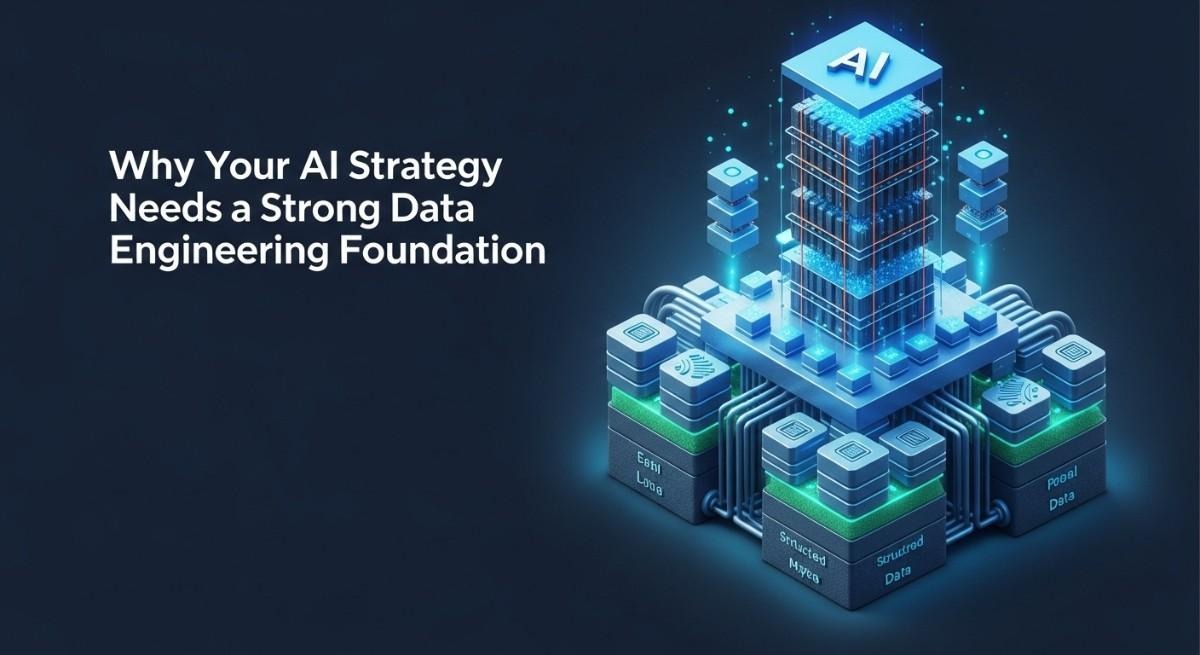
The problem isn’t the AI technology itself. Poor data foundations doom projects before they begin. Your AI strategy data engineering foundation determines success more than algorithm selection ever will. Clean, accessible, well-organized data enables AI to deliver value. Messy, siloed, unreliable data guarantees expensive failures.
This comprehensive guide explains why data engineering must precede AI implementation. You’ll discover what strong foundations look like and how to build them. Let’s explore the unglamorous infrastructure that makes glamorous AI possible.
Table of Contents
The Hidden Reality Behind AI Project Failures
Industry statistics paint a sobering picture of AI implementation success rates. Gartner research shows 85% of AI projects fail to deliver expected business value. VentureBeat found that 87% of data science projects never make it to production. These failures waste billions in corporate investment annually.
Executive teams blame technology immaturity or talent shortages. The real culprit hides in plain sight. Data quality, accessibility, and infrastructure problems kill far more projects than algorithm limitations. Companies try running before they can walk.
A Fortune 500 retailer invested $12 million in a customer recommendation AI. The project collapsed after 18 months of development. The machine learning models worked perfectly in testing. Production deployment revealed customer data spread across 47 disconnected systems. No one had mapped data relationships or established integration patterns. The AI couldn’t access the information it needed to function.
Why Companies Underestimate Data Engineering
Data engineering lacks the excitement surrounding artificial intelligence. Machine learning conferences draw thousands while data pipeline discussions attract dozens. Media coverage focuses on AI breakthroughs rather than database optimization. This attention imbalance creates dangerous misconceptions.
Companies budget millions for AI talent and tools. Data engineering receives whatever remains after sexier spending. Organizations hire ten data scientists before employing their first data engineer. The imbalance guarantees frustration as scientists spend 80% of their time wrangling data instead of building models.
Cultural factors compound the problem. Executives understand business strategy and recognize AI’s potential. Few grasp the technical complexity of modern data infrastructure. They assume existing IT systems provide adequate foundations. This assumption proves catastrophically wrong in most cases.
The True Cost of Poor Data Foundations
Projects limp forward on inadequate infrastructure consuming time and resources. Data scientists become expensive data janitors. They write custom scripts extracting information from legacy systems. Manual processes replace automated pipelines. Progress crawls while frustration mounts.
A healthcare company spent two years developing diagnostic AI. Their data scientists earned $200,000 annually. The team spent 18 months just preparing data for model training. That’s $3.6 million in salary alone before writing a single line of AI code. Proper data engineering would have compressed preparation to three months.
Technical debt accumulates rapidly in poorly architected systems. Quick fixes and workarounds pile up like unpaid credit cards. Each new AI use case requires custom integration work. Scaling becomes impossible as complexity spirals. The infrastructure eventually collapses under its own weight requiring expensive reconstruction.
Understanding Data Engineering Fundamentals
Data engineering builds the pipes moving information through your organization. Engineers design systems that collect, store, transform, and serve data reliably. They create infrastructure enabling analytics, reporting, and AI applications. The work happens in the background but enables everything visible.
Data pipelines automate information flow from sources to destinations. A pipeline might extract customer purchases from transaction databases. It transforms raw records into analytics-ready formats. The processed data lands in warehouses where AI models consume it. These pipelines run continuously without human intervention.
AI strategy data engineering requires thinking beyond traditional business intelligence. BI systems serve humans making decisions. AI systems consume data programmatically at massive scale. The volume, velocity, and variety requirements differ by orders of magnitude. Infrastructure must evolve accordingly.
Core Components of Data Engineering Infrastructure
Data ingestion systems bring information into your architecture. APIs pull data from SaaS applications. Change data capture streams updates from operational databases. File transfers import batch data from partners. Ingestion must handle diverse sources and formats reliably.
Storage layers organize information for different use cases. Data lakes hold raw information in original formats. Data warehouses contain structured, cleaned data optimized for analysis. Feature stores cache AI model inputs for fast access. Storage architecture balances cost, performance, and flexibility.
Processing engines transform raw data into usable formats. ETL jobs clean, validate, and enrich information. Stream processors handle real-time data flows. Orchestration tools schedule and monitor thousands of automated tasks. Processing infrastructure makes messy reality compatible with AI requirements.
Key Differences From Traditional IT
Traditional IT focuses on transactional systems serving business operations. ERP, CRM, and financial systems record business activities. These applications prioritize consistency and reliability. Schema rigidity prevents data corruption. Performance optimization serves human users.
Data engineering prioritizes analytical workloads with different characteristics. AI training processes enormous datasets offline. Model inference demands millisecond response times. Schema flexibility accommodates rapidly changing data sources. AI strategy data engineering optimizes for throughput rather than transaction guarantees.
Operational databases use normalized schemas preventing redundancy. Analytical systems denormalize data for query performance. OLTP systems process individual records quickly. OLAP systems aggregate millions of records efficiently. The technical patterns differ fundamentally despite both involving data.
Why AI Strategy Data Engineering Matters for Success
Machine learning models learn from historical data. Model quality directly correlates with training data quality. Garbage input produces garbage output regardless of algorithm sophistication. You cannot compensate for poor data with better AI.
A financial services firm built fraud detection AI using incomplete transaction data. The model achieved 94% accuracy in testing. Production performance dropped to 67% accuracy immediately. Investigation revealed training data excluded international transactions entirely. The AI had never seen the patterns it needed to detect. Proper AI strategy data engineering would have identified this gap before model development.
Data accessibility determines AI development velocity. Scientists spend 80% of their time finding and preparing data when infrastructure is poor. Strong foundations reduce preparation to 20% of project time. The same team delivers four times more value with proper engineering support.
Real-Time AI Demands Real-Time Data
Many AI applications require immediate responses to current conditions. Fraud detection must evaluate transactions as they occur. Recommendation engines personalize content based on recent behavior. Autonomous systems react to sensor data in milliseconds. Batch data updated nightly cannot support these use cases.
Streaming data pipelines deliver information continuously. Changes in operational systems flow to AI models immediately. AI strategy data engineering implements architectures supporting both batch and streaming patterns. The infrastructure adapts to application requirements rather than forcing compromise.
A rideshare company built driver dispatch AI requiring real-time location data. Their legacy batch pipelines updated every four hours. Drivers appeared in wrong locations causing terrible routing decisions. Implementing streaming infrastructure cost $400,000. The investment improved customer wait times by 43% and driver utilization by 28%.
Scale Requirements Exceed Traditional Systems
AI training consumes computational resources that dwarf normal business applications. A single model training run might process petabytes of data. Hundreds of experiments run simultaneously exploring different approaches. Infrastructure must scale elastically to meet sporadic intensive demands.
Production AI inference can generate millions of predictions per second. Each prediction requires fetching features from multiple data sources. Sub-second latency requirements demand sophisticated caching and optimization. Traditional databases cannot handle these workloads regardless of hardware investment.
Cloud platforms provide elastic infrastructure matching AI workload patterns. Compute resources scale up during training and down during idle periods. You pay only for actual consumption. AI strategy data engineering leverages cloud capabilities for cost-effective scale.
Building Blocks of Strong Data Engineering Foundations
Data quality frameworks establish standards and validation rules. Every dataset gets profiled for completeness, accuracy, and consistency. Automated checks catch problems at ingestion before corruption spreads. Quality metrics get monitored continuously with alerts on degradation.
A telecommunications company implemented comprehensive data quality monitoring. They discovered 23% of customer records contained address errors. AI churn prediction models had incorporated bad data for years. Cleaning the data improved model accuracy by 17 percentage points. Revenue impact exceeded $40 million annually.
Master data management creates single sources of truth for critical entities. Customer, product, and location information get standardized across systems. Every application references the same master records. AI models train on consistent definitions eliminating confusion. Data governance policies maintain quality over time.
Metadata Management and Data Catalogs
Metadata describes your data’s characteristics, lineage, and meaning. Data catalogs organize metadata making information discoverable. Scientists search catalogs finding datasets relevant to their projects. Documentation explains data definitions preventing misinterpretation. AI strategy data engineering makes data assets easily discoverable like books in a library.
Lineage tracking shows how data flows through systems. Engineers trace information from original sources to final destinations. Impact analysis reveals which AI models depend on specific datasets. Changes get evaluated for downstream effects before implementation. Lineage prevents unexpected breakage.
A pharmaceutical company built a data catalog documenting 15,000 datasets. Data scientists reduced research time by 60%. They stopped recreating datasets that already existed. Collaboration improved as teams discovered complementary work. The catalog investment paid for itself within nine months.
Data Pipeline Architecture and Orchestration
Modern data pipelines follow ELT patterns rather than traditional ETL. Raw data gets loaded into storage before transformation. Processing happens using scalable compute engines. This architecture handles growing data volumes more efficiently. AI strategy data engineering implements patterns supporting future scale.
Orchestration tools coordinate complex workflows automatically. Airflow, Prefect, and similar platforms schedule thousands of data jobs. Dependencies get managed automatically. Failed tasks retry with exponential backoff. Monitoring dashboards show pipeline health in real-time. Engineers receive alerts about problems before users notice.
Idempotent pipeline design enables safe retries. Jobs produce identical results regardless of execution count. Failures at any step allow restarting from that point. Data corruption from partial failures becomes impossible. Reliability increases dramatically through proper engineering patterns.
Feature Engineering and Feature Stores
Features are the data attributes AI models use for predictions. Raw data requires transformation into useful features. Date fields become day-of-week indicators. Transaction amounts become rolling averages. Feature engineering determines what information models can learn from.
Feature stores centralize feature computation and serving. Each feature gets computed once and reused across multiple models. Consistency improves as everyone uses identical calculations. Training-serving skew disappears when both environments reference the same store. AI strategy data engineering prevents subtle bugs that destroy model performance.
An e-commerce company built a feature store for product recommendations. Development velocity increased by 200% as teams stopped duplicating feature work. Model performance improved through better feature reuse. New models reached production in weeks instead of months.
Data Governance and Security Considerations
AI amplifies the consequences of data breaches and privacy violations. Models trained on customer data can leak sensitive information through their predictions. Regulatory compliance demands strict controls on data access and usage. Security must be built into foundations rather than bolted on later.
Access controls implement principle of least privilege. Users and systems receive minimum permissions necessary for their functions. Data scientists access anonymized datasets in development environments. Production data requires special authorization and audit logging. AI strategy data engineering embeds security at every layer.
Encryption protects data at rest and in transit. Storage encryption prevents unauthorized access to underlying files. TLS encrypts network communication between systems. Tokenization and masking hide sensitive fields from analytics workloads. Defense in depth provides multiple security layers.
Compliance and Regulatory Requirements
GDPR, CCPA, and similar regulations impose strict data handling requirements. Right to deletion demands purging customer data from all systems. Data minimization limits collection to necessary information only. Consent management tracks authorization for different data uses. Non-compliance risks massive fines and reputational damage.
Healthcare data faces HIPAA requirements in the United States. PHI demands extensive access controls and audit logging. Business associate agreements extend responsibility to vendors and partners. Technical safeguards prevent unauthorized disclosure. AI strategy data engineering implements controls satisfying regulatory requirements.
Financial services navigate PCI DSS for payment data and various banking regulations. Data residency rules restrict where information gets stored geographically. Immutability requirements demand append-only architectures. Audit trails document every data access. Compliance drives significant architectural decisions.
Data Lineage and Auditability
Regulators increasingly demand explaining AI decisions. Model transparency requires understanding training data sources and transformations. Lineage tracking documents complete data flow from origin to prediction. Engineers can prove which data contributed to specific model outputs.
Audit logging records every data access and modification. Suspicious patterns get detected automatically. Compliance teams review logs demonstrating proper controls. Timestamps and user identities create accountability. AI strategy data engineering implements comprehensive audit capabilities from the beginning.
A bank implemented full lineage tracking for their credit risk models. Regulators demanded proof that protected characteristics didn’t influence decisions. Complete lineage documentation satisfied requirements. Competitors without proper tracking faced investigations and fines. The engineering investment prevented regulatory problems.
Cloud vs. On-Premise Data Engineering
Cloud platforms provide managed services reducing operational complexity. Data warehouses like Snowflake and BigQuery eliminate infrastructure management. Streaming platforms like Confluent handle Kafka complexity. Machine learning platforms integrate storage, processing, and model deployment. Teams focus on business value instead of infrastructure maintenance.
Elastic scaling matches costs to actual usage. Development environments spin up on demand and shut down when idle. Training workloads burst to thousands of cores temporarily. You pay only for consumption rather than maintaining peak capacity perpetually. Cloud economics strongly favor AI workloads.
Vendor lock-in concerns arise with heavy platform usage. Proprietary features create migration barriers. Costs can spiral unexpectedly without proper governance. Some industries face regulatory restrictions on cloud usage. AI strategy data engineering weighs these factors against cloud benefits carefully.
Hybrid Architectures for Complex Requirements
Many organizations adopt hybrid approaches balancing different needs. Sensitive data stays on-premise satisfying compliance requirements. Less sensitive information moves to cloud for analytics. Secure connectivity links environments seamlessly. Applications span both environments transparently.
Edge computing processes data near its source. IoT devices generate enormous data volumes. Sending everything to central clouds proves expensive and slow. Local processing extracts insights before transmitting summaries. Manufacturing and retail increasingly deploy edge AI architectures.
Multi-cloud strategies prevent vendor lock-in while leveraging best-of-breed services. Storage might use AWS while processing happens in Google Cloud. Data movement between clouds adds complexity and cost. AI strategy data engineering carefully designs multi-cloud architectures minimizing cross-cloud traffic.
Building Your Data Engineering Team
Data engineers design and build data infrastructure. They implement pipelines, optimize databases, and manage data platforms. Skills span software engineering, distributed systems, and data architecture. Strong engineers balance theoretical knowledge with practical implementation ability.
Analytics engineers bridge data engineering and data science. They transform raw data into analysis-ready datasets. dbt and similar tools enable version-controlled data transformations. These specialists understand both technical pipelines and business context. Organizations increasingly recognize analytics engineering as distinct from data engineering.
Platform engineers build internal developer platforms for data teams. They standardize infrastructure patterns and tooling. Self-service capabilities let data scientists deploy models independently. Platform thinking reduces duplication while maintaining governance. AI strategy data engineering requires platform approaches at scale.
Skills and Competencies Required
Programming proficiency in Python and SQL forms the foundation. Scala and Java appear in big data technologies. Engineers write code daily building and maintaining pipelines. Software engineering practices like version control and testing apply fully. Data engineering is software engineering for data.
Distributed systems knowledge becomes critical at scale. Engineers must understand partitioning, replication, and consistency tradeoffs. Spark, Kafka, and similar frameworks demand architectural understanding. Debugging distributed systems requires specific troubleshooting approaches. Scale creates complexity requiring specialized expertise.
Cloud platform expertise accelerates development significantly. AWS, Azure, and GCP each offer dozens of relevant services. Engineers knowing these platforms deliver solutions faster. Certifications signal competency though practical experience matters more. AI strategy data engineering teams need cloud expertise for modern implementations.
Organizational Structure Considerations
Centralized data teams serve the entire organization. Engineers build shared platforms and common pipelines. Standardization increases but responsiveness may suffer. Scientists depend on central team prioritization. This model works well for smaller organizations.
Embedded engineers join product teams directly. They build data infrastructure for specific use cases. Agility increases but duplication proliferates. Different teams solve identical problems differently. Knowledge sharing requires deliberate effort. Growing organizations often start with embedded models.
Hub-and-spoke structures balance centralization and embedding. Core platform team builds shared infrastructure. Embedded engineers customize for team-specific needs. This hybrid approach scales well. AI strategy data engineering often evolves toward hub-and-spoke as organizations mature.
Implementation Roadmap for Data Engineering Foundations
Assessment comes first before building anything new. Document current data sources, systems, and integration patterns. Interview stakeholders understanding pain points and requirements. Identify gaps between current state and AI needs. This discovery phase prevents building wrong infrastructure.
Prioritize improvements based on impact and feasibility. Critical gaps blocking AI projects move to the top. Quick wins build momentum and credibility. Complex multi-year initiatives get broken into phases delivering incremental value. The roadmap balances short-term needs with long-term vision.
A retail company assessed their data infrastructure over six weeks. They discovered 40% of data lived in spreadsheets shared via email. No central repository existed. Their roadmap prioritized building a data lake. This foundation enabled subsequent AI initiatives. Starting anywhere else would have failed.
Quick Wins and Foundational Projects
Data quality dashboards provide immediate visibility into problems. Automated profiling reveals data characteristics and anomalies. Teams see gaps and errors clearly. Remediation efforts get prioritized based on metrics. Visibility alone improves quality through increased attention.
Centralizing key datasets creates shared resources. Customer master data gets consolidated from disparate sources. Product catalogs unify across systems. These foundational datasets enable multiple use cases. AI strategy data engineering often starts with master data consolidation.
Implementing a modern data warehouse modernizes analytics infrastructure. Snowflake or BigQuery provides immediate capabilities. Migration projects transfer data from legacy systems gradually. Quick wins emerge as analysts gain new capabilities. AI teams benefit from improved data availability.
Long-Term Architectural Initiatives
Building comprehensive data lakes requires significant investment. Organizing petabytes of diverse data takes time. Metadata management and cataloging create discoverability. Security and governance scale to enterprise requirements. Benefits compound over years as more data accumulates.
Implementing real-time streaming architectures transforms what’s possible. Kafka or similar platforms enable event-driven systems. Applications react to business events immediately. AI strategy data engineering unlocks real-time AI through streaming foundations. The transformation takes quarters or years depending on scale.
Platform engineering creates self-service capabilities for data teams. Infrastructure as code templates standardize provisioning. CI/CD pipelines automate deployment. Monitoring and observability become comprehensive. These platforms require sustained investment but dramatically improve productivity.
Measuring Success and ROI
Time-to-value for AI projects provides the clearest success metric. Strong foundations reduce project timelines dramatically. Data scientists spend more time on models and less on data preparation. Projects that took 18 months compress to 6 months. Faster delivery generates faster business value.
A manufacturing company tracked AI project timelines before and after infrastructure investment. Initial projects took 14 months average from start to production. Post-infrastructure projects averaged 5 months. The acceleration delivered three AI solutions yearly instead of one. Revenue impact tripled through increased velocity.
Data quality improvements show up in model performance. Prediction accuracy increases when training data improves. Error rates decrease in production systems. Customer satisfaction rises as AI delivers better experiences. AI strategy data engineering quality improvements translate directly to business metrics.
Cost Reduction and Efficiency Gains
Infrastructure automation reduces operational overhead substantially. Manual processes become automated pipelines. Engineers stop fighting fires and start building new capabilities. Headcount scales sub-linearly with data volume. A team of five manages infrastructure supporting hundreds of data scientists.
Cloud optimization reduces infrastructure spending. Proper engineering eliminates waste from idle resources. Spot instances and reserved capacity deliver further savings. Storage optimization reduces data footprint through compression and tiering. Organizations commonly save 40-60% on cloud costs through engineering improvements.
Preventing project failures generates enormous value. Each failed AI project wastes hundreds of thousands or millions in investment. Strong foundations increase success rates from 15% to 60% or higher. The delta represents tens of millions in value for large organizations. AI strategy data engineering pays for itself through risk reduction alone.
Team Productivity and Satisfaction
Data scientists report higher job satisfaction with good infrastructure. They spend time on interesting problems rather than data janitorial work. Productivity increases by 200-300% when engineers focus on actual modeling. Retention improves as talented people stay engaged.
Cross-functional collaboration improves with shared data platforms. Teams discover and build on each other’s work. Duplication decreases as people find existing datasets. Knowledge sharing accelerates through common tools and patterns. Organizational learning compounds over time.
Velocity increases become self-reinforcing. Each successful project contributes reusable components. Feature stores eliminate redundant work. Data pipelines serve multiple use cases. AI strategy data engineering creates network effects where each addition makes everything else more valuable.
Common Pitfalls and How to Avoid Them
Starting with AI before building data foundations guarantees frustration. Executives see exciting demos and demand immediate implementation. Reality crashes into poor data quality and accessibility. Projects stall while teams scramble to fix infrastructure. Resist pressure to skip foundational work.
A technology company rushed into production AI without proper pipelines. Their fraud detection model worked brilliantly in testing. Production deployment revealed stale data updated only nightly. Real-time fraud detection using day-old data failed catastrophically. They spent eight months rebuilding infrastructure they should have built first.
Underinvesting in data engineering creates perpetual bottlenecks. One engineer supporting dozens of data scientists becomes overwhelmed. Project queues grow as infrastructure work piles up. Organizations must staff data engineering proportional to data science. A healthy ratio runs around one engineer per three to five scientists.
Over-Engineering and Premature Optimization
Building infrastructure exceeding actual needs wastes resources. Complex architectures require more maintenance and expertise. Start simple and evolve based on real requirements. Many organizations can accomplish significant AI on modest infrastructure initially. AI strategy data engineering scales complexity with actual needs.
Premature standardization locks in suboptimal patterns. Early in your journey, experimentation yields learning. Different teams trying different approaches reveals what works best. Standardize after patterns emerge naturally. Too early standardization prevents discovering better approaches.
Technology selection requires balancing cutting-edge and proven. New technologies lack mature ecosystems and experienced engineers. Legacy technologies may not support modern AI requirements. Choose technologies with growing communities and good documentation. AI strategy data engineering makes pragmatic rather than emotional technology choices.
The Future of AI Strategy Data Engineering
Data mesh architectures decentralize ownership while maintaining standards. Domain teams own their data products. Central platform provides shared infrastructure and governance. This federated approach scales to large enterprises. Accountability improves when teams own what they build.
Active metadata management will use AI to improve data infrastructure. Systems automatically tag and classify datasets. Quality issues get detected without manual profiling. Lineage tracking becomes automatic through metadata graphs. AI improves the infrastructure enabling more AI.
Real-time everything becomes the new normal. Batch processing gives way to streaming architectures. AI models update continuously as new data arrives. Latency from event to insight compresses toward zero. AI strategy data engineering evolves to support real-time by default.
Emerging Technologies and Trends
Lakehouse architectures combine data lake flexibility with warehouse performance. Delta Lake, Iceberg, and Hudi enable ACID transactions on data lakes. The distinction between lakes and warehouses blurs. Organizations get benefits of both without managing separate systems. This consolidation simplifies architecture significantly.
Data observability platforms monitor data health like APM monitors applications. Automated testing catches data quality issues. Anomaly detection identifies unexpected changes. Incident response workflows minimize downtime. Data becomes as observable as applications. AI strategy data engineering adopts DevOps practices from software engineering.
Declarative data pipelines describe desired outcomes rather than procedural steps. Orchestration systems figure out execution details automatically. Dependencies get inferred from data usage patterns. Engineers declare relationships and systems handle implementation. Productivity increases as abstraction levels rise.
Read More:-Poe vs. ChatGPT Plus: Best Multi-Model Subscription for Teams
Conclusion

AI strategy data engineering foundations determine success more than any other factor. Machine learning algorithms receive attention but data infrastructure does the heavy lifting. Companies investing properly in foundations see dramatically higher AI success rates. Those skipping data engineering waste millions on failed projects.
Building strong foundations requires patience in a world demanding instant results. Executives want AI solutions immediately. Engineers know infrastructure takes time to build correctly. Organizations balancing urgency with proper preparation win long-term. Shortcuts create technical debt that eventually demands expensive repayment.
The roadmap starts with honest assessment of current capabilities. Most organizations overestimate their data readiness significantly. Documenting gaps prevents building on faulty assumptions. Prioritized improvements address critical needs first. Quick wins maintain momentum while longer initiatives proceed.
Team building matters as much as technology selection. Data engineers with the right skills bring capability your organization lacks. They design systems supporting current needs while enabling future growth. AI strategy data engineering requires investing in people before buying tools.
Start your data engineering journey today. Identify one AI project struggling with data issues. Analyze root causes honestly. Implement proper infrastructure for that use case. Success builds credibility for broader investment. Each improvement makes subsequent projects easier.
The organizations dominating tomorrow’s AI-driven markets build strong foundations today. Data engineering provides competitive moats as valuable as algorithms themselves. Your competitors invest in these capabilities right now. Waiting means falling behind in a race where second place means irrelevance. Begin building your AI strategy data engineering foundation today before tomorrow arrives without you.