Introduction
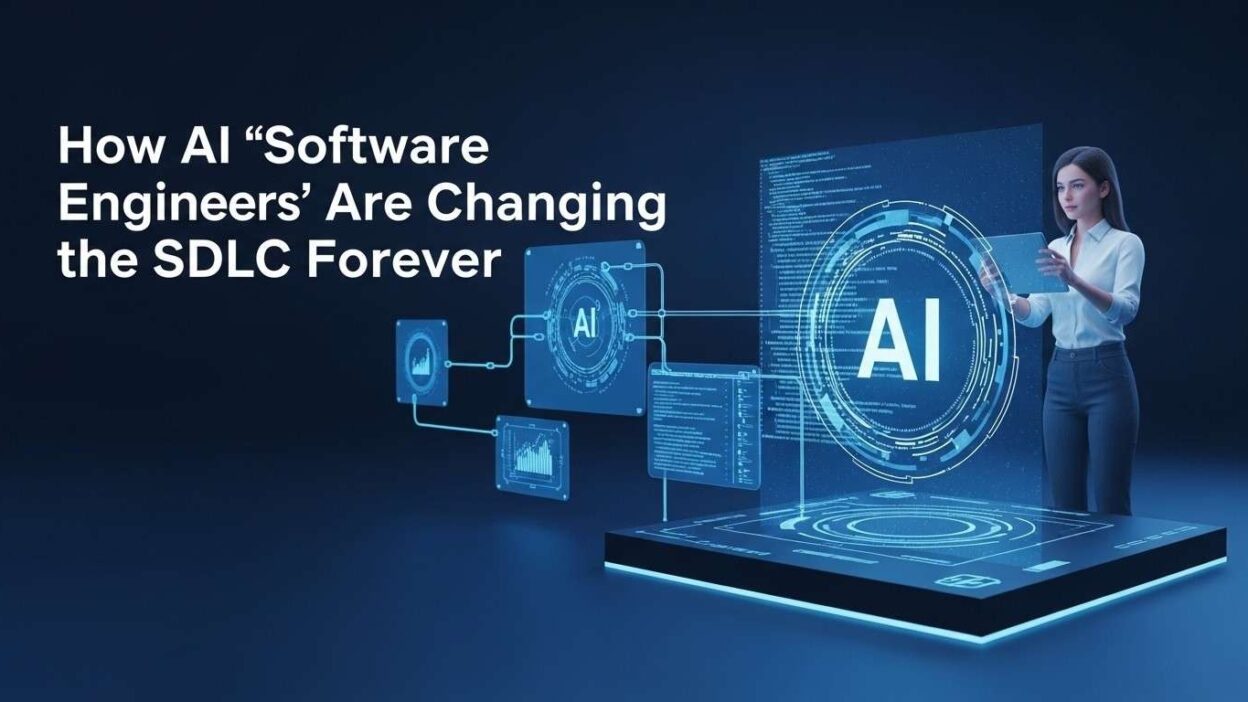
TL;DR Software development teams operate differently today than they did three years ago. AI software engineers SDLC conversations now dominate engineering leadership meetings, developer conferences, and startup pitch decks. These are not conversations about code completion tools. The discussion has moved well past autocomplete. AI systems now participate in requirement gathering, architecture decisions, test writing, code review, and deployment pipelines as active contributors rather than passive tools. Every stage of the Software Development Life Cycle faces transformation. This guide examines exactly what is changing, what the data shows, and how engineering organizations must respond to stay competitive.
Table of Contents
Defining AI Software Engineers: Beyond Copilot and Autocomplete
The term AI software engineer carries real weight in 2026. It describes autonomous AI systems capable of receiving a software task, planning an implementation approach, writing code, running tests, interpreting failures, iterating on the solution, and delivering a working result without human intervention at each step. This capability profile differs fundamentally from AI coding assistants that require a human to prompt every action and accept every output. Devin from Cognition AI, SWE-agent from Princeton, and AutoCodeRover all demonstrated autonomous task completion on real GitHub issues in controlled environments. The AI software engineers SDLC impact extends far beyond faster typing.
The Agentic Architecture Behind AI Software Engineers
Autonomous AI software engineers combine several technical capabilities into a coherent agent loop. A planning model decomposes a software task into executable subtasks. A code generation model writes implementation code for each subtask. A tool use layer gives the agent access to code execution environments, file systems, search engines, and external APIs. A reflection mechanism evaluates the output of each action and decides whether to proceed, retry, or escalate. Memory systems maintain context across long multi-step tasks that span hours rather than minutes. This architecture enables AI software engineers SDLC participation that goes far beyond single-turn code generation. The agent reasons about a problem the same way a junior engineer would reason through an assigned ticket.
What Distinguishes Agents from Copilots
Code copilots complete the developer’s immediate thought. They predict the next line or block of code based on surrounding context. The human drives every decision. Agents take a goal and pursue it through sequences of actions without human direction at each step. A copilot suggests how to write a database query. An agent receives a feature description, reads the existing schema, writes the migration script, implements the query layer, writes corresponding unit tests, and opens a pull request autonomously. Engineering leaders who confuse these two categories misunderstand the AI software engineers SDLC transformation. Copilot augments human engineers. Agents supplement or replace human engineers on defined task categories.
AI Software Engineers SDLC Impact: A Phase-by-Phase Breakdown
The Software Development Life Cycle spans six distinct phases. Each phase experiences AI software engineer involvement differently. Understanding the impact at each phase helps engineering leaders make grounded decisions about where AI deployment creates value and where human expertise remains non-negotiable.
Phase One: Requirements Engineering
Requirements gathering traditionally demands extensive human communication, interpretation, and documentation skill. AI software engineers SDLC involvement at this phase centers on requirements analysis and clarification rather than elicitation. AI agents parse product requirement documents, identify ambiguities, generate clarifying questions, and flag contradictions between stated requirements before a line of code gets written. Some teams use AI to generate user stories from rough product briefs, structured around standard acceptance criteria formats. The human product manager reviews and approves rather than writes from scratch. Misunderstood requirements cause 40 percent of software project failures according to industry research. AI analysis at the requirements phase catches structural errors earlier than manual review processes.
Phase Two: System Design and Architecture
Architecture decisions carry consequences for years. AI software engineers SDLC participation in design remains advisory rather than autonomous for most high-stakes systems. AI agents analyze codebase structure, identify coupling patterns, generate alternative architecture proposals, and produce architecture decision record drafts for human review. Tools like ArchGuard and Sourcegraph Cody provide AI-assisted architecture analysis. The agent proposes a microservice boundary split based on dependency analysis. A senior architect reviews the proposal, applies business context the AI lacks, and makes the final decision. AI speeds the analysis work that precedes architectural judgment without replacing the judgment itself.
Phase Three: Implementation and Coding
Implementation represents the phase where AI software engineers SDLC impact appears most dramatically. Autonomous coding agents now handle complete feature implementation on well-defined tasks. GitHub Copilot Workspace, Cursor Composer, and Devin all demonstrate autonomous multi-file feature implementation that takes minutes rather than hours on appropriate tasks. A product manager creates a ticket describing a new API endpoint with specific input validation rules and response format requirements. The AI agent reads the existing codebase architecture, implements the endpoint following established patterns, writes corresponding unit and integration tests, and opens a pull request with a descriptive summary. Human engineers review the output rather than write it. Teams report 40 to 70 percent time savings on implementation tasks with clear specifications.
Phase Four: Testing and Quality Assurance
Testing benefits from AI software engineers SDLC involvement at two distinct levels. Test generation creates unit tests, integration tests, and end-to-end test cases from implementation code automatically. Test execution and failure analysis uses AI to interpret test failures, identify root causes, and suggest fixes without human debugging sessions for common failure patterns. CodiumAI, Diffblue Cover, and Copilot-integrated test generation tools produce test suites from existing code with high coverage in minutes. AI agents identify edge cases that human test writers miss by analyzing the code path structure rather than the developer’s stated intentions. Bugs caught at the testing phase cost ten times less to fix than bugs caught in production. AI software engineers SDLC contribution at this phase delivers direct cost savings measured in engineering hours and incident response overhead.
Phase Five: Code Review
Code review consumes significant senior engineer time in most development organizations. AI software engineers SDLC participation at the review stage analyzes pull requests for common issues before a human reviewer sees the code. Security vulnerabilities get flagged. Performance anti-patterns surface. Style guide violations correct automatically. Missing test coverage receives explicit callout. CodeRabbit, Sourcegraph Cody, and GitHub Copilot pull request summaries all demonstrate this capability in production deployments. Human reviewers receive a pre-triaged pull request where obvious issues resolve before their review session begins. Senior engineers redirect their code review attention toward architectural concerns, business logic correctness, and knowledge transfer rather than formatting and boilerplate problems.
Phase Six: Deployment and Operations
DevOps and SRE practices integrate AI assistance at infrastructure provisioning, deployment pipeline configuration, and incident response stages. AI agents write Infrastructure-as-Code configurations from natural language descriptions of desired infrastructure states. Deployment pipeline YAML generation from CI/CD requirements reduces the specialized knowledge barrier for smaller teams. Incident response benefits from AI agents that analyze log streams, correlate error patterns, and generate runbook execution steps during production incidents. PagerDuty, Datadog, and AWS all ship AI-assisted operations features. AI software engineers SDLC participation at the operations phase reduces mean time to resolution on production incidents and makes infrastructure management accessible to teams without dedicated DevOps specialists.
Real-World Adoption of AI Software Engineers and Measured Results
Early adopter organizations provide data points that illuminate what AI software engineers SDLC integration actually delivers at production scale. These results help separate marketing claims from engineering reality.
Enterprise Adoption Patterns
Large technology companies deploy AI coding assistance broadly while limiting autonomous agent deployment to specific controlled use cases. Google, Microsoft, and Meta all report widespread GitHub Copilot or equivalent deployment across their engineering organizations. Productivity metrics vary by task type. Boilerplate code generation shows the strongest productivity gains, with engineers completing this work 55 to 65 percent faster. Complex algorithmic problem solving shows more modest gains of 15 to 25 percent. AI software engineers SDLC adoption at enterprise scale creates an interesting split. AI handles high-volume, lower-complexity coding work. Human engineers concentrate on architectural decisions, cross-team coordination, and novel problem solving where human judgment matters most.
Startup Use Cases: Smaller Teams Punching Above Their Weight
Startups use AI software engineers SDLC integration to stretch small engineering teams beyond their nominal capacity. A three-person engineering team delivers features at the pace a six-person team once required. AI agents handle backend CRUD operations, API integration code, and test suite maintenance while human engineers focus on the product-differentiating logic that creates competitive advantage. Several YC-backed startups in 2024 and 2025 built initial product versions with engineering teams of two to five using AI software engineers as force multipliers. This model changes startup hiring economics and extends runway without sacrificing development velocity.
Measured Velocity and Quality Outcomes
McKinsey research documents 20 to 45 percent developer productivity gains from AI coding tool adoption across surveyed organizations. GitHub’s own data shows Copilot users complete tasks 55 percent faster on average compared to non-Copilot baselines. Code quality metrics show more nuanced results. Test coverage improves when AI agents generate test suites automatically. Bug rates on AI-generated code compare favorably to human-written code on routine implementation tasks. Complex business logic implementation still shows higher defect rates from AI agents than from experienced human engineers. The AI software engineers SDLC productivity story is real and measurable, with the strongest gains on well-defined, lower-ambiguity implementation tasks.
What Changes for Human Engineers in an AI-Augmented SDLC
The AI software engineers SDLC transformation does not eliminate human engineering roles. It restructures what those roles require and how engineers spend their working hours. Understanding this shift helps organizations hire correctly and helps individual engineers develop the skills that remain valuable.
From Code Writer to Code Reviewer and Architect
Human engineers shift toward higher-leverage activities as AI handles routine implementation. Code review skill becomes more important rather than less important. Engineers review AI-generated pull requests with the same rigor they apply to junior human engineer output. Architecture and system design judgment matters more because AI agents implement whatever design they receive. A poor architectural decision executes at AI speed. The human engineer who specifies the architecture correctly creates enormous leverage. Engineers who thrive in AI-augmented SDLC environments develop strong mental models of system behavior, deep domain expertise, and excellent communication skills for working across product, design, and business teams.
Prompt Engineering as a Core Engineering Skill
Directing AI software engineers SDLC participation effectively requires prompt engineering skill that goes beyond casual instruction. A well-specified task description that defines the expected behavior, edge cases, constraints, and success criteria produces dramatically better AI agent output than a vague feature request. Engineers who write precise, comprehensive task specifications unlock the full productivity potential of AI coding agents. This skill set overlaps with the requirements engineering and technical specification skills that strong engineers always needed. AI amplifies the quality difference between precise and imprecise thinkers more than it changes which thinking skills matter.
Domain Expertise and Business Logic Understanding
AI agents excel at implementing clear specifications. They struggle with understanding the business context that determines whether a specification is correct in the first place. An AI agent cannot know that the pricing logic in the payment system must account for a specific regulatory requirement in three jurisdictions without that context appearing explicitly in its instructions. Human engineers who deeply understand the business domain they support provide the contextual intelligence that keeps AI agents working on the right problems. Domain expertise becomes a stronger differentiator in AI-augmented engineering teams than pure coding speed.
Risks and Limitations of AI Software Engineers in the SDLC
AI software engineers SDLC integration creates specific risks that engineering leaders must address proactively. Ignoring these risks leads to quality problems, security vulnerabilities, and team culture issues that undermine the productivity gains AI promises.
Code Quality and Security Vulnerabilities
AI-generated code introduces security vulnerabilities at measurable rates. Research from Stanford University documents that GitHub Copilot generates code with security flaws in 40 percent of security-sensitive scenarios without specific security-focused prompting. SQL injection, path traversal, and insecure deserialization patterns appear in AI-generated code that handles user input. Organizations integrating AI software engineers SDLC into security-sensitive systems must implement mandatory security scanning on all AI-generated code before merge. SAST tools like Semgrep and Snyk catch common vulnerability patterns. Human security review remains essential on authentication, authorization, and data handling code regardless of whether AI or humans wrote the initial implementation.
Over-Reliance and Skill Atrophy
Engineers who rely on AI assistance for every coding task risk atrophying the fundamental skills that make AI direction effective. A developer who cannot debug without AI assistance cannot effectively evaluate whether AI-generated code handles edge cases correctly. Senior engineers who stop writing code eventually lose the pattern recognition that makes architectural review accurate. Organizations must balance AI tool adoption with deliberate skill maintenance. Junior engineers need regular coding practice without AI assistance to build the foundational understanding that senior roles require. AI software engineers SDLC adoption creates a talent development challenge that engineering leaders must address through intentional practice programs rather than hoping atrophy does not occur.
Accountability and Ownership Gaps
Clear code ownership matters for maintenance, incident response, and knowledge transfer. AI-generated code creates ownership ambiguity in teams without explicit policies addressing it. Who owns a module where the AI wrote 80 percent of the implementation? Who carries accountability for a security bug in an AI-generated authentication flow? Engineering organizations integrating AI software engineers SDLC at scale need explicit ownership policies that assign human accountability for all code regardless of its origin. The engineer who reviewed and merged the pull request bears ownership responsibility. This policy preserves the accountability structures that functional engineering teams depend on.
Frequently Asked Questions: AI Software Engineers SDLC
Will AI software engineers replace human software engineers?
AI software engineers SDLC integration reduces the number of human engineers needed for routine implementation tasks at existing output levels. This does not mean wholesale replacement. Software demand continues growing faster than human engineering supply. AI enables the same team to deliver more rather than requiring fewer engineers to deliver the same amount. Individual engineer value shifts toward domain expertise, system design, and AI direction rather than raw coding speed. Engineers who develop these skills remain in high demand. Engineers whose value proposition rests entirely on coding speed face the most disruption. Career development that builds judgment and domain knowledge alongside technical skills prepares engineers for AI-augmented work environments.
Which SDLC phases benefit most from AI software engineer involvement?
Implementation and testing show the strongest measurable productivity gains in AI software engineers SDLC research. Boilerplate code generation, API integration implementation, and test suite creation represent the highest-volume, lowest-ambiguity tasks where AI delivers the most consistent value. Requirements analysis benefits significantly from AI pattern matching on requirements documents but requires human judgment for stakeholder communication. Architecture and design phases benefit from AI analysis tools while remaining judgment-intensive activities best led by senior human engineers. Operations and incident response show strong AI assistance value in log analysis and runbook execution without replacing human judgment on novel production scenarios.
How do you maintain code quality with AI software engineers?
Code quality in AI-augmented development environments requires systematic process controls rather than individual developer discipline. Mandatory automated security scanning on all pull requests catches vulnerability patterns in AI-generated code before human review. Comprehensive test requirements ensure AI-generated implementations meet coverage standards. Code review standards apply equally to AI-generated and human-generated code. Senior engineers calibrate their review approach to the specific quality risks of AI output rather than assuming AI code matches the quality profile of experienced human code. AI software engineers SDLC quality programs treat AI as a capable but imperfect contributor that requires appropriate oversight rather than a trusted senior engineer whose output needs only light review.
What skills should developers build to thrive alongside AI software engineers?
System design and architecture judgment ranks as the highest-value skill for engineers in AI-augmented environments. AI implements whatever design it receives. Strong architectural thinking creates leverage across everything the agent builds. Domain expertise and business context understanding gives human engineers the contextual knowledge AI agents lack. Technical writing and specification skill improves AI output quality dramatically. Security and code review expertise becomes more valuable as AI generates more of the code that needs review. Engineers who build these skills alongside their existing technical foundation position themselves well in AI software engineers SDLC environments.
How fast is AI software engineer capability advancing?
AI software engineer capability advances on a faster curve than most engineering leaders track. SWE-bench, the standard benchmark for autonomous software engineering capability, showed AI agent scores improving from 2 percent in early 2023 to above 40 percent by late 2024. Commercial products reach capabilities not demonstrated in research within six to twelve months. The AI software engineers SDLC transformation that engineering leaders plan for in 2026 will look modest compared to the capability profile these systems reach by 2028. Organizations that build adaptive processes rather than point-in-time integrations maintain strategic flexibility as AI capabilities continue expanding.
Do AI software engineers work well with existing development methodologies?
Agile and sprint-based development methodologies adapt to AI software engineer participation without fundamental redesign. AI agents accept sprint tickets with the same inputs human engineers receive. Ticket quality determines AI output quality more than it determines human output quality, making investment in better ticket writing a high-leverage process improvement. Stand-ups and sprint planning sessions include AI task assignment decisions alongside human engineer assignment decisions. Retrospectives address AI output quality trends alongside human performance trends. AI software engineers SDLC integration with existing methodologies succeeds through deliberate process adaptation rather than wholesale methodology replacement.
Preparing Your Engineering Organization for AI Software Engineers
Engineering leaders who approach AI software engineers SDLC integration strategically rather than reactively build organizations that capture productivity gains while managing the associated risks. Several concrete preparation steps make the difference between successful integration and expensive disappointment.
Audit Your SDLC for AI Integration Opportunities
Start with a systematic audit of where engineering time currently goes across each SDLC phase. Engineering manager surveys, time tracking data, and sprint retrospective records reveal the distribution of effort across task types. Tasks with clear specifications, established patterns, and well-defined success criteria represent the highest-value AI integration targets. Tasks requiring novel problem solving, extensive stakeholder communication, or business context judgment remain best handled primarily by human engineers. The audit creates an integration priority map rather than a general AI adoption mandate.
Build AI Review Competency Across the Team
Reviewing AI-generated code effectively requires different attention patterns than reviewing human-generated code. Train engineers on the specific failure modes and vulnerability patterns that AI coding agents introduce. Run code review exercises on known AI-generated samples with deliberately introduced flaws. Calibrate team intuitions about when AI output quality matches human expert quality versus when it requires closer scrutiny. AI software engineers SDLC integration succeeds when the engineering team develops genuine competency at evaluating AI output rather than rubber-stamping it due to speed pressure.
Read More:-How to Reduce AWS Costs Using AI-Driven Cloud Optimization Agents
Conclusion
The AI software engineers SDLC transformation is not coming. It is already here. Teams that treat it as a future concern while competitors integrate AI agents into their daily development workflows will find the competitive gap widening faster than they expect.
The change is not that AI replaces engineers. The change is that engineering teams of a given size deliver what previously required teams twice as large. The change is that implementation bottlenecks shift to specification and review bottlenecks. The change is that the most valuable engineering skills shift from raw coding speed toward system thinking, domain expertise, and the judgment that makes AI direction effective.
AI software engineers SDLC integration succeeds when organizations treat it as a workflow transformation rather than a tool adoption. Each phase of the development lifecycle gets deliberate attention. Integration points get explicit process design. Quality controls address the specific risks of AI-generated output. Human engineers develop the skills that AI amplifies rather than the skills AI replaces.
Engineering leaders who build adaptive organizations now will lead teams with significant competitive advantages through 2026 and beyond. The AI software engineers SDLC story rewards early, thoughtful adoption and punishes both premature hype-driven deployment and defensive delay. Build the foundation this year. The engineering organization you lead in five years depends on the decisions you make today.