Introduction
TL;DR Sales teams waste hours every single day on repetitive tasks. Responding to leads takes precious time. Following up drains energy. Scheduling meetings creates endless back-and-forth emails. Your best sales representatives spend more time coordinating than actually selling.
The numbers tell a harsh truth. Manual lead response takes 3-6 hours on average. Only 27% of leads receive a response within the first hour. Slow follow-ups kill conversion rates instantly. Your competitors might already be responding in seconds while you’re still typing.
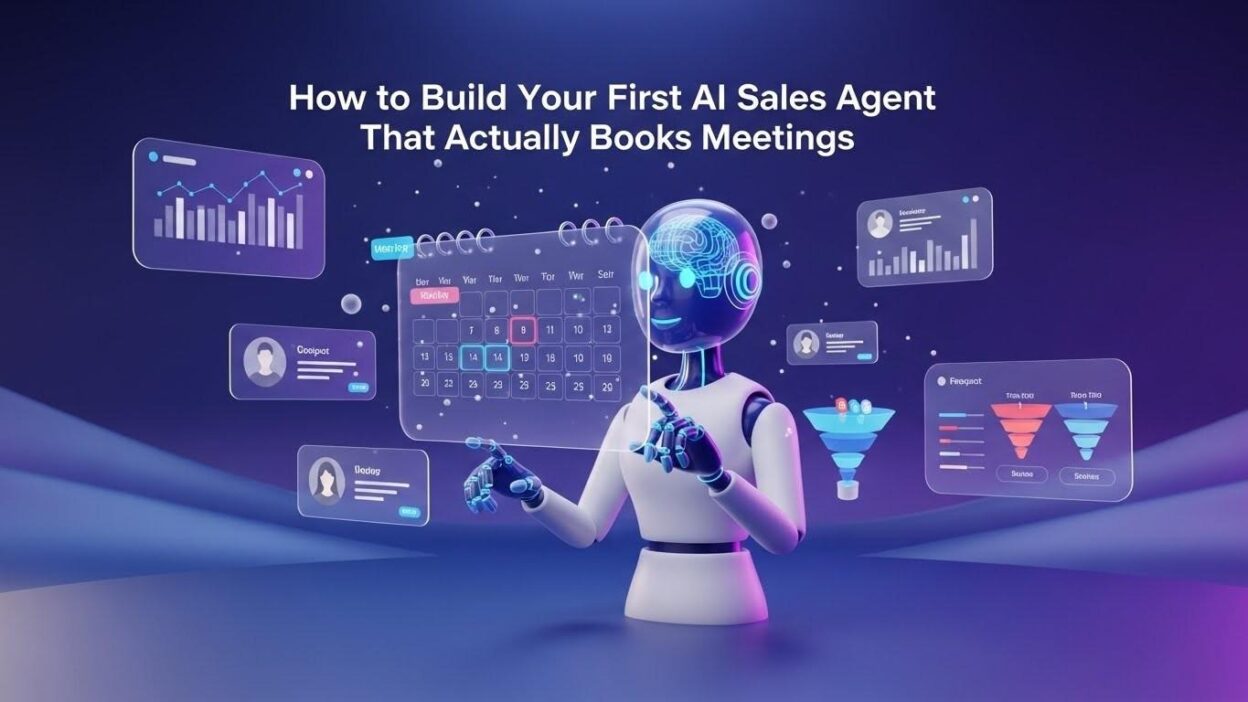
An AI sales agent that automates meeting booking changes everything dramatically. These intelligent systems respond instantly to every inquiry. They qualify leads automatically without human intervention. They book meetings directly into your calendar while you sleep. Your team focuses entirely on closing deals instead of administrative busywork.
Building your first autonomous sales agent sounds intimidating. The technical complexity seems overwhelming at first glance. Many business owners assume they need engineering degrees. The reality surprises most people completely.
You can create a functional AI sales agent that automates meeting booking in days, not months. No coding expertise required for basic implementations. Modern platforms provide drag-and-drop interfaces anyone can master. This guide walks you through every single step.
Table of Contents
Understanding What Makes AI Sales Agents Actually Work
The Core Components Every Sales Agent Needs
An effective AI sales agent that automates meeting booking requires three essential elements working together. Natural language processing forms the foundation of comprehension. Machine learning enables the system to improve continuously. Integration capabilities connect everything to your existing tools.
Natural language processing allows your agent to understand human conversations. It interprets questions correctly regardless of phrasing variations. The system recognizes intent behind every message instantly. Your prospects feel like they’re talking to a real person.
Machine learning helps your agent get smarter over time. It analyzes successful conversations to identify patterns. Failed interactions teach the system what to avoid. Performance improves automatically with each customer interaction.
Integration capabilities tie your agent into actual business workflows. Calendar connections enable direct scheduling without manual input. CRM synchronization keeps all data perfectly organized. Email platforms allow seamless communication across all channels.
The best sales agents handle multiple conversation scenarios simultaneously. They answer product questions with accurate information every time. They overcome common objections using proven talking points. They qualify leads based on your specific criteria instantly.
Your AI sales agent that automates meeting booking must sound human and helpful. Robotic responses destroy trust immediately with prospects. Natural conversation flows build rapport effectively. Personality matters just as much as functionality.
How Modern Sales Agents Differ from Simple Chatbots
Traditional chatbots follow rigid scripts without any flexibility. They match keywords to predetermined responses mechanically. Unexpected questions confuse them completely. Users quickly recognize the limitations and frustration builds.
AI sales agents think differently than basic bots do. They understand context from previous messages in conversations. They adapt responses based on the prospect’s engagement level. They recognize buying signals and adjust accordingly in real-time.
A simple chatbot asks the same questions every single time. An intelligent AI sales agent that automates meeting booking personalizes the entire experience. It remembers previous interactions with returning visitors. It references specific details from earlier in the conversation.
Decision-making capability separates agents from basic automation tools. Your agent evaluates whether a lead qualifies for sales. It determines the right meeting type based on needs. It selects optimal time slots considering everyone’s preferences.
Sales agents execute multi-step workflows without constant supervision required. They send follow-up messages at strategically optimal times. They reschedule appointments when conflicts arise automatically. They notify your team only when human intervention becomes necessary.
The autonomy level makes all the difference in results. Basic bots require humans for anything beyond simple tasks. Advanced agents handle complete sales cycles from introduction through booking. Your team receives only qualified prospects ready for conversations.
Choosing the Right Platform for Your Sales Agent
Evaluating No-Code vs Custom-Built Solutions
No-code platforms democratize AI agent creation for everyone. Tools like Make, Voiceflow, and Botpress provide visual builders. You design conversation flows by dragging and connecting blocks. Technical knowledge becomes unnecessary for basic implementations.
These platforms offer pre-built templates for common scenarios. You can launch an AI sales agent that automates meeting booking within hours. Customization options allow you to match your brand personality. Integration libraries connect to hundreds of popular business tools.
No-code solutions work perfectly for straightforward sales processes. Your agent handles standard qualification questions effectively. It books appointments following simple availability rules. Most small businesses find these platforms completely sufficient.
Custom-built solutions offer unlimited flexibility for complex needs. Developers can create unique features specific to your business. Integration possibilities expand beyond standard platform limitations. Large enterprises often require this level of customization.
Building custom agents requires significant technical expertise and time. Development costs run into thousands or tens of thousands. Maintenance demands ongoing developer attention and resources. Only pursue custom solutions when no-code platforms truly can’t work.
Cost comparison reveals stark differences between approaches immediately. No-code platforms charge monthly fees ranging from free to $200. Custom development requires $10,000-$50,000 upfront investment minimum. Maintenance adds another $1,000-$5,000 monthly ongoing.
Key Features Your Platform Must Include
Calendar integration stands as the most critical feature for any system. Your AI sales agent that automates meeting booking needs direct access to schedules. Two-way synchronization prevents double-booking disasters completely. Support for Google Calendar, Outlook, and iCloud proves essential.
Multi-channel communication capability expands your reach dramatically across platforms. Your agent should work through email, website chat, WhatsApp, and SMS. Prospects contact you through their preferred method comfortably. You capture more leads by meeting people where they are.
CRM connectivity keeps your sales data organized and accessible always. Every conversation should sync automatically to your database. Lead information updates in real-time without manual entry. Your sales team sees complete interaction histories instantly.
Natural language understanding determines how well your agent communicates effectively. Look for platforms using advanced AI models like GPT-4. The system should handle typos and slang without confusion. Multilingual support opens international markets for your business.
Analytics and reporting features provide insights into performance metrics constantly. Track response times, qualification rates, and booking conversion percentages. Identify conversation bottlenecks where prospects drop off. Data-driven improvements accelerate your results significantly.
Customization options let you match the agent to your brand voice. Adjust personality, tone, and communication style precisely. Upload your product information and sales playbooks. Your AI sales agent that automates meeting booking becomes a true extension of your team.
Building Your Sales Agent Step-by-Step
Defining Your Agent’s Purpose and Conversation Flow
Start by identifying the exact job your agent will perform. Write down specific tasks you want automated completely. Most businesses focus on lead qualification and appointment scheduling initially. Clear objectives guide every subsequent decision you make.
Map your current sales process from first contact through booking. Document every question your team asks prospects regularly. Note common objections and how you overcome them effectively. This analysis creates your agent’s conversation blueprint.
Create buyer personas representing your ideal customers precisely. List the qualification criteria that separate good leads from bad. Define what information you need before scheduling meetings. Your AI sales agent that automates meeting booking uses these rules automatically.
Design the conversation flow using a flowchart or diagram. Start with the greeting and introduction to your business. Branch into different paths based on prospect responses. End every successful path with a clear meeting booking action.
Write out actual dialogue for each conversation scenario completely. Use natural language that sounds like your best salesperson. Keep sentences short and easy to understand quickly. Avoid jargon unless your audience expects technical terminology.
Plan for handling unexpected situations and edge cases carefully. What happens when someone asks questions you didn’t anticipate? How does your agent redirect confused prospects back on track? Build fallback responses that maintain helpful, professional tone always.
Connecting Your Tools and Data Sources
Begin by integrating your calendar system with your chosen platform. Most tools offer one-click connections to major calendar providers. Authorize access so your agent can read availability accurately. Set buffer times between meetings to prevent exhaustion burnout.
Configure your working hours and blackout periods precisely. Block off personal time, lunch breaks, and internal meetings. Your AI sales agent that automates meeting booking respects these boundaries automatically. Prospects only see genuinely available time slots.
Connect your CRM to sync lead information bidirectionally and seamlessly. Tools like HubSpot, Salesforce, and Pipedrive integrate with most platforms. Every conversation creates or updates contact records automatically. Your database stays current without any manual data entry.
Link your email system to enable direct communication from your agent. Gmail and Outlook connections typically take just minutes to establish. Your agent sends messages using your actual email address. Prospects see emails coming directly from your business.
Upload your knowledge base containing product information and FAQs comprehensively. Include pricing details, feature lists, and case studies. Your agent references this information when answering questions accurately. Regular updates keep responses current as your offerings evolve.
Set up notification systems to alert your team about important events. Get pinged when high-value leads book meetings immediately. Receive daily summaries of agent performance and activity. Stay informed without constantly monitoring the system manually.
Training Your Agent to Qualify Leads Effectively
Define your ideal customer profile with specific, measurable criteria. Company size, industry, budget, and timeline all matter for qualification. Your AI sales agent that automates meeting booking uses these factors automatically. Only qualified prospects receive meeting invitations from your calendar.
Create a scoring system that ranks leads based on fit. Assign points for positive attributes like decision-making authority. Deduct points for red flags like unrealistic budget expectations. Your agent calculates scores instantly during each conversation.
Write qualification questions that feel natural, not like an interrogation. Ask about challenges they’re facing right now in business. Inquire about goals they want to achieve soon. Natural dialogue extracts necessary information without feeling pushy or aggressive.
Program your agent to recognize buying signals during conversations clearly. Phrases like “How soon can we start?” indicate high intent. Questions about implementation suggest serious interest developing. Your system prioritizes these hot leads for immediate booking.
Establish different meeting types for various qualification levels appropriately. Discovery calls suit early-stage prospects exploring options still. Demo meetings work for qualified leads ready to see solutions. Strategy sessions serve enterprise buyers needing customized approaches.
Test your qualification logic with sample conversations extensively before launching. Role-play different prospect scenarios and evaluate agent responses. Refine questions and scoring criteria based on test results. Your AI sales agent that automates meeting booking improves through iteration.
Setting Up Intelligent Meeting Scheduling Logic
Configure meeting types with specific durations and preparation requirements. Discovery calls might be 15 minutes without special prep needed. Product demos could require 30 minutes with advance materials sent. Executive meetings might need 60 minutes with extensive research beforehand.
Establish round-robin distribution if multiple team members take meetings. Your agent automatically rotates bookings fairly among available representatives. Load balancing prevents overwhelming your top performers with excessive calls. Team capacity stays optimized without manual intervention required.
Program timezone handling to eliminate confusion for international prospects. Your AI sales agent that automates meeting booking converts times automatically. Prospects see options in their local timezone always. Confirmation emails clearly state meeting times for both parties.
Set minimum notice requirements to give yourself adequate preparation time. Require at least 24 hours notice for standard meetings perhaps. Executive calls might need 72 hours advance booking. These rules prevent last-minute scheduling stress completely.
Create buffer times before and after meetings automatically every time. A 15-minute buffer allows travel time between in-person appointments. It provides mental reset time between back-to-back video calls. Your schedule stays sustainable instead of crushing and exhausting.
Enable rescheduling and cancellation options within reasonable timeframes always. Allow prospects to change appointments up to 24 hours before. Your agent handles rescheduling automatically without human involvement. Confirmation emails remind everyone of the new time immediately.
Crafting Conversations That Convert Prospects to Bookings
Writing Natural Opening Messages That Build Trust
Your opening message sets the tone for the entire interaction. Greet prospects warmly like you’re starting an actual conversation. Use their name if you have it from form submissions. Personalization increases engagement rates by 20% on average immediately.
Introduce your AI sales agent that automates meeting booking transparently and honestly. Most people appreciate knowing they’re talking to an AI assistant. Deception damages trust and hurts your brand reputation long-term. Authenticity wins over trying to fool people.
State your purpose clearly within the first two sentences. Explain that you’re here to help them explore your solution. Mention that you can answer questions and schedule meetings. Clear expectations prevent confusion and frustration later on.
Ask an engaging opening question relevant to their likely needs. Reference the page they visited or form they submitted. Show you understand why they reached out to you. Relevance keeps people engaged instead of immediately closing the chat.
Keep your greeting concise and easy to read quickly. Long paragraphs intimidate busy prospects scrolling on mobile devices. Two to three short sentences work perfectly for openings. Save detailed information for when they show interest.
End your greeting with a clear call to action. Ask a specific question that moves the conversation forward. Offer obvious next steps like “What brings you here today?” Simple prompts generate higher response rates than open-ended greetings.
Handling Objections Without Losing the Booking
Anticipate common objections your prospects raise during conversations regularly. Budget concerns top the list for most businesses today. Timing issues like “We’re not ready yet” come up frequently. Authority objections such as “I need to check with my boss” delay decisions.
Program your AI sales agent that automates meeting booking with proven responses. Address budget concerns by emphasizing ROI and cost savings. Handle timing objections by offering flexible implementation schedules. Authority objections get overcome by offering to include decision-makers.
Frame objections as opportunities to provide helpful information always. If someone mentions budget constraints, share financing options available. When they cite timing concerns, explain your onboarding support. Every objection deserves a thoughtful, value-focused response.
Use social proof to overcome hesitation and build confidence. Reference similar clients who had the same concerns initially. Share specific results they achieved after moving forward. Numbers and concrete examples convince better than vague promises.
Offer low-commitment next steps when prospects seem hesitant about deciding. Suggest a brief 15-minute exploratory conversation instead of a full demo. Provide a resource like a case study before scheduling. Reducing perceived risk increases booking rates significantly.
Never argue with prospects or make them feel wrong. Acknowledge their concerns as valid and understandable always. Empathy builds rapport even when you disagree with their reasoning. Your agent maintains patience that human reps sometimes lose.
Creating Urgency Without Being Pushy or Aggressive
Build natural urgency into your conversation flow strategically and subtly. Mention limited availability for this month or quarter. Reference upcoming price changes if applicable to your business. Scarcity motivates action when presented authentically and honestly.
Highlight the cost of inaction specific to their situation. Calculate how much money they lose monthly without your solution. Quantify the time wasted using their current inefficient process. Concrete numbers make delays feel more expensive than they seem.
Your AI sales agent that automates meeting booking can emphasize time-sensitive opportunities. Special promotions ending soon create genuine reasons to act. Beta access or early adopter bonuses incentivize quick decisions. Just ensure these offers are real and legitimate.
Frame booking as the logical next step in their journey. “Most people at this stage schedule a quick call to see if we’re a fit.” Social proof normalizes the action you want them to take. Following what others do feels safer than being first.
Use countdown timers for special offers if your platform supports them. Visual representations of urgency work better than text alone. A timer showing 2 days remaining converts better than just saying “limited time.” Psychology drives more bookings this way.
Avoid aggressive tactics that damage your brand reputation permanently. Never use false scarcity or fake countdown timers. Don’t pressure people into decisions they’re not ready for yet. Sustainable growth comes from trust, not manipulation or trickery.
Integrating Advanced Features That Boost Performance
Implementing Smart Follow-Up Sequences
Create automated follow-up sequences for prospects who don’t book immediately. Your AI sales agent that automates meeting booking should send a reminder 24 hours later. A second follow-up goes out after 3 days if needed. Persistence pays off without becoming annoying or invasive.
Vary your follow-up messages instead of repeating the same text. The first follow-up might share a relevant case study. The second could offer a different resource or testimonial. Fresh content keeps people engaged across multiple touchpoints successfully.
Time your follow-ups based on prospect behavior and engagement patterns. Someone who asked detailed questions deserves faster follow-up than passive browsers. Active engagement signals higher intent requiring quicker response times. Your agent prioritizes accordingly automatically.
Include new value in every follow-up message you send. Share a blog post addressing their specific concerns. Offer a free tool or template relevant to their business. Pure value without pressure builds goodwill and eventual conversions.
Set logical limits on follow-up frequency to avoid harassment. Three to five touches over two weeks feels appropriate for most. After that, move them to a longer-term nurture sequence. Know when to give people space instead of pushing.
Track which follow-up sequences generate the most bookings. Analyze what messaging works best at different stages. Your AI sales agent that automates meeting booking improves through data analysis. Continuous optimization increases conversion rates over time consistently.
Adding Personalization Based on Prospect Data
Collect relevant information early in conversations strategically and naturally. Ask about company size, industry, and current challenges they face. Store this data to personalize all subsequent interactions. Your agent references these details throughout the conversation.
Customize meeting descriptions based on what you’ve learned about prospects. A SaaS company gets different agenda items than a retailer. Industry-specific pain points appear in confirmation emails automatically. Relevance increases show-up rates by reducing generic communications.
Use dynamic content that changes based on prospect attributes. Someone from healthcare sees compliance-related benefits emphasized more. Manufacturing prospects learn about efficiency gains and cost reduction. Your AI sales agent that automates meeting booking tailors everything automatically.
Reference previous interactions when prospects return to your website. “Welcome back! Last time we talked about your scaling challenges.” Continuity makes conversations feel more human and less robotic. Memory creates better experiences that people appreciate.
Personalize meeting reminders with specific value propositions for each person. Remind them why they booked and what they’ll gain. Include prep instructions tailored to their stated goals. Customization reduces no-shows significantly compared to generic reminders.
Segment prospects into different conversation tracks based on their profile. Enterprise buyers follow different paths than small businesses do. High-value prospects receive more attention and customized messaging. Your agent adapts to each situation automatically without manual sorting.
Connecting Payment Processing for Deposit Collection
Integrate payment systems like Stripe or PayPal into your booking flow. Collect deposits during the scheduling process to reduce no-shows. Even small amounts like $25-$50 create commitment from prospects. Your AI sales agent that automates meeting booking handles transactions automatically.
Explain your deposit policy clearly before requesting payment information. State whether deposits are refundable under certain conditions. Transparency prevents disputes and maintains trust with prospects. People appreciate knowing exactly what to expect upfront.
Offer the option to waive deposits for highly qualified prospects. Enterprise buyers might not appreciate deposit requirements at all. Use your qualification logic to determine who gets this exception. Flexibility serves different customer segments appropriately and effectively.
Automate refund processing for legitimate cancellations made within your policy. Your agent can handle refunds instantly without human approval. Speed and ease improve customer experience even when meetings don’t happen. Good experiences lead to future opportunities later.
Track deposit collection rates to measure commitment levels accurately. Low deposit rates might indicate pricing issues or trust problems. High collection rates with low show-up rates suggest other problems. Data reveals where your process needs improvement most.
Consider offering credit toward your service instead of refunds. Deposits become account credits for no-shows who want to reschedule. This approach maintains the commitment while showing flexibility. Your AI sales agent that automates meeting booking manages credits automatically.
Testing and Optimizing Your Sales Agent
Running Pilot Tests Before Full Launch
Start with a small segment of your traffic initially. Direct 10-20% of leads to your agent while monitoring results. Compare performance against your existing process objectively. Small-scale testing reveals issues without risking your entire pipeline.
Create test scenarios covering every possible conversation path thoroughly. Role-play as different prospect types with varying needs. Test objections, edge cases, and unusual requests carefully. Your AI sales agent that automates meeting booking should handle everything gracefully.
Recruit team members to test your agent extensively before launch. Sales representatives know which questions prospects actually ask. They can identify gaps in your agent’s knowledge or logic. Internal testing catches problems customers shouldn’t ever see.
Monitor conversations in real-time during initial testing phases carefully. Watch how prospects respond to your agent’s messages. Note where confusion happens or conversations break down. Direct observation provides insights analytics alone can’t reveal.
Gather feedback from test prospects who interacted with your agent. Ask if the experience felt helpful or frustrating overall. Inquire whether they’d recommend the process to others. User feedback guides improvements better than assumptions do.
Set specific success metrics before launching your pilot test. Define what conversion rate would justify full deployment. Establish quality standards for conversation flow and customer satisfaction. Clear goals help you make objective go-no-go decisions.
Analyzing Performance Data to Improve Results
Track key metrics that indicate your agent’s effectiveness daily. Conversation completion rate shows how many people finish interactions. Qualification rate reveals what percentage meet your criteria. Booking conversion rate measures ultimate success at scheduling meetings.
Monitor response time metrics to ensure speed advantages materialize. Your AI sales agent that automates meeting booking should respond in seconds, not minutes. Slow responses negate the entire point of automation. Speed directly impacts conversion rates significantly.
Analyze conversation transcripts to identify improvement opportunities constantly. Look for questions your agent can’t answer adequately yet. Find objections that consistently derail booking attempts. Each conversation contains lessons for optimization efforts.
A/B test different messaging approaches to find what works best. Try various opening greetings and compare response rates. Test different ways of handling common objections systematically. Data-driven optimization beats guessing every single time.
Calculate the ROI of your agent compared to manual processes. Measure time saved by your sales team monthly. Track how many additional meetings you book automatically. Quantify the value of faster lead response times.
Review no-show rates for meetings booked by your agent. High no-show rates suggest qualification problems or poor communication. Low no-show rates validate your deposit strategy and reminder system. Your AI sales agent that automates meeting booking should match or beat human performance.
Continuously Improving Based on Real Conversations
Update your agent’s knowledge base regularly with new information. Add recently published case studies and testimonials promptly. Include updated pricing or product features as they launch. Fresh information keeps your agent accurate and current always.
Refine qualification criteria as you learn what makes good leads. Some characteristics might predict success better than you initially thought. Other factors might prove less important than expected. Adjust your scoring system based on actual outcomes.
Expand your agent’s capabilities gradually over time strategically. Start with basic qualification and booking functionality initially. Add payment processing after mastering the basics completely. Layer in advanced personalization once foundations work perfectly.
Train your agent on newly successful conversation patterns regularly. When a human rep closes a deal, analyze their approach. Incorporate effective techniques into your agent’s responses. Your AI sales agent that automates meeting booking learns from your best performers.
Address common failure points that emerge from conversation data. If prospects frequently ask about specific topics, add that content. When certain objections stump your agent, program better responses. Continuous improvement becomes a systematic process, not random updates.
Celebrate wins and learn from every success your agent achieves. A particularly smooth booking conversation deserves analysis and replication. High-value deals that started with your agent prove its effectiveness. Success stories motivate your team and justify continued investment.
Common Mistakes to Avoid When Building Your Agent
Overcomplicating Your Initial Implementation
Many businesses try building overly sophisticated agents from the start. They want to handle every possible scenario perfectly immediately. Complexity delays launch and often creates more problems. Start simple and add features incrementally instead.
Your first AI sales agent that automates meeting booking needs just core functionality. Basic qualification questions and calendar scheduling prove sufficient initially. Advanced features can wait until you master fundamentals. Simplicity gets you live and learning faster.
Avoid trying to automate your entire sales process at once. Focus on one specific bottleneck like initial lead response. Perfect that single function before expanding scope further. Incremental wins build momentum and team confidence gradually.
Don’t customize every tiny detail before launching your agent. Generic templates work fine for testing and learning phases. Over-customization wastes time without improving results much initially. You can polish personality and branding after proving the concept.
Resist adding integrations you don’t immediately need right now. Start with calendar and CRM connections only at first. Email, SMS, and other channels can come later. Each integration adds complexity that can cause problems.
Launch with a minimum viable agent, not a perfect solution. You’ll learn more from real conversations than theoretical planning. Early feedback guides development better than endless pre-launch preparation. Perfect is the enemy of good and done.
Neglecting the Human Handoff Process
Your AI sales agent that automates meeting booking can’t close deals alone. It sets up conversations that human reps must finish successfully. The handoff between AI and human requires careful orchestration. Poor transitions destroy the positive experience your agent created.
Provide your sales team with complete conversation transcripts before meetings. They should know exactly what prospects asked and learned. This context prevents repetitive questions that frustrate people. Seamless continuity impresses prospects and builds credibility.
Set clear expectations with prospects about what happens next. Explain that a human expert will conduct the actual meeting. Describe what they should prepare before the call. Clarity reduces confusion and improves show-up rates significantly.
Train your sales representatives to reference the AI conversation naturally. “I saw you mentioned challenges with your current system.” Acknowledgment shows attention and validates the prospect’s time investment. Disconnected conversations feel careless and unprofessional.
Create a feedback loop between your sales team and agent development. Representatives hear objections your agent didn’t anticipate or handle well. Their insights improve qualification accuracy and conversation quality. Collaboration between AI and humans drives best results.
Monitor customer satisfaction across the entire journey, not just agent performance. A perfect AI conversation means nothing if the meeting disappoints. Optimize the complete experience from first contact through deal closure. Your AI sales agent that automates meeting booking is just one piece.
Ignoring Privacy and Compliance Requirements
Data privacy regulations like GDPR and CCPA apply to AI agents. You must disclose what information you collect and how you use it. Prospects need options to opt out or delete their data. Non-compliance risks massive fines and legal problems.
Store conversation data securely with proper encryption and access controls. Limit who can view prospect information within your organization. Regular security audits protect against breaches that damage trust. Your AI sales agent that automates meeting booking handles sensitive business information.
Obtain explicit consent before recording conversations or storing personal details. Clear opt-in processes satisfy legal requirements and ethical standards. Many platforms include consent management features you should activate. Transparency builds trust instead of suspicion.
Comply with marketing laws regarding automated outreach and follow-ups. CAN-SPAM Act in the US requires unsubscribe options in emails. TCPA regulations govern text message marketing practices strictly. Know the rules for every channel your agent uses.
Consider industry-specific regulations that might apply to your business. Healthcare must follow HIPAA requirements for patient information. Financial services face additional scrutiny and compliance obligations. Your agent’s design must accommodate these special requirements.
Document your data handling practices and train your team appropriately. Everyone should understand privacy policies and compliance requirements. Regular training prevents accidental violations that legal ignorance doesn’t excuse. Compliance protects your business and respects your prospects..
Read More:-Best Smart Call Routing Strategies for Higher Sales Conversion
Conclusion: Launching Your AI Sales Agent Successfully

Building an AI sales agent that automates meeting booking transforms how your business captures opportunities. Manual lead response can’t compete with instant, 24/7 automation. Your sales team focuses on conversations that close revenue instead of administrative tasks.
The technology has matured enough that anyone can implement it. No-code platforms eliminate technical barriers completely. Templates and integrations make deployment faster than ever before. Your first agent can be live within a week.
Start with clear objectives and simple functionality initially. Perfect your core qualification and booking process first completely. Add advanced features only after mastering the basics thoroughly. Incremental progress beats attempting everything at once.
Test extensively before full deployment to all prospects. Gather feedback from real users and your sales team. Refine based on data, not assumptions or preferences. Your AI sales agent that automates meeting booking improves through iteration and learning.
Measure success through conversion rates and time savings carefully. Track how many qualified meetings your agent books monthly. Calculate the hours your team reclaims for selling activities. ROI becomes obvious when you measure properly.
Commit to continuous improvement as your business evolves. Update your agent with new products, pricing, and messaging. Expand capabilities based on what prospects actually need. Your agent should grow alongside your business naturally.
The companies winning in 2025 automate intelligently and strategically. They use AI to handle repetitive work flawlessly. They free humans for relationship-building and complex problem-solving. Your AI sales agent that automates meeting booking provides competitive advantage.
Don’t wait for perfect conditions to start building today. Your competitors are already deploying these systems successfully now. Every day of delay costs you opportunities and revenue. Begin with a simple pilot and learn as you go.
The future belongs to businesses that embrace AI thoughtfully. Sales automation will only become more sophisticated and capable. Early adopters gain experience and market position advantages. Start building your first agent this week.
Your prospects expect instant responses and seamless booking experiences. Manual processes feel outdated compared to automated competitors. An AI sales agent that automates meeting booking meets modern expectations. It’s no longer optional for growth-focused businesses.
Take the first step today by choosing your platform. Define your initial use case and conversation flow. Launch a pilot with a small segment of traffic. Learn, optimize, and scale as confidence and results grow.
The technology works when implemented correctly and strategically. Thousands of businesses already prove this daily with results. Your AI sales agent that automates meeting booking can deliver similar success. The question isn’t whether to build one but when.