Introduction
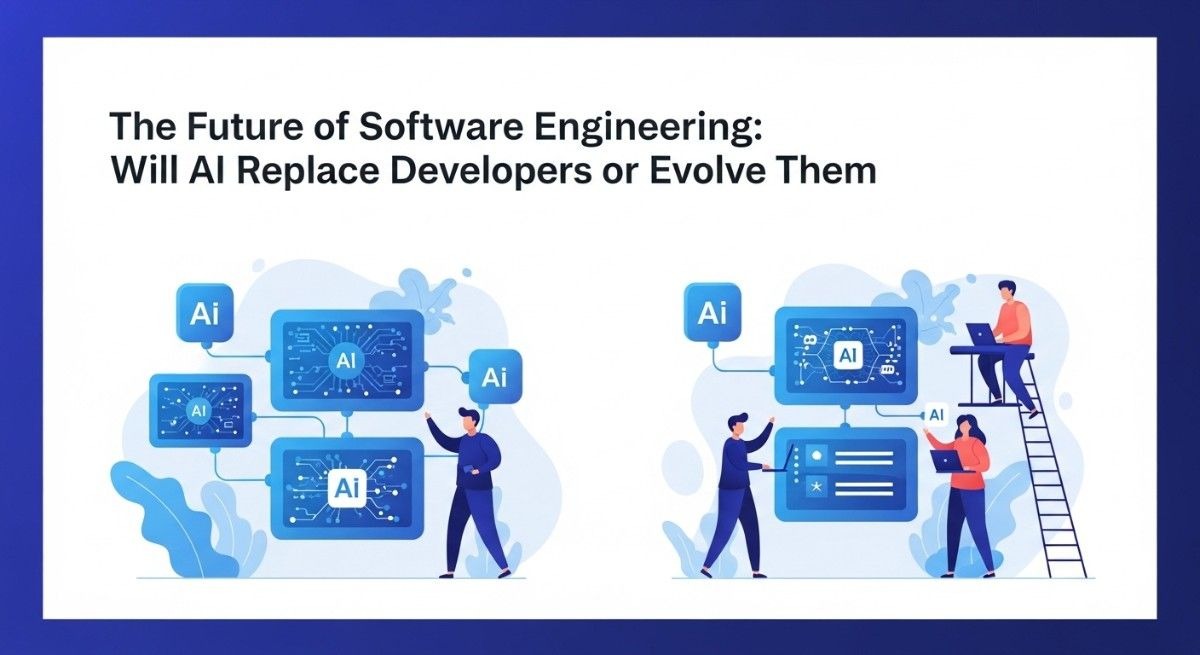
TL;DR Software development stands at a pivotal moment in history. Artificial intelligence has entered the coding arena with unprecedented capabilities.
The question AI replacing developers dominates conference rooms and online forums worldwide. Engineering teams wonder if their jobs will exist in five years.
GitHub Copilot writes entire functions from comments. ChatGPT debugs code and explains algorithms. Devin claims to be the first AI software engineer capable of building complete applications.
The anxiety is real and understandable. Previous technological revolutions eliminated entire professions while creating new ones.
This deep analysis explores what actually happens when AI meets software engineering. You’ll discover the nuanced reality beyond the hype and fear.
Table of Contents
The Current State of AI in Software Development
AI coding tools have evolved from experimental curiosities to daily development companions. Millions of developers now use these assistants in their regular workflow.
Code completion represents the most widespread application currently. Tools like GitHub Copilot suggest entire code blocks as developers type. These suggestions draw from billions of lines of public code repositories.
The accuracy varies significantly based on context and programming language. Popular languages like Python and JavaScript receive better suggestions. Niche languages or proprietary frameworks get less reliable assistance.
Bug detection has improved dramatically through machine learning models. Static analysis tools powered by AI identify potential security vulnerabilities. Pattern recognition algorithms spot code smells and performance bottlenecks.
Code review automation handles repetitive aspects of quality assurance. AI systems check style consistency and common error patterns. Human reviewers then focus on architecture decisions and business logic correctness.
Documentation generation saves countless hours of tedious work. AI reads code structure and generates initial API documentation. Comments and explanations appear automatically for complex functions.
Testing assistance accelerates quality assurance processes. AI generates test cases based on code analysis. Edge cases that humans might overlook get identified systematically.
Legacy code translation bridges technology generation gaps. Companies with decades-old COBOL systems can modernize gradually. AI translates portions while preserving business logic integrity.
The current limitations remain significant despite impressive capabilities. Context understanding still falls short of human comprehension. AI cannot grasp business requirements the way experienced developers do.
Understanding What AI Can Actually Do Today
Separating reality from marketing hype requires examining concrete capabilities. AI excels at specific, well-defined coding tasks currently.
Pattern matching forms the foundation of most AI coding assistance. Models trained on massive codebases recognize common solutions. When you write a function signature, AI predicts likely implementations.
Syntax generation happens nearly flawlessly for standard operations. Creating boilerplate code, class structures, and basic CRUD operations works reliably. Developers save time on repetitive structural coding.
Algorithm implementation for common problems performs well. Sorting algorithms, data structure manipulations, and standard calculations get suggested accurately. The AI has seen these patterns thousands of times during training.
API integration code appears with remarkable accuracy. Popular libraries and frameworks receive extensive training data coverage. Connection code, authentication flows, and basic endpoints generate correctly.
Error message interpretation helps developers troubleshoot faster. AI reads stack traces and suggests potential causes. Solutions from Stack Overflow and documentation get surfaced quickly.
Refactoring suggestions identify improvement opportunities. Code duplication, complex functions, and unclear variable names get flagged. Proposed improvements maintain functionality while enhancing readability.
Language translation between programming languages works for straightforward code. Converting JavaScript to Python or Java to C# succeeds with basic logic. Complex idioms and language-specific features still cause problems.
Performance optimization recommendations emerge from analyzing execution patterns. Database query improvements, caching opportunities, and algorithm selection get suggested. Developers must validate these recommendations carefully.
The Fundamental Limitations of Current AI Systems
Understanding AI constraints reveals why AI replacing developers completely remains distant. Several fundamental barriers exist that incremental improvements cannot overcome easily.
Business context comprehension eludes current AI architectures. An AI cannot understand why a company needs specific features. Strategic product decisions require human judgment and market understanding.
Requirement ambiguity handling fails consistently. Real-world project requirements arrive incomplete and contradictory. Humans negotiate and clarify these ambiguities through conversation and empathy.
Creative problem-solving for novel challenges shows AI weaknesses. New types of applications require innovative architectural thinking. AI relies on patterns from training data rather than genuine creativity.
Ethical decision-making in code design needs human values. Privacy tradeoffs, accessibility considerations, and fairness implications require moral reasoning. Algorithms cannot make value judgments about societal impact.
Long-term system architecture planning exceeds current capabilities. Designing systems that scale over years demands experience and foresight. Technical debt considerations involve predictions about future business needs.
Stakeholder communication remains exclusively human territory. Explaining technical concepts to non-technical executives requires emotional intelligence. Understanding unspoken concerns and building consensus needs interpersonal skills.
Quality judgment in subjective areas depends on human taste. Code elegance, user experience intuition, and design aesthetics lack objective measures. Developers bring aesthetic sensibilities that AI cannot replicate.
Debugging complex distributed systems requires deep systematic thinking. Tracking down race conditions and network issues involves hypothesis formation. The scientific method applied to software debugging remains human-dominated.
How AI is Transforming Developer Workflows Right Now
Current AI integration changes how developers spend their time daily. The transformation amplifies human capabilities rather than replacing them.
Routine coding tasks consume far less time than previously. Boilerplate generation happens in seconds instead of minutes. Developers focus mental energy on challenging problems instead.
Documentation writing becomes less burdensome. Initial drafts appear automatically from code analysis. Engineers refine and add context rather than starting from blank pages.
Code review efficiency increases through automated first passes. Style violations and obvious bugs get caught before human review. Senior developers examine architecture and design rather than syntax errors.
Learning new frameworks accelerates with AI assistance. Example code for unfamiliar libraries appears on demand. Developers experiment more freely knowing help is immediately available.
Debugging speed improves when AI suggests potential causes. Error messages get interpreted and solutions proposed instantly. Trial and error cycles shorten dramatically for common issues.
Testing coverage expands as AI generates test cases. Edge cases get identified that developers might miss. Quality assurance becomes more comprehensive without proportional time investment.
Legacy code understanding happens faster with AI explanation. Old codebases lacking documentation become more accessible. New team members onboard more quickly to existing projects.
Productivity metrics show measurable improvements in many organizations. Development velocity increases by 20-40% in some studies. Code quality metrics often improve simultaneously with speed gains.
The Skills Developers Need to Thrive Alongside AI
The developer skill landscape is shifting rapidly. Some abilities become more valuable while others diminish in importance.
Problem decomposition rises to critical importance. Breaking complex requirements into solvable pieces becomes the primary skill. AI handles individual pieces while humans orchestrate overall solutions.
Prompt engineering for AI tools requires practice and nuance. Getting useful output from AI assistants involves careful instruction. This meta-skill determines how effectively developers leverage AI capabilities.
Code review and quality assessment gain prominence. Evaluating AI-generated code for correctness and efficiency becomes routine. Developers must spot subtle bugs that look superficially correct.
System design and architecture knowledge becomes more valuable. High-level decisions about technology choices and component interactions remain human. These strategic choices determine project success more than implementation details.
Domain expertise in business areas differentiates developers. Understanding healthcare workflows, financial regulations, or logistics challenges provides irreplaceable value. AI lacks this contextual business knowledge.
Cross-functional collaboration skills matter more than ever. Working with designers, product managers, and customers requires communication finesse. Technical excellence alone no longer suffices for career advancement.
Security thinking must improve as AI generates more code. Automated code may contain vulnerabilities that look functional. Developers need sharp security awareness to catch these issues.
Performance analysis and optimization expertise remains highly valued. Understanding how code executes and identifying bottlenecks requires deep knowledge. AI suggests improvements but humans validate and implement them properly.
Economic Realities: Job Market Impacts and Trends
Employment data reveals nuanced changes rather than wholesale displacement. The job market for developers continues evolving in interesting ways.
Overall developer employment keeps growing globally. Demand for software across industries outpaces automation gains. More businesses need custom software than ever before.
Entry-level position dynamics show the most significant shifts. Junior developers who primarily wrote simple CRUD operations face challenges. Companies question paying humans for work AI handles adequately.
Mid-level developer roles remain robust and stable. These professionals combine technical skill with business understanding. Their experience translating requirements into architecture stays irreplaceable.
Senior engineer demand actually increases as AI capabilities expand. Architects and technical leads guide AI usage effectively. Strategic thinking and mentorship become more valuable than coding speed.
Specialization in AI integration creates new career paths. Developers who master prompt engineering and AI tool chains find opportunities. Organizations need experts bridging human developers and AI assistants.
Quality assurance positions shift toward AI output validation. Testing AI-generated code requires different skills than testing human code. Security review of automated code becomes its own specialty.
Salary trends show divergence based on skill level. Developers who adapt and leverage AI command premium compensation. Those competing directly with AI capabilities face wage pressure.
Remote work flexibility continues expanding the global talent pool. Companies hire developers worldwide more readily. This geographic arbitrage affects wages independently of AI factors.
Real-World Case Studies: Companies Using AI in Development
Examining actual implementations reveals practical insights. Several organizations have shared their experiences publicly.
Microsoft integrated GitHub Copilot across their engineering organization. Developer surveys showed 88% felt more productive using the tool. Task completion rates improved while satisfaction scores increased simultaneously.
The company found junior developers benefited most initially. Experienced engineers took longer to trust and integrate AI suggestions. Training programs helped senior developers overcome skepticism and adopt tools effectively.
Google’s internal AI coding tools support thousands of engineers daily. Code review time decreased by approximately 30% after deployment. Fewer trivial issues reached human reviewers.
The search giant observed interesting quality improvements. AI-reviewed code contained fewer style inconsistencies. Logic errors requiring human judgment remained at similar rates.
Shopify experimented with AI for Ruby on Rails development. Their specific framework customizations initially posed challenges. Retraining models on internal codebases improved suggestion accuracy substantially.
The e-commerce platform discovered AI excelled at test generation. Testing coverage increased without expanding QA team size. Developers wrote more comprehensive tests with less effort.
Stripe deployed AI for documentation generation and maintenance. API documentation stayed synchronized with code changes automatically. Developer relations teams focused on tutorials and guides instead of reference docs.
The payments company measured documentation quality improvements. Completeness increased while errors decreased compared to manually maintained docs. Customer satisfaction with documentation rose noticeably.
The Psychological Impact on Developer Communities
The conversation around AI replacing developers creates real emotional responses. Understanding these psychological dynamics matters for healthy adaptation.
Anxiety levels have increased measurably among early-career developers. Job security concerns affect mental health and career planning. Bootcamp graduates question whether their investments will pay off.
Experienced developers show more mixed reactions. Some embrace AI as productivity enhancement. Others resist adoption viewing it as unnecessary complexity.
Imposter syndrome intensifies when AI writes code faster. Developers question their value if machines handle technical tasks. This erosion of professional identity creates genuine distress.
Community forums reveal heated philosophical debates. Discussions about coding as craft versus commodity become emotional. The meaning and purpose of development work gets questioned fundamentally.
Burnout patterns shift toward different stressors. Keeping pace with rapid AI tool evolution creates fatigue. The pressure to continuously adapt and learn new systems never relents.
Mentorship relationships face new challenges. Senior developers question what skills to teach juniors. Traditional progression paths from junior to senior become less clear.
Professional pride sources need redefinition. Writing elegant code matters less than orchestrating systems. Developers must find satisfaction in different aspects of their work.
Support networks and communities become more important. Sharing experiences with AI tools helps normalize the transition. Collective adaptation proves easier than individual struggle.
AI as a Catalyst for Developer Evolution
The optimistic view frames AI as an evolutionary pressure. Developers adapt and ascend to higher-value activities.
Historical technology transitions offer encouraging precedents. Compilers eliminated hand-written assembly code. Developers moved to higher-level languages and created more complex systems.
High-level languages abstracted away memory management. Garbage collection automated tedious manual work. Programmers focused on business logic instead of pointer arithmetic.
Integrated development environments automated syntax checking. Code completion for standard language features became expected. Nobody mourns the loss of looking up basic syntax constantly.
Version control systems eliminated manual file management. Developers stopped emailing code files and losing work. Collaboration scaled to distributed teams globally.
The pattern repeats consistently throughout computing history. Tools automate mechanical tasks. Humans tackle increasingly abstract and strategic challenges.
Current AI represents another step in this progression. Routine code generation joins the list of automated tasks. Developers gain leverage to solve bigger problems.
The ceiling for individual developer productivity keeps rising. One person can build systems that previously required teams. Small companies create products competing with enterprise software.
This productivity multiplication expands what software can address. Problems previously too expensive to solve with code become viable. The total addressable market for software development grows continuously.
Preparing for Different Future Scenarios
Planning for uncertainty requires considering multiple possible trajectories. Different timelines and outcomes demand different preparations.
The gradual evolution scenario sees AI as increasingly capable assistants. Developers adapt continuously to new tools and workflows. Employment remains strong though job descriptions evolve steadily.
This path requires consistent learning and skill development. Staying current with AI capabilities becomes part of professional maintenance. Developers who adapt thrive while those resisting face challenges.
The rapid disruption scenario imagines faster AI advancement. General artificial intelligence capable of understanding requirements emerges within years. Junior developer roles disappear quickly while senior positions consolidate.
Preparing for this possibility means building unique value propositions. Deep domain expertise and client relationships become protective moats. Technical skills alone prove insufficient for job security.
The plateau scenario assumes AI hits fundamental limitations soon. Current capabilities represent near-term ceiling. Developers continue working much as they do today with better tools.
This outcome requires less dramatic adaptation. Mastering current AI tools suffices for career stability. The psychological adjustment becomes the primary challenge rather than skill transformation.
The bifurcation scenario splits the profession into distinct paths. Elite developers become AI orchestrators commanding high compensation. Routine coding becomes commoditized with lower pay and job security.
Positioning yourself in the elite tier requires strategic career moves. Building leadership skills, domain expertise, and business acumen becomes critical. Pure coding ability differentiates less than comprehensive professional capabilities.
The Role of Human Creativity in Software Engineering
Creativity represents a potential lasting human advantage. Understanding its role in development reveals why AI replacing developers faces obstacles.
Product innovation starts with identifying unmet needs. Recognizing what users want before they articulate it requires empathy. AI cannot observe human frustration and imagine solutions independently.
User experience design involves aesthetic judgment and emotional understanding. Creating interfaces that feel natural and delightful depends on human psychology. Algorithms lack the subjective experience to evaluate user satisfaction authentically.
Novel architecture patterns emerge from creative synthesis. Combining existing concepts in new ways produces architectural innovations. Microservices, event sourcing, and other patterns came from human insight.
Problem reframing often proves more valuable than problem-solving. Recognizing that the stated problem differs from the real issue requires critical thinking. AI optimizes for the problem as stated rather than questioning assumptions.
Analogical reasoning draws insights from unrelated domains. Applying biological concepts to distributed systems or physics to databases sparks innovation. Cross-domain thinking remains distinctly human territory.
Experimental playfulness leads to serendipitous discoveries. Trying weird approaches “just to see what happens” produces unexpected breakthroughs. AI lacks curiosity and intrinsic motivation to explore without specific goals.
Taste and elegance judgment distinguish good solutions from merely functional ones. Developers recognize beautiful code and satisfying system designs. This aesthetic dimension cannot be formalized completely.
Humor and personality in software create memorable user experiences. Applications with character and charm build stronger user connections. Injecting humanity into products requires humans.
Building a Sustainable Career in the AI Era
Career planning requires strategic thinking about long-term positioning. Specific actions improve resilience and growth prospects.
Continuous learning becomes non-negotiable for career longevity. Dedicating time weekly to learning new concepts and tools compounds advantages. The half-life of technical knowledge continues shrinking.
T-shaped skill development balances depth and breadth. Deep expertise in one area provides distinctive value. Broad familiarity across domains enables collaboration and adaptation.
Business acumen complements technical skills increasingly. Understanding profit models, customer acquisition, and unit economics makes developers strategic partners. Technical excellence without business context limits career ceiling.
Communication skills determine how effectively you influence decisions. Writing clear documentation and persuasive proposals matters more as AI handles coding. Presenting technical concepts to diverse audiences becomes differentiating.
Networking within and beyond tech communities opens opportunities. Relationships provide career options when industries shift. Diverse professional networks offer varied perspectives and possibilities.
Personal brand building establishes reputation and visibility. Writing blog posts, speaking at conferences, and contributing to open source creates recognition. These efforts compound over years into significant career assets.
Financial planning provides security during transitions. Emergency funds enable calculated career risks. Investments reduce dependence on salary alone for financial security.
Entrepreneurial thinking creates options beyond traditional employment. Side projects and consulting build optionality. The ability to create value independently provides ultimate job security.
Ethical Considerations in AI-Assisted Development
The technology raises important ethical questions. Developers must grapple with these issues personally and professionally.
Code authorship and intellectual property rights remain ambiguous. When AI generates code, who owns the copyright legally? Training on open-source code raises questions about license compliance.
Attribution for AI-assisted work lacks clear norms. Should developers disclose which portions AI wrote? How much AI assistance renders work no longer your own creation?
Bias in AI-generated code perpetuates existing inequalities. Models trained on historical code inherit historical biases. Accessibility oversights and problematic assumptions get automated at scale.
Security vulnerabilities from AI code require heightened vigilance. AI may suggest code patterns containing known exploits. Developers bear responsibility for security regardless of code source.
Environmental impact of AI training and operation deserves consideration. Large language models consume massive energy training and running. The carbon footprint of AI assistance raises sustainability questions.
Employment displacement ethics create moral dilemmas. Individual developers benefit from AI while potentially contributing to peers’ job loss. Collective action and policy advocacy become moral obligations.
Data privacy in code analysis tools needs scrutiny. AI coding assistants often send code to external servers. Confidential business logic and sensitive data may leak inadvertently.
Dependency on proprietary AI tools creates vendor lock-in concerns. Relying heavily on specific platforms reduces autonomy. Open-source alternatives deserve support even when less capable.
Frequently Asked Questions
Will AI completely replace software developers in the next decade?
Complete replacement remains extremely unlikely within ten years. AI replacing developers entirely would require artificial general intelligence surpassing human capabilities across all cognitive tasks. Current AI excels at specific narrow functions but lacks general reasoning and creativity. Developers who adapt and leverage AI tools will remain highly employable.
Should I still pursue a career in software development?
Yes. Software development careers remain among the most promising available. The field continues growing globally despite automation advances. Focus on building problem-solving skills, business understanding, and AI tool proficiency. Developers who embrace continuous learning will find abundant opportunities.
What programming languages should I learn to be AI-proof?
Language choice matters less than fundamental programming concepts and problem-solving ability. Python remains valuable due to AI and data science dominance. Learning multiple languages builds adaptability. Focus more on software architecture, algorithms, and system design than specific syntax.
How can junior developers compete with AI coding tools?
Junior developers should embrace AI as a learning accelerator rather than competitor. Use AI tools to learn faster and tackle more challenging projects. Develop skills AI cannot replicate like stakeholder communication, requirements gathering, and creative problem-solving. Seek mentorship and focus on building business domain expertise early.
Do companies prefer hiring developers experienced with AI tools?
Increasingly yes. Organizations want developers who leverage AI for productivity gains. Familiarity with tools like GitHub Copilot, ChatGPT for coding, and AI-powered testing demonstrates adaptability. This experience signals you understand modern development workflows and continuous learning mindset.
Will AI make coding bootcamps obsolete?
Bootcamps must adapt but remain relevant. The fundamentals they teach become more important as AI handles syntax details. Bootcamps should emphasize problem-solving, system design, and professional skills. Programs integrating AI tool training will thrive while those ignoring AI risk obsolescence.
How do senior developers stay relevant as AI improves?
Senior developers remain valuable through experience, judgment, and leadership. Focus on architecture, mentoring, stakeholder management, and strategic technical decisions. Build deep domain expertise in specific industries. These human-centric skills resist automation better than pure coding ability.
What percentage of developer jobs might AI eliminate?
Predictions vary wildly from 10% to 50% job displacement. Entry-level positions performing routine tasks face highest risk. The net impact likely includes both elimination and creation of roles. Historical technology transitions suggest total developer employment continues growing despite automation.
Read More:-Perplexity Pages vs. Traditional Blogs: Which Drives Better SEO?
Conclusion
The future of software engineering involves collaboration between humans and AI rather than replacement. AI replacing developers completely remains a distant possibility rather than an imminent threat.
Current AI excels at specific, well-defined coding tasks. Pattern matching, syntax generation, and common algorithm implementation work reliably. These capabilities automate mechanical aspects of development work.
Fundamental human advantages persist in critical areas. Business context understanding, creative problem-solving, and ethical judgment remain exclusively human. Stakeholder communication and strategic architecture decisions require human insight and empathy.
Developer roles are evolving rather than disappearing. Junior positions focusing on basic coding face pressure and transformation. Senior roles emphasizing judgment, leadership, and domain expertise grow more valuable.
The job market shows continued strength despite automation advances. Demand for software across industries keeps expanding. Developers who adapt and leverage AI tools find abundant opportunities.
Essential skills are shifting toward higher-level capabilities. Problem decomposition, system design, and AI