Introduction
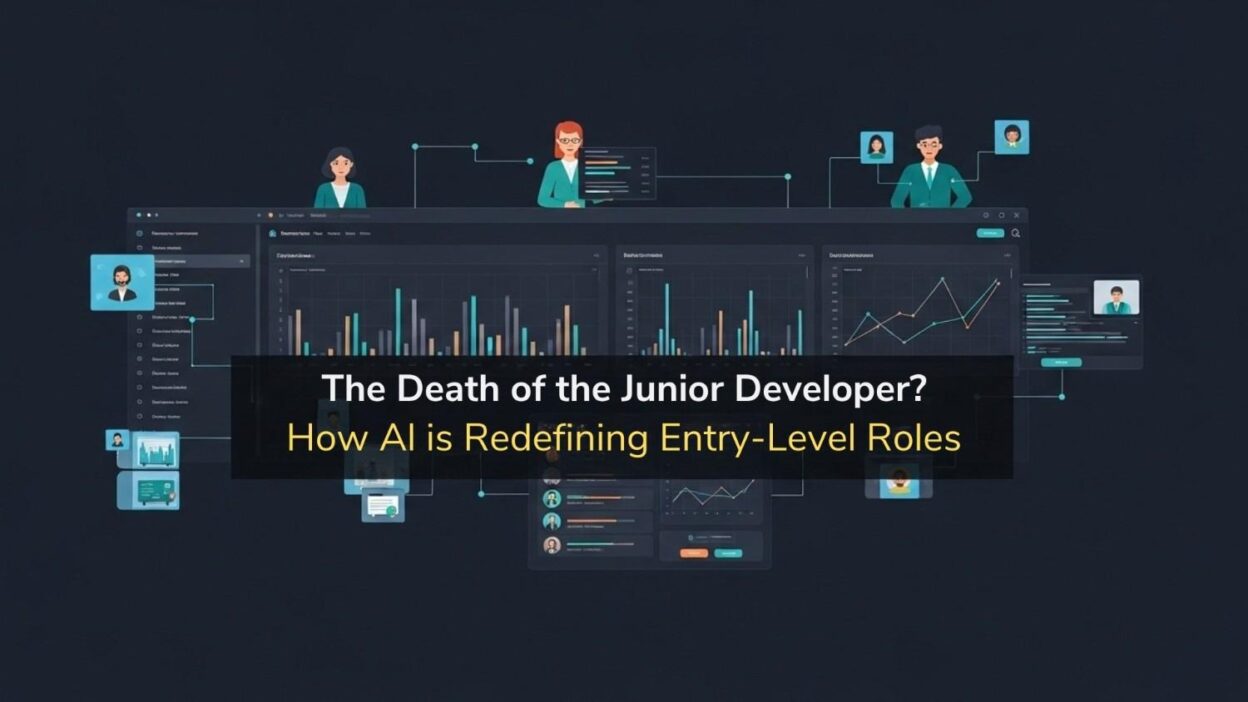
TL;DR Junior developers face an unprecedented crossroads today. Artificial intelligence tools write code faster than ever before. GitHub Copilot suggests entire functions instantly. ChatGPT debugs complex problems in seconds. The traditional path into software development looks dramatically different now.
Fresh graduates wonder if their skills still matter. Bootcamp students question their investment decisions. Entry-level positions seem to vanish from job boards. AI Redefining Junior Developer Roles represents more than a trend. This shift fundamentally alters career trajectories across the tech industry.
The anxiety feels real and justified. Companies automate tasks that juniors traditionally handled. Code reviews happen through AI-powered tools. Bug fixes emerge from machine learning models. Your concerns about career viability deserve serious examination.
This analysis explores the actual impact on entry-level careers. You’ll discover which skills remain invaluable despite automation. New opportunities emerge alongside the disruptions. Understanding this transformation helps you adapt successfully. The future belongs to developers who embrace strategic evolution.
Table of Contents
The Traditional Junior Developer Role
Junior developers historically started with simple maintenance tasks. You fixed minor bugs in existing codebases. Documentation updates consumed significant portions of your day. Senior developers mentored you through code reviews patiently.
Entry-level positions taught fundamental programming concepts gradually. You learned version control through daily commits. Testing principles emerged from writing unit tests. Debugging skills developed through countless error messages.
Companies valued juniors for specific contributions beyond pure coding. Fresh perspectives questioned established assumptions productively. Recent education brought modern techniques into legacy systems. Enthusiasm compensated for experience gaps frequently.
The apprenticeship model defined technology career paths reliably. You spent years mastering syntax and patterns. Senior developers invested time in your growth. Organizations accepted slower initial productivity as standard. This ecosystem nurtured talent development systematically.
How AI Tools Actually Work in Development
Modern AI coding assistants operate through pattern recognition fundamentally. Large language models train on billions of code lines. GitHub repositories provide training data extensively. The systems learn common programming patterns deeply.
Context awareness distinguishes advanced AI tools significantly. Copilot examines your current file before suggesting code. The model understands function names and variable declarations. Comments guide generation toward specific implementations.
AI Redefining Junior Developer Roles happens through automation capabilities. Tools complete boilerplate code instantly. Repetitive patterns get recognized and replicated. Syntax errors decrease through real-time suggestions. Your typing speed multiplies through intelligent autocomplete.
Limitations remain substantial despite impressive capabilities. AI struggles with novel problem architectures. Complex business logic requires human reasoning. Domain-specific knowledge exceeds model training. Security considerations need human judgment always.
The technology excels at specific tasks consistently. Converting designs into basic HTML works reliably. Database queries generate from natural language. API integrations follow documented patterns. Standard algorithms implement correctly usually.
Tasks AI Handles Better Than Junior Developers
Code generation for common patterns happens instantaneously. You describe a sorting algorithm in comments. AI produces the complete implementation correctly. Standard data structures appear through simple prompts. Your productivity increases for routine coding.
Documentation writing improves through AI assistance dramatically. Function descriptions generate from code analysis. README files draft themselves from project examination. Code comments explain complex logic automatically. Technical writing quality increases across teams.
Syntax error detection surpasses human capability entirely. AI catches typos before compilation. Missing semicolons get flagged immediately. Bracket matching happens automatically. Your debugging time decreases substantially.
Basic testing scenarios generate without manual effort. Unit tests emerge from function signatures. Edge cases get identified through analysis. Test coverage improves through automated suggestions. Quality assurance accelerates significantly.
Refactoring suggestions maintain code quality continuously. AI identifies duplicate code patterns. Variable naming improvements appear contextually. Function extraction opportunities get highlighted. Your codebase stays cleaner naturally.
Skills AI Cannot Replace
Problem decomposition requires human creativity fundamentally. Breaking complex requirements into manageable pieces demands judgment. Business context influences technical decisions heavily. AI Redefining Junior Developer Roles doesn’t eliminate strategic thinking. You translate ambiguous requirements into concrete specifications.
Stakeholder communication remains purely human territory. Understanding customer needs requires empathy. Explaining technical constraints uses interpersonal skills. Negotiating scope involves emotional intelligence. Your ability to bridge business and technology proves invaluable.
System architecture decisions need experience-based intuition. Choosing between microservices and monoliths requires context. Database selection depends on growth projections. Technology stack choices impact years of development. These decisions carry consequences AI cannot fully comprehend.
Code review quality depends on understanding intent. You evaluate whether solutions match requirements. Performance implications need domain knowledge. Security vulnerabilities require contextual awareness. Automated tools miss nuanced problems consistently.
Team collaboration creates value AI cannot replicate. Pair programming generates shared understanding. Knowledge transfer happens through human interaction. Mentorship relationships build organizational capability. Your interpersonal skills become increasingly valuable.
The Evolution of Entry-Level Requirements
Hiring managers adjust expectations for junior positions substantially. Pure coding ability ranks lower than before. Problem-solving skills gain priority dramatically. Communication capabilities matter more than syntax knowledge. AI Redefining Junior Developer Roles shifts evaluation criteria fundamentally.
Technical interviews change focus areas significantly. Algorithmic puzzles decrease in importance. System design discussions happen earlier. Behavioral questions probe deeper. Your ability to use AI tools effectively becomes tested.
Portfolio requirements evolve beyond simple projects. Contributions to open source demonstrate collaboration. Complex problem explanations show thinking processes. AI tool usage documentation proves adaptability. Employers seek evidence of augmented capabilities.
Education paths diversify across multiple dimensions. Computer science degrees remain valuable but insufficient. Bootcamps emphasize AI tool proficiency. Self-taught developers showcase practical applications. Your learning approach matters less than demonstrated skills.
Certification programs incorporate AI competencies explicitly. Cloud platforms teach automation integration. DevOps training includes AI-assisted workflows. Security courses address AI-generated code risks. Industry recognizes the permanent technology shift.
New Opportunities Created by AI
Prompt engineering emerges as a specialized skill. Crafting effective AI instructions requires practice. Understanding model limitations guides usage patterns. Your expertise in AI interaction becomes valuable. Organizations need developers who maximize tool effectiveness.
AI tool customization creates implementation roles. Companies want assistants trained on internal codebases. Custom models need domain-specific fine-tuning. Integration workflows require thoughtful design. AI Redefining Junior Developer Roles includes new specializations.
Quality assurance for AI-generated code demands attention. Reviewing automated output requires critical thinking. Security audits catch model mistakes. Performance optimization fixes inefficient generations. Your oversight ensures production readiness.
Process automation opportunities multiply across organizations. Repetitive tasks become automation candidates. Workflow optimization improves team productivity. Tool chain integration streamlines development. Companies value automation architects increasingly.
Developer experience engineering gains prominence rapidly. Internal tools need thoughtful design. AI assistant configuration improves workflows. Documentation systems integrate intelligent search. Your focus shifts toward enabling others.
Case Studies: Companies Adapting Hiring
Technology giants modify junior positions strategically. Google emphasizes AI collaboration skills. Microsoft seeks developers comfortable with Copilot. Meta prioritizes system thinking over syntax. AI Redefining Junior Developer Roles reflects industry-wide changes.
Startups eliminate traditional junior positions entirely. Small teams cannot afford learning curves. AI tools replace entry-level bandwidth. Senior developers leverage automation heavily. New graduates face tougher market conditions.
Enterprise organizations take hybrid approaches. Some departments maintain apprenticeship models. Others adopt AI-first development practices. Internal variation creates confusion. Career paths become less predictable.
Consulting firms build AI-augmented teams. Juniors focus on client communication. AI handles implementation details. Billable hours shift toward strategy. Value delivery changes fundamentally.
Remote-first companies leverage AI extensively. Distributed teams use asynchronous code generation. Time zone differences matter less. Productivity expectations increase substantially. Geographic barriers lower while skill bars rise.
Strategies for Junior Developers to Stay Relevant
Embrace AI tools as productivity multipliers actively. Learn prompt engineering techniques thoroughly. Experiment with multiple coding assistants. Understand strengths and weaknesses deeply. Your competitive advantage comes from effective usage.
Develop strong fundamentals that AI cannot replace. Master problem decomposition methodologies. Study system design principles extensively. Practice explaining technical concepts clearly. AI Redefining Junior Developer Roles makes soft skills critical.
Build expertise in areas requiring human judgment. Security analysis demands contextual understanding. Performance optimization needs domain knowledge. Accessibility compliance requires empathy. Specialize where AI assistance remains limited.
Contribute to open source projects actively. Public repositories demonstrate real capabilities. Collaboration shows teamwork abilities. Code reviews prove analytical thinking. Your portfolio needs tangible evidence.
Focus on business impact over pure coding. Understand user needs deeply. Measure feature success quantitatively. Communicate value clearly. Companies hire problem solvers primarily.
The Myth of Developer Extinction
Historical precedents show technology creates opportunities. Spreadsheets didn’t eliminate accountants. Calculators increased mathematician productivity. Automation typically augments rather than replaces. AI Redefining Junior Developer Roles follows similar patterns.
Software complexity grows faster than automation capabilities. Applications become more sophisticated continuously. User expectations increase relentlessly. Business requirements expand infinitely. Developer demand remains strong despite tools.
New platforms require development constantly. Mobile apps need ongoing updates. Cloud services multiply options. IoT devices create integration challenges. Your skills apply across expanding domains.
Programming becomes more accessible broadly. Citizen developers emerge in every department. Technical literacy spreads organizationally. Professional developers guide implementations. Your role evolves toward architecture and governance.
The shortage of experienced developers continues. AI cannot mentor junior talent. Leadership skills remain purely human. Technical judgment develops through experience. Senior positions need human occupants.
What Senior Developers Think About AI
Experienced programmers view AI as powerful assistants. Tools accelerate routine coding significantly. Focus shifts toward higher-level problems. Productivity gains feel substantial immediately. AI Redefining Junior Developer Roles changes mentorship approaches.
Concerns center on code quality issues. AI-generated solutions lack elegance sometimes. Performance optimization gets overlooked. Security vulnerabilities slip through. Human oversight remains essential always.
Training responsibilities change fundamentally now. Teaching syntax becomes less important. Explaining problem-solving methodologies gains priority. Critical thinking instruction increases. Juniors need different skill foundations.
Some seniors embrace AI enthusiastically. Others resist changing workflows. Generational differences appear clearly. Adaptation speed varies dramatically. Industry transformation continues regardless.
Mentorship evolves beyond code reviews. Career guidance becomes more important. Skill development planning requires updates. Navigating AI integration needs support. Your growth path needs experienced guides.
Education System Response to AI
Universities update curricula slowly but deliberately. Computer science programs add AI literacy. Software engineering courses teach tool usage. Ethics discussions address automation implications. Academic institutions recognize permanent shifts.
Bootcamps adapt faster to market demands. AI tool proficiency becomes core curriculum. Project-based learning emphasizes augmented development. Job placement strategies highlight AI skills. AI Redefining Junior Developer Roles drives education changes.
Online learning platforms proliferate AI courses. Prompt engineering tutorials appear everywhere. Tool-specific certifications launch regularly. Community resources multiply rapidly. Self-directed learning becomes easier.
Corporate training programs emphasize AI integration. Internal workshops teach best practices. Tool rollouts include comprehensive education. Change management supports adoption. Organizations invest in reskilling.
Continuing education becomes mandatory practically. Technology changes require constant learning. Skill refreshment happens continuously. Professional development never stops. Your career demands perpetual adaptation.
Legal and Ethical Considerations
Code ownership questions emerge frequently. AI-generated code raises copyright concerns. Training data licensing needs clarification. Attribution becomes complicated. Legal frameworks lag behind technology.
Bias in AI tools affects development work. Models reflect training data limitations. Certain languages receive better support. Cultural perspectives vary across tools. AI Redefining Junior Developer Roles includes fairness considerations.
Security implications require careful attention. AI might suggest vulnerable patterns. Generated code needs thorough review. Dependency risks increase subtly. Your vigilance protects applications.
Privacy concerns affect tool adoption. Code context shares proprietary information. Sensitive data exposure risks exist. Enterprise policies restrict AI usage. Compliance requirements limit capabilities.
Environmental costs deserve acknowledgment. Large models consume substantial energy. Training requires massive computation. Inference adds carbon footprints. Sustainable development includes tool choices.
The Hybrid Developer of Tomorrow
Future developers combine human and AI capabilities. You orchestrate multiple tools simultaneously. Critical thinking guides AI usage. Domain expertise informs prompt engineering. AI Redefining Junior Developer Roles creates augmented professionals.
Technical skills blend with business acumen. Understanding user needs drives development. Measuring impact guides priorities. Communication bridges stakeholders. Your value comes from holistic contributions.
Continuous learning defines career sustainability. New tools emerge constantly. Best practices evolve rapidly. Industry standards shift frequently. Adaptability becomes your greatest asset.
Specialization opportunities multiply across dimensions. AI tool expertise creates niches. Domain knowledge provides advantages. Process optimization offers paths. Your career choices expand significantly.
The successful developer embraces change actively. Resistance guarantees obsolescence. Curiosity drives growth. Experimentation builds skills. Your mindset determines outcomes.
Practical Steps to Take Today
Experiment with multiple AI coding assistants. Try GitHub Copilot for daily work. Test ChatGPT for problem-solving. Explore specialized tools for your stack. Compare capabilities systematically.
Build projects showcasing AI collaboration. Document your workflow explicitly. Explain tool usage decisions. Measure productivity improvements. AI Redefining Junior Developer Roles requires demonstrable proficiency.
Join communities discussing AI development. Online forums share best practices. Local meetups explore implementations. Conference talks reveal trends. Networking builds knowledge networks.
Contribute to open source AI tools. Report bugs and suggest improvements. Create extensions and plugins. Share usage patterns publicly. Your involvement builds expertise.
Develop a personal learning roadmap. Identify skill gaps honestly. Prioritize high-impact areas. Schedule regular study time. Track progress measurably.
Industry Predictions for the Next Five Years
Entry-level positions will transform completely. AI proficiency becomes mandatory universally. Hiring bars rise substantially. Compensation reflects augmented productivity. Market dynamics shift permanently.
Education programs standardize AI integration. Degrees require tool competency. Certifications validate AI skills. Learning paths incorporate automation. Academic standards evolve continuously.
New job titles emerge across organizations. AI Developer Relations grows. Prompt Engineering Specialists appear. Code Quality Auditors multiply. AI Redefining Junior Developer Roles creates career categories.
Tool capabilities advance exponentially. Code generation improves dramatically. Error rates decrease substantially. Context understanding deepens. Human-AI collaboration becomes seamless.
Developer productivity expectations increase. Individual output multiplies. Team sizes shrink. Project timelines compress. Industry velocity accelerates.
Frequently Asked Questions
Will AI completely replace junior developers?
AI tools automate specific tasks rather than entire roles. Junior developers evolve into AI-augmented positions. Companies still need humans for problem-solving. Communication and creativity remain essential. Entry-level positions transform but persist. Your adaptability determines career viability. Focus on skills AI cannot replicate. The market continues demanding talented beginners.
How should I learn to work with AI coding tools?
Start experimenting with free tools immediately. Try GitHub Copilot through student programs. Use ChatGPT for coding questions. Build small projects demonstrating collaboration. Document your learning process publicly. Join online communities discussing AI development. Practice prompt engineering deliberately. Your hands-on experience builds proficiency fastest.
What skills matter most for junior developers now?
Problem decomposition ranks above pure coding. Communication skills prove increasingly valuable. System thinking guides better decisions. AI tool proficiency becomes mandatory. Business acumen differentiates candidates. Security awareness protects applications. Continuous learning ensures relevance. Your soft skills become competitive advantages.
Are bootcamps still worth the investment?
Quality bootcamps adapt curricula to AI reality. Programs teaching augmented development remain valuable. Look for AI tool integration emphasis. Job placement rates indicate market relevance. Cost-benefit analysis varies by program. Research employer perceptions carefully. Your due diligence prevents poor investments.
How do I stand out in an AI-assisted job market?
Build projects showcasing unique thinking. Contribute to open source meaningfully. Develop specialized domain knowledge. Master multiple AI tools thoroughly. Create content explaining your approach. Network actively within communities. Demonstrate business impact clearly. Your differentiation requires strategic effort.
Will salaries decrease for entry-level developers?
Market forces create complex dynamics. Productivity increases may justify higher pay. Competition could pressure compensation downward. Geographic arbitrage affects wages. Specialized skills command premiums. Industry segments vary significantly. Your negotiating position depends on differentiation. Value creation determines earnings ultimately.
What companies hire junior developers today?
Enterprise organizations maintain apprenticeship programs. Consultancies need client-facing talent. Growing startups require versatile team members. Government agencies seek technical staff. Educational institutions hire developer educators. Your target employer depends on priorities. Research company cultures thoroughly. Alignment ensures mutual success.
How quickly is AI technology changing development work?
Change happens faster than most expect. New tools launch monthly. Capabilities improve continuously. Best practices evolve rapidly. Industry standards shift frequently. Your adaptation speed matters critically. Continuous learning becomes mandatory. Embrace perpetual change actively.
Read More:-Automating SaaS Multi-Tenancy Setup with AI Infrastructure as Code
Conclusion
AI Redefining Junior Developer Roles represents reality rather than speculation. The transformation affects every aspect of entry-level careers. Traditional paths into software development have changed permanently. Your success requires acknowledging and adapting to this shift.
The death of junior developers remains greatly exaggerated. Roles evolve rather than disappear. New responsibilities replace automated tasks. Human judgment stays essential. Companies still need talented beginners.
AI tools augment capabilities rather than eliminate positions. Productivity multiplies through effective collaboration. Problem-solving remains fundamentally human. Communication skills gain importance. Your value proposition simply shifts.
The barrier to entry rises in some dimensions. Technical proficiency expectations increase. AI competency becomes mandatory. Competition intensifies noticeably. Market dynamics favor adaptable candidates.
Opportunities expand in unexpected directions. New specializations emerge continuously. Hybrid skills command premiums. Problem solvers remain in demand. Your career potential actually increases.
Education and training must evolve rapidly. Traditional curricula need updates. Practical AI skills require emphasis. Continuous learning becomes mandatory. Institutions adapt or become irrelevant.
The successful junior developer embraces AI enthusiastically. Tools become force multipliers. Learning accelerates through intelligent assistance. Productivity reaches unprecedented levels. Your career trajectory improves through adoption.
Focus on irreplaceable human capabilities. Critical thinking cannot automate. Creativity drives innovation. Empathy enables collaboration. Communication bridges understanding. These skills define your value.
Build a portfolio demonstrating augmented development. Showcase AI-assisted projects. Document your workflow decisions. Explain tool usage rationally. Evidence beats claims always.
Network within the evolving community. Learn from experienced developers. Share knowledge generously. Collaborate on challenging problems. Relationships create opportunities.
Stay current with rapid technological changes. Follow industry developments actively. Experiment with emerging tools. Attend relevant conferences. Curiosity prevents obsolescence.
The future belongs to hybrid developers. You combine human insight with AI capability. Strategic thinking guides tool usage. Domain expertise informs decisions. AI Redefining Junior Developer Roles creates enhanced professionals.
Your career remains viable through adaptation. Embrace change as opportunity. Develop complementary skills. Leverage AI as an ally. Success requires evolution.
The junior developer role transforms rather than dies. Entry points shift but persist. New graduates still find opportunities. Companies still need fresh talent. Your path forward exists clearly.
Prepare yourself for hybrid development work. Master AI collaboration techniques. Build irreplaceable human skills. Stay adaptable always. Your future remains bright.