Introduction
TL;DR Modern SaaS platforms demand sophisticated infrastructure management. Multi-tenancy architectures create unique deployment challenges. Manual configuration becomes unsustainable at scale.
AI Infrastructure as Code for SaaS transforms how engineering teams work. Intelligent automation replaces repetitive manual tasks. Infrastructure provisioning accelerates from days to minutes.
Traditional infrastructure management relies on human expertise exclusively. DevOps engineers write configurations manually for each tenant. Errors creep into deployments through copy-paste mistakes.
Artificial intelligence brings unprecedented capabilities to infrastructure automation. Machine learning algorithms optimize resource allocation automatically. Predictive analytics prevent issues before they impact customers.
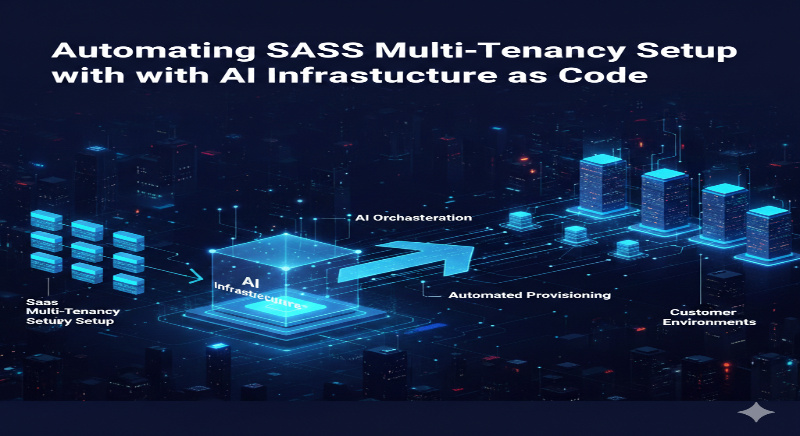
This comprehensive guide explores AI-powered infrastructure automation. You’ll discover how intelligent systems manage multi-tenant deployments. We examine practical implementation strategies and real-world results.
The marriage of AI and Infrastructure as Code creates powerful synergies. Autonomous systems learn from deployment patterns. Optimization occurs continuously without human intervention.
Table of Contents
Understanding Multi-Tenancy in Modern SaaS Applications
Multi-tenancy allows a single application instance to serve multiple customers. Each tenant operates in isolated environments. Shared infrastructure reduces operational costs dramatically.
Three primary multi-tenancy models exist in SaaS architecture. Single-tenant deployments provide complete isolation per customer. Multi-tenant shared database architectures maximize resource efficiency. Hybrid approaches balance isolation with economic benefits.
Resource allocation becomes complex with hundreds of tenants. Each customer requires specific compute, storage, and network resources. Usage patterns vary wildly across different tenant profiles.
Architectural Patterns for Multi-Tenant SaaS
Database-per-tenant models offer maximum isolation. Each customer gets dedicated database instances. Data breaches cannot cross tenant boundaries easily.
Shared database with schema separation reduces infrastructure costs. Logical separation maintains data isolation. Query performance optimization requires careful planning.
Row-level security implements the most cost-effective approach. All tenants share identical database schemas. Application logic enforces data access controls.
Compute resource allocation strategies vary by workload. Serverless functions scale independently per tenant. Container orchestration enables efficient resource sharing.
Challenges in Traditional Multi-Tenant Management
Manual tenant provisioning consumes significant engineering time. Creating new customer environments requires multiple steps. Human error introduces security vulnerabilities frequently.
Configuration drift plagues manually managed infrastructure. Environments diverge from standard templates over time. Troubleshooting becomes increasingly difficult.
Resource optimization demands constant monitoring and adjustment. Under-provisioned tenants experience performance issues. Over-provisioned resources waste budget unnecessarily.
Compliance requirements multiply complexity exponentially. GDPR, HIPAA, and SOC 2 demand specific configurations. Manual verification cannot guarantee consistent compliance.
The Evolution of Infrastructure as Code
Infrastructure as Code revolutionized DevOps practices fundamentally. Declarative configurations replaced manual server setup. Version control enabled infrastructure reproducibility.
Terraform emerged as the leading IaC platform. HashiCorp Configuration Language describes desired infrastructure states. Cloud-agnostic design supports multi-cloud deployments.
AWS CloudFormation provides native infrastructure automation. JSON and YAML templates define AWS resources. Deep integration with AWS services offers advantages.
Pulumi introduced programming languages to infrastructure definitions. TypeScript, Python, and Go replace domain-specific languages. Software engineering practices apply to infrastructure management.
Traditional IaC Limitations at Scale
Static templates require manual customization for variations. Each tenant configuration demands separate template files. Maintenance overhead grows linearly with tenant count.
Parameter management becomes unwieldy quickly. Hundreds of variables need documentation and validation. Configuration errors remain difficult to detect.
Optimization strategies remain purely manual. Engineers analyze metrics and adjust configurations reactively. Proactive optimization rarely occurs systematically.
Testing infrastructure code presents unique challenges. Validation requires actual cloud deployments. Feedback loops extend over minutes or hours.
The Need for Intelligent Automation
Complex multi-tenant environments overwhelm human capabilities. Optimal configurations require analyzing thousands of data points. Manual decision-making cannot achieve this comprehensively.
Workload patterns change continuously and unpredictably. Peak usage times vary across different tenant cohorts. Static configurations cannot adapt dynamically.
Cost optimization opportunities hide in vast metric datasets. Identifying waste requires sophisticated analysis. Human teams lack bandwidth for continuous review.
Security best practices evolve rapidly. New vulnerabilities emerge constantly. Manual security updates lag behind threats.
Introducing AI Infrastructure as Code for SaaS
AI Infrastructure as Code for SaaS combines machine learning with automation. Intelligent systems generate infrastructure configurations automatically. Continuous learning improves decisions over time.
Natural language processing interprets infrastructure requirements. Engineers describe needs in plain language. AI translates descriptions into proper code.
Machine learning models predict resource requirements accurately. Historical usage patterns inform capacity planning. Right-sizing occurs automatically for each tenant.
Anomaly detection identifies infrastructure issues proactively. Unusual patterns trigger automated investigations. Problems resolve before customers notice.
How AI Enhances Infrastructure Automation
Generative AI creates infrastructure templates from specifications. Large language models understand deployment patterns. Code generation happens in seconds rather than hours.
Reinforcement learning optimizes resource allocation continuously. AI agents experiment with different configurations. Reward functions maximize performance while minimizing costs.
Predictive analytics forecast tenant growth accurately. Scaling decisions occur preemptively. Capacity crunches never impact user experience.
Computer vision analyzes architecture diagrams automatically. Visual representations convert into executable code. Documentation transforms into deployments seamlessly.
Key Components of AI-Powered IaC Systems
Policy engines encode organizational standards as machine-readable rules. AI systems validate configurations against policies automatically. Compliance violations get blocked before deployment.
Knowledge graphs capture infrastructure relationships comprehensively. Dependencies between resources become explicit. Impact analysis predicts change consequences accurately.
Natural language interfaces democratize infrastructure management. Non-technical team members describe requirements conversationally. AI handles technical implementation details completely.
Simulation environments test configurations without actual deployments. Digital twins model infrastructure behavior. Validation completes in seconds rather than minutes.
Benefits of AI-Driven Infrastructure Management
Deployment velocity increases by 10x or more typically. Tenant onboarding completes in minutes automatically. Sales teams close deals without engineering bottlenecks.
Configuration consistency reaches near-perfect levels. AI-generated code follows standards uniformly. Drift detection and remediation happen continuously.
Cost optimization achieves 30-50% savings commonly. Unused resources get identified and eliminated automatically. Right-sizing occurs based on actual usage patterns.
Security posture improves through automated compliance checking. Vulnerabilities get detected during code generation. Remediation suggestions appear instantly.
Implementing AI Infrastructure as Code: Core Technologies
Several technology categories enable AI Infrastructure as Code for SaaS. Large language models form the foundation. Specialized tools address specific automation needs.
OpenAI Codex and GitHub Copilot generate infrastructure code. Natural language prompts produce Terraform or CloudFormation templates. Code quality improves through iterative refinement.
Amazon CodeWhisperer provides AWS-specific code generation. Deep integration with AWS services improves accuracy. Security scanning happens during code creation.
HashiCorp Sentinel implements policy as code frameworks. Machine learning models learn from policy violations. Automated remediation suggestions reduce manual work.
Machine Learning Models for Infrastructure
Supervised learning predicts resource requirements accurately. Training data comes from historical tenant usage. Regression models estimate compute and memory needs.
Clustering algorithms group tenants by usage patterns. Similar workloads share optimized configurations. Template reuse increases dramatically.
Time series forecasting predicts future resource demands. LSTM networks capture seasonal patterns effectively. Autoscaling decisions improve substantially.
Anomaly detection identifies unusual infrastructure behavior. Isolation forests flag suspicious resource consumption. Security incidents get detected faster.
Integration with Existing IaC Tools
Terraform providers expose AI capabilities as resources. Machine learning models become infrastructure components. Predictions integrate into deployment workflows.
Custom Terraform providers wrap AI services. OpenAI API calls happen during plan execution. Generated code gets validated before application.
Kubernetes operators implement AI-driven orchestration. Custom resource definitions describe intelligent behaviors. Controllers execute ML-informed decisions continuously.
GitOps workflows incorporate AI validation gates. Pull requests trigger automated analysis. Approval happens only after AI verification.
Data Sources for AI Training
CloudWatch metrics provide performance data for AWS resources. Prometheus collects metrics from Kubernetes clusters. Time-series databases store historical patterns.
Application logs reveal user behavior patterns. Log aggregation platforms centralize tenant activity. Natural language processing extracts insights automatically.
Cost and usage reports inform optimization models. Billing data identifies waste opportunities. Financial metrics guide right-sizing decisions.
Security audit logs train threat detection models. Historical incidents create labeled training data. Pattern recognition improves over time.
Practical Architecture for AI-Powered Multi-Tenancy
Building AI Infrastructure as Code for SaaS requires thoughtful design. Several architectural patterns prove effective. Your specific requirements guide implementation choices.
Tenant Provisioning Workflows
Natural language interfaces accept tenant creation requests. Sales teams describe customer requirements conversationally. AI translates business needs into technical specifications.
Machine learning models select optimal infrastructure templates. Historical data informs template selection. Similar tenants receive similar configurations.
Code generation happens automatically from specifications. Terraform modules assemble based on requirements. Custom resources get created as needed.
Validation occurs before any actual deployment. Simulations predict performance and costs. Approval workflows engage human oversight selectively.
Deployment executes across multiple cloud regions. Geographic requirements get satisfied automatically. Compliance regulations influence region selection.
Dynamic Resource Optimization
Continuous monitoring tracks all tenant metrics. CPU, memory, disk, and network usage stream into analytics. Real-time processing identifies optimization opportunities.
Machine learning models recommend configuration changes. Predictions estimate improvement impacts. Cost-benefit analysis guides implementation priorities.
Automated scaling decisions happen within defined boundaries. Safety constraints prevent runaway costs. Human approval gates protect critical changes.
Testing validates optimization changes safely. Canary deployments limit blast radius. Rollback mechanisms activate upon problems.
Security and Compliance Automation
Policy engines define security requirements formally. Regulations translate into machine-readable rules. AI validates every configuration automatically.
Threat detection models analyze infrastructure continuously. Unusual patterns trigger security reviews. Automated remediation fixes common vulnerabilities.
Encryption key management happens automatically. Rotation schedules enforce based on policies. Compliance audits retrieve evidence instantly.
Access control policies adapt to usage patterns. Least privilege principles enforce algorithmically. Anomalous access attempts get blocked automatically.
Real-World Implementation Strategies
Successful AI Infrastructure as Code for SaaS deployments follow proven patterns. Starting small and scaling gradually works best. Learning happens through iterative improvement.
Phase 1: Foundation Building
Select a single tenant provisioning workflow initially. Automate the most repetitive task first. Quick wins build organizational momentum.
Integrate AI code generation for basic templates. Start with simple infrastructure patterns. Complexity increases as confidence grows.
Collect metrics comprehensively from day one. Historical data becomes training material. More data enables better AI models.
Establish policy frameworks early. Encode critical requirements formally. Automated enforcement begins immediately.
Phase 2: Intelligence Integration
Deploy machine learning models for resource prediction. Right-sizing starts with non-critical tenants. Validation confirms accuracy before broader rollout.
Implement anomaly detection for cost optimization. Flag unusual spending patterns automatically. Investigation workflows guide follow-up actions.
Add natural language interfaces gradually. Start with read-only queries initially. Write operations require additional safeguards.
Create simulation environments for testing. Digital twins model proposed changes. Confidence grows through validation.
Phase 3: Autonomous Operations
Enable automated optimization within guardrails. Machine learning makes decisions independently. Human oversight monitors aggregate outcomes.
Implement self-healing infrastructure capabilities. Detected problems trigger automated remediation. Resolution happens without human intervention.
Deploy predictive scaling based on forecasts. Capacity additions happen before demand arrives. Performance remains consistently high.
Continuous learning improves models automatically. New data refines predictions constantly. Systems become smarter over time.
Measuring Success and ROI
Track tenant provisioning time carefully. Reductions demonstrate automation value. Minutes replace hours or days.
Monitor infrastructure cost trends closely. Optimization savings compound over time. 30-50% reductions validate investments.
Measure configuration drift and compliance violations. Reductions prove consistency improvements. Audit findings decrease substantially.
Count security incidents and vulnerabilities. Proactive detection reduces breaches. Remediation time drops dramatically.
Tools and Platforms for AI Infrastructure Automation
The AI Infrastructure as Code for SaaS ecosystem matures rapidly. Specialized platforms emerge continuously. Choosing appropriate tools accelerates implementation.
AI-Powered IaC Platforms
Pulumi AI generates infrastructure code from natural language. The platform supports multiple programming languages. Cloud-agnostic design prevents vendor lock-in.
Stacklet provides AI-driven cloud governance. Policy enforcement happens automatically. Multi-cloud support covers AWS, Azure, and GCP.
env0 adds AI capabilities to Terraform workflows. Cost predictions guide deployment decisions. Drift detection happens continuously.
Resourcely uses AI for infrastructure design. Visual interfaces generate proper code. Best practices enforcement occurs automatically.
Machine Learning Operations Tools
MLflow tracks machine learning experiments systematically. Model versioning enables reproducibility. Deployment pipelines integrate ML models.
Kubeflow orchestrates ML workflows on Kubernetes. Distributed training scales across clusters. Model serving happens efficiently.
Weights & Biases provides experiment tracking. Hyperparameter optimization improves model quality. Team collaboration features enhance productivity.
SageMaker offers managed machine learning infrastructure. Pre-built algorithms accelerate development. Deployment happens with minimal configuration.
Observability and Monitoring Solutions
Datadog collects metrics from all infrastructure layers. Machine learning detects anomalies automatically. Alert fatigue decreases through intelligent filtering.
New Relic provides AI-powered application monitoring. Incident intelligence correlates related issues. Root cause analysis happens faster.
Dynatrace uses AI for performance optimization. Davis AI engine identifies problems automatically. Remediation recommendations appear instantly.
Prometheus and Grafana create open-source monitoring stacks. Machine learning plugins add intelligence. Customization supports unique requirements.
Integration and Orchestration Platforms
Zapier connects disparate tools without coding. Natural language creates automation workflows. Infrastructure tools integrate seamlessly.
n8n provides open-source workflow automation. AI nodes enable intelligent routing. Self-hosting maintains data control.
Temporal orchestrates complex infrastructure workflows. Reliable execution handles failures gracefully. Long-running processes complete successfully.
Apache Airflow schedules infrastructure tasks programmatically. Directed acyclic graphs define dependencies. Python integration enables AI incorporation.
Security Considerations for AI-Powered Infrastructure
AI Infrastructure as Code for SaaS introduces unique security challenges. AI models require protection themselves. Generated code needs validation rigorously.
Securing AI Models and Training Data
Training data contains sensitive infrastructure patterns. Encryption protects data at rest and transit. Access controls limit exposure strictly.
Model theft represents a significant risk. Adversaries could reverse-engineer infrastructure strategies. Authentication mechanisms protect model endpoints.
Poisoning attacks compromise model integrity. Malicious training data creates backdoors. Data validation prevents contaminated inputs.
Model inversion attacks extract training data. Differential privacy techniques mitigate risks. Privacy budgets limit information leakage.
Validating AI-Generated Code
Static analysis scans generated infrastructure code. Security linters identify common vulnerabilities. Compliance checkers verify policy adherence.
Dynamic testing executes code in isolated environments. Sandbox deployments reveal runtime issues. Validation completes before production deployment.
Human review gates critical infrastructure changes. Senior engineers approve AI recommendations. Accountability remains with human decision-makers.
Version control tracks all generated configurations. Git history provides audit trails. Rollback capabilities enable quick recovery.
Protecting Multi-Tenant Boundaries
AI systems must respect tenant isolation strictly. Code generation never crosses boundaries. Data leakage prevention remains paramount.
Encryption enforces separation at infrastructure level. Tenant-specific keys prevent unauthorized access. Key management happens automatically.
Network segmentation isolates tenant workloads. Virtual private clouds create boundaries. Firewall rules enforce restrictions.
Identity and access management controls remain strict. Role-based access prevents privilege escalation. Audit logs track all activities.
Cost Optimization Through AI Infrastructure Management
AI Infrastructure as Code for SaaS delivers substantial cost savings. Intelligent resource allocation eliminates waste. Continuous optimization compounds benefits over time.
Identifying Waste and Inefficiency
Machine learning analyzes resource utilization comprehensively. Idle instances get flagged automatically. Recommendations include specific actions.
Right-sizing suggestions appear continuously. Oversized resources shrink to appropriate tiers. Performance remains unaffected.
Reserved instance optimization happens algorithmically. Purchasing recommendations maximize savings. Coverage gaps get identified automatically.
Storage optimization eliminates unused volumes. Orphaned snapshots delete automatically. Lifecycle policies enforce retention rules.
Predictive Cost Management
Forecasting models predict monthly spending accurately. Budget alerts trigger before overruns occur. Finance teams gain visibility early.
Anomaly detection flags unusual cost patterns. Unexpected charges get investigated immediately. Bill shock becomes rare.
What-if analysis simulates infrastructure changes. Cost impacts appear before deployment. Informed decisions replace guesswork.
Multi-cloud cost comparison guides workload placement. Price differences inform architecture decisions. Savings accumulate from optimal distribution.
Automated Cost Controls
Budget guardrails prevent runaway spending. Automated shutdown stops expensive resources. Development environments pause overnight automatically.
Spot instance integration reduces compute costs. AI predicts interruption likelihood. Workload placement optimizes for savings.
Auto-scaling boundaries enforce cost discipline. Maximum instance counts prevent surprises. Performance requirements balance budget constraints.
Tagging policies enable cost attribution. Chargeback systems allocate expenses accurately. Accountability improves spending behavior.
Challenges and Limitations of AI Infrastructure Automation
AI Infrastructure as Code for SaaS creates tremendous value. Realistic expectations prevent disappointment. Understanding limitations guides successful implementation.
Technical Complexity and Learning Curves
AI systems add layers of complexity. Debugging becomes more challenging. Understanding model decisions requires expertise.
Training machine learning models demands specialized knowledge. Data science skills supplement DevOps capabilities. Hiring needs expand accordingly.
Integration with legacy systems creates friction. Older infrastructure lacks necessary APIs. Modernization investments become necessary.
Tool proliferation overwhelms smaller teams. Choosing optimal platforms requires research. Vendor lock-in risks need evaluation.
Data Quality and Availability Requirements
Machine learning requires substantial historical data. New platforms lack training material. Cold start problems delay benefits.
Data inconsistencies corrupt model training. Cleaning and normalization demand effort. Garbage in creates garbage out.
Privacy regulations restrict data usage. GDPR and CCPA limit collection scope. Compliance requirements add complexity.
Metric standardization across environments proves difficult. Heterogeneous infrastructure produces incompatible data. Normalization layers add overhead.
Organizational and Cultural Barriers
Teams resist automation that threatens jobs. Change management becomes critical. Communication emphasizes augmentation over replacement.
Trust in AI decisions builds gradually. Early mistakes damage confidence. Transparency and explainability help.
Skill gaps prevent effective utilization. Training investments become mandatory. External expertise accelerates adoption.
Organizational silos impede data sharing. DevOps, Security, and Finance must collaborate. Breaking down barriers takes time.
Ethical and Governance Concerns
Algorithmic bias can perpetuate infrastructure inequities. Training data reflects historical patterns. Conscious effort prevents discrimination.
Accountability for AI decisions remains unclear. Legal frameworks lag technology. Establishing responsibility prevents paralysis.
Explainability requirements challenge complex models. Regulatory compliance demands transparency. Simpler models sometimes work better.
Vendor dependencies create strategic risks. Proprietary AI platforms lock customers in. Open-source alternatives mitigate concerns.
Future Trends in AI Infrastructure as Code
The AI Infrastructure as Code for SaaS field evolves rapidly. Emerging technologies unlock new capabilities. Forward-thinking organizations prepare accordingly.
Autonomous Infrastructure Management
Self-managing infrastructure becomes reality. AI systems handle routine operations completely. Human intervention occurs only for strategic decisions.
Intent-based networking extends to full infrastructure. Engineers specify desired outcomes only. AI determines implementation automatically.
Chaos engineering integrates with AI. Automated resilience testing happens continuously. Systems become antifragile through learning.
Zero-touch operations eliminate manual interventions. Automated remediation handles all common issues. Uptime approaches theoretical maximums.
Advanced AI Capabilities
Large language models improve code generation quality. GPT-5 and beyond understand infrastructure intricately. Natural language becomes the primary interface.
Multimodal AI combines text, images, and metrics. Architecture diagrams generate deployable code. Visual programming becomes practical.
Federated learning enables cross-organization collaboration. Models improve from collective experience. Privacy preservation maintains confidentiality.
Quantum computing accelerates optimization problems. Resource allocation calculations complete instantly. Previously intractable problems become solvable.
Industry Standardization Efforts
Open standards for AI infrastructure emerge. Interoperability between platforms improves. Vendor lock-in decreases substantially.
Regulatory frameworks adapt to AI automation. Compliance requirements become clearer. Legal uncertainty diminishes gradually.
Certification programs validate AI infrastructure skills. Professional development paths emerge. Talent availability increases.
Best practice libraries grow comprehensively. Community-driven knowledge accelerates adoption. Learning curves flatten over time.
Frequently Asked Questions About AI Infrastructure as Code for SaaS
What exactly is AI Infrastructure as Code for SaaS?
AI Infrastructure as Code for SaaS combines artificial intelligence with infrastructure automation. Machine learning models generate configurations automatically. Intelligent systems optimize resource allocation continuously. The approach eliminates manual multi-tenant setup tasks. Natural language interfaces simplify infrastructure management. Organizations deploy tenants faster while reducing costs.
How does AI improve traditional Infrastructure as Code?
AI adds intelligence to static automation. Machine learning predicts resource requirements accurately. Optimization happens automatically without human intervention. Code generation accelerates from natural language descriptions. Anomaly detection identifies issues proactively. Traditional IaC requires manual template creation and tuning.
What skills do teams need for AI infrastructure automation?
DevOps expertise remains foundational. Cloud platform knowledge stays essential. Machine learning familiarity becomes increasingly valuable. Data engineering skills support model training. Python programming enables custom integrations. Teams often combine specialists rather than requiring universal expertise.
How much does AI Infrastructure as Code implementation cost?
Initial investments range from $50,000 to $500,000 typically. Cloud AI services charge per API call. Custom model training requires compute resources. Tool licensing adds recurring expenses. ROI materializes within 6-12 months commonly. Long-term savings exceed implementation costs substantially.
Can AI completely replace DevOps engineers?
No, AI augments rather than replaces engineers. Strategic decisions still require human judgment. Complex troubleshooting benefits from expertise. AI handles repetitive and predictable tasks. Engineers focus on high-value activities. Roles evolve toward AI supervision and optimization.
What are the security risks of AI-generated infrastructure?
Generated code may contain vulnerabilities if untested. Model poisoning could introduce backdoors. Data leakage risks exist with improper isolation. Validation and testing mitigate these concerns. Human review gates critical changes. Security improves compared to manual processes overall.
How long does AI Infrastructure as Code implementation take?
Pilot projects complete in 2-3 months typically. Basic automation delivers value quickly. Full implementation requires 6-12 months. Complexity depends on existing infrastructure. Phased rollouts reduce risk. Continuous improvement extends indefinitely.
Which cloud platforms support AI infrastructure automation best?
AWS provides the most comprehensive AI services. Azure offers strong enterprise integrations. Google Cloud excels at machine learning infrastructure. Multi-cloud tools support all platforms. Platform choice depends on existing investments. Most AI Infrastructure as Code for SaaS solutions work everywhere.
How do you measure success of AI infrastructure automation?
Track tenant provisioning time reductions. Monitor infrastructure cost changes. Measure configuration drift incidents. Count security vulnerabilities detected. Survey developer satisfaction levels. ROI calculations compare costs against savings. Success metrics vary by organizational priorities.
What happens when AI makes incorrect infrastructure decisions?
Rollback mechanisms restore previous states quickly. Monitoring detects problems rapidly. Human oversight prevents catastrophic errors. Learning from mistakes improves future decisions. Guardrails constrain AI actions appropriately. Incident rates decrease as systems mature.
Read More:-The ROI of Custom AI: Why Off-the-Shelf LLMs Aren’t Enough for Business
Conclusion

AI Infrastructure as Code for SaaS transforms multi-tenant platform management fundamentally. Intelligent automation replaces manual configuration entirely. Organizations deploy new tenants in minutes rather than days.
Machine learning optimizes resource allocation continuously. Cost savings reach 30-50% commonly. Infrastructure efficiency improves beyond human capabilities.
Security postures strengthen through automated compliance checking. Vulnerabilities get detected during code generation. Remediation happens faster than manual processes.
The technology stack combines established IaC tools with AI capabilities. Terraform and Kubernetes provide foundations. Machine learning models add intelligence layers.
Implementation requires careful planning and phased rollouts. Starting small builds confidence and expertise. Success compounds as systems learn continuously.
Organizations gain competitive advantages through faster deployment. Sales cycles shorten when provisioning happens instantly. Customer satisfaction improves with consistent performance.
Engineering teams focus on strategic initiatives. Repetitive tasks disappear through automation. Job satisfaction increases despite initial skepticism.
The AI Infrastructure as Code for SaaS ecosystem matures rapidly. New tools and platforms emerge continuously. Capabilities expand beyond current imagination.
Challenges exist around complexity and learning curves. Data quality requirements demand attention. Cultural adaptation takes time and effort.
Future trends point toward fully autonomous infrastructure. Self-healing systems manage themselves completely. Human intervention becomes exception rather than rule.
Standardization efforts reduce implementation friction. Best practices crystallize through community collaboration. Adoption accelerates across industries.
The investment in AI infrastructure automation pays substantial dividends. Reduced operational costs improve profit margins. Faster time-to-market captures revenue opportunities.
Security and compliance become easier rather than harder. Automated enforcement exceeds manual consistency. Audit readiness stays current continuously.
Start your AI Infrastructure as Code for SaaS journey today. Begin with single workflow automation. Expand capabilities based on results and learning.
The competitive landscape rewards early adopters. Organizations implementing AI infrastructure automation pull ahead. Laggards struggle with manual processes increasingly.
Choose appropriate tools matching your requirements. Cloud platform alignment matters significantly. Open standards prevent future lock-in.
Invest in team training and skill development. Machine learning expertise becomes organizational asset. External consultants accelerate initial implementation.
Monitor results and iterate continuously. AI systems improve through feedback loops. Optimization never truly completes.
Embrace the future of infrastructure management. AI Infrastructure as Code for SaaS delivers transformative benefits. Your multi-tenant platform achieves new levels of efficiency and reliability.