Introduction
TL;DR Multi-agent systems represent the future of artificial intelligence architecture. Individual AI agents collaborate to solve complex problems. Teams of specialized agents outperform single monolithic models. Distributed intelligence mirrors how human organizations actually work.
Developers need robust frameworks to build these systems effectively. The right tools accelerate development from months to weeks. AI Frameworks for Multi-Agent Systems provide essential infrastructure. You avoid reinventing coordination protocols and communication patterns.
This comprehensive guide examines eight leading frameworks thoroughly. Each platform offers unique strengths for different use cases. Your choice depends on technical requirements and team expertise. Understanding these options helps you select the optimal solution.
The multi-agent paradigm solves problems impossible for single agents. Complex workflows decompose into specialized subtasks. Agents handle different domains simultaneously. Coordination happens through structured communication protocols. Your applications achieve capabilities previously unattainable.
Table of Contents
Understanding Multi-Agent System Architecture
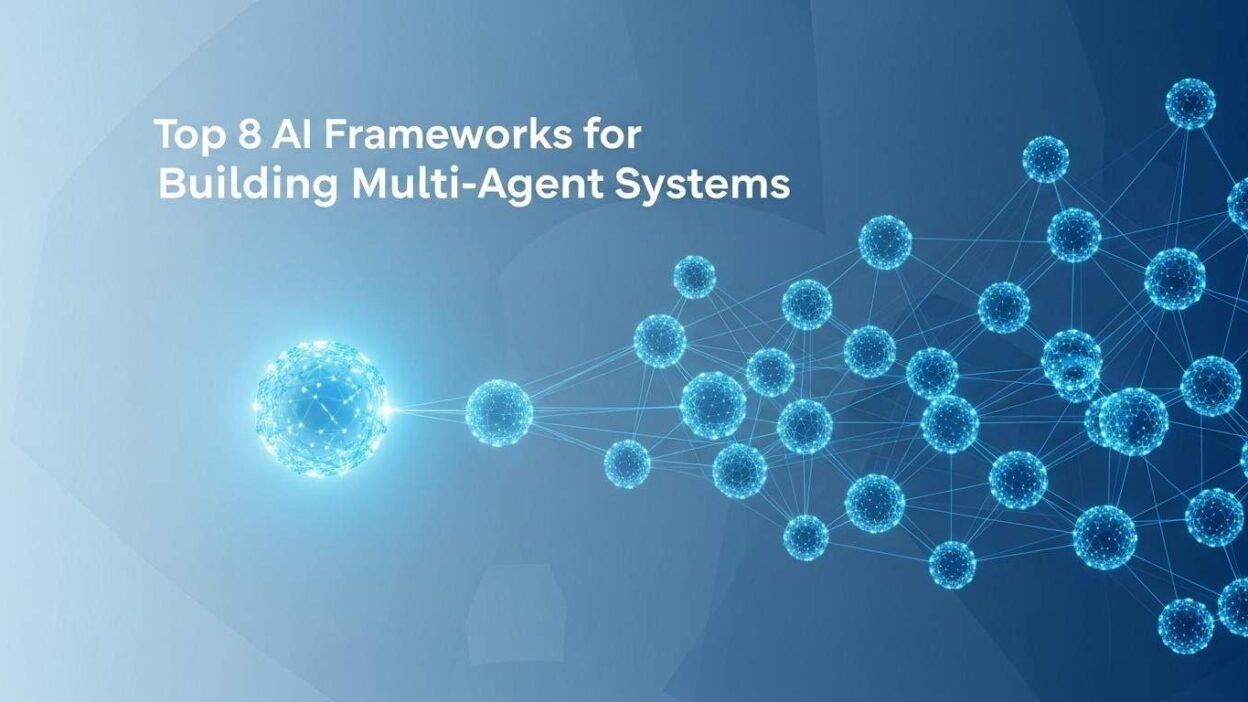
Multi-agent systems distribute intelligence across multiple autonomous entities. Each agent possesses specific expertise and capabilities. Agents communicate through well-defined protocols. Collective behavior emerges from individual interactions.
The architecture requires careful coordination mechanisms. Message passing enables information exchange between agents. Shared memory provides centralized state management. Event-driven patterns trigger reactive behaviors. Your system design determines scalability and reliability.
Agent autonomy creates both opportunities and challenges. Independent decision-making enables parallel processing. Conflicting goals require negotiation protocols. Resource contention needs arbitration mechanisms. AI Frameworks for Multi-Agent Systems handle these complexities automatically.
Communication patterns define system behavior fundamentally. Hierarchical structures suit command-and-control scenarios. Peer-to-peer networks enable collaborative problem-solving. Publish-subscribe models broadcast information efficiently. Your application requirements guide architectural choices.
State management becomes critical at scale. Shared databases create synchronization bottlenecks. Distributed ledgers ensure consistency across agents. Event sourcing maintains complete interaction history. Data architecture impacts performance significantly.
Why Multi-Agent Systems Matter Now
Artificial intelligence applications grow increasingly complex daily. Single models struggle with multifaceted problems. Specialized agents excel at narrow tasks. Combining expertise multiplies capabilities exponentially.
Real-world problems rarely fit single-agent paradigms. Customer service requires routing, retrieval, and response. Financial analysis needs data gathering, modeling, and reporting. Manufacturing optimization involves planning, scheduling, and monitoring. AI Frameworks for Multi-Agent Systems enable these workflows.
Scalability demands distributed architectures inherently. Monolithic systems hit performance ceilings quickly. Agent-based designs scale horizontally naturally. Adding capacity means deploying more agents. Your infrastructure grows with demand.
Maintainability improves through separation of concerns. Each agent encapsulates specific functionality. Updates affect individual components selectively. Testing happens at the agent level. Development velocity increases substantially.
Economic factors drive adoption aggressively. Different tasks require different model sizes. Expensive large models handle complex reasoning. Cheaper small models execute routine operations. Cost optimization happens through intelligent agent selection.
Framework 1: LangGraph
LangGraph brings graph-based coordination to multi-agent systems. The framework models agent interactions as state machines. Nodes represent individual agent actions. Edges define possible transitions between states. Your workflow logic becomes visually explicit.
State management happens through persistent graphs. Each node maintains its own state. Edges carry messages between agents. Conditional routing enables dynamic workflows. Complex orchestration becomes manageable easily.
LangGraph integrates with LangChain ecosystem seamlessly. Existing LangChain tools work without modification. Chain components become graph nodes directly. Memory systems persist across agent interactions. AI Frameworks for Multi-Agent Systems benefit from this compatibility.
Human-in-the-loop capabilities distinguish LangGraph significantly. Workflows pause for human approval strategically. Users provide input at decision points. Agent autonomy combines with human oversight. Critical operations maintain necessary controls.
The framework supports cyclic workflows naturally. Agents iterate until conditions satisfy. Retry logic handles transient failures. Feedback loops enable continuous improvement. Your systems adapt through experience.
Error handling receives special attention throughout. Exceptions trigger specific recovery paths. Fallback agents provide redundancy. Circuit breakers prevent cascading failures. Reliability increases through thoughtful design.
Framework 2: CrewAI
CrewAI simplifies multi-agent development through role-based abstraction. You define agents by their responsibilities clearly. Crews represent teams working toward common goals. Tasks describe specific objectives agents accomplish. The mental model mirrors human organizations.
Role specialization drives CrewAI’s design philosophy. Researcher agents gather information comprehensively. Analyst agents process data into insights. Writer agents generate polished content. Each role has distinct capabilities and behaviors.
Sequential and parallel task execution both work. Linear workflows proceed step by step. Concurrent tasks leverage multiple agents simultaneously. Dependencies determine execution order automatically. AI Frameworks for Multi-Agent Systems enable flexible orchestration.
Memory systems span multiple dimensions thoughtfully. Short-term memory maintains conversation context. Long-term memory persists across sessions. Entity memory tracks specific subjects. Knowledge accumulates over time naturally.
Tool integration expands agent capabilities substantially. Agents access search engines for research. APIs enable external system interaction. Custom tools handle domain-specific needs. Extensibility proves straightforward.
Delegation mechanisms enable hierarchical workflows. Senior agents assign tasks to subordinates. Expertise routing optimizes resource utilization. Complex problems decompose naturally. Management patterns scale effectively.
Framework 3: AutoGen
AutoGen pioneered conversational multi-agent systems originally. Microsoft Research developed the framework extensively. Agents communicate through natural language primarily. Conversations drive problem-solving processes. The approach feels intuitive and flexible.
Code execution capabilities distinguish AutoGen uniquely. Agents write and run code autonomously. Generated programs solve computational problems. Results inform subsequent agent actions. Programming becomes an agent capability.
Human proxy agents enable seamless interaction. Users participate in agent conversations directly. Input requests pause automated workflows. Humans provide expertise when needed. AI Frameworks for Multi-Agent Systems integrate human intelligence.
Group chat functionality supports complex interactions. Multiple agents discuss problems collaboratively. Consensus emerges through conversation. Different perspectives improve solutions. Collective intelligence exceeds individual capabilities.
Constraint satisfaction guides agent behavior. Budget limits prevent runaway costs. Time limits ensure timely completion. Quality thresholds maintain standards. Guardrails protect against undesired outcomes.
The framework provides extensive customization options. Custom agent classes implement specific behaviors. Conversation patterns adapt to requirements. Integration points support diverse architectures. Flexibility accommodates varied use cases.
Framework 4: MetaGPT
MetaGPT applies software engineering principles to multi-agent design. Agents assume specific software development roles. Product managers define requirements clearly. Architects design system structures. Engineers implement solutions. The framework mimics actual development teams.
Standardized operating procedures guide agent interactions. Clear workflows reduce coordination overhead. Each role follows established protocols. Handoffs between agents happen smoothly. AI Frameworks for Multi-Agent Systems benefit from structure.
Document-driven communication reduces ambiguity significantly. Agents produce formal specifications. Design documents capture architectural decisions. Code reviews ensure quality standards. Artifacts persist for future reference.
The framework generates complete software projects. Product requirement documents start processes. Architecture designs emerge next. Implementation code follows specifications. Documentation accompanies deliverables. End-to-end automation becomes possible.
Memory management spans project lifecycles. Context accumulates across development phases. Previous decisions inform current work. Consistency maintains throughout projects. Knowledge bases grow organically.
Quality assurance happens continuously throughout. Validators check outputs against requirements. Reviewers ensure best practices. Testers verify functionality. Multiple checkpoints catch errors early.
Framework 5: Microsoft Semantic Kernel
Semantic Kernel provides enterprise-grade multi-agent infrastructure. Microsoft develops the framework actively. Enterprise features receive priority attention. Production readiness guides design decisions. Reliability matters fundamentally.
Plugin architecture enables modular agent capabilities. Semantic functions wrap AI model calls. Native functions interface with external systems. Plugins combine functions into cohesive units. AI Frameworks for Multi-Agent Systems achieve extensibility.
Planning capabilities automate workflow generation. Agents create execution plans dynamically. Goals decompose into actionable steps. Resources allocate optimally. Manual orchestration becomes unnecessary.
Memory connectors support diverse storage backends. Vector databases enable semantic search. Relational databases maintain structured data. File systems persist artifacts. Storage flexibility accommodates requirements.
Cross-platform compatibility covers major ecosystems. .NET applications integrate natively. Python bindings support data science workflows. Java support serves enterprise environments. Language barriers disappear effectively.
Security features meet enterprise standards. Authentication integrates with identity providers. Authorization controls access granularly. Audit logging tracks all operations. Compliance requirements become manageable.
Framework 6: LlamaIndex Agents
LlamaIndex specializes in data-centric multi-agent systems. Retrieval augmented generation drives the architecture. Agents access knowledge bases intelligently. Information retrieval happens contextually. Data becomes actionable through intelligent querying.
Query engines power agent capabilities fundamentally. Semantic search finds relevant information. Structured queries extract specific data. Hybrid approaches combine both methods. AI Frameworks for Multi-Agent Systems enable sophisticated data access.
Index management handles diverse data sources. Documents load from various formats. Structured data integrates from databases. APIs provide real-time information. Unified interfaces simplify agent development.
Agent-based query pipelines enable complex workflows. Router agents direct queries appropriately. Retrieval agents fetch relevant information. Synthesis agents generate coherent responses. Multi-step reasoning becomes possible.
Tool integration extends beyond simple retrieval. Agents execute calculations programmatically. External APIs provide supplementary data. Custom tools handle domain logic. Capabilities expand through extensibility.
Evaluation frameworks ensure quality continuously. Relevance metrics assess retrieval accuracy. Faithfulness checks verify answer correctness. Answer relevance measures response quality. Quantitative feedback drives improvements.
Framework 7: Haystack
Haystack focuses on natural language processing applications. Document search drives the framework originally. Multi-agent capabilities emerged naturally. Pipelines coordinate multiple processing steps. Information extraction happens at scale.
Pipeline architecture provides flexible orchestration. Nodes perform specific processing tasks. Edges route data between components. Branching enables conditional logic. AI Frameworks for Multi-Agent Systems leverage proven patterns.
Document stores support massive knowledge bases. Elasticsearch powers full-text search. Weaviate enables vector similarity. SQL databases maintain structured data. Storage options accommodate diverse needs.
Retrieval agents find relevant information quickly. Dense retrievers use semantic embeddings. Sparse retrievers leverage keyword matching. Hybrid approaches combine both methods. Precision improves through optimization.
Reader agents extract answers from documents. Transformer models understand context deeply. Extractive readers identify relevant passages. Generative readers synthesize novel responses. Question answering becomes reliable.
Agent collaboration happens through pipelines. Retrieval feeds into reading naturally. Multiple retrievers work in parallel. Ensemble methods combine predictions. Accuracy increases through cooperation.
Framework 8: LangFlow
LangFlow brings visual development to multi-agent systems. Drag-and-drop interfaces simplify creation. No-code approaches democratize access. Technical barriers lower substantially. Rapid prototyping accelerates development.
Component libraries provide ready-made building blocks. Agent templates cover common patterns. Tool integrations connect popular services. Custom components extend functionality. Productivity increases dramatically.
Flow-based programming models agent interactions. Nodes represent processing steps. Connections define data flow. Visual debugging shows execution. Understanding improves through visualization. AI Frameworks for Multi-Agent Systems become accessible.
Real-time collaboration enables team development. Multiple developers work simultaneously. Changes sync automatically. Comments facilitate communication. Productivity multiplies through cooperation.
Deployment becomes straightforward through automation. Flows export to production formats. API endpoints expose agent capabilities. Monitoring dashboards track performance. Operations simplify considerably.
The platform supports complex workflows easily. Conditional logic routes data dynamically. Loops enable iterative processing. Error handling maintains robustness. Enterprise requirements become achievable.
Choosing the Right Framework
Technical requirements drive framework selection primarily. Data-intensive applications favor LlamaIndex or Haystack. Conversational systems benefit from AutoGen or CrewAI. Software generation suits MetaGPT perfectly. Your use case determines optimal choices.
Team expertise influences adoption success significantly. Python developers prefer most frameworks. .NET shops appreciate Semantic Kernel. No-code teams choose LangFlow. Skill alignment accelerates development. AI Frameworks for Multi-Agent Systems vary in learning curves.
Scalability needs affect architecture decisions. High-throughput applications require robust infrastructure. Small projects tolerate simpler solutions. Growth projections guide choices. Over-engineering wastes resources.
Integration requirements constrain options sometimes. Existing LangChain investments favor LangGraph. Microsoft ecosystems prefer Semantic Kernel. Standalone deployments enjoy freedom. Compatibility considerations matter practically.
Budget constraints limit possibilities realistically. Open-source frameworks minimize licensing costs. Cloud-native solutions carry operational expenses. Self-hosting reduces recurring fees. Total cost of ownership requires calculation.
Community support impacts long-term viability. Active communities provide quick answers. Extensive documentation accelerates learning. Regular updates maintain security. Ecosystem health predicts sustainability.
Implementation Best Practices
Start small and iterate continuously. Prototype core functionality first. Validate approaches before scaling. Learn from initial implementations. Complexity increases gradually safely.
Design agent boundaries thoughtfully always. Single responsibility principle applies. Clear interfaces reduce coupling. Well-defined contracts ease maintenance. Architecture quality determines success.
Monitor performance metrics religiously. Response times indicate bottlenecks. Error rates reveal reliability issues. Cost tracking prevents budget overruns. AI Frameworks for Multi-Agent Systems need instrumentation.
Implement comprehensive error handling everywhere. Graceful degradation maintains service. Retry logic handles transient failures. Circuit breakers prevent cascades. Resilience requires planning.
Test multi-agent interactions thoroughly. Unit tests verify individual agents. Integration tests confirm cooperation. End-to-end tests validate workflows. Quality assurance prevents production issues.
Document agent behaviors completely. Responsibilities need clear descriptions. Communication protocols require specification. Configuration options deserve explanation. Future maintainers need guidance.
Future Trends in Multi-Agent Systems
Agent capabilities expand rapidly currently. Tool use becomes more sophisticated. Reasoning improves through better models. Memory systems grow more powerful. Evolution continues accelerating.
Standardization efforts gain momentum industry-wide. Interoperability protocols emerge slowly. Common interfaces enable agent portability. Best practices consolidate gradually. Maturity increases steadily.
Specialized agent types proliferate continuously. Domain-specific agents appear frequently. Vertical solutions solve industry problems. Horizontal platforms enable customization. AI Frameworks for Multi-Agent Systems diversify.
Autonomous coordination becomes more sophisticated. Self-organizing teams emerge naturally. Dynamic role assignment optimizes resources. Adaptive workflows respond to conditions. Intelligence increases through learning.
Ethical frameworks receive growing attention. Bias detection prevents discrimination. Transparency requirements drive explainability. Accountability mechanisms ensure responsibility. Governance becomes critical.
Frequently Asked Questions
What makes multi-agent systems better than single agents?
Multi-agent systems decompose complex problems into specialized subtasks. Individual agents excel at narrow domains. Collaboration combines diverse expertise effectively. Parallel processing accelerates completion dramatically. Scalability improves through horizontal distribution. Maintenance becomes easier through modular design. Single agents struggle with multifaceted challenges. Distributed intelligence mirrors human organizational structures. Your applications achieve capabilities impossible otherwise.
How do I choose between these AI Frameworks for Multi-Agent Systems?
Evaluate your specific use case requirements first. Data-intensive applications favor LlamaIndex or Haystack. Conversational systems benefit from AutoGen or CrewAI. Software generation suits MetaGPT naturally. Consider your team’s technical expertise carefully. Assess scalability needs realistically. Check integration requirements thoroughly. Calculate total cost of ownership. Review community support and documentation. Prototype with top candidates before deciding. Your choice depends on multiple factors.
Can multi-agent systems work with different LLM providers?
Most frameworks support multiple language model providers. You swap between OpenAI, Anthropic, and others easily. API abstraction layers enable provider independence. Cost optimization happens through strategic selection. Different agents use different models appropriately. Expensive models handle complex reasoning. Cheaper models execute routine tasks. Flexibility reduces vendor lock-in risks. Your architecture remains portable across providers.
How do agents communicate in these systems?
Communication mechanisms vary across frameworks significantly. Message passing enables direct agent interaction. Shared memory provides centralized state access. Event buses broadcast information widely. Function calls invoke agent capabilities. Natural language enables flexible communication. Structured data ensures reliability. Protocol selection depends on requirements. AI Frameworks for Multi-Agent Systems handle coordination automatically.
What are common challenges in multi-agent development?
Coordination complexity increases with agent count. Race conditions cause unpredictable behaviors. Deadlocks halt progress completely. State synchronization requires careful design. Error propagation affects multiple agents. Debugging distributed systems proves difficult. Performance optimization becomes multidimensional. Cost control requires monitoring. These frameworks address challenges systematically. Your architecture choices mitigate risks.
Do I need DevOps expertise for multi-agent systems?
Production deployments benefit from DevOps knowledge significantly. Monitoring distributed systems requires tools. Scaling needs orchestration platforms. Deployment automation accelerates releases. Error tracking across agents needs infrastructure. Performance optimization uses metrics. Cloud-native frameworks simplify operations. Managed services reduce operational burden. Your team capabilities determine requirements. Start simple and grow expertise.
How do multi-agent systems handle failures?
Robust systems implement comprehensive error handling. Retry logic handles transient failures automatically. Circuit breakers prevent cascading problems. Fallback agents provide redundancy. Graceful degradation maintains partial service. Dead letter queues capture failed messages. Health checks detect agent failures. AI Frameworks for Multi-Agent Systems include resilience patterns. Your design determines reliability.
What’s the learning curve for these frameworks?
Complexity varies across frameworks substantially. LangFlow offers low-code simplicity. MetaGPT requires software engineering understanding. Semantic Kernel suits experienced .NET developers. LlamaIndex assumes data pipeline knowledge. Documentation quality affects learning speed. Community support accelerates problem-solving. Hands-on practice builds competency fastest. Your background influences adoption timeline. Most developers become productive within weeks.
Read More:-Small Language Models (SLMs) vs. LLMs: The Shift Toward On-Premise AI
Conclusion
AI Frameworks for Multi-Agent Systems transform how we build intelligent applications. Distributed architecture solves problems impossible for single agents. Specialized agents collaborate effectively toward common goals. The paradigm shift changes software development fundamentally.
Eight frameworks offer distinct approaches to multi-agent coordination. LangGraph provides state machine orchestration. CrewAI simplifies role-based design. AutoGen enables conversational intelligence. MetaGPT applies software engineering principles. Semantic Kernel delivers enterprise features. LlamaIndex excels at data operations. Haystack powers NLP applications. LangFlow democratizes development.
Your framework choice depends on multiple factors. Technical requirements guide initial screening. Team expertise affects adoption success. Scalability needs determine architecture. Integration constraints limit options. Budget considerations influence decisions. Community support ensures longevity.
Multi-agent systems represent the future clearly. Complexity demands distributed solutions. Specialization improves efficiency dramatically. Collaboration multiplies capabilities exponentially. Your applications need these architectures.
Implementation requires careful planning always. Start simple and iterate continuously. Design boundaries thoughtfully. Monitor performance religiously. Handle errors comprehensively. Test interactions thoroughly. Document behaviors completely. Best practices ensure success.
The field evolves rapidly continuously. New frameworks emerge regularly. Existing platforms improve constantly. Standards develop gradually. Capabilities expand relentlessly. Staying current requires attention.
AI Frameworks for Multi-Agent Systems enable unprecedented capabilities. Tasks impossible yesterday become routine today. Agent collaboration unlocks new possibilities. Distributed intelligence solves complex problems. Your competitive advantage depends on adoption.
Choose frameworks matching your specific needs. Evaluate options against requirements systematically. Prototype before committing fully. Learn from early implementations. Scale gradually with confidence.
The multi-agent future arrives now. Organizations building these systems gain advantages. Developers mastering these frameworks become invaluable. Applications leveraging agent collaboration win markets. Your journey begins with framework selection.
Start building multi-agent systems today. Select appropriate AI Frameworks for Multi-Agent Systems carefully. Experiment with different approaches. Learn through practical application. Success comes from deliberate action.