Introduction
TL;DR Law firms handle hundreds of contracts each month. Reviewing each one takes time. Missing a clause can cost clients thousands of dollars. That is why AI for law firms contract analysis automation is changing how legal teams work. It speeds up review. It cuts errors. It lets lawyers focus on strategy.
This blog covers everything you need to know. You will learn how AI tools work. You will see why firms adopt them. You will get answers to common questions lawyers ask before buying in.
Table of Contents
Why Contract Review Is a Major Pain Point for Law Firms
Contract review is slow by nature. A single commercial agreement can run 50 pages. A junior associate may spend eight hours reviewing it. A senior partner then reviews it again. That is expensive time.
Mistakes happen during manual review. Attorneys miss inconsistent indemnification clauses. They overlook renewal dates. They fail to flag unusual payment terms. These errors expose clients to risk.
Firms also deal with volume pressure. Mergers bring hundreds of agreements at once. Due diligence windows are tight. Teams burn out meeting deadlines. AI for law firms contract analysis automation solves all of this.
The Cost of Manual Contract Review
The American Bar Association estimates legal work costs firms $200 to $900 per hour. A single contract review can take four to twelve hours. That adds up fast for clients.
Errors in contracts carry a heavier cost. Missed termination rights lead to locked-in vendor relationships. Overlooked liability caps expose companies to unlimited damages. These are not small risks.
AI tools reduce this burden significantly. They scan documents in seconds. They flag problematic clauses instantly. Firms save money and protect clients at the same time.
What Is AI for Law Firms Contract Analysis Automation?
AI for law firms contract analysis automation refers to software that uses machine learning and natural language processing to read, interpret, and analyze legal contracts. The AI does not just search for keywords. It understands legal language in context.
These tools can extract key data points from any contract. They identify parties, dates, obligations, payment terms, and risk clauses. They compare contracts against your firm’s preferred language. They flag deviations automatically.
The technology learns over time. The more contracts it reviews, the smarter it becomes. It adapts to your firm’s specific needs.
How Natural Language Processing Powers Legal AI
Natural language processing, or NLP, is the engine behind contract AI. NLP allows machines to read text the way humans do. It understands meaning, not just words.
Legal language is complex. It uses defined terms, nested clauses, and cross-references. NLP models trained on legal documents handle this complexity well. They parse long sentences. They identify what each clause does.
Modern legal AI uses large language models. These models have read millions of contracts. They know what a standard indemnification clause looks like. They flag anything that deviates from it.
Key Features of AI Contract Analysis Tools
Not all AI contract tools are the same. The best platforms offer a specific set of features. Understanding these features helps you choose the right tool for your firm.
Clause Extraction and Identification
The tool reads every paragraph. It identifies clause types automatically. Confidentiality clauses, payment terms, termination rights, and governing law sections are all labeled.
Attorneys get a clean summary of every major provision. They do not need to read the full contract to find what matters. This alone saves hours per document.
Risk Scoring and Flagging
AI tools assign risk scores to contracts. A contract with unusual liability terms scores higher. One with missing indemnification clauses triggers a warning.
Attorneys can set their own risk thresholds. The AI flags anything above the acceptable level. This makes review more consistent and reliable.
Contract Comparison
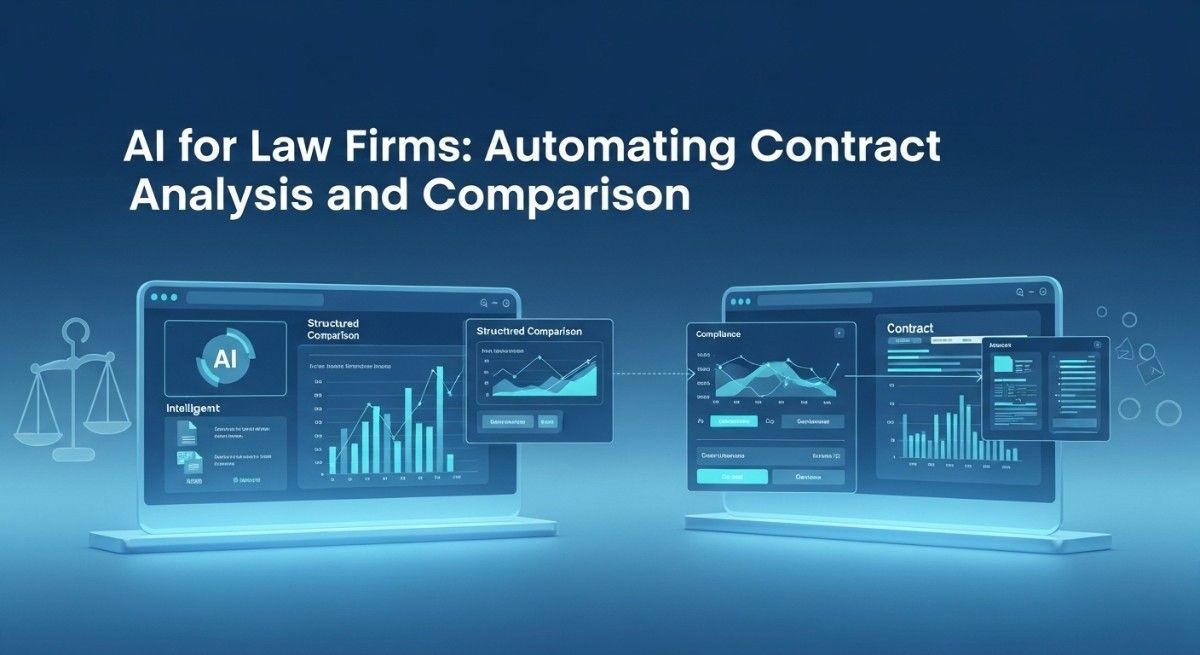
Comparing two versions of a contract used to take hours. AI does it in seconds. The tool highlights every change between versions. It shows deleted language, added clauses, and modified terms side by side.
This feature is critical during negotiations. Attorneys can track concessions easily. They catch sneaky changes that slip past human reviewers.
Playbook Compliance Checking
Many firms use contract playbooks. These documents define acceptable and unacceptable language for common clause types. AI tools enforce playbook rules automatically.
The system compares every clause against the playbook. Non-compliant language gets flagged. The attorney gets a clear action item. This keeps all contracts within firm standards.
Benefits of AI for Law Firms Contract Analysis Automation
Adopting AI for law firms contract analysis automation delivers concrete advantages. These benefits affect profitability, accuracy, and client satisfaction.
Faster Turnaround Times
A contract that takes eight hours to review manually takes thirty minutes with AI assistance. The AI handles the reading. The attorney handles the judgment calls. Clients get answers faster.
Faster review means more volume. Firms can take on more work without hiring more staff. Revenue increases without a proportional increase in cost.
Higher Accuracy and Consistency
Human reviewers get tired. They miss things late in a long document. AI never gets tired. It reviews page one with the same attention as page fifty.
Consistency matters in large deals. When twenty attorneys review different parts of a transaction, inconsistencies appear. AI enforces uniform standards across all documents.
Reduced Legal Risk for Clients
Missed clauses cause legal disputes. AI catches what humans overlook. Clients receive better protection. Firms build stronger reputations.
Risk reduction is a powerful selling point. Clients want to know their firm uses the best tools. AI adoption signals competence and forward thinking.
Lower Operational Costs
Junior associate time spent on manual review is expensive. AI handles the routine work. Associates focus on higher-value tasks. Firms get more output from the same team.
Some firms reduce reliance on contract review outsourcing. The AI handles what used to go to legal process outsourcing vendors. Cost savings are significant.
Real-World Use Cases for Legal AI
AI for law firms contract analysis automation applies across many practice areas. Here are the most common use cases legal teams encounter.
Mergers and Acquisitions Due Diligence
M&A deals involve hundreds of contracts. The due diligence team must review every vendor agreement, lease, and customer contract. This work happens in compressed timeframes.
AI tools process large contract volumes fast. They flag change-of-control clauses. They identify contracts requiring third-party consent. Deal teams get accurate summaries in hours, not weeks.
Lease Abstraction and Real Estate
Real estate attorneys manage large lease portfolios. Each lease contains critical dates, rent escalation clauses, and tenant obligations. Missing a renewal deadline is a costly error.
AI extracts key lease data automatically. Attorneys get structured summaries for each property. Portfolio management becomes far more efficient.
Vendor and Supplier Agreement Review
Corporate legal teams review hundreds of vendor contracts each year. Standard terms and conditions vary widely. Acceptable risk limits differ by vendor type.
AI checks every agreement against approved playbook language. Non-standard terms get flagged. Legal teams spend less time on routine review and more time on exceptions.
Employment Contract Review
HR and legal teams review employment agreements, non-compete clauses, and severance terms regularly. These documents follow patterns but often contain negotiated variations.
AI identifies non-standard non-compete language quickly. It flags unusual equity terms. Employment teams maintain consistency across all offers.
How to Choose the Right AI Contract Tool for Your Firm
Selecting the right AI for law firms contract analysis automation platform requires careful evaluation. The wrong tool wastes money. The right tool transforms your practice.
Integration with Existing Systems
Your AI tool must connect with your document management system. It should work with iManage, NetDocuments, or SharePoint depending on your firm’s setup.
Seamless integration reduces friction. Attorneys adopt tools they can access within their existing workflow. Standalone platforms often go unused.
Customization and Playbook Support
Every firm has different standards. Your AI tool must support custom playbooks. It must learn your firm’s preferred language for specific clause types.
Look for platforms that allow attorneys to train the AI on proprietary precedents. The tool should improve as it processes more of your firm’s documents.
Security and Data Privacy
Client contracts contain sensitive business information. Your AI vendor must meet strict data security standards. Look for SOC 2 Type II certification. Verify data encryption in transit and at rest.
Some firms require on-premises deployment. Others accept secure cloud environments. Confirm the vendor’s data residency policies match your client obligations.
Ease of Use and Training
Attorneys are busy. A tool that requires weeks of training will face resistance. Look for intuitive interfaces. Prioritize platforms with strong onboarding support.
Pilot programs help. Run a small team on the tool for thirty days. Measure adoption and satisfaction before firm-wide rollout.
Overcoming Resistance to AI Adoption in Law Firms
Not every attorney welcomes AI. Some worry about job displacement. Others doubt the technology’s accuracy. These concerns are worth addressing directly.
AI Assists Attorneys, It Does Not Replace Them
AI handles routine extraction and comparison tasks. Attorneys make every judgment call. The AI surfaces information. The attorney decides what to do with it.
Legal AI is a tool, like legal research software. It makes attorneys more effective. It does not eliminate the need for legal expertise.
Accuracy Builds Over Time
Early AI models had limitations. Modern platforms trained on millions of legal documents are highly accurate. Leading tools achieve over 90% accuracy on standard clause extraction tasks.
Accuracy improves with firm-specific training. The more your attorneys use the tool and provide feedback, the better it performs. It learns your firm’s language and standards.
The Future of AI for Law Firms Contract Analysis Automation
AI for law firms contract analysis automation will continue to evolve rapidly. Several trends are shaping the next generation of legal AI tools.
Generative AI and Contract Drafting
The next wave of legal AI does more than analyze. It drafts contracts. Attorneys input key deal terms. The AI generates a first draft using your firm’s preferred language.
Generative AI cuts drafting time dramatically. Attorneys review and refine instead of writing from scratch. Deal timelines shrink. Clients benefit.
Predictive Analytics for Contract Outcomes
Future AI tools will predict how courts interpret specific contract language. They will flag clauses with high litigation risk based on case law trends. Attorneys get proactive risk intelligence.
This shifts legal work from reactive to strategic. Firms catch problems before they become disputes. Clients receive better advice.
Multi-Language and Cross-Border Contract Analysis
Global deals involve contracts in multiple languages. AI tools with multilingual capabilities analyze French, German, Spanish, and Mandarin contracts alongside English ones.
Cross-border firms gain a significant advantage. They provide consistent analysis across all jurisdictions. Clients with international operations receive unified support.
Implementation Roadmap for Law Firms
Rolling out AI for law firms contract analysis automation requires a structured approach. Rushing implementation creates problems. A phased rollout delivers better results.
Assessment and Vendor Selection
Start by auditing your current contract review workflow. Identify the highest-volume and most time-consuming contract types. This data guides your vendor conversations.
Issue a request for proposal to two or three leading vendors. Evaluate based on accuracy, integration, security, and support. Run demos with real contracts from your practice.
Pilot Program
Select a small team for the pilot. Choose attorneys who handle high-volume contract work. Set clear success metrics before the pilot begins. Measure time saved, errors caught, and user satisfaction.
Collect detailed feedback during the pilot. Identify friction points. Work with the vendor to resolve issues before wider rollout.
Firm-Wide Rollout
Train all attorneys on the platform. Assign internal champions to support adoption. Communicate the benefits clearly and consistently.
Monitor usage and outcomes after rollout. Track the impact on billing efficiency and error rates. Use this data to refine your approach over time.
Frequently Asked Questions
How accurate is AI contract analysis?
Leading AI contract analysis tools achieve 85 to 95 percent accuracy on standard clause extraction. Accuracy improves with firm-specific training. Human review remains essential for complex or unusual provisions.
Is AI contract analysis secure for client data?
Reputable platforms offer enterprise-grade security. Look for SOC 2 Type II certification, end-to-end encryption, and clear data retention policies. Confirm the vendor’s practices match your ethical obligations and client agreements.
Can AI replace contract lawyers?
AI does not replace contract lawyers. It handles routine extraction and comparison tasks. Attorneys retain responsibility for all legal judgment, advice, and strategy. AI makes lawyers more efficient, not obsolete.
What types of contracts can AI analyze?
AI tools handle most commercial contract types. Common examples include vendor agreements, employment contracts, leases, NDAs, software licenses, and merger agreements. Specialized tools exist for specific industries like healthcare, finance, and real estate.
How long does it take to implement an AI contract tool?
Implementation timelines vary by firm size and complexity. A basic deployment takes four to eight weeks. Full integration with document management systems and custom playbook training may take three to six months.
What is the ROI of AI contract analysis tools?
ROI depends on contract volume and hourly billing rates. Many firms report a 60 to 80 percent reduction in contract review time. This translates to significant cost savings and capacity gains. Most firms achieve positive ROI within six to twelve months.
Read More:-Will AI Replace Project Managers? How to Stay Essential
Conclusion

AI for law firms contract analysis automation is no longer a future concept. It is a present competitive advantage. Firms that adopt these tools review contracts faster, catch more issues, and deliver better client outcomes.
The technology works. The business case is strong. The implementation path is clear. What remains is the decision to act.
Start by assessing your current workflow. Identify your highest-pain contract types. Evaluate two or three leading platforms with real contracts from your practice. Run a pilot. Measure the results.
AI for law firms contract analysis automation will become standard practice across the legal industry. Firms that move early build expertise, efficiency, and competitive differentiation. The right time to start is now.
Your clients deserve faster answers, fewer errors, and better protection. AI helps you deliver all three.