Introduction
TL;DR Education faces unprecedented challenges in the modern world. Classroom sizes continue growing beyond manageable levels. Teachers struggle to meet individual student needs. Learning gaps widen as some students fall behind.
AI for education offers transformative solutions to these problems. Personalized tutor bots provide one-on-one attention at scale. Every student receives customized instruction matching their pace. Learning becomes more engaging and effective simultaneously.
Traditional tutoring remains expensive and inaccessible for many families. Qualified tutors charge $50-$100 per hour typically. Scheduling conflicts create additional barriers. Geographic limitations restrict options further.
AI-powered tutoring democratizes access to quality education. Students learn anytime from anywhere conveniently. The technology adapts to individual learning styles naturally. Cost barriers disappear with scalable digital solutions.
This comprehensive guide explores building personalized tutor bots. You’ll discover the technology powering educational AI. Implementation strategies receive detailed explanation. Real-world examples demonstrate practical applications successfully.
Table of Contents
The Current State of Education and Learning Gaps
Modern classrooms struggle with fundamental challenges daily. A single teacher manages 25-35 students simultaneously. Individual attention becomes nearly impossible under these conditions. Struggling students slip through the cracks regularly.
Understanding Individual Learning Differences
Every student learns at a unique pace. Some grasp concepts quickly with minimal explanation. Others need repeated exposure and multiple approaches. Traditional teaching methods serve the middle effectively.
Advanced students become bored with repetitive instruction. They lose engagement when lessons move too slowly. Potential remains underdeveloped without appropriate challenges. Gifted programs reach only a fraction of students.
Struggling learners need extra time and support. Keeping pace with the class creates anxiety. Confidence erodes with each misunderstood concept. Gaps compound as new material builds on shaky foundations.
Learning styles vary dramatically across students. Visual learners need diagrams and illustrations. Auditory learners prefer explanations and discussions. Kinesthetic learners require hands-on activities. Most classrooms cannot accommodate all preferences simultaneously.
The Teacher Shortage Crisis
Qualified educators remain in short supply globally. Burnout drives experienced teachers from the profession. New graduates often choose more lucrative careers. STEM subjects face particularly acute shortages.
Rural and underserved communities suffer most acutely. Top teachers concentrate in affluent districts. Students in disadvantaged areas lack quality instruction. Educational inequality perpetuates across generations.
Teachers spend excessive time on administrative tasks. Grading, paperwork, and reporting consume valuable hours. Direct instruction time decreases as workload increases. Student interaction becomes rushed and superficial.
Professional development opportunities remain limited. Teachers need training in new methodologies continually. Budget constraints restrict access to quality programs. Outdated teaching methods persist despite available improvements.
Rising Costs of Private Tutoring
Private tutoring creates significant financial burden. Middle-class families struggle to afford regular sessions. Low-income students have virtually no access. The achievement gap widens along economic lines.
Quality tutors concentrate in wealthy areas. Urban centers offer more options than rural regions. Students in remote locations lack local resources. Travel time adds another obstacle for families.
Scheduling poses logistical challenges for busy families. After-school activities compete for available time. Tutors maintain limited availability hours. Finding compatible schedules proves difficult regularly.
How AI for Education Transforms Learning
AI for education revolutionizes the teaching and learning experience. Personalized instruction becomes available to every student. Adaptive systems respond to individual needs instantly. Learning outcomes improve measurably across populations.
Personalization at Scale
AI tutor bots adjust to each student’s level automatically. Initial assessments identify knowledge gaps precisely. Subsequent lessons target specific areas needing improvement. Mastery determines progression to new topics.
The system remembers every interaction with students. Learning patterns emerge from accumulated data. Teaching strategies adapt based on effectiveness. Continuous optimization happens without manual intervention.
Multiple students receive simultaneous personalized attention. The AI handles thousands of concurrent sessions easily. Each interaction remains unique and tailored. Scalability eliminates traditional tutoring constraints completely.
Content difficulty adjusts dynamically during lessons. Students encountering difficulty receive additional support immediately. Those demonstrating mastery advance to challenging material. Boredom and frustration both decrease significantly.
24/7 Availability and Accessibility
Students access tutoring whenever they need help. Late-night studying receives immediate support. Weekend practice sessions happen without scheduling. Learning continues during school breaks naturally.
Geographic barriers disappear with internet connectivity. Rural students access the same quality as urban peers. International students learn from world-class AI tutors. Physical location becomes completely irrelevant.
Language support expands educational access dramatically. AI translates and explains in native languages. Multilingual students learn in their strongest language. Language barriers no longer impede understanding.
Special needs accommodations happen automatically. Visual impairments receive audio descriptions. Reading difficulties trigger text-to-speech features. Learning disabilities get appropriate modifications instantly.
Infinite Patience and Encouragement
AI tutors never show frustration or impatience. Questions receive thoughtful responses every time. Students ask for clarification without embarrassment. The learning environment feels psychologically safe always.
Positive reinforcement happens consistently and genuinely. Progress celebrations motivate continued effort. Struggles receive supportive encouragement. Growth mindset language permeates all interactions.
Practice opportunities become unlimited and varied. Students repeat exercises until achieving mastery. Different problem variations prevent memorization. Understanding deepens through deliberate practice.
Mistakes transform into learning opportunities. The AI explains errors without judgment. Alternative approaches present when students struggle. Conceptual understanding takes priority over correct answers.
Core Technologies Powering Educational AI
Building effective tutor bots requires several technologies. AI for education combines multiple innovations synergistically. Understanding these components guides successful implementation.
Natural Language Processing
Students communicate with tutor bots conversationally. Natural language processing interprets questions accurately. The AI understands context and intent clearly. Responses feel natural and human-like consistently.
Sentiment analysis detects frustration and confusion. The system adjusts tone and approach accordingly. Encouragement increases when students struggle. Pacing slows for difficult concepts automatically.
Question answering capabilities provide instant responses. Students get explanations in understandable language. Complex topics break down into digestible parts. Follow-up questions receive equally helpful answers.
Dialogue management maintains coherent conversations. The AI remembers previous discussion context. Responses connect logically to earlier exchanges. Learning conversations flow naturally over time.
Machine Learning and Adaptive Systems
Recommendation algorithms suggest appropriate content. The system predicts what students need next. Learning paths optimize for individual progress. Resources match current skill levels precisely.
Predictive analytics identify struggling students early. Intervention happens before gaps become insurmountable. Proactive support prevents discouragement and disengagement. Success rates improve through early detection.
Performance modeling tracks skill development over time. Growth metrics reveal learning velocity. Weak areas receive automatic additional focus. Strong areas advance without unnecessary repetition.
Reinforcement learning optimizes teaching strategies. The AI experiments with different approaches. Successful methods receive preferential selection. Teaching effectiveness improves continuously automatically.
Knowledge Graphs and Content Structure
Educational content organizes as interconnected concepts. Prerequisites link to advanced topics clearly. Dependencies between skills map explicitly. Learning paths follow logical progressions.
The AI navigates this knowledge structure intelligently. Gaps in foundational knowledge trigger remediation. Prerequisite mastery precedes advanced material introduction. Conceptual understanding builds systematically.
Multiple explanation strategies exist for each concept. Visual, verbal, and example-based approaches coexist. The system selects methods matching student preferences. Effectiveness data guides future strategy selection.
Assessment questions align with learning objectives. Difficulty levels span from basic to advanced. Question banks prevent repetition and memorization. Mastery demonstrations require varied skill application.
Multimodal Learning Integration
Text explanations suit reading-oriented learners. Audio narration helps auditory processors. Video demonstrations engage visual learners. Interactive exercises benefit kinesthetic students.
Mathematical concepts receive symbolic and graphical representations. Equations appear alongside corresponding graphs. Abstract ideas connect to concrete examples. Multiple modalities reinforce understanding effectively.
Diagrams and illustrations enhance explanations. Complex processes animate step-by-step. Visual relationships clarify abstract concepts. Memory retention improves with visual anchors.
Interactive simulations enable experimentation. Students manipulate variables and observe results. Cause-and-effect relationships become tangible. Discovery learning happens naturally through exploration.
Building Your Educational AI Tutor Bot
Creating personalized tutor bots requires systematic planning. AI for education implementations follow proven patterns. These steps guide successful development projects.
Defining Learning Objectives and Scope
Identify specific subjects and grade levels. Focus produces better results than broad coverage. Math tutoring for middle school represents clear scope. Narrow specialization enables deeper expertise.
Map curriculum standards and learning objectives. State requirements guide content development. Standardized test alignment ensures relevance. Skill progression follows educational research principles.
Determine assessment and evaluation methods. Formative assessments monitor ongoing progress. Summative evaluations measure mastery achievement. Diagnostic tests identify knowledge gaps precisely.
Establish success metrics and measurement criteria. Learning gains quantify educational impact. Engagement metrics reveal user satisfaction. Retention rates indicate long-term value.
Curating and Structuring Educational Content
Gather high-quality instructional materials. Textbooks, videos, and practice problems provide foundation. Subject matter experts validate content accuracy. Pedagogical review ensures teaching effectiveness.
Organize content into logical learning units. Chapters divide into sections and subsections. Concepts arrange from simple to complex. Dependencies between topics map explicitly.
Create diverse practice problems and exercises. Varied difficulty levels accommodate different abilities. Multiple problem types prevent pattern recognition. Real-world applications demonstrate practical relevance.
Develop comprehensive explanation libraries. Multiple explanation approaches address different learning styles. Step-by-step breakdowns clarify complex procedures. Common misconceptions receive explicit attention.
Selecting AI Models and Platforms
Choose language models powering conversational interaction. GPT-4 and Claude offer strong educational capabilities. Open-source alternatives like Llama provide cost-effective options. Model selection balances quality and budget constraints.
Implement knowledge retrieval systems for content access. Vector databases store educational materials efficiently. RAG architectures ground responses in curriculum content. Hallucinations decrease with retrieval-augmented generation.
Deploy recommendation engines for personalized paths. Collaborative filtering suggests appropriate content. Content-based filtering matches student skill levels. Hybrid approaches combine multiple techniques effectively.
Integrate assessment engines for skill evaluation. Item response theory models estimate ability levels. Computerized adaptive testing adjusts difficulty dynamically. Mastery learning principles guide progression decisions.
Designing the Student Experience
Create intuitive conversational interfaces. Students interact through natural language easily. Chat-style interactions feel familiar and comfortable. Voice input accommodates different preferences.
Implement engaging visual design elements. Colorful graphics appeal to younger learners. Clean layouts reduce cognitive load. Gamification elements motivate continued engagement.
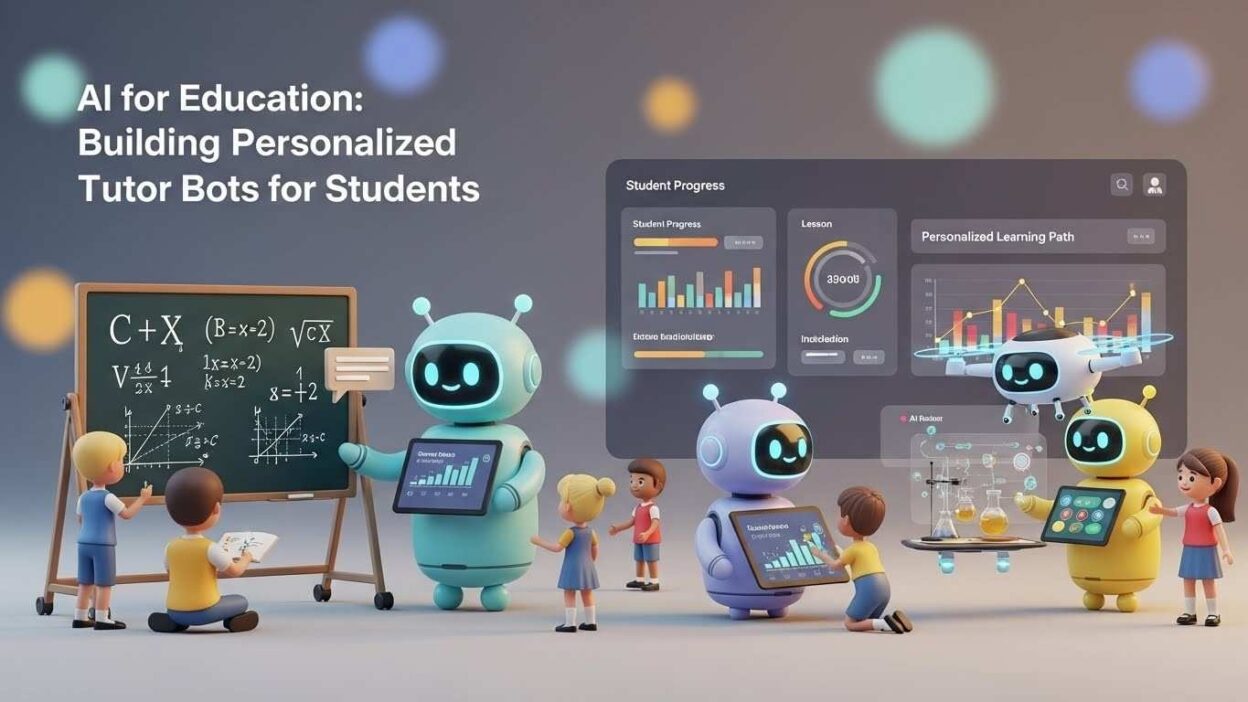
Develop progress tracking and visualization. Students see their advancement clearly. Achievement badges celebrate milestones. Growth charts illustrate improvement over time.
Build parent and teacher dashboards. Stakeholders monitor student progress remotely. Detailed analytics reveal strengths and weaknesses. Communication features enable collaboration.
Testing and Iteration
Conduct pilot programs with small student groups. Real-world usage reveals unexpected issues. Feedback guides refinement and improvement. Iterative development produces superior results.
Measure learning outcomes against baselines. Standardized tests quantify educational gains. Comparison groups establish effectiveness. Statistical significance validates impact claims.
Analyze engagement and usage patterns. Session duration indicates captivation levels. Return rates demonstrate perceived value. Feature usage guides prioritization decisions.
Refine based on quantitative and qualitative data. Student feedback reveals pain points. Teacher input provides professional perspective. Continuous improvement maintains relevance.
Real-World Applications and Success Stories
AI for education implementations demonstrate impressive results globally. These examples showcase practical applications across contexts.
K-12 Mathematics Tutoring
A California school district deployed AI math tutors. Students accessed the system during and after school. The bot provided step-by-step problem-solving guidance. Explanations adapted to individual student needs.
Test scores improved 15% over the academic year. Struggling students showed the largest gains. Teacher workload decreased with automated grading. Classroom time focused on collaborative activities.
Student engagement increased measurably throughout deployment. Homework completion rates rose by 25%. Math anxiety decreased among participating students. Confidence grew with mastery achievement.
Parents reported improved attitudes toward mathematics. Home learning became more productive and positive. Family stress around homework decreased significantly. The investment paid dividends across metrics.
Language Learning for Adult Students
An online platform built AI conversation partners. Adult learners practiced speaking foreign languages naturally. The bot corrected pronunciation and grammar gently. Cultural context enriched every interaction.
Speaking confidence improved dramatically within weeks. Students overcame fear of making mistakes. Practice quantity increased 10x compared to traditional classes. Fluency development accelerated substantially.
Personalized vocabulary instruction targeted practical needs. Business professionals learned industry-specific terms. Travelers mastered tourist communication essentials. Customization enhanced relevance and motivation.
Subscription retention rates exceeded industry averages. Students perceived genuine value from the service. Word-of-mouth referrals drove organic growth. The business model proved sustainable long-term.
Test Preparation and College Admissions
A test prep company enhanced offerings with AI tutoring. Students prepared for SAT and ACT exams intelligently. Diagnostic assessments identified weak subject areas. Practice focused on concepts needing improvement.
Average score improvements exceeded 200 points. Students achieved target scores in fewer study hours. Test anxiety decreased through thorough preparation. College admission rates improved among participants.
Personalized study plans optimized time allocation. High-priority topics received appropriate attention. Strong areas maintained without excessive practice. Efficiency maximized given limited preparation time.
Cost per student decreased while quality increased. The AI handled routine instruction and practice. Human tutors focused on complex questions. The hybrid model optimized both cost and effectiveness.
Special Education Support
A nonprofit organization developed AI tutors for learning disabilities. Students with dyslexia received customized reading instruction. ADHD students got focused attention in short bursts. Autism spectrum learners interacted without social pressure.
Reading levels improved faster than traditional interventions. Multisensory approaches engaged different learning pathways. Infinite patience prevented frustration and discouragement. Progress happened at individual student pace.
Parents gained valuable support tools for home learning. The AI provided guidance for supporting children. Consistency between school and home improved. Family stress levels decreased measurably.
Teachers documented IEP progress more efficiently. Detailed usage data informed educational planning. Accommodation effectiveness received objective measurement. Special education outcomes improved across the board.
Challenges and Ethical Considerations
Implementing AI for education requires addressing concerns carefully. Responsible development prioritizes student welfare absolutely.
Privacy and Data Protection
Student data demands the highest protection standards. Personal information requires careful handling always. Compliance with COPPA and FERPA remains mandatory. Trust depends on demonstrated responsibility.
Anonymization and aggregation protect individual privacy. Analytics happen without identifying specific students. Parental consent precedes any data collection. Transparency builds confidence among stakeholders.
Data retention policies limit storage duration. Information deletes after legitimate purposes conclude. Security measures prevent unauthorized access. Regular audits verify compliance maintenance.
Maintaining Human Connection
AI tutors supplement rather than replace teachers. Human relationships remain central to education. Social-emotional learning requires human interaction. Technology enhances rather than eliminates educators.
Teachers focus on higher-value activities with AI support. Lesson planning improves with freed time. Individual student relationships deepen. Professional satisfaction often increases paradoxically.
Hybrid models balance technology and humanity. AI handles routine instruction and practice. Teachers provide mentorship and inspiration. Students benefit from both dimensions simultaneously.
Bias and Fairness
Training data must represent diverse populations. Biased data produces biased AI behavior. Careful curation ensures equitable treatment. Regular audits detect emerging bias issues.
Content review eliminates cultural insensitivity. Multiple perspectives inform curriculum development. Inclusive language appears throughout materials. Every student feels respected and valued.
Performance monitoring disaggregates by demographic groups. Effectiveness should distribute equally across populations. Gaps trigger immediate investigation and correction. Equity remains a continuous priority.
Digital Divide and Accessibility
Internet access remains unequal across communities. School-provided devices mitigate some disparities. Offline functionality helps in connectivity deserts. Creative solutions expand access continually.
Cost structures must enable broad adoption. Free tiers serve disadvantaged populations. Subsidies and grants increase accessibility. Education should never become luxury goods.
Assistive technology integration serves all learners. Screen readers work seamlessly with AI tutors. Keyboard navigation accommodates motor impairments. Universal design principles guide development.
Measuring Success and Learning Outcomes
AI for education requires rigorous evaluation. Multiple metrics capture different success dimensions. Continuous assessment drives improvement efforts.
Academic Performance Metrics
Standardized test scores provide objective measures. Pre-test and post-test comparisons reveal gains. Control groups establish baseline expectations. Statistical analysis confirms significance.
Grades and classroom performance show practical impact. Teachers observe improved homework quality. Class participation increases with confidence. Academic trajectories shift positively.
Concept mastery assessments measure deep understanding. Students demonstrate skills in varied contexts. Transfer learning indicates genuine comprehension. Memorization versus understanding becomes distinguishable.
Engagement and Motivation Indicators
Usage frequency reveals perceived value. Daily active users indicate habitual engagement. Session duration suggests captivation levels. Return rates demonstrate satisfaction.
Voluntary usage exceeds required minimums. Students choose AI tutoring for optional study. Recommendations to peers occur organically. Enthusiasm becomes visible and measurable.
Completion rates for lessons and exercises. Students finish started activities consistently. Dropout rates remain low throughout courses. Persistence indicates effective motivation strategies.
Long-Term Educational Impact
College enrollment rates among users. AI tutoring may improve higher education access. Career trajectory data reveals lasting effects. Educational attainment follows through life.
Lifelong learning habits develop from positive experiences. Students maintain curiosity beyond formal schooling. Self-directed learning skills transfer across domains. Educational mindsets shape future success.
Frequently Asked Questions
How does AI for education differ from traditional online learning?
AI for education adapts to individual students dynamically. Traditional e-learning follows fixed paths for everyone. AI provides conversational interaction like human tutors. Personalization happens automatically based on performance.
Can AI tutors really replace human teachers?
AI tutors supplement rather than replace educators. Human teachers provide mentorship and inspiration. Social-emotional learning requires human connection. Technology handles routine instruction efficiently.
What age groups benefit most from AI tutoring?
Students across all age groups benefit significantly. Elementary students develop strong foundations. Middle and high schoolers fill knowledge gaps. Adult learners pursue continuing education flexibly.
How much does implementing educational AI cost?
Costs vary widely based on scope and scale. Small implementations start under $10,000. Enterprise deployments require substantial investment. Open-source options reduce expenses significantly.
Is student data safe with AI tutoring systems?
Reputable systems prioritize data security rigorously. Encryption protects information during transmission. Compliance with educational privacy laws is mandatory. Regular security audits verify protection measures.
How quickly do students show improvement?
Many students show gains within weeks. Consistent usage accelerates improvement rates. Individual results vary based on starting points. Long-term use produces the largest benefits.
Can AI tutors teach creative subjects?
AI tutors handle many creative subjects effectively. Writing receives constructive feedback and guidance. Music theory instruction works particularly well. Visual arts education shows promising results.
What technical requirements do schools need?
Basic internet connectivity suffices for most systems. Standard computers or tablets work adequately. Bandwidth requirements remain modest. Technical barriers stay minimal intentionally.
Read More:-FinTech Automation: Using AI for Fraud Detection and Risk Analysis
Conclusion
AI for education represents the future of personalized learning. Every student deserves customized instruction matching their needs. Technology makes this vision achievable at scale. Traditional barriers to quality education crumble.
Personalized tutor bots provide unprecedented learning support. Students receive one-on-one attention whenever needed. Adaptive systems respond to individual progress continuously. Learning becomes more effective and engaging simultaneously.
The technology combines multiple AI innovations synergistically. Natural language processing enables conversation. Machine learning adapts teaching strategies. Knowledge graphs structure educational content. Multimodal approaches engage diverse learners.
Implementation requires careful planning and execution. Clear learning objectives guide development. High-quality content forms the foundation. Appropriate AI models power interactions. Iterative testing refines the experience.
Real-world results demonstrate transformative potential. Test scores improve across student populations. Engagement and motivation increase measurably. Long-term educational outcomes show promise.
Challenges demand thoughtful responsible approaches. Privacy protection remains absolutely paramount. Human connection supplements technology appropriately. Bias and fairness require continuous attention. Accessibility ensures equitable access for all.
Success measurement validates educational impact. Academic performance metrics quantify learning gains. Engagement indicators reveal student satisfaction. Long-term outcomes demonstrate lasting value.
The future of AI for education looks exceptionally bright. Technology will continue advancing rapidly. Educational AI becomes more sophisticated continually. Implementation costs decrease with maturity.
Schools and educators should embrace these innovations. Pilot programs test effectiveness in your context. Student feedback guides refinement and improvement. Successful adoption requires stakeholder collaboration.
Parents can advocate for educational AI adoption. District and school leaders need awareness. The technology benefits students dramatically. Investment in AI for education serves children well.
Developers should prioritize educational applications. Social impact accompanies financial returns. The field needs continued innovation. Your contributions could transform countless lives.
Students themselves gain powerful learning tools. Take advantage of available AI tutoring resources. Consistent usage produces impressive results. Your educational future brightens with technology.
AI for education democratizes access to quality instruction. Geographic and economic barriers fade away. Every motivated student can achieve their potential. The promise of education becomes reality.