Introduction
TL;DR Marketing and creative agencies face a universal challenge today. Client demands grow exponentially while budgets remain flat. Competition intensifies from freelancers and offshore teams. Profit margins shrink under the pressure of delivering more for less.
The traditional solution involves hiring more people. Junior designers, copywriters, and account managers join the team. Payroll expenses balloon while overhead costs multiply. This approach solves volume problems but destroys profitability.
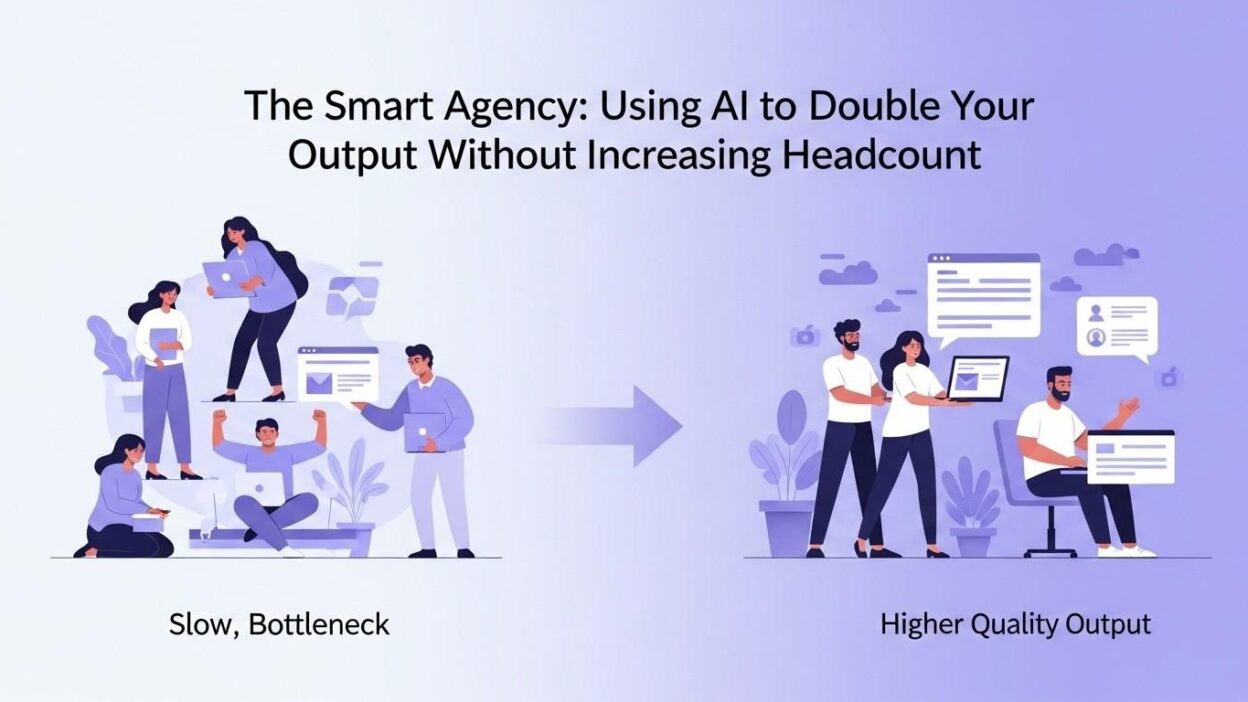
AI for Agency Productivity offers a revolutionary alternative path forward. Smart agencies now leverage artificial intelligence to multiply output dramatically. Teams accomplish twice the work without adding headcount. The technology handles repetitive tasks while humans focus on strategy and creativity.
This comprehensive guide reveals exactly how agencies double their productivity through AI. You’ll discover specific tools, workflows, and strategies that deliver measurable results. Your agency can compete with firms twice your size while maintaining healthy margins.
Table of Contents
Understanding the Agency Productivity Crisis
The Scaling Problem
Agencies operate on a fundamentally flawed business model. Revenue correlates directly with billable hours. More projects require more people. Growth demands constant hiring and training.
Client expectations have shifted dramatically in recent years. Turnaround times that were acceptable a decade ago now seem glacial. Brands expect content produced daily rather than monthly. Campaign iterations happen in days instead of weeks.
Profitability suffers as agencies add staff to meet demand. Junior employees require supervision that consumes senior team time. Office space expands to accommodate growing teams. Benefits, equipment, and overhead scale linearly with headcount.
The math simply doesn’t work for sustainable growth. Agencies need ten percent margin improvement but achieve three percent. Revenue grows twenty percent while expenses increase twenty-five percent. Traditional scaling methods lead to lower profitability despite higher revenue.
Where Time Actually Goes
Time tracking reveals shocking inefficiencies across agency operations. Creative work consumes only thirty to forty percent of employee hours. The remaining time disappears into administrative tasks and communication.
Email management alone eats two hours daily per team member. Meetings multiply as teams grow larger. Status updates, check-ins, and coordination calls fragment productive time. Deep work becomes impossible amid constant interruptions.
Asset management and version control waste countless hours. Designers search for approved logos and brand guidelines repeatedly. Copywriters recreate briefs that exist somewhere in shared drives. Simple file retrieval tasks consume fifteen to twenty minutes each.
Reporting and documentation burden account managers significantly. Clients demand detailed progress updates and performance metrics. Compiling this information manually requires hours each week. AI for Agency Productivity addresses these specific time drains.
The Cost of Saying No
Agencies turn down profitable work due to capacity constraints. A lucrative project arrives but the team is fully booked. Referring business to competitors feels painful. These lost opportunities represent hidden costs of inefficiency.
Client relationships suffer when agencies cannot accommodate urgent requests. Brands remember when their agency couldn’t help during crisis moments. Competitors swoop in offering faster turnaround times. Loyalty erodes when responsiveness falters.
Employee burnout accelerates when teams run at maximum capacity constantly. Talented creatives leave for less stressful environments. Replacing experienced team members costs six to nine months of salary. High turnover compounds the capacity problem.
Identifying High-Impact AI Use Cases
Content Creation and Ideation
Copywriting represents the most obvious AI productivity opportunity. First drafts that took hours now generate in minutes. Blog posts, social media captions, and ad copy all flow from AI tools. Human writers refine and polish rather than starting from blank pages.
Creative brainstorming accelerates with AI collaboration. Teams generate fifty campaign concepts in the time previously needed for ten. The AI suggests variations and alternatives humans might never consider. Quantity increases while quality remains high through human curation.
Content personalization scales infinitely with AI assistance. Creating twenty email variations for different audience segments becomes trivial. Each prospect receives messaging tailored precisely to their needs. This level of customization was previously impossible at scale.
Long-form content like white papers and case studies benefit enormously. AI drafts the structure and core content. Writers focus on voice, tone, and strategic messaging. Production time drops from days to hours using AI for Agency Productivity.
Visual Design and Production
Image generation tools create custom visuals on demand. Stock photography needs decrease dramatically. Brand-specific imagery appears within minutes of requesting. Designers art-direct AI rather than creating every pixel manually.
Design variations multiply effortlessly through AI assistance. A single concept spawns dozens of color and layout alternatives. A/B testing becomes feasible for every campaign element. Client presentations showcase more options in less time.
Video production accelerates through AI-powered editing tools. Rough cuts assemble automatically from raw footage. B-roll selection and scene transitions happen intelligently. Editors refine the story rather than performing tedious technical tasks.
Production file preparation for various platforms automates completely. Resizing graphics for different social media dimensions takes seconds. Format conversions happen automatically. Designers eliminate hours of repetitive mechanical work.
Client Communication and Reporting
Meeting summaries generate automatically from recorded calls. Action items extract themselves without manual note-taking. Team members who missed meetings catch up instantly. Communication efficiency improves dramatically across organizations.
Client reports compile themselves from connected data sources. Performance metrics flow automatically into branded templates. Account managers review and contextualize rather than building reports manually. Monthly reporting time drops from eight hours to one.
Proposal creation accelerates through AI-assisted writing. Past proposal content adapts intelligently to new opportunities. Pricing calculations and scope definitions happen within minutes. Teams respond to RFPs same-day rather than over weeks.
Email responses draft themselves based on message content. Common questions receive instant suggested replies. Account managers approve and personalize rather than typing everything. Client communication volume increases without proportional time investment when using AI for Agency Productivity.
Research and Strategy
Market research that took days now completes in hours. AI scans thousands of articles, reports, and data sources. Key insights emerge organized and summarized. Strategists analyze findings rather than gathering information manually.
Competitive analysis happens continuously rather than quarterly. AI monitors competitor activities across all channels. Changes in positioning or messaging trigger automatic alerts. Agencies maintain current intelligence without dedicating staff to monitoring.
Audience research reveals insights impossible to find manually. AI identifies patterns across demographic and behavioral data. Micro-segments emerge that human analysts would miss. Strategy becomes more precise and effective.
Trend forecasting improves through AI pattern recognition. Historical data reveals predictive signals for future developments. Agencies advise clients proactively rather than reactively. Strategic value delivery increases substantially.
Implementing AI Tools Effectively
Building Your AI Tech Stack
Start with generative AI platforms for content creation. ChatGPT, Claude, or Google Gemini form the foundation. These tools handle writing, brainstorming, and basic research. Monthly subscriptions cost minimal amounts relative to employee salaries.
Add image generation capabilities through Midjourney or DALL-E. Visual ideation and concept development accelerate dramatically. Teams explore creative directions faster than traditional methods. The modest subscription costs pay back within days.
Integrate AI-powered design tools like Adobe Firefly. Existing design workflows incorporate AI assistance seamlessly. Teams don’t abandon familiar software. Enhanced capabilities layer on top of current processes.
Implement meeting transcription services like Otter or Fireflies. Every client call and internal meeting generates searchable transcripts. Information retention improves across the organization. Communication becomes more efficient when using AI for Agency Productivity.
Training Your Team
Overcome initial resistance through hands-on demonstrations. Show team members actual time savings on their specific tasks. Fear of job replacement dissolves when people see AI as assistance. Emphasize that AI handles boring work while humans do interesting work.
Create internal guidelines for AI usage. Define which tasks benefit from AI versus those requiring pure human work. Establish quality control processes for AI-generated content. Teams need clear guardrails to use AI confidently.
Develop prompt engineering skills across the team. Effective AI usage requires knowing how to communicate with models. Share successful prompts and techniques internally. Collective intelligence grows as team members learn from each other.
Celebrate early wins to build momentum. Publicize projects where AI delivered exceptional results. Recognize team members who discover innovative AI applications. Positive reinforcement accelerates adoption throughout the agency.
Creating AI-Enhanced Workflows
Map current processes before adding AI components. Identify bottlenecks and time-consuming steps. Target those specific points for AI intervention. Incremental improvements compound into major productivity gains.
Design hybrid workflows combining human and AI strengths. AI generates initial outputs. Humans review, refine, and approve. Quality remains high while speed increases dramatically. The collaboration produces better results than either alone.
Establish feedback loops that improve AI outputs over time. Document which prompts generate best results. Refine approaches based on actual performance. Your agency develops proprietary techniques that competitors lack.
Build templates and systems that operationalize AI advantages. Standardized approaches ensure consistency across team members. New employees inherit proven AI workflows immediately. Organizational capability transcends individual knowledge when implementing AI for Agency Productivity.
Measuring Productivity Improvements
Key Performance Indicators
Track project delivery speed as a primary metric. Measure average turnaround time before and after AI implementation. Expect twenty to forty percent reductions initially. Further improvements emerge as teams master AI tools.
Monitor revenue per employee closely. This metric reveals whether productivity gains translate to profitability. Healthy agencies generate two hundred thousand to three hundred thousand dollars per employee. AI should push these numbers significantly higher.
Calculate time spent on administrative versus billable work. The ratio should shift toward billable activities. Teams spending sixty percent of time on revenue-generating work can reach seventy-five percent or more. This shift directly impacts bottom-line results.
Measure client satisfaction alongside productivity metrics. Faster delivery means nothing if quality suffers. Track NPS scores and project approval rates. AI for Agency Productivity should improve both speed and client happiness.
Before and After Analysis
Document current productivity baselines before implementing AI. Record typical timeframes for common deliverables. Count how many projects teams complete monthly. This baseline enables accurate improvement measurement.
Compare output quality between traditional and AI-assisted work. Blind tests reveal whether clients notice differences. Many agencies find AI-assisted work equals or exceeds purely human output. Quality maintenance proves AI viability.
Track employee satisfaction throughout AI implementation. Measure whether team members feel less stressed. Monitor whether they report more engaging work. Productivity improvements that destroy morale fail long-term.
Calculate actual cost savings from efficiency gains. Time saved translates directly to capacity for additional projects. Quantify revenue from projects you couldn’t have accepted previously. ROI calculations justify continued AI investment.
Client Value Demonstration
Show clients the enhanced capabilities AI enables. Faster iteration cycles let them test more creative directions. Deeper research informs smarter strategies. Clients receive more value without increased fees.
Offer new services that were previously uneconomical. Personalized content at scale becomes feasible. Continuous optimization replaces periodic campaigns. AI for Agency Productivity unlocks entirely new revenue streams.
Maintain pricing despite increased efficiency. Clients pay for value delivered, not hours spent. Your improved margins stay invisible to clients. This approach rewards innovation with profitability.
Overcoming Implementation Challenges
Addressing Team Concerns
Job security fears represent the most common resistance. Team members worry AI will replace them. Emphasize that agencies face no-win choices without AI. Competitors using AI will take your clients and your jobs.
Creative professionals fear AI threatens their craft. Acknowledge that AI generates mediocre work without human direction. Position AI as amplifying human creativity rather than replacing it. The best results come from human-AI collaboration.
Quality concerns arise naturally around AI-generated content. Implement strict review processes that catch errors. Maintain human accountability for all client deliverables. Quality standards remain unchanged even as production methods evolve.
Learning curves frustrate teams initially. New tools require time investment before productivity improves. Schedule dedicated training time. Accept temporary slowdowns as teams build AI skills that will pay long-term dividends.
Managing Client Expectations
Transparency about AI usage varies by client. Some appreciate knowing you use cutting-edge tools. Others prefer not knowing production details. Gauge client preferences and respond accordingly when using AI for Agency Productivity.
Legal and ethical considerations require careful navigation. Some clients prohibit AI-generated content in contracts. Others have specific disclosure requirements. Review agreements carefully before implementing AI workflows.
Intellectual property questions emerge around AI-generated work. Current law remains unsettled in many jurisdictions. Consult legal counsel about your specific situation. Conservative approaches protect both agency and clients.
Data Security and Privacy
Client confidentiality requires careful AI tool selection. Free consumer AI tools may use your inputs for training. Enterprise versions offer stronger privacy protections. Invest in appropriate tools for sensitive client work.
Internal information security policies must address AI usage. Establish guidelines about what data can go into AI systems. Train teams on security best practices. Breaches destroy client trust and agency reputation.
Compliance requirements vary by industry and geography. Healthcare and financial clients face strict regulations. Verify that your AI usage meets applicable standards. Non-compliance creates liability that outweighs productivity benefits.
Scaling Beyond Initial Implementation
Advanced AI Integration
API integrations connect AI directly into your tools. Custom workflows trigger AI processing automatically. Manual copying between systems disappears. Seamless integration multiplies efficiency gains.
Custom AI models trained on your specific work improve results. Fine-tuning creates outputs matching your agency’s style. Brand voice consistency increases. Clients receive work that feels authentically yours.
AI-powered project management optimizes resource allocation. Systems predict project duration and flag potential delays. Account managers can intervene proactively. Delivery reliability improves alongside productivity using AI for Agency Productivity.
Building Competitive Advantages
Develop proprietary AI techniques unique to your agency. Document your most effective prompts and workflows. This intellectual property differentiates you from competitors. Clients cannot replicate your capabilities easily.
Market your AI-enhanced capabilities strategically. Position your agency as innovative and forward-thinking. Attract clients seeking cutting-edge partners. Premium pricing becomes justifiable through demonstrated advantages.
Train clients to expect AI-accelerated service levels. Rapid turnaround becomes your standard offering. Competitors cannot match your responsiveness. Client switching costs increase as they depend on your speed.
Expanding Service Offerings
Launch new services enabled by AI efficiency. Continuous content creation becomes economically viable. Real-time campaign optimization replaces monthly reviews. Clients get more value without you adding headcount.
Enter markets previously too expensive to serve. Small businesses couldn’t afford agency services historically. AI efficiency makes serving them profitable. Your addressable market expands dramatically.
Develop productized services with AI automation. Standardized offerings generate recurring revenue. Delivery costs approach zero as AI handles execution. Profit margins on these services can exceed eighty percent.
Frequently Asked Questions
Will AI really double our productivity or is that marketing hype?
Doubling productivity represents a realistic goal for most agencies. Initial implementations commonly achieve thirty to fifty percent improvements. Mature AI integration reaches or exceeds doubling over twelve to eighteen months. Results depend on current efficiency and implementation quality. Agencies starting from highly manual processes see the largest gains. AI for Agency Productivity delivers measurable results when implemented thoughtfully.
How much does implementing AI actually cost?
Initial costs remain surprisingly low for most agencies. Basic tool subscriptions total one hundred to three hundred dollars monthly. Enterprise versions for larger teams cost several thousand. Training time represents the largest investment initially. Budget twenty to forty hours per team member for skills development. Total first-year costs rarely exceed twenty thousand dollars for ten-person agencies.
What if clients prohibit AI usage in contracts?
Client restrictions on AI are becoming common. Review all contracts carefully before implementation. Many restrictions focus on AI training rather than usage. Enterprise AI tools that don’t train on your data often satisfy concerns. Negotiate contract terms that allow AI for internal processes. Position AI as a tool like Adobe software rather than external service.
How do we prevent AI from making our work feel generic?
Generic AI outputs result from generic prompts. Detailed, specific instructions produce distinctive work. Develop unique prompting techniques that capture your agency’s voice. Use AI for first drafts that humans then customize. Brand personality comes from human refinement. AI for Agency Productivity amplifies rather than replaces human creativity.
Can AI handle our specific industry niche?
AI works across virtually every industry and specialty. Models train on broad knowledge that includes your niche. You may need to provide context and background initially. The AI learns your specific domain through interaction. Industry-specific results improve with fine-tuning. Niche expertise remains valuable for directing AI effectively.
What happens when competitors also adopt AI?
AI adoption becomes table stakes rather than competitive advantage. Early adopters capture efficiency benefits first. Later adopters must match your capabilities to compete. Continuous innovation maintains your lead. The agencies that use AI most effectively will dominate. Waiting ensures you fall behind rather than catching up.
How long before AI replaces agency employees entirely?
Complete automation remains decades away if it happens at all. AI handles specific tasks, not entire job functions. Humans provide strategy, creativity, and client relationships. These capabilities resist automation. Agency employment will shift toward higher-value activities. Teams become smaller and more profitable rather than eliminated.
Should we tell clients we use AI?
Transparency depends on client relationships and contracts. Some clients appreciate your innovative approach. Others prefer not knowing technical details. Default to discretion unless asked directly. Focus conversations on outcomes rather than methods. Position AI as professional tooling like design software.
What if AI generates content that violates copyrights?
Copyright issues remain unsettled legally around AI outputs. Use AI for ideation and drafting rather than final deliverables. Human review catches potential problems before client delivery. Many AI tools offer indemnification for enterprise customers. Your contracts should clarify liability for all work. Conservative approaches minimize legal risks when using AI for Agency Productivity.
How do we measure ROI on AI implementation?
Track time savings on specific tasks before and after AI. Multiply saved hours by employee billing rates. Count additional projects completed with same team. Calculate revenue from new services enabled by AI. Most agencies see positive ROI within three to six months. Documentation and measurement ensure you capture actual benefits.
Read More:-AI in FinTech: Automating Fraud Detection and Compliance Reporting
Conclusion

AI for Agency Productivity represents the most significant opportunity in decades for agency business models. The technology enables small teams to compete with firms many times their size. Profit margins expand as output increases without proportional cost growth.
Implementation requires strategic thinking rather than blind adoption. Identify high-impact use cases specific to your agency. Select appropriate tools that integrate into existing workflows. Train teams thoroughly to build genuine AI fluency.
Productivity doubling happens through accumulated incremental gains. Each task automated or accelerated contributes to overall efficiency. Compound improvements over months deliver transformative results. Your agency accomplishes in one year what previously took two.
Client value increases alongside internal productivity. Faster turnaround times delight clients. Deeper research informs better strategies. Enhanced creative exploration produces superior campaigns. AI for Agency Productivity benefits everyone involved.
Competitive dynamics will force AI adoption across the industry. Agencies that move early gain sustainable advantages. Those that delay will struggle against more efficient competitors. The window for differentiation through AI is closing.
Start your AI implementation today with manageable pilot projects. Choose one high-volume workflow to enhance initially. Measure results carefully and refine your approach. Success with early projects builds momentum for broader adoption.
Your agency’s future depends on embracing AI thoughtfully. The alternative involves declining relevance as competitors pull ahead. Traditional labor-intensive models cannot survive against AI-enhanced operations. Evolution requires courage but extinction requires only inaction.
The smart agency uses AI for Agency Productivity to multiply impact without multiplying costs. Your team accomplishes more meaningful work while AI handles repetition. Clients receive better service at healthier margins. Everyone wins except agencies that refuse to adapt.
Take the first step this week toward doubling your agency’s output. Subscribe to AI tools and schedule team training. Document current productivity baselines for future comparison. Your implementation journey begins with commitment to change. The agencies thriving five years from now are the ones taking action today.