Introduction
TL;DR Software teams ship code faster than ever. Feature velocity is up. Team sizes are growing. Pull request volumes are exploding. Manual code reviews struggle to keep pace with that speed.
AI-driven code reviews in CI/CD pipeline workflows solve this problem directly. They catch bugs before humans review a single line. They enforce coding standards automatically. They flag security vulnerabilities in real time. They let senior engineers focus their review time on architecture and logic, not style and syntax.
This blog gives you the complete implementation picture. You will understand what AI code review actually does, which tools lead the market, how to wire them into your pipeline correctly, and how to measure whether they work. Whether you run GitHub Actions, GitLab CI, Jenkins, or CircleCI, this guide covers your setup.
Table of Contents
What Are AI-Driven Code Reviews in a CI/CD Pipeline?
A traditional code review requires a human to read every changed line, understand context, spot errors, and write actionable feedback. That process is valuable. It is also slow, inconsistent, and bottlenecked by reviewer availability.
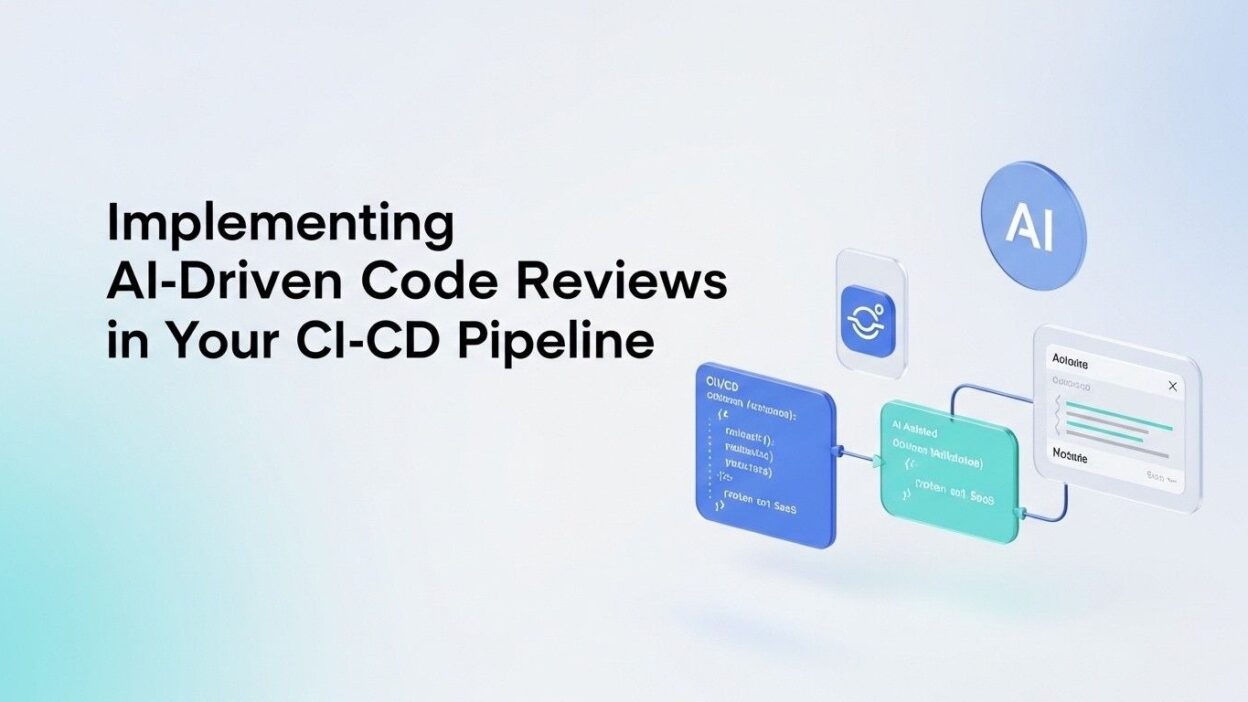
AI-driven code reviews in CI/CD pipeline workflows replace or augment that manual process with intelligent automated analysis. The AI reads the diff when a developer opens a pull request. It analyzes code against a set of learned patterns, static rules, security signatures, and language-specific best practices. It posts inline comments directly on the pull request with specific, actionable feedback.
This analysis happens in seconds. It runs on every PR without fatigue or inconsistency. It does not skip the boring checks because it had three meetings before lunch. It applies the same standard to a junior developer’s first PR and a staff engineer’s tenth PR of the week.
The result is a faster, more consistent, and more thorough first-pass review that reaches developers before any human reviewer opens the PR. That feedback loop acceleration is the core value of AI-driven code reviews in CI/CD pipeline implementations.
Why Engineering Teams Need AI Code Review in 2025
Review Bottlenecks Kill Developer Productivity
A developer finishes a feature. They open a PR. Then they wait. Sometimes for hours. Sometimes for days. That waiting time is wasted productive capacity.
Code review bottlenecks are one of the top killers of engineering velocity. Senior engineers become review bandwidth constraints. They cannot keep up with the volume of PRs from a growing team.
AI-driven code reviews in CI/CD pipeline setups eliminate the initial waiting period. The AI reviews immediately. The developer gets feedback in minutes. They fix issues right away while the code is still fresh in their mind. Human reviewers inherit a pre-screened PR. Their review time drops significantly.
Inconsistent Reviews Create Code Quality Problems
Different reviewers catch different things. One senior engineer cares deeply about naming conventions. Another focuses on performance. A third misses both and concentrates on test coverage. That inconsistency produces uneven code quality across the codebase.
AI enforces consistent standards on every PR. It applies the same rules regardless of who wrote the code and who is reviewing it. That consistency raises the floor of code quality across the entire engineering team.
Security Vulnerabilities Need Earlier Detection
Security issues caught in production cost orders of magnitude more to fix than security issues caught in review. SQL injection vulnerabilities, hardcoded credentials, insecure deserialization, and dependency vulnerabilities all appear at the code level. Human reviewers miss them regularly, especially under time pressure.
AI-driven code reviews in CI/CD pipeline configurations catch these vulnerabilities at PR time. The developer learns about the issue before the code merges. The fix costs one commit instead of an incident response, a patch release, and a post-mortem.
How AI Code Review Works Inside a CI/CD Pipeline
The Trigger Mechanism
Every AI code review starts with a pipeline trigger. A developer opens a pull request or pushes a commit to a feature branch. The CI/CD platform detects that event. It fires a webhook or starts a pipeline run.
The AI code review tool receives the trigger. It pulls the code diff from the repository. It identifies which files changed, which lines changed, and what the surrounding context looks like. That diff is the input to the analysis engine.
This trigger mechanism is the same one that runs your tests, builds your Docker image, and deploys to staging. AI-driven code reviews in CI/CD pipeline architectures plug into the same event stream that powers your existing automation.
The Analysis Engine
The analysis engine is where the intelligence lives. Different tools use different approaches. Some use large language models fine-tuned on code. Some use static analysis with AI-powered pattern matching. Some combine both approaches.
The engine analyzes the diff for multiple categories of issues simultaneously. It checks for bugs and logic errors. It identifies security vulnerabilities. It evaluates code style against configured standards. It assesses test coverage on changed code paths. It reviews documentation completeness. It checks for performance antipatterns.
Sophisticated AI engines understand language-specific context. They know that a null check in Java has different implications than a nil check in Go. They understand framework conventions in Rails, Django, Spring, and Express. That contextual understanding is what separates AI code review from simple linting.
The Feedback Delivery Mechanism
After analysis, the tool posts feedback directly on the pull request. Comments appear inline at the specific lines that need attention. Each comment explains the problem, states why it matters, and suggests how to fix it.
This inline comment format is familiar to every developer. It looks exactly like a human reviewer’s feedback. Developers read it, understand it, and act on it without learning a new workflow.
The tool also posts a summary comment at the PR level. This summary gives an overall quality score, a count of issues by severity, and highlights the most critical findings. Team leads and reviewers see the summary and understand the PR’s state before reading a single line of code.
AI-driven code reviews in CI/CD pipeline implementations can also set status checks. A PR with critical security findings fails its status check. Merge is blocked until the developer resolves the issue. That enforcement mechanism gives AI code review real teeth.
Top AI Code Review Tools for CI/CD Integration
CodeRabbit
CodeRabbit is a purpose-built AI code review platform that integrates with GitHub, GitLab, and Azure DevOps. It uses GPT-4-class models fine-tuned for code review tasks.
CodeRabbit posts a PR summary as soon as a PR opens. It walks through every changed file with specific inline comments. It understands the full context of the PR description, linked issues, and previous conversation. Its reviews read like a thoughtful senior engineer’s feedback, not a linter output.
Setup takes about ten minutes. You install the GitHub App or GitLab integration, configure a YAML file in your repository, and every future PR gets AI review automatically. CodeRabbit is one of the most developer-friendly options for AI-driven code reviews in CI/CD pipeline workflows.
Qodo (Formerly CodiumAI)
Qodo focuses heavily on test coverage and code integrity. Where other tools prioritize bug detection, Qodo generates test suggestions alongside its code review. It identifies code paths that lack test coverage and proposes specific test cases.
Qodo integrates with GitHub and GitLab. It works inside VS Code and JetBrains IDEs as well. Teams that care deeply about test coverage find Qodo’s dual IDE and CI approach valuable. The AI review and the test generation reinforce each other.
Sourcery
Sourcery specializes in Python code quality. It understands idiomatic Python deeply. It catches anti-patterns that general-purpose AI reviewers miss. It suggests refactors that reduce complexity and improve readability specific to Python conventions.
Sourcery integrates into GitHub Actions and GitLab CI with minimal configuration. Python engineering teams find Sourcery’s language-specific depth valuable for maintaining high-quality codebases. For Python-heavy organizations, Sourcery is a strong choice for AI-driven code reviews in CI/CD pipeline setups.
Amazon CodeGuru Reviewer
Amazon CodeGuru Reviewer is AWS’s enterprise-grade code review service. It supports Java and Python. It uses machine learning models trained on millions of code reviews from Amazon’s internal engineering practice.
CodeGuru integrates natively with AWS CodePipeline, GitHub, Bitbucket, and GitLab. It focuses on performance issues, resource leaks, and security vulnerabilities. For teams already running on AWS infrastructure, CodeGuru adds AI code review without leaving the AWS ecosystem.
GitHub Copilot Code Review
GitHub Copilot’s code review feature brings AI review directly into the GitHub PR experience. For teams already using Copilot for coding assistance, the code review capability extends Copilot’s value into the review workflow.
Copilot code review understands repository context accumulated from previous Copilot usage. It recognizes patterns specific to your codebase. That context awareness produces more relevant feedback than generic AI reviewers operating without repository history.
DeepSource
DeepSource is a static analysis platform with AI-powered enhancement. It supports over twenty programming languages. It integrates with GitHub, GitLab, Bitbucket, and Azure DevOps.
DeepSource tracks code health metrics over time. It shows trends in issues introduced and resolved across PRs. Engineering leaders use DeepSource’s dashboards to understand code quality trajectory across teams. It is a strong choice for organizations that want both AI-driven code reviews in CI/CD pipeline workflows and code health reporting.
Step-by-Step Implementation Guide
Assess Your Current Pipeline and Review Process
Before adding any tool, understand your current state. Document your CI/CD platform. Identify where in your pipeline you want AI review to run. Decide whether AI review should block merges or only inform them.
Survey your engineering team about current review pain points. Where do reviews take the longest? What categories of issues slip through most often? What standards do reviewers apply inconsistently? Those answers shape your tool selection and configuration decisions.
Step 2 — Select the Right Tool for Your Stack
Match the tool to your language, platform, and team size. A Python-heavy team benefits from Sourcery’s depth. A Java or Python team on AWS benefits from CodeGuru. A multi-language team on GitHub or GitLab benefits from CodeRabbit’s breadth.
Evaluate tools on five dimensions. Language support breadth matters for polyglot codebases. GitHub, GitLab, or Bitbucket integration quality determines setup friction. Customization options for rules and thresholds determine fit to your standards. Pricing at your PR volume determines budget fit. Review quality on your actual codebase determines real value.
Run a two-week pilot on a low-risk repository before rolling out broadly. A pilot reveals how the tool performs on your specific code patterns and surfaces any false-positive issues to address in configuration.
Step 3 — Configure Your CI/CD Pipeline Integration
Every major CI/CD platform supports AI code review tool integration. The configuration pattern is consistent across platforms.
On GitHub Actions, you add a workflow file to your repository’s .github/workflows directory. The workflow triggers on pull request events. It calls the AI review tool’s action or API. The tool posts results back to the PR.
On GitLab CI, you add a job to your .gitlab-ci.yml file. The job runs on merge request events. It calls the tool’s CLI or API. Results appear as MR comments.
On Jenkins, you install the relevant plugin or add a pipeline step that calls the tool’s API. Jenkins posts results to your repository platform’s PR interface.
AI-driven code reviews in CI/CD pipeline configurations follow this same pattern regardless of which platform you use. The tool vendor provides documentation specific to each platform. Follow it closely and test with a sample PR before declaring the setup complete.
Step 4 — Define Your Review Rules and Severity Thresholds
Out-of-the-box rules are a starting point. They are not your final configuration. Every codebase has unique conventions. Every team has unique standards. Your AI code review configuration should reflect those specifics.
Create a configuration file in your repository. Define which rule categories apply. Set severity levels for different issue types. Mark certain patterns as acceptable for your codebase if the default rules flag them incorrectly. Add custom rules for domain-specific patterns your team cares about.
Set clear policies on which severity levels block merges. Critical security findings should always block. High-severity bugs should likely block. Style suggestions should inform but not block. Those severity policies align AI-driven code reviews in CI/CD pipeline enforcement with your team’s quality priorities.
Step 5 — Train Your Team on Working with AI Feedback
AI code review is a tool. Its value depends on how developers use it. Engineers need to understand what the AI checks for, how to read its feedback, and how to resolve its findings efficiently.
Run a team session when you roll out AI code review. Walk through real AI feedback on recent PRs. Discuss which feedback the team finds valuable. Address concerns about false positives. Establish norms around when to override AI findings and how to document those overrides.
Set clear expectations about AI review’s role. It is the first reviewer, not the last. Human reviewers still own the final approval decision. AI-driven code reviews in CI/CD pipeline workflows augment human judgment. They do not replace it.
Step 6 — Monitor, Tune, and Expand Coverage
After rollout, monitor the system’s performance. Track false positive rates. Track which issue categories developers resolve versus dismiss. Track whether PR cycle times actually decrease.
Hold a monthly review of AI feedback quality. Identify rule categories producing mostly noise. Tighten them or disable them. Identify areas where the AI misses real issues. Add custom rules to cover them. This tuning process is what transforms a decent AI code review setup into an excellent one.
Expand coverage gradually. Start with one team or one repository. Prove value. Add another team. Standardize configuration across teams. Establish a shared configuration library that all teams inherit from. AI-driven code reviews in CI/CD pipeline implementations reach maximum value when they cover the entire engineering organization consistently.
Measuring the Impact of AI Code Review
PR Cycle Time Reduction
Measure the average time from PR open to PR merge before and after AI review implementation. Most teams see a 20–40% reduction in cycle time within the first month. Faster cycle times mean faster feature delivery. That metric resonates with engineering leadership and business stakeholders.
Bug Escape Rate
Track how many bugs reach production that originated in code that passed AI review versus code reviewed only manually. Most teams see meaningful reduction in escaped defects after AI review implementation. Quantifying that reduction builds the business case for continued investment.
Security Finding Rate
Count the number of security issues caught at PR time after AI review implementation. Compare that to the baseline before implementation. Security findings caught in review cost a fraction of security issues caught in production. That cost difference is a compelling ROI metric for security-focused stakeholders.
Developer Satisfaction with Review Process
Survey developers quarterly about review quality and speed. Ask specific questions. Does AI feedback help you write better code? Does AI review reduce the burden on your senior colleagues? Do you feel more confident merging code after AI review? Qualitative feedback reveals value that metrics alone miss.
Common Mistakes When Implementing AI-Driven Code Reviews in CI/CD Pipeline Workflows
Blocking Every PR on Every AI Finding
Blocking merges on all AI findings, including low-severity style suggestions, creates developer frustration fast. Engineers start dismissing all AI feedback to unblock their PRs. The tool loses credibility.
Block merges only on critical and high-severity findings. Let medium and low findings inform without blocking. That calibration makes enforcement feel reasonable. Developers trust the system rather than fight it.
Skipping Repository-Specific Configuration
Default configurations produce too many false positives on most codebases. Developers lose confidence in the tool quickly when every PR generates noise. Invest time in repository-specific configuration during rollout. Mark known acceptable patterns as allowed. Tune sensitivity thresholds to your code complexity level.
Not Communicating the Purpose to the Team
Engineers who do not understand why AI code review exists may feel surveilled or distrusted. Communicate the purpose clearly. The goal is faster feedback, consistent standards, and security protection. AI-driven code reviews in CI/CD pipeline setups help every engineer, including seniors who get more focused review time on the things that matter.
Treating AI Review as a Replacement for Human Review
AI code review is not a replacement for human review. It is a pre-screening layer. AI catches mechanical issues. Humans catch architectural problems, business logic errors, and subtle design flaws. Both layers are necessary. Teams that cut human review because AI review exists accumulate technical debt on the issues AI cannot catch.
Advanced Techniques for AI-Driven Code Reviews in CI/CD Pipeline Architectures
Custom Rule Development for Domain-Specific Patterns
Standard AI review rules cover general coding best practices. Your domain may have patterns that general rules miss entirely. A financial services codebase has specific requirements around floating-point arithmetic. A healthcare codebase has specific data handling requirements. A high-frequency trading system has specific latency constraints.
Build custom rules for your domain. Most AI code review platforms support custom rule configuration through YAML or JSON configuration files. Some support custom rule scripting in Python or JavaScript. Those custom rules encode your team’s institutional knowledge into the review system.
AI Review Integration with Issue Trackers
Connect your AI code review findings to your issue tracker. When AI identifies a recurring pattern across multiple PRs, create a tracked issue for systematic remediation. Link AI findings to existing tickets when the finding relates to a known codebase problem.
This integration makes AI findings actionable beyond the individual PR. It creates a code quality backlog that engineering leadership can prioritize and track. AI-driven code reviews in CI/CD pipeline workflows become a quality intelligence source for the entire engineering organization.
Combining AI Review with SAST and SCA Tools
AI code review complements Static Application Security Testing (SAST) and Software Composition Analysis (SCA) tools. SAST tools run deep security scans on the full codebase. SCA tools check dependency vulnerabilities. AI code review adds intelligent, context-aware analysis on the changed code specifically.
Layer all three into your pipeline. Run AI code review for fast, contextual feedback on the diff. Run SAST for deep security scanning on merge to main. Run SCA on every dependency file change. Each layer catches issues the others miss. The combination gives comprehensive coverage without any single tool becoming a bottleneck.
Frequently Asked Questions
Will AI code review replace human code reviewers?
No. AI-driven code reviews in CI/CD pipeline setups handle mechanical, pattern-based issues efficiently. Humans handle architectural decisions, business logic validation, and mentoring conversations. Both roles are necessary and distinct. AI frees human reviewers to focus where their judgment adds the most value.
How accurate are AI code review tools?
Accuracy varies by tool and language. Leading tools on supported languages catch 70–90% of common bug patterns with acceptable false positive rates. Security vulnerability detection rates are particularly high on well-known vulnerability classes. Accuracy improves as you tune the configuration to your codebase.
What programming languages do AI code review tools support?
Language support varies by tool. JavaScript, TypeScript, Python, Java, Go, Ruby, C#, and C++ are widely supported. Specialized tools like Sourcery focus on specific languages. DeepSource covers over twenty languages. Check language support carefully when evaluating tools for polyglot codebases.
How do I handle false positives from AI code review?
Configure your tool to suppress known false positives at the repository level. Most tools support inline suppression comments for specific findings. Build a list of approved suppressions in your configuration file. Review your suppression list quarterly to ensure you are not hiding real issues.
Can AI code review tools understand my project’s specific conventions?
Yes, with configuration. Most tools support custom rules and configuration files. You define your project’s specific naming conventions, architectural patterns, and coding standards. The AI enforces those custom rules alongside its standard analysis. AI-driven code reviews in CI/CD pipeline implementations become more valuable as you invest in custom configuration.
How much do AI code review tools cost?
Pricing varies widely. Some tools like CodeRabbit offer free tiers for open-source projects. Paid tiers typically range from $10 to $30 per developer per month. Enterprise plans with advanced features cost more. Evaluate cost against the value of reduced cycle time, fewer escaped bugs, and senior engineer time saved.
How long does it take to implement AI code review in a CI/CD pipeline?
A basic integration takes two to four hours. A well-configured, production-ready integration with custom rules and tuned thresholds takes one to two weeks. Include team onboarding time in your planning. A well-onboarded team gets dramatically more value from the tool than one that receives no guidance.
Read More:-Why Your RAG System Is Giving Wrong Answers and How to Fix It
Conclusion
Engineering teams face a real tension. Speed and quality both matter. Manual code reviews create a ceiling on how fast teams can ship while maintaining quality standards. AI removes that ceiling.
AI-driven code reviews in CI/CD pipeline workflows give every developer fast, consistent, and thorough feedback on every pull request. They catch bugs early. They enforce standards automatically. They protect your codebase from security vulnerabilities before they ever reach production.
The implementation path is clear. Assess your current process. Choose a tool that fits your language and platform. Configure it thoughtfully. Train your team on using the feedback. Measure the results. Tune continuously.
The return shows up fast. Cycle times drop. Escaped bugs decrease. Senior engineers get their focus back. Junior engineers learn faster from AI feedback that never runs out of patience. The entire team ships better code more quickly.
AI-driven code reviews in CI/CD pipeline architectures are not a future consideration. They are a current competitive advantage. Teams that implement them today build faster, more securely, and with more confidence than teams that rely on manual review alone.
Start with one repository. Show the results. Expand from there. Your future codebase will reflect that decision in every PR that ships clean, fast, and with fewer issues reaching your users.