Introduction
TL;DR Retail customers talk constantly. They post reviews on Google and Amazon. They tweet complaints at 11 PM. They fill out post-purchase surveys. They leave comments on loyalty apps and chat with support agents throughout the day.
All of that feedback contains gold. It reveals what products delight customers. It exposes what frustrates them at checkout. It shows which store experiences drive loyalty and which ones drive customers straight to competitors.
Most retailers never fully mine that gold. Feedback sits in disconnected systems. Analysts sample small portions manually. By the time insights surface, the season has changed and the opportunity has passed.
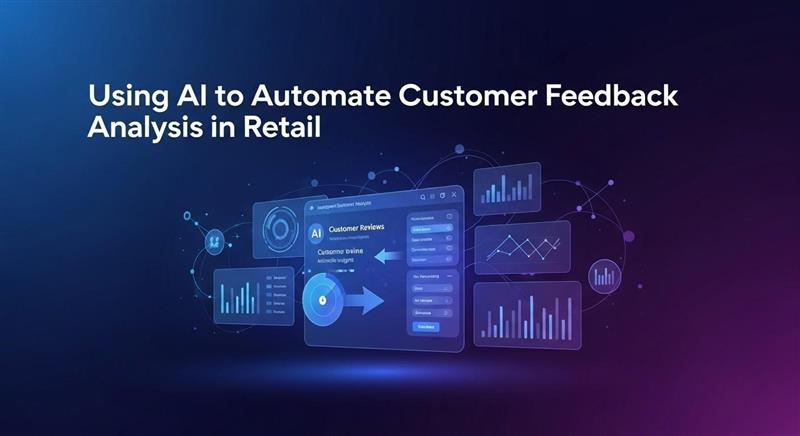
AI customer feedback analysis automation for retail solves this problem directly. It processes every piece of feedback across every channel in real time. It classifies sentiment, extracts themes, identifies trends, and routes insights to the right teams automatically.
This blog covers exactly how AI customer feedback analysis automation for retail works, where it delivers the highest value, and how retail organizations can implement it effectively. The competitive pressure in retail is relentless. Brands that listen faster and act faster win.
Table of Contents
Why Traditional Feedback Analysis Fails Retail Businesses
Traditional feedback analysis was built for a different era. Customer feedback arrived in manageable volumes through a limited number of channels. A team of analysts could read survey responses, compile findings, and present reports on a monthly cycle.
That model collapsed under the weight of digital retail. A mid-size retailer with 200 stores and an active e-commerce presence now receives tens of thousands of feedback touchpoints daily. Reviews, social mentions, support tickets, chat transcripts, returns comments, and in-store survey responses all arrive simultaneously.
Manual analysis of this volume is impossible. Even large analyst teams can review only a fraction of available feedback. They apply subjective interpretations. They miss emerging issues buried in the long tail of low-volume feedback channels. By the time a monthly report reaches decision-makers, the data describing it is weeks old.
Speed is the fatal weakness of manual feedback analysis in retail. A product defect surfaces in reviews on Tuesday. Manual analysis catches it in the monthly report four weeks later. By then, hundreds of additional customers experienced the defect. Returns piled up. Social complaints multiplied. The reputational damage spread far beyond what early detection would have allowed.
AI customer feedback analysis automation for retail eliminates this lag entirely. Automated systems detect emerging issues within hours of the first signals. They alert relevant teams immediately. Retail organizations act before problems compound.
Consistency is another critical failure of manual analysis. Different analysts apply different criteria to the same feedback. One analyst classifies a comment as a product quality complaint. Another classifies it as a packaging issue. This inconsistency corrupts trend data and undermines confidence in findings. Automated analysis applies identical classification criteria to every piece of feedback without exception.
The Scale of Customer Feedback in Modern Retail
Understanding the true scale of feedback modern retailers generate clarifies why automation is necessary rather than optional. The numbers are staggering at any meaningful business size.
A retailer with one million active customers generates roughly 50,000 to 150,000 feedback interactions monthly across all channels combined. That includes purchase reviews, customer service interactions, social media mentions, loyalty app ratings, email replies, and in-store survey responses.
A dedicated analyst reading and coding 100 feedback items per hour works roughly 160 hours per month. That analyst processes 16,000 items monthly. The remaining 34,000 to 134,000 items go unread. Hidden in that unread volume are product failures, service breakdowns, competitive threats, and product improvement opportunities that never reach decision-makers.
AI customer feedback analysis automation for retail processes that entire volume in minutes, not months. It reads every item. It codes every item with identical criteria. It surfaces patterns that no human analyst team could identify from partial sample analysis.
How AI Customer Feedback Analysis Automation for Retail Works
The technology behind AI customer feedback analysis automation for retail combines several machine learning disciplines into an integrated processing pipeline. Understanding each component helps retail leaders evaluate solutions and set realistic expectations.
Data ingestion connects the AI system to every feedback source. APIs pull reviews from Google, Trustpilot, Amazon, and retail-specific platforms. Social listening connectors monitor Twitter, Instagram, Facebook, and TikTok for brand mentions and product commentary. Customer service platforms export chat transcripts and ticket notes. Survey platforms feed response data continuously. The AI system ingests all of this in near real time.
Text preprocessing cleans raw feedback before analysis. It removes formatting artifacts, corrects common spelling errors, handles emoji and informal language, and normalizes text for consistent processing. This step significantly affects downstream analysis quality. Poor preprocessing produces unreliable sentiment and theme classifications.
Sentiment analysis classifies the emotional tone of each feedback item. Modern retail sentiment models go beyond simple positive, negative, and neutral classifications. They identify mixed sentiment within a single review. They detect sarcasm and irony with increasing accuracy. They assign sentiment scores that enable trend tracking over time.
Topic modeling and theme extraction identify what each piece of feedback discusses. A review mentioning slow checkout, unhelpful staff, and dirty restrooms generates three separate topic classifications. Each topic receives its own sentiment score. This granularity enables precise action. A store operations team receives actionable data on specific issues rather than a vague summary of customer dissatisfaction.
AI customer feedback analysis automation for retail also performs named entity recognition. It identifies specific product names, store locations, staff interactions, and competitor references within feedback. This entity-level data enables product-specific analysis, location-level comparison, and competitive intelligence extraction from customer voice data.
Sentiment Analysis Technologies Powering Retail Feedback AI
Sentiment analysis in retail feedback AI relies on transformer-based language models. BERT, RoBERTa, and their retail-specific fine-tuned variants understand context far better than earlier keyword-based approaches.
A keyword-based system reading the sentence ‘I would not say this product is bad’ interprets it as negative because of the word ‘bad.’ A transformer model understands the double negation and correctly classifies it as cautiously positive. This contextual understanding dramatically improves accuracy on real customer language, which is rarely simple or direct.
Aspect-based sentiment analysis is the most valuable technique for retail applications. Rather than assigning a single sentiment score to an entire review, aspect-based models identify individual aspects mentioned in the text and score each separately. A shoe review might generate separate sentiment scores for comfort, durability, style, sizing accuracy, and delivery experience. Each aspect score feeds into category-specific analytics dashboards.
Multilingual sentiment models enable global retail brands to analyze feedback in the customer’s native language without translation. Translation introduces errors and loses nuance. Native-language analysis produces more accurate sentiment scores and more precise theme extraction for international retail operations.
Continuous model retraining keeps sentiment accuracy high as language evolves. Customer language changes. New slang emerges. New product categories generate new vocabulary. AI customer feedback analysis automation for retail systems that retrain on recent data maintain accuracy as language evolves over time.
Key Business Benefits of AI Customer Feedback Analysis Automation for Retail
The business case for AI customer feedback analysis automation for retail rests on several distinct value streams. Each value stream deserves examination because they affect different parts of the retail organization.
Product improvement speed is the first major benefit. AI systems identify product quality issues from review data within hours of the first complaints appearing. Quality teams receive automated alerts when negative sentiment around specific product attributes spikes above baseline. They investigate and resolve issues faster. They prevent small defect signals from becoming full-scale quality crises.
A major apparel retailer using AI feedback analysis identified a fabric pilling issue in a new denim line within 36 hours of launch. Manual analysis would have caught it in the monthly review cycle three to four weeks later. The early detection enabled the retailer to pause reorders, communicate proactively with early purchasers, and avoid stocking a product that would have generated thousands of additional complaints and returns.
Customer experience optimization benefits from continuous, channel-specific feedback monitoring. AI systems track net promoter scores, checkout satisfaction ratings, return process sentiment, and staff interaction quality at the individual store level. Store managers receive weekly dashboards showing their specific strengths and weakness areas compared to the chain average.
Competitive intelligence emerges from AI analysis of open feedback channels. Customers mention competitors in reviews and social comments. They describe what they bought elsewhere and why. They compare prices, quality, and service. AI customer feedback analysis automation for retail extracts these competitive references automatically. Merchandising and strategy teams receive structured competitive intelligence derived from customer voice rather than industry analyst reports.
Personalization and marketing strategy improve with AI feedback insights. Understanding which product attributes generate the strongest positive sentiment by customer segment enables marketing teams to craft messages that resonate with specific audience groups. AI analysis reveals that younger customers consistently praise sustainability credentials while older customers praise product durability. Both insights directly shape campaign strategy.
How AI Feedback Analysis Reduces Retail Customer Churn
Customer churn is one of the most expensive problems in retail. Acquiring a new customer costs five to seven times more than retaining an existing one. AI customer feedback analysis automation for retail addresses churn risk proactively by identifying at-risk customers before they leave.
Churn prediction models analyze patterns in customer feedback over time. A customer who submits a highly positive review after their first purchase then files a complaint after their third purchase shows a deteriorating sentiment trajectory. AI models flag this customer for proactive outreach. A retention offer or personal apology arrives before the customer decides to take their business elsewhere.
Issue resolution speed directly affects retention. Research consistently shows that customers whose complaints get fast resolution show higher loyalty than customers who never complained at all. AI feedback systems route complaints to resolution teams immediately. Fast resolution converts a potential churn event into a loyalty-building interaction.
Satisfaction trend monitoring at the cohort level identifies systemic issues driving churn across customer segments. When first-time buyers from a specific acquisition channel show consistently lower satisfaction scores than buyers from other channels, that pattern signals a mismatch between acquisition messaging and actual product or service experience. AI surfaces this pattern instantly. Manual analysis may never find it.
Implementing AI Customer Feedback Analysis Automation for Retail
Implementation success depends on preparation, vendor selection, integration planning, and organizational change management. Each dimension requires careful attention.
Data source audit is the starting point. Map every channel where customers leave feedback about your retail brand. Identify which channels carry the highest volume. Identify which carry the most actionable signal. Prioritize connecting high-volume, high-signal channels first. This prioritization delivers early business value and builds internal confidence in the technology.
Vendor evaluation requires understanding your specific retail context. General-purpose sentiment analysis platforms perform adequately on standard feedback. Retail-specific platforms trained on product reviews, store experience feedback, and retail customer service interactions deliver meaningfully better accuracy on retail-specific language. Evaluate vendors against sample feedback from your own channels before committing.
Key vendor evaluation criteria include supported languages, channel integrations, customization capabilities, dashboard flexibility, alert configurability, and integration with your existing retail technology stack. Your CRM, e-commerce platform, customer service system, and store operations tools all need to receive AI insights in formats their users can act on efficiently.
Taxonomy development defines the topic categories and sentiment dimensions the AI system tracks. Generic taxonomies deliver generic insights. Retail-specific taxonomies that reflect your product categories, service touchpoints, and strategic priorities deliver actionable insights. Invest time in taxonomy development before deployment. A well-designed taxonomy shapes the quality of every insight the system produces.
AI customer feedback analysis automation for retail delivers more value when business rules govern insight routing. Define which insight types route to which teams. Product quality alerts go to category managers and quality teams. Store experience alerts go to regional operations managers and individual store teams. Social sentiment spikes go to marketing and communications. Automated routing ensures insights reach decision-makers who can act on them without manual triage.
Integration With Retail Technology Ecosystems
Standalone AI feedback analysis platforms generate insights that live in dashboards nobody checks consistently. Integration with existing retail technology workflows ensures insights drive action rather than collecting in reports.
CRM integration connects customer feedback analysis to individual customer records. A customer who mentions a specific complaint in a review gets a flag in the CRM. The next service interaction, email, or loyalty communication reflects awareness of that complaint. This integrated experience demonstrates that the brand listens and remembers. It builds trust and improves recovery outcomes.
Product information management integration connects review-derived product insights directly to the merchandising workflow. When AI analysis identifies consistent complaints about sizing inconsistency in a product category, that insight surfaces in the PIM system where buyers and merchandisers work. They see it in the context of their existing product management tools rather than having to check a separate analytics dashboard.
Customer service platform integration feeds AI-analyzed feedback into agent workflows. Agents handling contacts from customers who left recent negative reviews receive that context before the interaction begins. They approach the interaction with appropriate empathy and escalation readiness. First-contact resolution rates improve when agents have complete customer sentiment context.
E-commerce platform integration enables real-time product page optimization based on AI feedback insights. Review themes that customers find most useful surface prominently in product descriptions. Frequently asked questions identified through review analysis populate FAQ sections automatically. Product imagery that customers praise in reviews gets featured more prominently in listings.
AI Feedback Analysis Use Cases Across Retail Channels
AI customer feedback analysis automation for retail applies differently across channels. Understanding channel-specific applications helps retail teams maximize value from each feedback source.
E-commerce review analysis delivers the richest structured feedback data. Product reviews are focused, specific, and numerous. AI analysis of review text identifies product attribute sentiment with high precision. Size and fit comments, material quality observations, delivery experience ratings, and packaging assessments all emerge clearly from review text analysis. Category managers use this data for buyer decisions, product development briefs, and supplier quality conversations.
Social media monitoring captures spontaneous customer expression that survey-based feedback rarely surfaces. Customers express genuine frustration and genuine delight on social platforms in ways they moderate on formal feedback forms. AI social listening identifies emerging brand narratives before they reach crisis levels. It captures competitive comparisons and identifies product use cases that marketing teams never anticipated.
Customer service transcript analysis reveals systemic issues invisible in aggregate metrics. CSAT scores show overall satisfaction. AI transcript analysis shows exactly what interactions drive low scores. It identifies specific friction points in return processes, loyalty program redemption, and online order support. Operations teams receive actionable guidance rather than vague directives to improve customer service quality.
In-store survey analysis connects physical retail experience data to operational decisions. AI analysis of open-ended survey comments at the store level identifies patterns across customer segments, visit times, and purchase categories. District managers see which stores excel at specific experience dimensions and which stores struggle. Best practice transfer from high-performing stores to struggling stores becomes data-driven rather than anecdotal.
Post-purchase email survey analysis provides structured feedback on the complete purchase journey. AI analysis tracks satisfaction across discovery, purchase, fulfillment, product experience, and return experience stages. Journey stage analysis reveals where satisfaction drops most sharply and guides investment prioritization in customer experience improvement programs.
Real-Time Alerting and Crisis Prevention in Retail
Real-time alerting is one of the highest-value capabilities of AI customer feedback analysis automation for retail. It transforms feedback analysis from a reporting function into an early warning system.
Alert configuration defines the conditions that trigger immediate notification. Volume spikes in negative sentiment around specific products or store locations trigger product and operations alerts. Mentions of safety-related terms in product feedback trigger immediate quality team notifications. Sentiment score declines below defined thresholds for key customer segments trigger retention team alerts.
Social crisis prevention depends entirely on real-time monitoring. A video of a negative in-store experience posted by a customer with a large following can reach millions of viewers within hours. AI social listening detects these high-velocity negative events at the point of posting. Communications teams receive alerts within minutes. They develop response strategies before the situation escalates beyond manageable scope.
Competitor mention monitoring within your feedback data reveals vulnerability signals worth immediate attention. When customers consistently mention switching to a specific competitor and explain why, that competitive pressure signal demands urgent strategic response. AI systems surface these patterns in real time rather than leaving them buried in weekly report summaries.
Measuring ROI from AI Customer Feedback Analysis Automation for Retail
Every technology investment in retail requires justification through measurable business outcomes. AI customer feedback analysis automation for retail delivers measurable ROI across several dimensions.
Issue resolution speed improvement is the most directly measurable benefit. Benchmark your current average time from feedback submission to issue identification and resolution before implementation. Measure the same metric after implementation. Retailers typically see 60 to 80 percent reductions in mean time to issue identification after deploying AI feedback analysis.
Return rate reduction follows faster product quality detection. When product defects surface in hours rather than weeks, recall and correction happen before the full customer base encounters the issue. Track return rates for product categories before and after AI feedback analysis deployment. Correlate return rate changes with feedback analysis response time improvements.
Customer satisfaction score improvement provides another measurable outcome. Track NPS, CSAT, and CES scores before and after AI feedback implementation. Well-implemented programs typically produce 5 to 15 point NPS improvements over the 12 months following deployment. Attribute improvements to specific interventions driven by AI feedback insights.
Analyst productivity improvement measures the efficiency gain from automation. Track analyst hours per insight delivered before and after AI implementation. Most retail organizations achieve 5 to 10 times productivity improvement. Analysts shift from manual data coding to insight interpretation and strategic recommendation. The quality of analysis improves alongside the quantity.
Revenue impact from competitive intelligence is harder to quantify but consistently cited as a major benefit by retail organizations that implement AI feedback analysis. Faster competitive response, more accurate product development, and better-targeted marketing all contribute to revenue outcomes that AI feedback insights enable.
Building an Internal Capability for Continuous Improvement
Technology implementation creates capability. Sustained organizational focus creates competitive advantage. Retail organizations that treat AI customer feedback analysis automation for retail as an ongoing capability rather than a one-time project extract dramatically more value over time.
Model refinement improves accuracy continuously. Taxonomy updates reflect evolving product assortments and customer language. Alert threshold calibration reduces false positives as teams understand which signals demand immediate action. Dashboard evolution reflects changing strategic priorities. Each refinement cycle makes the system more valuable.
Cross-functional feedback review cadences institutionalize insight-to-action workflows. Weekly review sessions that bring together merchandising, operations, marketing, and customer service teams create structured forums for acting on AI-derived insights. Without structured review cadences, insights accumulate in dashboards without driving decisions.
Feedback loop creation closes the loop between customer insight and organizational response. When the AI system identifies an issue, tracks the organizational response, and then measures whether customer sentiment on that issue improved after the response, it creates a learning loop. Teams see the impact of their actions in customer feedback data. This visibility motivates sustained engagement with the feedback analysis system.
Frequently Asked Questions About AI Customer Feedback Analysis Automation for Retail
What types of feedback can AI analyze for retail businesses?
AI customer feedback analysis automation for retail handles product reviews, social media comments and mentions, customer service chat transcripts, email support responses, post-purchase survey text, in-store survey responses, loyalty app ratings and comments, and returns reason descriptions. Any text-based customer expression about the retail experience is analyzable with modern AI feedback systems.
How accurate is AI sentiment analysis for retail feedback?
Retail-specific AI sentiment models trained on product and store experience feedback typically achieve 85 to 92 percent accuracy on standard feedback text. Accuracy varies by feedback channel, language, and review complexity. Aspect-based sentiment models that score individual product or experience attributes typically outperform document-level sentiment models for retail applications. Regular retraining on recent feedback maintains accuracy as customer language evolves.
How long does it take to implement AI feedback analysis in retail?
A basic implementation connecting primary feedback channels to an AI analysis platform takes 6 to 10 weeks. Full enterprise implementations with deep CRM, e-commerce, and operations system integrations, custom taxonomy development, and organization-wide dashboard deployment typically take 4 to 6 months. Phased implementations that connect highest-priority channels first deliver early business value while broader integration proceeds.
Can AI feedback analysis handle multiple languages for global retail brands?
Yes. Leading AI customer feedback analysis automation for retail platforms support 50 to 100 languages natively. Multilingual models analyze feedback in the customer’s native language without translation, preserving linguistic nuance and colloquial expressions. Global retailers use multilingual feedback analysis to compare customer satisfaction patterns across markets and identify market-specific product or service improvement opportunities.
How does AI feedback analysis differ from traditional survey analysis?
Traditional survey analysis processes structured responses to predetermined questions from a sample of customers. AI feedback analysis processes unstructured text from every available feedback source without predefined question structures. AI analysis captures unsolicited customer expression that surveys miss entirely. It detects issues customers never mention in surveys because no survey question prompted them to. The combination of structured survey data and AI-analyzed unstructured feedback delivers the most complete picture of customer experience.
What retail teams benefit most from AI feedback analysis?
Merchandising and buying teams use AI feedback insights for product selection, development, and supplier performance management. Customer experience and operations teams use store-level sentiment analysis for performance management and improvement prioritization. Marketing teams use feedback-derived customer language and sentiment insights for campaign development. Customer service teams use real-time feedback alerts for proactive customer recovery. AI customer feedback analysis automation for retail generates relevant insights for nearly every retail business function.
What secondary keywords relate to AI customer feedback analysis for retail SEO?
Closely related secondary keywords include retail sentiment analysis tools, customer review analysis automation, retail voice of customer technology, NPS analysis automation, social listening for retail brands, customer experience analytics retail, and retail feedback management software. Content covering these subtopics alongside the primary topic builds strong topical authority and captures broader search intent across the retail technology buyer journey.
Related Topics and Secondary Keywords for Comprehensive SEO Coverage
A strong content strategy around AI customer feedback analysis automation for retail requires thorough coverage of adjacent subtopics. These topics attract readers at different stages of the research and purchase journey.
Voice of customer programs represent the strategic framework within which AI feedback analysis operates. Retailers researching VoC programs encounter AI feedback analysis as a core technology component. Content connecting AI analysis to VoC program design captures decision-makers planning strategic customer listening initiatives.
Customer experience management platforms often include or integrate with AI feedback analysis capabilities. Content comparing standalone feedback analysis tools with full CXM suites helps buyers at the technology evaluation stage. This comparison content drives high purchase-intent search traffic from retail technology buyers.
Retail NPS and CSAT benchmarking content attracts retail leaders researching performance standards. Connecting benchmark context to AI feedback analysis capabilities shows how AI tools help retailers track performance against industry standards continuously rather than through periodic benchmark surveys.
Product review management for retail e-commerce is a specific high-traffic subtopic. Retailers seeking to manage review volume, respond to reviews efficiently, and extract product insights from review data find AI customer feedback analysis automation for retail a directly relevant solution. Content specifically addressing review management automation captures this search intent precisely.
Customer churn prediction in retail combines feedback analysis with behavioral data modeling. Content connecting AI feedback sentiment signals to churn prediction models addresses a high-value audience of retail analytics and loyalty program professionals. This subtopic bridges the feedback analysis and customer analytics content categories effectively.
Read More:-
Conclusion

Customer feedback is the most honest data your retail business generates. Customers tell you exactly what they love, what frustrates them, and what would make them choose a competitor. Most of that data currently goes unread, unanalyzed, and unactioned.
AI customer feedback analysis automation for retail changes this reality fundamentally. Every review gets read. Every complaint gets classified. Every trend gets detected. Every insight gets routed to the team that can act on it. The cycle from customer experience to organizational response compresses from weeks to hours.
The business impact is clear across every retail category. Product quality improves faster. Customer satisfaction scores climb. Churn rates fall. Competitive intelligence sharpens. Marketing effectiveness increases. All of this flows from listening better and acting faster on what customers say.
Implementation requires planning, vendor selection, integration work, and organizational change management. None of these challenges are insurmountable. The retailers that have made this investment consistently report that AI customer feedback analysis automation for retail delivers among their highest returns on technology investment.
The competitive pressure in retail is relentless. Margins are thin. Customer loyalty is fragile. The brands that win long-term are the ones that understand their customers most deeply and respond to their needs most quickly. AI customer feedback analysis automation for retail is the engine that makes that depth of understanding and speed of response possible at scale.